

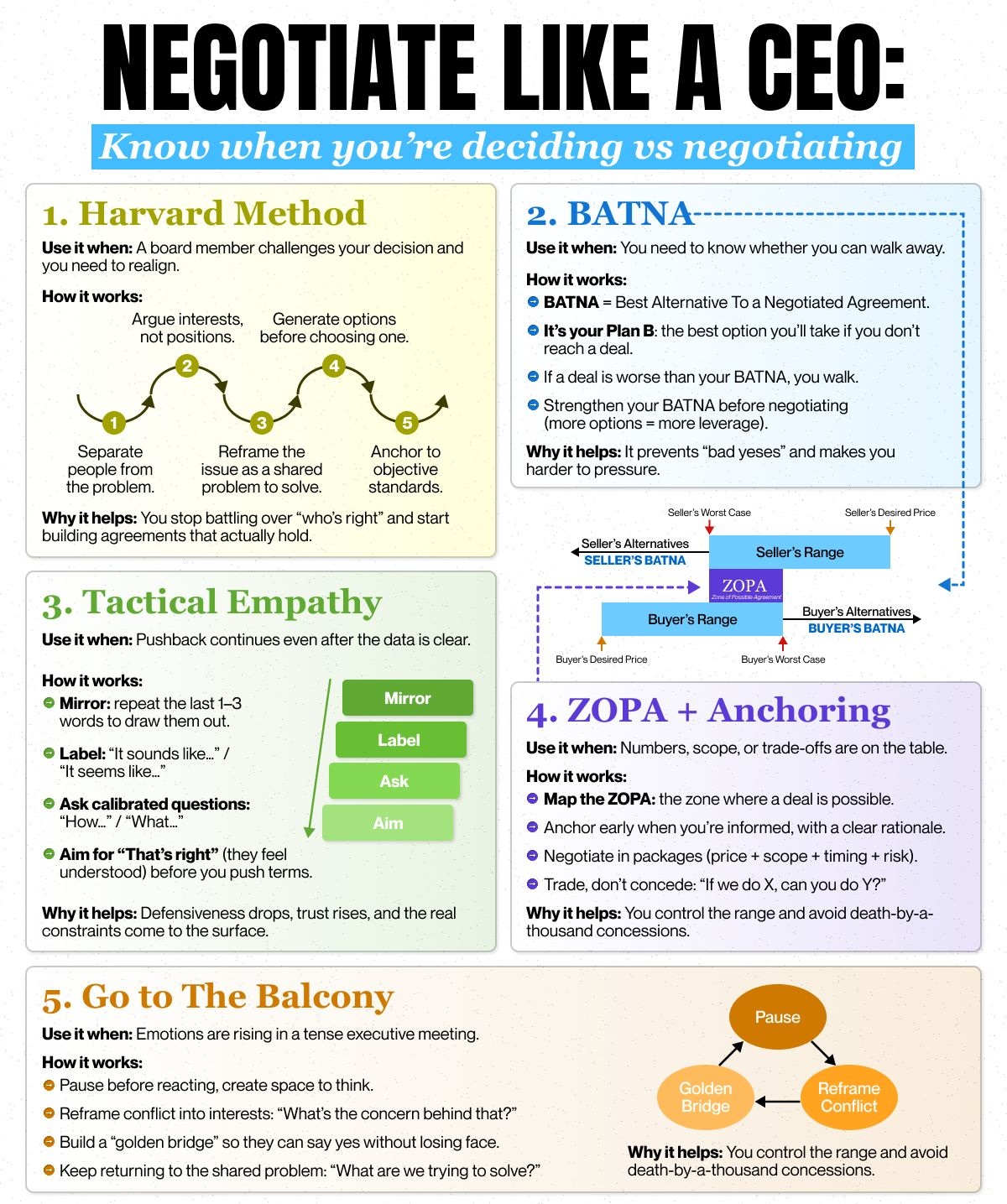
As a CEO, every move you make, every decision you rubber-stamp, reverberates throughout your organization. You might believe you’re simply approving a hire or reallocating a budget. However, at the senior leadership level, many of these seemingly straightforward “decisions” are, in reality, complex negotiations. Your CFO sees a cost precedent being set, your VP interprets a power dynamic shift, and your team views a budget reallocation as a strategic pivot. Misinterpreting these moments leads to underpreparation, which, in turn, strips you of your leverage.
The most successful leaders aren’t just authoritative; they are adept negotiators. They understand that losing isn’t about lacking authority, but failing to recognize the negotiation afoot. When you identify the negotiation early, you gain an insurmountable advantage: you prepare alternatives, assess leverage, manage emotions, protect crucial relationships, and strategically control anchors.
This guide will equip you with five powerful frameworks, transforming you from a reactive leader into a strategic one, always a step ahead in the intricate dance of executive decision-making.
The Subtle Art of Executive Negotiation
At the highest echelons of leadership, the stakes are perpetually elevated. Comp changes, key hires, strategic shifts, and capital allocation are not just items on a checklist; they are battlegrounds where the astute CEO can either secure a triumph or concede unwittingly. The distinction between making a decision and navigating a negotiation is critical. If you approach these pivotal moments as mere decisions, you will inevitably be underprepared, ceding power and influence. The true advantage lies with the leader who first recognizes the negotiation, regardless of title.
Beyond the Title: Power in Perception
Many leaders assume their position grants them ultimate control. While authority is certainly a factor, it can be a deceptive one. A CEO with a grand title but a reactive negotiating stance can quickly find themselves losing ground to a more strategic counterpart, even one with less formal power. The perception of control and the ability to steer outcomes are often more about foresight and preparation than about a pre-ordained right.
The Cost of Underpreparation
Underpreparation in a negotiation is akin to entering a chess match without having studied your opponent’s common openings. You might make a few good moves, but eventually, you’ll be outmaneuvered. At the executive level, this translates into missed opportunities, suboptimal agreements, damaged relationships, and ultimately, a less effective leadership tenure. Understanding that negotiation is a constant undercurrent enables you to approach every significant interaction with the necessary diligence and strategic thinking.
1. The Harvard Method: Building Agreements That Last
When disagreements arise, especially with vital stakeholders like board members, and alignment is crucial, the Harvard Method offers a robust framework. It focuses on solving the issue while meticulously preserving relationships, transforming confrontational stalemates into opportunities for collaborative problem-solving.
Separating People from the Problem
The core tenet of the Harvard Method is to disentangle the individuals involved from the actual issue at hand. Often, personal emotions, egos, and past grievances can cloud judgment, turning a legitimate discussion into a personal battle. By consciously separating the person from the problem, you create a neutral ground for dialogue. This means addressing the problem objectively, without attributing blame or making personal attacks. The goal is to avoid battling over “who’s right” and instead focus on what is right for the situation.
Arguing Interests, Not Positions
A common pitfall in negotiations is to cling rigidly to stated positions. A position is what someone says they want; an interest is why they want it. For example, a CFO’s position might be “we cannot exceed budget X for this hire.” Their interest, however, might be “maintaining financial stability,” “adhering to shareholder expectations,” or “ensuring long-term sustainability.” By delving into the underlying interests, you uncover the motivations and needs that drive the stated positions. This deeper understanding opens up a much wider array of potential solutions that can satisfy everyone’s core concerns, even if their initial positions seemed incompatible.
Reframing the Issue as a Shared Problem to Solve
Once interests are understood, the next step is to reframe the conflict as a common challenge. Instead of “Your decision is wrong,” the dialogue shifts to “How can we ensure this hire aligns with our financial stability goals while also securing the best talent?” This subtle but powerful linguistic shift fosters a collaborative mindset, transforming adversaries into allies working towards a mutually beneficial outcome. It encourages joint ownership of the problem and its resolution.
Generating Options Before Choosing One
Prematurely fixating on a single solution can stifle creativity and limit potential gains. The Harvard Method advocates for brainstorming a diverse range of options before making any commitments. This “expanding the pie” approach encourages creative thinking, exploring various ways to satisfy underlying interests. For example, if a compensation package is the point of contention, options might include equity, deferred bonuses, performance incentives, or non-monetary benefits, rather than simply haggling over the base salary. The more options you generate, the higher the likelihood of discovering a truly innovative and mutually agreeable solution.
Anchoring to Objective Standards
Finally, when evaluating the generated options, it’s crucial to anchor discussions to objective, legitimate, and external standards. This removes subjectivity and personal opinion from the decision-making process. Objective standards can include market rates, industry benchmarks, legal precedents, expert opinions, or established company policies. By referring to these external criteria, you ensure fairness and legitimacy, making the final agreement more robust and defensible. This step helps in building agreements that actually hold, as they are grounded in verifiable reality rather than mere conjecture or power plays.
2. BATNA: Your Ultimate Walkaway Power
Your Best Alternative To a Negotiated Agreement (BATNA) is arguably the most critical piece of information you can possess before entering any negotiation. It’s your Plan B, your escape route, your non-negotiable bottom line. Knowing your BATNA, and understanding your counterpart’s, provides immense leverage and prevents you from accepting a suboptimal deal simply to avoid walking away empty-handed.
Defining Your Best Alternative
Before engaging in any high-stakes discussion, meticulously identify your BATNA. What is the most favorable course of action you can take if the current negotiation fails? This isn’t just about refusing a bad deal; it’s about having a clear, actionable alternative that you are prepared to pursue. For example, if you’re negotiating a supplier contract, your BATNA might be engaging with a different vendor, bringing production in-house, or redesigning the product to eliminate the need for that specific component. Your BATNA should be realistic and robust, giving you genuine power to walk away.
Their BATNA: Understanding Your Counterpart’s Options
Just as important as knowing your own BATNA is understanding your counterpart’s. What are their alternatives if they don’t reach an agreement with you? This requires thorough research and empathetic consideration. If your counterpart has strong alternatives, they will likely be less flexible. If their options are limited, you hold more power. For instance, if you are a critical customer for a supplier struggling to meet quotas, their BATNA for losing your business might be severe, giving you a stronger bargaining position. Conversely, if they have a long line of eager clients, their BATNA is high, and your leverage diminishes.
The Walkaway Point
Your BATNA defines your reservation price – the worst deal you would be willing to accept before you implement your alternative. If an offer falls below your BATNA, you must be prepared to walk away. This isn’t a bluff; it’s a strategic decision rooted in sound preparation. Accepting a deal worse than your BATNA is a guaranteed loss. It prevents “bad yeses” – agreeing to terms you know are detrimental – and makes you harder to pressure into unfavorable concessions.
Strengthening Your BATNA for Maximum Leverage
The beauty of BATNA is that it isn’t static. You can strategically improve your BATNA before even entering a negotiation. This means actively exploring and developing more attractive alternatives. If you’re buying a company, talk to multiple sellers. If you’re seeking investment, court several potential investors. The more credible options you have, the stronger your BATNA becomes, and consequently, the more leverage you possess at the negotiating table. A stronger BATNA directly translates into a more advantageous outcome.
The ZOPA: Where Deals Happen
The Zone of Possible Agreement (ZOPA) is the overlap between your reservation price and your counterpart’s reservation price. It’s the space where a mutually acceptable agreement can be found.
- Your Reservation Price: The absolute minimum you will accept. This is determined by your BATNA.
- Their Reservation Price: The absolute maximum they will concede. This is determined by their BATNA.
A ZOPA exists when your reservation price is higher than your counterpart’s, or vice versa, indicating room for an agreement. If your reservation price is below theirs (meaning you’re willing to pay more than they’re willing to accept, or accept less than they’re willing to give), there’s a positive ZOPA. If there’s no overlap, meaning you can’t find common ground without one party accepting a deal worse than their BATNA, then no ZOPA exists, and a deal is unlikely. Understanding the ZOPA allows you to focus your efforts within the feasible range and recognize when a deal is simply not possible without compromising your core interests. The image illustrates this by showing the seller’s range (from worst case to desired price) and the buyer’s range (from desired price to worst case), with the ZOPA being the sweet spot where these ranges overlap.
3. Tactical Empathy: When Logic Isn’t Enough
As a CEO, you often operate with data-driven precision. However, you quickly learn that logic alone doesn’t always sway a room, especially when emotions run high. Tactical empathy is the art of understanding and acknowledging the other party’s perspective and feelings, not necessarily agreeing with them, but showing that you understand. This powerful psychological tool is invaluable when pushback persists despite clear data.
Mirroring: Reflecting for Deeper Understanding
Mirroring involves subtly repeating the last one to three significant words your counterpart has used. This simple technique encourages them to elaborate without feeling interrogated. It shows you’re listening intently and invites them to divulge more information. For instance, if a colleague says, “I’m concerned about the aggressive timeline for this project,” mirroring “aggressive timeline” might prompt them to explain why it feels aggressive, revealing underlying anxieties or resource constraints that weren’t initially apparent.
Labeling Emotion: Giving Feelings a Name
Labeling is the direct acknowledgment of the other person’s emotions. Phrases like “It sounds like you’re feeling frustrated about…” or “It seems like there’s some apprehension regarding…” can defuse tension and build rapport. The goal isn’t to diagnose or interpret their feelings, but to simply reflect what you observe. When people feel heard and understood, their defensiveness drops, trust begins to rise, and the real underlying constraints and concerns often come to the surface. This is critical for moving past emotional barriers to a productive discussion.
Calibrated Questions: Guiding the Conversation
Calibrated questions are open-ended “How” or “What” questions designed to make your counterpart feel in control while subtly guiding them towards your desired outcome. These questions bypass direct confrontation and instead invite collaboration. Examples include: “How do you propose we address this challenge?” or “What would it look like if we were to achieve X?” These questions encourage the other party to think critically about solutions, often leading them to propose ideas that align with your interests, making them feel like they own the solution.
Aiming for “That’s Right”: The Ultimate Validation
The ultimate goal of tactical empathy is to elicit the response, “That’s right.” This signifies that your counterpart feels truly understood. It’s a profound moment of connection, far more powerful than “You’re right” (which can feel conciliatory) or “Yes” (which can be a superficial agreement). When they say “That’s right,” it means you’ve accurately grasped their perspective, their interests, and their emotional state. Once you reach this point, their resistance significantly lessens, and they are much more receptive to hearing your propositions and collaboratively finding a path forward. Tactical empathy recognizes that data informs decisions, but emotion drives them. By mastering emotion, you master the room.
4. ZOPA + Anchoring: Mastering Value and Scope
When numbers, scope, or complex trade-offs are on the table, a strategic approach to the Zone of Possible Agreement (ZOPA) combined with the power of anchoring becomes indispensable. This framework is about controlling the financial and structural boundaries of the negotiation, ensuring you don’t succumb to a death-by-a-thousand concessions.
Mapping the ZOPA: Defining the Playfield
As discussed, the ZOPA is the theoretical space where a deal can happen – the overlap between your reservation price and your counterpart’s. Before entering any negotiation involving quantifiable terms, meticulously map this zone. Understand your absolute minimum (your BATNA driven walkaway point) and your aspirational maximum. Then, try to estimate your counterpart’s analogous points. This exercise helps you understand the boundaries of the discussion and where potential common ground lies. It’s about defining the playing field before the game begins.
Anchoring Early: Setting the Initial Reference Point
The anchoring effect dictates that the first number introduced in a negotiation heavily influences the eventual outcome. If you have good information and a clear, well-justified rationale, make the first offer. This “anchor” sets a psychological starting point that subsequent offers will gravitate towards. For example, if you’re selling a product, anchoring with a higher-than-expected but justifiable price creates an initial perception of high value. Your counterpart will then likely negotiate down from your anchor, rather than up from a lower expectation. However, if you lack sufficient information, or your rationale is flimsy, it might be better to let the other party anchor, as a poorly informed anchor can backfire. The key is to be confident and well-prepared when deploying your anchor.
Negotiating in Packages: Expanding the Pie
Single-issue negotiations are inherently limiting. They often devolve into a zero-sum game where one party’s gain is the other’s loss. To expand leverage, always seek to negotiate in packages. This means bundling multiple variables together, such as price, scope, timing, risk allocation, intellectual property rights, payment terms, or after-sales support. By introducing multiple variables, you create opportunities for trade-offs that can benefit both parties. For example, instead of just negotiating on price, you might offer a slightly higher price in exchange for faster delivery and extended warranty. This allows both parties to find value in different aspects, leading to a more comprehensive and mutually beneficial agreement.
Trading Rather Than Conceding: The Art of Reciprocity
Avoid making blind concessions. Every compromise you make should be met with a reciprocal gain. The principle here is “If I do X, can you do Y?” This frames every movement as a conditional trade, not a unilateral gift. It reinforces the idea of mutual give-and-take and prevents the other party from expecting free concessions. For example, instead of simply dropping your price, you might say, “I can reduce the unit cost by $5 if we increase the order volume by 20% and agree to a 60-day payment term.” This strategy helps control the range of the negotiation and prevents the financial bleed of death-by-a-thousand concessions, ensuring that every movement serves a strategic purpose.
5. Go to The Balcony: Controlling Your Reactions
Executive meetings are often tense, charged environments where emotions can flare. The ability to control your own reaction, especially when ego or frustration threatens to take over, is a hallmark of strategic leadership. “Going to the Balcony” is a powerful metaphorical step back, allowing you to gain perspective and think rationally amidst the storm.
Pause Before Reacting: Creating Space for Thought
When confronted with an aggressive demand, a personal attack, or an emotionally charged statement, your natural inclination might be to react immediately. The “Go to the Balcony” technique advises pausing before reacting. This pause, even if just a few seconds, creates a critical mental space. It allows your prefrontal cortex (the rational part of your brain) to override your amygdala (the emotional, fight-or-flight center). During this pause, take a deep breath, and mentally step back from the immediate fray. This brief moment of detachment prevents impulsive decisions and allows for a more measured and strategic response.
Reframe Conflict into Interests: Uncovering the “Why”
Once you’ve paused, the next step is to reframe the conflict into underlying interests. Instead of focusing on the aggressive tone or the unreasonable demand, ask yourself (or subtly ask them, if appropriate) “What’s the concern behind that?” or “What interest is driving this position?” This takes the discussion away from the superficial and often emotional surface, and dives into the deeper motivations. For example, a board member’s angry outburst about a budget overrun might stem from a legitimate concern about fiduciary responsibility or investor confidence, rather than a personal vendetta. Understanding these underlying interests is crucial for finding common ground.
Building a “Golden Bridge”: Enabling a Graceful Exit
A significant challenge in negotiations is allowing the other party to back down without losing face. This is where building a “golden bridge” comes in. A golden bridge is a way for your counterpart to say “yes” to your proposal while maintaining their dignity and avoiding public embarrassment. It might involve reframing their concession as a new idea they initiated, offering a compensatory gesture, or simply providing a narrative that allows them to appear strong even as they shift their position. The goal is to make it easy and attractive for them to move towards an agreement without feeling defeated.
Returning to Shared Objectives: The Unifying Goal
Amidst heated discussions, it’s easy to lose sight of the overarching goals. Continually bring the conversation back to the shared objectives: “What are we trying to solve?” or “How does this decision serve our company’s mission?” This refocuses attention on the common purpose that initially brought everyone to the table. By consistently aligning discussions with fundamental, shared interests, you remind everyone that despite individual differences, a collective win is the ultimate aim. The leader who controls their reaction ultimately controls the room, guiding it toward constructive outcomes rather than succumbing to emotional traps.
Integrating Frameworks for Executive Prowess
These five frameworks are not isolated tools but complementary strategies that, when integrated, form a powerful negotiation arsenal for any CEO.
- Preparation is Paramount: Always start with BATNA. Knowing your walkaway point and understanding theirs provides the foundation for all other strategies. Without a strong BATNA, even the most eloquent arguments can crumble under pressure.
- Harvard Method for Alignment: When relational dynamics are complex and alignment is critical, the Harvard Method offers a structured path to consensus. It ensures that relationships aren’t sacrificed at the altar of decision-making.
- Tactical Empathy for Connection: When logic hits a wall, tactical empathy becomes your key to unlocking hidden interests and defusing emotional roadblocks. It’s about influencing through understanding, not just through intellectual superiority.
- ZOPA + Anchoring for Value: When quantifiable outcomes are at stake, ZOPA and anchoring empower you to define the negotiation’s parameters and secure optimal value. You set the stage and control the flow of concessions.
- Go to The Balcony for Control: In moments of high tension, the ability to “Go to The Balcony” is your personal safeguard against impulsive errors. It ensures that you lead with strategic thought, not reactive emotion.
The interplay between these frameworks is what truly differentiates a strategic leader. Imagine a scenario where a key executive is resisting a new strategic initiative. You might first apply Tactical Empathy to understand their underlying concerns, perhaps mirroring their statements and labeling their anxieties. This uncovers their interests, which you then address using the Harvard Method by reframing the initiative as a shared problem and generating options that meet their interests while still aligning with the company’s goals. All the while, you are subconsciously aware of your BATNA (what you’d do if they completely refuse) and managing your own emotions by Going to The Balcony to ensure a calm, rational demeanor. If the negotiation involves resource allocation, ZOPA + Anchoring would come into play, anchoring the discussion with well-justified numbers and trading variables to achieve a packaged solution.
This holistic approach means you’re always several steps ahead, not just reacting to immediate challenges but proactively shaping outcomes.
Executive Negotiation: A Continuous Journey
Negotiation is not a one-time event; it is an ongoing process woven into the fabric of executive leadership. Every interaction, from a casual conversation with a direct report to a high-stakes board meeting, contains elements that require a negotiator’s mindset. The more you practice recognizing these moments and applying these frameworks, the more intuitive and powerful your leadership will become.
The ability to identify when you are deciding versus negotiating is the cornerstone of effective executive leadership. Mastering these distinctions and deploying the right strategies at the right time will not only lead to better deals and more favorable outcomes but will also strengthen your relationships, build trust, and solidify your reputation as a truly strategic CEO.
The stakes at your level are immense, and the consequences of underpreparation can be transformative. Embrace negotiation as a core competency, and watch your strategic influence soar.
Ready to transform your strategic leadership and negotiation skills?
At IoT Worlds, we understand the intricate dynamics of executive decision-making and the power of strategic negotiation. Our insights and services are designed to equip leaders like you with the cutting-edge frameworks and practical tools needed to navigate the complex landscape of modern business. Discover how our expertise can empower you to not just make decisions, but to master negotiations, secure better outcomes, and accelerate your organizational success.
Unlock your full leadership potential. Email us today at info@iotworlds.com.
