

The Internet of Things (IoT) has rapidly transformed from a futuristic concept into a ubiquitous reality, seamlessly integrating physical objects into a vast digital network. From smart homes and connected cars to industrial sensors and critical infrastructure, IoT devices are generating unprecedented volumes of data and automating processes on a global scale. This interconnectedness, while offering unparalleled convenience and efficiency, also introduces a complex web of security challenges. At the heart of these challenges lies a fundamental question: how do we ensure that only trusted devices are allowed to participate in this intricate ecosystem? The answer lies in robust device authentication.
Device authentication is not merely a technical checkbox; it is the cornerstone of a secure and reliable IoT world. Without it, the entire edifice of interconnected devices and data exchange crumbles, leaving organizations and individuals vulnerable to a myriad of cyber threats. This comprehensive article delves into the critical importance of device authentication in IoT, exploring its mechanisms, best practices, and the profound impact it has on the future of our connected society.
The IoT Landscape: A World of Interconnectedness and Vulnerabilities
The sheer scale and diversity of the IoT landscape are staggering. Millions, and soon billions, of devices are constantly communicating, sharing data, and executing commands. This decentralized and distributed nature makes securing the IoT inherently more complex than traditional IT environments. Unlike enterprise networks where firewalls and access controls can be centralized, IoT devices often operate in diverse and sometimes hostile environments, with varying computational capabilities and security postures.
The rapid proliferation of IoT devices has outpaced the development and adoption of robust security measures. This has led to a situation where many devices are deployed with inadequate security, creating attractive targets for malicious actors. These vulnerabilities can lead to:
- Data Breaches: Sensitive personal or organizational data intercepted from compromised devices.
- System Disruption: Malicious commands issued to devices, leading to operational failures or physical damage.
- Botnet Attacks: Compromised devices recruited into botnets to launch large-scale distributed denial-of-service (DDoS) attacks.
- Privacy Violations: Unauthorized access to personal information collected by IoT devices in homes and workplaces.
- Physical Harm: In critical infrastructure or medical IoT, a compromised device could have life-threatening consequences.
It is within this context of immense potential and inherent risk that device authentication emerges as the paramount defense mechanism.
What is Device Authentication?
At its core, device authentication is the process of verifying the identity of an IoT device before granting it access to a network, server, or application. It is the digital equivalent of checking an ID at a secure entrance. This verification ensures that only legitimate and authorized devices can send or receive data, preventing imposters or rogue devices from infiltrating the system.
Imagine a smart home where every appliance, from the thermostat to the security cameras, is connected to the internet. Without proper authentication, an intruder could potentially spoof the identity of a legitimate device, gain access to the home network, and compromise the entire system. Device authentication acts as the gatekeeper, ensuring that only certified and registered devices are allowed to interact with the homeowner’s digital ecosystem.
The goal of device authentication is to establish trust. In a world where devices communicate autonomously, knowing and trusting the identity of each participant is fundamental to maintaining the integrity and security of the entire IoT ecosystem.
Why Device Authentication is Not Optional, But Essential
The importance of device authentication in IoT cannot be overstated. It is not an add-on feature but a foundational requirement for any secure IoT deployment. Here’s why it matters:
Preventing Unauthorized Access
The most immediate benefit of strong device authentication is the prevention of unauthorized devices from connecting to the network. Without authentication, any device could potentially join an IoT network and begin communicating, potentially injecting malicious data, eavesdropping on legitimate communications, or taking control of other devices. Authentication acts as the first line of defense, filtering out illegitimate actors at the point of entry.
Protecting Sensitive Data from Cyberattacks
Many IoT devices handle sensitive data, ranging from personal health information in medical devices to industrial control data in manufacturing plants. If a device is compromised, this sensitive data becomes vulnerable. Device authentication ensures that only devices with proven identities can access and transmit such data, significantly reducing the risk of data breaches and intellectual property theft.
Maintaining Trust Between Connected Devices
In a complex IoT ecosystem, devices often interact with each other without human intervention. For instance, a smart sensor might communicate with a central hub, which then relays information to a cloud platform. Trust between these devices is paramount. If one device’s identity cannot be verified, the entire chain of trust can be broken, leading to unreliable data and potentially flawed automated decisions. Authentication builds this trust by ensuring that each device is indeed who it claims to be.
Ensuring Secure Communication in IoT Systems
Beyond simply preventing unauthorized access, device authentication often precedes and facilitates secure communication. Once a device’s identity is verified, secure communication protocols like TLS/SSL can be established, encrypting data in transit and ensuring its confidentiality and integrity. Without initial authentication, even encrypted communication could be initiated by an imposter, rendering the encryption null and void in terms of identity assurance.
Compliance and Regulatory Requirements
As IoT proliferates, governments and regulatory bodies are increasingly imposing stricter security requirements. Industries such as healthcare, finance, and critical infrastructure are subject to regulations that mandate robust security measures, including strong authentication. Implementing comprehensive device authentication is not just good practice; it’s often a legal and ethical imperative.
Foundational Elements of Robust IoT Security
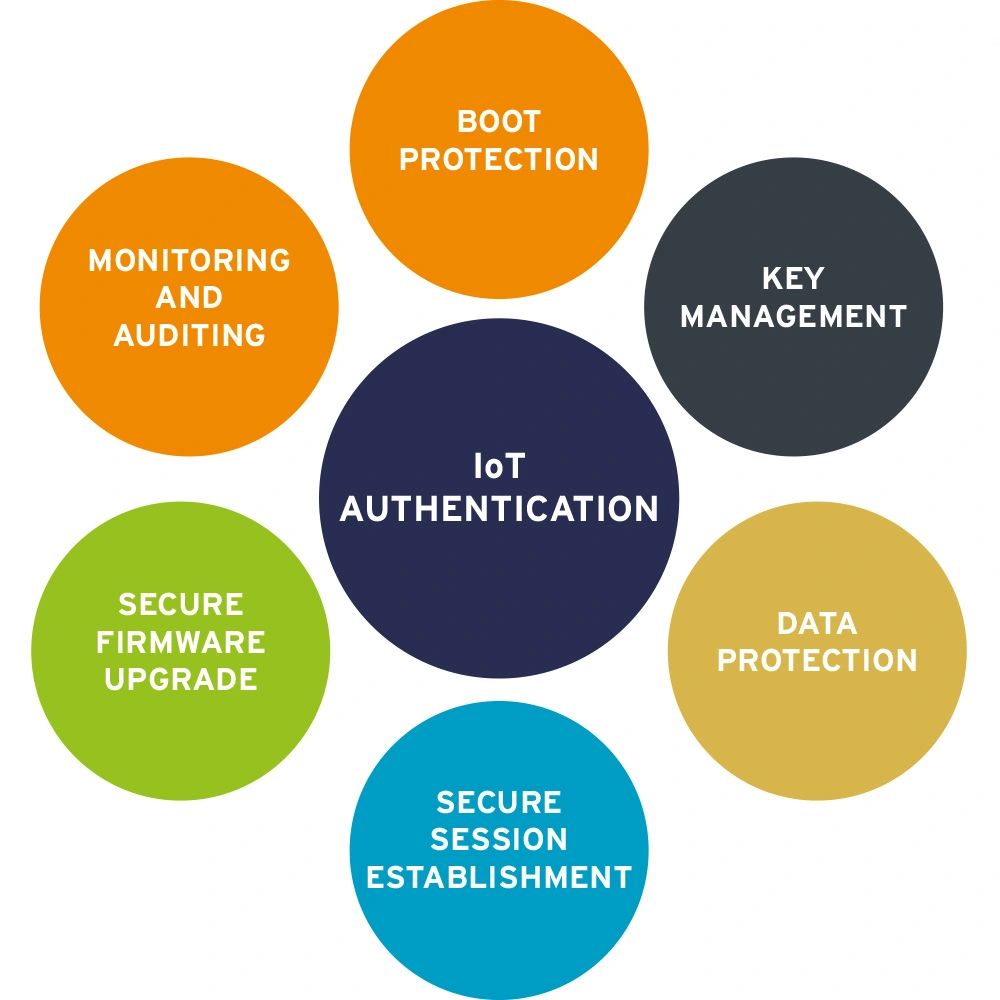
While device authentication is central, it exists within a broader framework of IoT security. Several other critical elements work in conjunction with authentication to create a truly resilient IoT ecosystem. These include:
Boot Protection
Secure boot mechanisms ensure that only authenticated and authorized firmware can run on an IoT device. This prevents attackers from injecting malicious code during the device’s startup sequence, a common vulnerability that can compromise the entire device even before authentication can occur. Boot protection establishes a “root of trust” from the very first instruction executed by the device.
Key Management
The effectiveness of many authentication methods, particularly those relying on cryptography, hinges on secure key management. This involves generating, storing, distributing, and revoking cryptographic keys securely. Poor key management can undermine even the most sophisticated authentication protocols, as compromised keys can lead to unauthorized access and data breaches. This includes managing device-specific keys, symmetric keys, and public/private key pairs used in digital certificates.
Data Protection
Once authenticated, devices transmit and receive data. This data must be protected both in transit and at rest. Encryption, access controls, and data integrity checks are crucial to safeguard sensitive information from eavesdropping, tampering, and unauthorized access. Data protection complements authentication by securing the information that devices are authorized to handle.
Secure Session Establishment
After successful authentication, a secure communication session needs to be established between the device and the network or application. This involves using protocols like Transport Layer Security (TLS) or Datagram Transport Layer Security (DTLS) to encrypt all data exchanged during the session. Secure session establishment ensures ongoing confidentiality and integrity of communications after the initial authentication handshake.
Secure Firmware Upgrade
IoT devices often require software updates to patch vulnerabilities, add new features, or improve performance. However, firmware upgrades themselves can be a major security risk if not handled properly. Secure firmware upgrade mechanisms ensure that only legitimate, authenticated, and cryptographically signed firmware can be installed on a device, preventing attackers from pushing malicious updates and taking control of devices. This is a critical ongoing security measure throughout the device’s lifecycle.
Monitoring and Auditing
Continuous monitoring and auditing of device behavior and network activity are essential for detecting and responding to security incidents. This involves logging authentication attempts, communication patterns, and any anomalous behavior that might indicate a compromise. Robust monitoring systems provide visibility into the health and security posture of the IoT ecosystem, allowing for proactive threat detection and rapid incident response.
These elements, working together with strong device authentication, form a comprehensive shield against the multifaceted threats facing the IoT.
Common Device Authentication Methods in IoT
The chosen authentication method for an IoT device depends on various factors, including the device’s computational capabilities, power constraints, network environment, and the level of security required. Here are some of the most common approaches:
Pre-Shared Keys (PSK)
Pre-Shared Keys (PSKs) are one of the simplest and most widely used authentication methods, particularly for resource-constrained devices. In this method, both the device and the authentication server share a secret key beforehand. During authentication, the device presents its identity and the PSK to the server, which then verifies the key to grant access.
How it Works
- Key Provisioning: A secret key is securely installed on the device and registered with the authentication server during manufacturing or initial setup.
- Authentication Request: When the device initiates communication, it sends an authentication request to the server, including its identity.
- Key Comparison: The server retrieves the corresponding PSK for that device and compares it with information provided by the device (e.g., a hash of the key combined with a nonce).
- Access Grant: If the keys match, the device is authenticated and granted access.
Advantages
- Simplicity: Easy to implement and manage, especially for a small number of devices.
- Low Resource Footprint: Requires minimal computational power and memory, making it suitable for resource-constrained IoT devices.
- Fast Authentication: The process is relatively quick.
Disadvantages
- Scalability Issues: Managing unique PSKs for millions of devices can become a significant logistical challenge.
- Vulnerability to Compromise: If one PSK is compromised, an attacker could potentially impersonate the associated device.
- No Forward Secrecy: If the PSK is ever compromised, past communications secured with that key can be decrypted.
- Key Distribution: Securely distributing and rotating PSKs is crucial but can be difficult.
Use Cases
PSKs are often used in closed IoT environments, such as a factory floor with a limited number of devices, or for initial provisioning where devices are later upgraded to more robust authentication methods.
Digital Certificates (Public Key Infrastructure – PKI)
Digital certificates, underpinned by Public Key Infrastructure (PKI), provide a much stronger and more scalable authentication mechanism. PKI relies on public-key cryptography, where each device has a unique public/private key pair. A digital certificate binds a device’s public key to its identity, and this certificate is digitally signed by a trusted Certificate Authority (CA).
How it Works
- Key Pair Generation: Each IoT device generates a unique public/private key pair. The private key remains secret on the device.
- Certificate Signing Request (CSR): The device sends a CSR containing its public key and identifying information to a CA.
- Certificate Issuance: The CA verifies the device’s identity and then issues a digital certificate, cryptographically signing it with its own private key. This certificate contains the device’s public key and other identity information.
- Authentication: When the device needs to authenticate, it presents its digital certificate to the server. The server verifies the CA’s signature on the certificate using the CA’s public key and then challenges the device to prove possession of the private key corresponding to the public key in the certificate (e.g., by digitally signing a random challenge).
- Access Grant: If both verifications are successful, the device is authenticated.
Advantages
- Strong Security: Public-key cryptography offers robust security against impersonation and tampering.
- Scalability: PKI can manage a large number of devices efficiently.
- Non-Repudiation: Digital signatures provide proof of origin, preventing devices from denying they sent a particular message.
- Hierarchical Trust: The trust chain from the root CA allows for flexible trust management.
- Lifecycle Management: Certificates can be revoked if a device is compromised, providing a mechanism to withdraw trust.
Disadvantages
- Complexity: PKI implementation and management can be complex, requiring expertise in cryptography and certificate lifecycle management.
- Resource Intensive: Public-key operations are computationally more demanding than PSKs, which might be an issue for extremely resource-constrained devices.
- Certificate Authority Management: Maintaining a secure and reliable CA is critical.
Use Cases
Digital certificates are ideal for large-scale IoT deployments, critical infrastructure, and applications requiring high levels of security and scalability, such as smart city deployments, industrial IoT, and connected healthcare.
Token-Based Authentication
Token-based authentication relies on the concept of issuing temporary, verifiable tokens to devices after an initial authentication step. These tokens then serve as credentials for subsequent interactions, eliminating the need for repeated full authentication. OAuth 2.0 and JSON Web Tokens (JWTs) are common implementations of token-based authentication.
How it Works
- Initial Authentication: The device first authenticates using another method (e.g., PSK, digital certificate, or a dedicated registration process).
- Token Issuance: Upon successful initial authentication, the authentication server issues a short-lived access token to the device.
- Subsequent Requests: For subsequent API calls or data exchanges, the device includes the access token in its requests.
- Token Verification: The server verifies the token’s validity, checks its expiration, and extracts any embedded permissions or device identity from the token.
- Access Grant: If the token is valid and authorized, the device’s request is processed.
Advantages
- Reduced Load on Authentication Server: Once a token is issued, subsequent requests don’t require re-authenticating with the primary authentication server.
- Granular Access Control: Tokens can embed specific permissions, allowing for fine-grained control over what a device can access.
- State Management: Tokens are often stateless on the server side, simplifying scaling.
- Improved User Experience: For human-operated devices, it reduces repeated login prompts.
Disadvantages
- Token Compromise: If a token is stolen before it expires, it can be used by an attacker to impersonate the device.
- Revocation Challenges: Revoking an issued token can be challenging, especially for stateless tokens, and often relies on short expiration times.
- Token Size: JWTs can become large if they contain extensive claims, potentially increasing network overhead.
Use Cases
Token-based authentication is suitable for devices that interact with various services and APIs, providing a flexible way to manage access control for different functionalities. It’s common in web-connected IoT devices, mobile IoT applications, and microservices architectures.
Hardware-Based Authentication
Hardware-based authentication leverages specialized hardware components built into IoT devices to provide a highly secure root of trust and robust authentication. These components are designed to be tamper-resistant and can securely store cryptographic keys and perform security-sensitive operations.
How it Works
Common hardware security modules include:
- Trusted Platform Modules (TPMs): Secure cryptoprocessors that can securely store RSA keys, generate random numbers, and perform cryptographic operations like hashing and signing. They provide a unique identity and attestation capabilities for the device.
- Hardware Security Modules (HSMs): Dedicated cryptographic processors that manage and protect cryptographic keys and perform encryption/decryption operations. Often used in gateways or servers for key management.
- Secure Elements (SEs): Tamper-resistant microcontrollers designed to store sensitive data (like keys) and execute cryptographic operations in isolation. Often found in SIM cards, smart cards, and embedded microcontrollers.
In hardware-based authentication, the hardware module is typically used to:
- Securely Store Keys: Private keys or device identifiers are stored within the hardware, making them extremely difficult to extract.
- Perform Cryptographic Operations: The hardware module performs cryptographic operations (e.g., signing challenges, generating random numbers) using its stored keys, without exposing the keys themselves.
- Device Attestation: The hardware can attest to the device’s integrity, proving that it hasn’t been tampered with and is running legitimate software (e.g., via secure boot verification).
Advantages
- Highest Level of Security: Hardware security modules offer strong protection against physical attacks, software exploits, and side-channel attacks.
- Tamper Resistance: Designed to resist physical intrusion and analysis.
- Root of Trust: Provides a foundational level of trust for the entire device.
- Unique Device Identity: Often includes unique hardware identifiers (e.g., device certificates burned into silicon) that are immutable.
Disadvantages
- Increased Cost: Hardware security components add to the bill of materials for IoT devices.
- Design Complexity: Integrating and programming these components requires specialized expertise.
- Supply Chain Security: Ensuring the integrity of hardware components throughout the supply chain is crucial.
- Limited Availability: Not all IoT devices have the form factor or budget to include dedicated hardware security modules.
Use Cases
Hardware-based authentication is essential for high-security IoT applications, such as critical infrastructure, automotive IoT, medical devices, and industrial control systems where the consequences of compromise are severe. It’s often combined with digital certificates for end-to-end security.
Biometric Authentication (Emerging)
While more common for user authentication, biometric authentication is an emerging area for certain specialized IoT devices, particularly those with human interaction or high-security requirements. This involves using unique biological characteristics (fingerprints, facial recognition, voice prints) to authenticate a device or authorize its access.
How it Works
- Enrollment: Biometric data is captured and securely stored (typically as a template, not the raw data) on the device or a connected server.
- Authentication: When access is requested, the device captures new biometric data, compares it to the stored template, and, if a match is found, grants access. For device authentication, this could involve recognizing features of the device itself or an authorized operator.
Advantages
- User-Friendly (for human interaction): Eliminates the need for passwords or keys for human operators.
- High Security (when implemented well): Biometric traits are difficult to forge.
Disadvantages
- Sensor Requirements: Requires specialized biometric sensors on the device.
- Spoofing Risks: Advanced spoofing techniques can trick some biometric systems.
- Privacy Concerns: Handling and storing biometric data raises significant privacy issues.
- Not Ideal for Autonomous Devices: Primarily useful where human interaction is involved.
Use Cases
Could be relevant for high-security access control systems (e.g., smart locks authenticated by fingerprint), specialized robotic systems requiring operator verification, or specific medical devices. This is less about device-to-device authentication and more about human-to-device authentication that then authorizes device operations.
Choosing the Right Authentication Method: A Practical Approach
Selecting the appropriate device authentication method is a critical design decision in any IoT project. There is no one-size-fits-all solution; the choice must be tailored to the specific context and requirements. Consider the following factors:
- Security Requirements: What is the potential impact of a security breach? For critical infrastructure or medical devices, the highest level of security (e.g., hardware-based PKI) is imperative. For a simple smart light, a less robust method might suffice.
- Device Resources: Does the device have sufficient processing power, memory, and battery life to support computationally intensive cryptographic operations (e.g., public-key cryptography)? Resource-constrained devices might necessitate PSKs or lighter cryptographic primitives.
- Scalability: How many devices will be deployed? PSKs become unmanageable quickly with a large fleet, while PKI is designed for scale.
- Network Environment: Will devices operate in a controlled internal network or an open, untrusted environment?
- Lifecycle Management: How will device identities and credentials be managed over the device’s entire lifespan, including provisioning, updates, and decommissioning?
- Cost: Hardware security modules and PKI infrastructure incur higher costs than simpler software-based solutions.
- Compliance: Are there any industry-specific regulations or standards that mandate particular authentication methods?
Often, a layered approach combining multiple authentication methods can provide the most resilient security. For example, a device might use hardware-based authentication to secure its own identity, digital certificates for network authentication, and token-based authentication for accessing specific cloud services.
The Device Authentication Lifecycle: From Manufacturing to Decommissioning
Device authentication is not a one-time event; it’s a continuous process that spans the entire lifecycle of an IoT device. Each stage presents unique challenges and requires specific security considerations.
Secure Device Provisioning
The journey of device authentication begins even before a device connects to a network, during its manufacturing and initial provisioning. This stage is critical for establishing the device’s initial identity and securely injecting its credentials.
Secure Key Injection
During manufacturing, unique cryptographic keys, device identities, and potentially initial certificates or PSKs must be securely injected into the device’s hardware (e.g., a secure element or TPM). This process must be protected against tampering and unauthorized access to prevent supply chain attacks. JTAG/SWD ports should be secured or disabled after provisioning.
Zero-Touch Provisioning
Ideally, devices should be able to provision themselves securely upon first boot, without manual intervention. This “zero-touch” approach minimizes human error and reduces the risk of credential exposure. This often involves a unique device identifier and a pre-registered public key that allows the device to securely connect to a provisioning service and obtain its full operational credentials.
Enrollment with Identity Management Systems
Devices need to be enrolled with a central identity and access management (IAM) system that stores their identities, credentials, and associated policies. This system will be responsible for validating authentication requests and managing device access throughout its operational life.
Ongoing Authentication and Authorization
Once provisioned and deployed, devices continuously authenticate themselves to various entities within the IoT ecosystem.
Device-to-Cloud Authentication
This is the most common form of authentication, where devices establish secure connections with cloud platforms to send telemetry data, receive commands, and update firmware. This typically involves TLS/DTLS mutual authentication using digital certificates or token-based authentication.
Device-to-Device Authentication
In some scenarios, devices need to authenticate directly with each other (e.g., in a mesh network or local cluster). This often relies on local cryptographic keys, secure pairing mechanisms, or short-range secure communication protocols like Zigbee or Bluetooth Low Energy (BLE) with strong security profiles.
Device-to-Gateway Authentication
Gateways often act as intermediaries between edge devices and the cloud. Devices authenticate to the gateway, and the gateway authenticates to the cloud. This can involve different authentication methods used at each hop.
Regular Re-authentication
To mitigate the risk of long-lived compromised sessions, devices should periodically re-authenticate or renew their session tokens. This limits the window of opportunity for an attacker operating with a stolen session.
Credential Management and Rotation
Cryptographic keys and credentials have a finite lifespan and should be regularly rotated to enhance security.
Key Rotation
Regularly generating new cryptographic keys and replacing old ones reduces the impact of a potential key compromise over time. This process must be automated and secure, often facilitated by the device’s secure hardware and the central key management system.
Certificate Renewal
Digital certificates expire. A robust system must be in place to automatically renew certificates before they expire, ensuring uninterrupted and secure operation. This involves the device requesting a new certificate from the CA and securely installing it.
Credential Revocation
If a device is lost, stolen, compromised, or decommissioned, its credentials (e.g., certificate, token, PSK) must be immediately revoked to prevent unauthorized access. Certificate Revocation Lists (CRLs) or Online Certificate Status Protocol (OCSP) are used for revoking certificates. For tokens, mechanisms like blacklists or short expiration times are employed.
Secure Decommissioning
When an IoT device reaches the end of its useful life, it must be securely decommissioned. This involves:
Secure Erasure of Credentials and Data
All sensitive data and cryptographic keys stored on the device must be securely erased to prevent them from falling into the wrong hands if the device is disposed of or recycled.
Deregistration from Systems
The device’s identity must be removed from all relevant identity management and authentication systems, revoking any lingering access rights.
Neglecting any stage of this lifecycle can introduce critical vulnerabilities, undermining the entire security posture of the IoT ecosystem.
Advanced Concepts and Future Trends in IoT Authentication
As the IoT continues to evolve, so too do the methods and strategies for device authentication. Emerging trends and advanced concepts are pushing the boundaries of what’s possible in securing the connected world.
Physical Unclonable Functions (PUFs)
Physical Unclonable Functions (PUFs) are a promising technology for generating unique, device-specific cryptographic keys directly from the inherent physical characteristics of a silicon chip. Like a digital fingerprint, a PUF generates a unique output (a “response”) based on a given input (a “challenge”), where this input-output pair is physically determined by microscopic manufacturing variations within the chip.
How They Work
- Unique Physical Properties: Minor, random variations in the manufacturing process of integrated circuits create unique physical characteristics that are impossible to clone or reproduce precisely.
- Challenge-Response Mechanism: When a “challenge” (an electrical signal or input) is applied to the PUF, it interacts with these physical properties to produce a unique “response” (a cryptographic key or identifier).
- Key Generation: This response can then be used as a seed for cryptographic key generation or directly as a device identifier.
Advantages
- Truly Unique Identity: PUFs provide a “silicon fingerprint” that is unique to each chip, offering a strong, inherent device identity.
- Key Generation on Demand: Keys are generated when needed and not permanently stored, reducing the risk of key extraction.
- Tamper Resistance: Any attempt to physically probe or reverse engineer the PUF typically alters its physical characteristics, making it impossible to reproduce the same response.
- Lower Cost: In some cases, PUFs can be more cost-effective than dedicated secure elements for key storage.
Disadvantages
- Stability Challenges: PUF responses can be sensitive to environmental factors (temperature, voltage changes), requiring sophisticated error correction codes.
- Complexity: Designing and implementing robust PUF solutions is complex.
- Limited Standardization: Still an active area of research and development, with less standardization compared to established methods.
Use Cases
PUFs are being explored for extremely resource-constrained devices, secure key storage, and providing a root of trust in environments where traditional secure elements might be too expensive or impractical.
Decentralized Identifiers (DIDs) and Verifiable Credentials
Decentralized Identifiers (DIDs) and Verifiable Credentials (VCs), often leveraging blockchain technology, represent a paradigm shift in identity management. Instead of relying on centralized authorities, DIDs allow entities (including IoT devices) to create and own their unique, persistent, and globally resolvable identifiers.
How They Work
- DID Creation: An IoT device generates its own private key and registers a public key on a decentralized ledger (e.g., a blockchain). This action creates its unique, self-sovereign DID.
- Verifiable Credentials: Third-party “issuers” (e.g., device manufacturers, certification bodies) can then issue “verifiable credentials” to the device, digitally signing claims about its attributes (e.g., manufacture date, compliance certifications, capabilities). These VCs are stored by the device.
- Presentation and Verification: When the device needs to authenticate or prove an attribute, it presents its DID and a relevant VC to a “verifier.” The verifier uses the issuer’s public key (retrieved via the issuer’s DID) and the device’s public key (retrieved via its DID) to cryptographically verify the authenticity and integrity of the VC.
Advantages
- Self-Sovereign Identity: Devices control their own identities and credentials, reducing reliance on centralized authorities.
- Enhanced Privacy: Devices can selectively disclose only the necessary information (e.g., “I am a certified medical device” without revealing the full certificate).
- Tamper-Proof Records: Blockchain provides an immutable and auditable record of identity and credential issuance.
- Interoperability: DIDs and VCs offer a standardized approach to identity management across diverse IoT ecosystems.
Disadvantages
- Blockchain Overhead: Depending on the underlying blockchain, there can be latency and transaction costs.
- Complexity: Implementing DIDs and VCs requires a deep understanding of blockchain and cryptographic principles.
- Standardization Still Evolving: While progress is being made, full standardization and widespread adoption are still underway.
Use Cases
DIDs and VCs are particularly well-suited for complex supply chain verification, trusted data exchange, and scenarios where device identity needs to be proven across multiple, independent domains without reliance on a single central authority. Imagine a drone proving its airworthiness credentials to multiple air traffic control systems.
Machine Learning for Anomaly Detection in Authentication
While traditional authentication methods verify explicit credentials, machine learning (ML) can provide an additional layer of security by continuously profiling normal device behavior. Any deviation from this established baseline can trigger an alert or prompt for re-authentication, indicating a potential compromise.
How It Works
- Behavioral Baselines: ML models analyze historical data from devices (e.g., communication patterns, data rates, accessed resources, timestamps, battery usage) to establish a “normal” behavioral baseline for each device type or individual device.
- Real-Time Monitoring: In real-time, new device activity is fed into the ML model, which compares it against the learned baseline.
- Anomaly Flags: Significant deviations or anomalous patterns (e.g., a device suddenly communicating with an unknown server, a change in data transmission frequency, or an attempt to access an unauthorized resource after a seemingly legitimate authentication) are flagged as potential security incidents.
Advantages
- Proactive Threat Detection: Can identify sophisticated attacks that might bypass traditional authentication checks.
- Adaptive Security: ML models can learn and adapt to new threats and evolving device behaviors.
- Reduced False Positives: Well-trained models can distinguish between legitimate variations and true anomalies.
- Complementary: Enhances existing authentication mechanisms rather than replacing them.
Disadvantages
- Data Requirements: Requires significant amounts of high-quality historical data for training.
- Computational Overhead: ML inference on edge devices can be resource-intensive.
- False Positives/Negatives: Poorly trained models can generate too many alerts or miss real threats.
- Concept Drift: Normal device behavior can change over time, requiring continuous model retraining.
Use Cases
ML-based anomaly detection can be applied across all IoT verticals, especially for mission-critical systems where detecting unusual behavior quickly is paramount, such as industrial control systems or smart grid infrastructure. It acts as an invaluable post-authentication security layer.
Best Practices and Strategic Considerations for IoT Device Authentication
Implementing effective device authentication requires more than just choosing a technical solution. It demands a holistic, strategic approach that encompasses design, deployment, and ongoing management.
Embrace a “Security by Design” Philosophy
Security should be an integral part of the IoT device development process from the very beginning, not an afterthought.
- Threat Modeling: Conduct thorough threat modeling early in the design phase to identify potential vulnerabilities and design appropriate authentication countermeasures.
- Secure Hardware: Prioritize the use of secure hardware components (TPMs, SEs, PUFs) where feasible and necessary.
- Minimizing Attack Surface: Design devices and software with minimal functionality to reduce the number of potential entry points for attackers.
- Principle of Least Privilege: Ensure devices (and their associated identities) only have the minimum permissions necessary to perform their intended functions.
Implement Multi-Factor Authentication (MFA) Where Possible
While challenging for fully autonomous devices, explore MFA for IoT scenarios that involve human interaction or critical operations. This could involve combining a device’s inherent identity with a human operator’s password, biometric, or physical token.
Leverage Established Standards and Protocols
Do not reinvent the wheel. Rely on widely accepted and well-audited security standards and protocols (e.g., X.509 certificates, TLS/DTLS, OAuth 2.0, IEEE 802.1AR for device identity). This ensures interoperability and benefits from community scrutiny for bug identification.
Robust Key and Certificate Management
This is a recurring theme for a reason: poor key management is a leading cause of security breaches.
- Hardware-Backed Key Storage: Store private keys and other sensitive credentials in secure hardware.
- Automated Key Rotation and Renewal: Implement automated systems to rotate keys and renew certificates before expiration.
- Secure Key Distribution: Ensure that keys are provisioned and distributed securely throughout the supply chain.
- Efficient Revocation: Have a clear and efficient process for revoking compromised or decommissioned credentials.
Secure Supply Chain Integration
Vulnerabilities can be introduced at any point in the supply chain, from chip manufacturing to device assembly.
- Trusted Manufacturing: Partner with trusted manufacturers who can guarantee secure key injection and device provisioning processes.
- Verifiable Components: Aim for verifiable identities for components to ensure their authenticity.
- Logistics Security: Safeguard devices during transport to prevent tampering or interception before deployment.
Continuous Monitoring and Auditing
The battle against cyber threats is ongoing.
- Logging and Alerting: Implement comprehensive logging of authentication attempts, access events, and device behavior. Develop robust alerting mechanisms for suspicious activities.
- Security Information and Event Management (SIEM): Integrate IoT device logs into a centralized SIEM system for deeper analysis and correlation with other security data.
- Regular Security Audits: Conduct periodic security audits, penetration testing, and vulnerability assessments of IoT devices and their authentication systems.
Firmware Over-the-Air (FOTA) Updates
Secure firmware updates are crucial for patching vulnerabilities and updating authentication mechanisms throughout the device’s lifespan.
- Cryptographic Signing: All firmware updates must be cryptographically signed by a trusted entity.
- Secure Boot: Ensure devices verify the signature of new firmware before installation.
- Rollback Protection: Prevent devices from reverting to older, vulnerable firmware versions.
User Education and Awareness
For IoT solutions that involve human interaction, educate users about best practices for device security, including strong password usage (if applicable), recognizing phishing attempts, and the importance of firmware updates.
The Future is Authenticated: Impact Across Industries
The implications of robust device authentication extend across every industry touched by IoT. Without it, the promised benefits of interconnectedness become hollow, overshadowed by crippling security risks.
Smart Cities
In smart cities, authenticated traffic sensors, smart lampposts, public safety cameras, and environmental monitors ensure accurate data collection and prevent malicious actors from disrupting essential services or gathering illicit intelligence. Secure authentication is vital for managing autonomous public transport and critical infrastructure remotely.
Healthcare
Medical IoT (IoMT) devices require the highest levels of security. Authenticated wearable health monitors, connected medical equipment, and remote patient monitoring systems ensure patient data privacy, prevent unauthorized access to critical care devices, and maintain the integrity of diagnostic information. A compromised medical device could literally be life-threatening.
Agriculture (Smart Farming)
Authenticated soil sensors, automated irrigation systems, and connected livestock trackers ensure data integrity, optimize resource allocation, and prevent manipulation of agricultural processes that could impact food supply and safety.
Manufacturing (Industry 4.0)
In industrial IoT (IIoT), device authentication is critical for securing operational technology (OT) networks. Authenticated sensors, robotic arms, and programmable logic controllers (PLCs) prevent unauthorized control, safeguard intellectual property, and ensure the safety and efficiency of production lines. A breach here could halt production, cause extensive damage, or even lead to industrial espionage.
Automotive
Connected vehicles rely heavily on device authentication for secure vehicle-to-everything (V2X) communication, over-the-air (OTA) updates, and protecting critical vehicle systems from remote attacks. Authenticating every component, module, and communication channel is paramount for passenger safety and preventing vehicle theft.
Smart Homes
While seemingly less critical than industrial applications, smart home device authentication protects personal privacy, prevents unauthorized access to home networks, and ensures the proper functioning of security systems, smart locks, and energy management systems.
Conclusion: Securing the Digital Fabric of Our Lives
Device authentication is not just a technical requirement in the age of IoT; it is a fundamental imperative. As billions of devices become integral to our daily lives, industries, and critical infrastructure, the ability to unequivocally verify their identities is the bedrock upon which trust, security, and sustained innovation are built.
From preventing data breaches and system disruptions to enabling compliance with evolving regulations, robust authentication is the linchpin that holds the sprawling IoT ecosystem together. By embracing secure design principles, leveraging advanced cryptographic techniques, adopting hardware-backed security, and meticulously managing the entire device lifecycle, we can build a future where the promise of IoT is fully realized, without compromising safety, privacy, or reliability.
The journey towards a fully secure IoT is ongoing, requiring continuous vigilance, adaptation, and investment in cutting-edge security solutions. For organizations embarking on or expanding their IoT initiatives, prioritizing device authentication is not an option – it’s a strategic necessity. It’s about protecting assets, ensuring operations, and ultimately, building a more resilient and trustworthy connected world.
Ready to Fortify Your IoT Deployment?
The complexities of securing an interconnected world can be daunting. At IoT Worlds, we specialize in crafting robust, scalable, and future-proof device authentication strategies that align with your business objectives and mitigate your risks. Whether you’re designing a new IoT product, scaling an existing deployment, or grappling with compliance challenges, our experts are here to guide you.
Don’t let security vulnerabilities undermine your innovation. Elevate your IoT security posture and build the trust your customers and stakeholders demand.
Contact us today to discuss your device authentication needs and secure your place in the connected future.
Email us at info@iotworlds.com to start the conversation.
