Effective communication is not merely a desirable trait in leadership; it is the bedrock upon which successful teams, projects, and organizations are built. In today’s dynamic business environment, where information overload and remote work are increasingly common, the ability to communicate with clarity, consistency, and conviction has become more crucial than ever. This article will delve into the essential principles of leadership communication, offering a comprehensive framework to transform your interactions from merely transactional to truly transformational.
Bad communication is a silent killer of productivity and potential. It doesn’t just slow teams down; it actively sabotages their chances of success. When instructions are vague, feedback is avoided, or expectations are unclear, the consequences are predictable: missed deadlines, duplicated efforts, eroding trust, and ultimately, a failure to achieve organizational goals. Conversely, communicating like a leader isn’t about wielding esoteric vocabulary or mastering rhetorical flourishes. It’s about being unequivocally clear, consistently reliable, and direct enough that everyone involved understands precisely what is expected of them and, crucially, trusts you to follow through.
This guide will provide actionable strategies, rooted in psychological principles and real-world leadership experiences, to help you cultivate the communication superpowers that turn talk into action. We will explore seven core pillars of effective leadership communication, dissecting each one to provide you with the tools and understanding necessary to elevate your communication game and, in turn, your leadership impact.
The Indispensable Role of Communication in Leadership
Leadership communication skills are the foundation of effective leadership and a key driver of team success. Whether you’re guiding a small project team or steering a large enterprise through significant transformation, how you communicate directly influences trust, performance, and long-term outcomes. Effective leadership doesn’t occur in a vacuum; it is actualized through communication. Leaders must articulate vision, facilitate decision-making, direct strategy, and inspire their teams. Communication is the primary vehicle through which these critical functions are performed.
Leaders who communicate clearly establish a groundwork of trust. When teams grasp the rationale behind decisions and understand what is expected of them, they can effectively align their efforts with broader organizational objectives. This clarity not only mitigates uncertainty but also enhances accountability and boosts morale. Furthermore, leadership communication effectively bridges hierarchical divides. Daily interactions, from informal one-on-one conversations to formal public presentations, shape perceptions of a leader’s credibility and competence. Leaders adept at tailoring their messages to diverse audiences typically excel at motivating and aligning their teams.
Many leaders struggle with communication, not due to a lack of intelligence or experience, but because they fundamentally misunderstand what communication entails. It’s not solely about what is said; it’s about what is heard and understood. Leaders often focus on disseminating information rather than ensuring comprehension. They meticulously prepare presentations and talking points, assuming clarity will naturally follow. This assumption, however, often leads to breakdowns in communication.
Effective leadership communication starts with intent. Before speaking, leaders must be clear about what they want their audience to think, feel, and do by the end of the conversation. This necessitates stepping outside one’s own perspective and considering the audience’s viewpoint. If people leave a meeting feeling unsure about a plan or its feasibility, the message has not landed, regardless of how thorough the analysis or polished the presentation.
The Nexus of Intent and Impact
The distinction between a leader’s intent and the impact of their words is critical. While a leader may intend to motivate or clarify, the ultimate measure of their communication is the result it produces in their team. When a message causes confusion, it’s not the recipient’s fault; it’s the sender’s responsibility to clarify and correct. This shift in perspective—from defending intent to owning impact—is a hallmark of truly effective leadership communication. It underscores the idea that strong communication is not a “nice to have” but a core job requirement.
Strategic Versus Tactical Communication
Leadership communication operates on two principal levels: strategic and tactical. Tactical communication encompasses the day-to-day messaging and operational coordination, such as delegating tasks, providing immediate feedback, or clarifying next steps. Strategic communication, on the other hand, is focused on longer-term objectives. It involves articulating a compelling vision, embodying core values, and aligning communication approaches with overarching organizational priorities.
Both dimensions are essential. Tactical communication ensures that daily operations run smoothly, while strategic communication ensures that these daily efforts contribute to a larger, unified purpose. Together, these dimensions ensure that leadership doesn’t just communicate; it connects purpose with actionable steps.
Seven Pillars of Leadership Communication
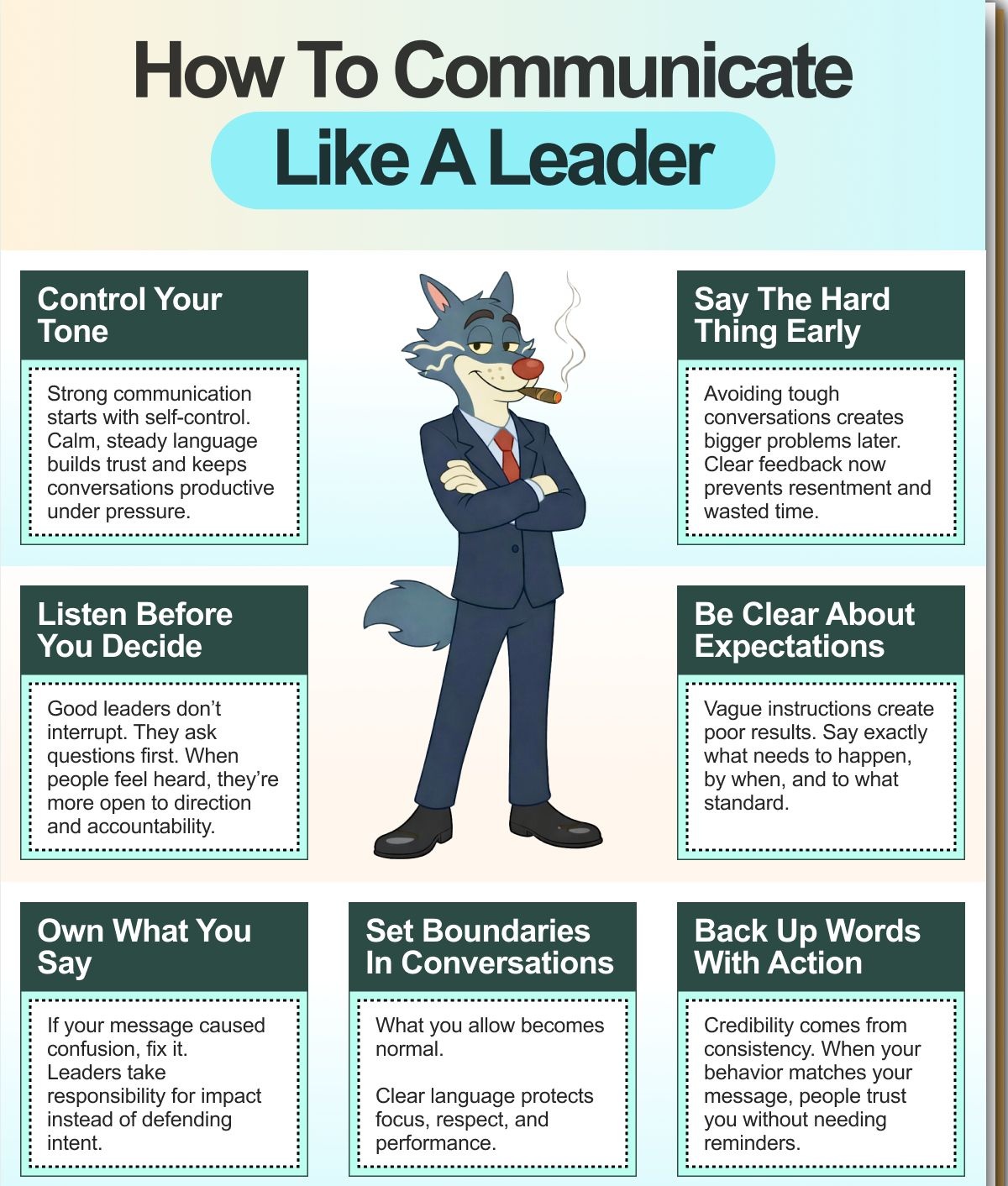
To communicate like a leader is to master a set of interconnected skills that build trust, foster clarity, and inspire action. These are not merely “soft skills” but critical competencies that differentiate high-performing leaders from the rest.
Control Your Tone: The Unspoken Message
Control over one’s tone is paramount in leadership communication. Strong communication begins with self-control. The way you convey a message often matters as much as the message itself. Under pressure, calm and steady language signals competence and composure, fostering an environment of trust and keeping conversations productive. Conversely, panic, aggression, or impatience project the exact opposite, eroding confidence and hindering effective dialogue.
The Power of Poise Under Pressure
Consider a crisis situation. A leader who speaks with a measured, calm tone, even when delivering difficult news, instills a sense of stability and reassurance in their team. This doesn’t mean suppressing emotion entirely, but rather processing it and choosing a delivery that promotes a thoughtful, rather than reactive, response from others. This controlled delivery demonstrates emotional intelligence and the ability to lead effectively through adversity.
Non-Verbal Cues and Their Impact
Tone extends beyond just the words spoken; it encompasses non-verbal cues. Facial expressions, body language, and even the pace of speech contribute significantly to the overall message. A leader who maintains open body language, makes appropriate eye contact, and speaks at a clear, consistent pace will be perceived as more approachable and trustworthy than one who is closed off, avoids eye contact, or speaks erratically. These non-verbal signals are often processed subconsciously and can profoundly impact how a message is received.
Say The Hard Thing Early: The Cost of Avoidance
Avoiding tough conversations is a common pitfalls of leadership, but it inevitably leads to bigger, more complex problems down the line. Delaying clear feedback or sidestepping difficult discussions doesn’t make the issue disappear; it merely allows resentment to fester, targets to be missed, and valuable time to be wasted.
Feedback as a Gift, Not a Punishment
Effective leaders understand that delivering constructive criticism, even when uncomfortable, is a gift to their team members. It provides an opportunity for growth and correction, preventing minor issues from escalating into significant performance gaps. This requires courage and a commitment to the long-term development of individuals and the team. Framing feedback as a tool for improvement, rather than a punitive measure, can significantly impact its reception and efficacy.
Proactive Problem Solving
Addressing challenging topics proactively demonstrates decisiveness and a willingness to tackle issues head-on. This approach builds respect and prevents the accumulation of unresolved problems that can ultimately cripple a team’s morale and productivity. It creates a culture where issues are addressed transparently and efficiently, rather than being swept under the rug.
Listen Before You Decide: The Wisdom of Inquiry
Good leaders are not characterized by their ability to provide all the answers, but by their aptitude for asking the right questions. They prioritize listening over immediate response, seeking to understand diverse perspectives before forming conclusions or making decisions. When individuals feel genuinely heard, they become significantly more receptive to direction and more invested in shared accountability. This isn’t a “soft” approach; it’s an intelligent and highly efficient path to better outcomes.
Active Listening as a Strategic Tool
Active listening involves fully concentrating on what is being said, both verbally and non-verbally, without interrupting or formulating a response prematurely. It means clarifying understanding, reflecting back what has been heard, and demonstrating empathy. This practice builds rapport, uncovers crucial information, and fosters a sense of psychological safety within the team. Leaders who master active listening are better equipped to identify underlying issues, anticipate challenges, and make more informed decisions.
Fostering Collaboration and Buy-In
By inviting input and truly listening to team members, leaders not only gain valuable insights but also cultivate a sense of ownership and collective responsibility. When people feel their voices are valued, they are more likely to buy into decisions and commit to their execution, even if their initial suggestions were not ultimately adopted. This inclusive approach transforms decision-making from a top-down mandate into a collaborative endeavor.
Be Clear About Expectations: The Blueprint for Success
Vague instructions are a recipe for vague results. A hallmark of effective leadership communication is the unwavering commitment to clarity regarding expectations. Leaders must articulate precisely what needs to happen, by when, and to what standard. If an instruction is not specific, it is not an instruction; it is merely a suggestion open to interpretation, which inevitably leads to confusion and suboptimal outcomes.
Defining Deliverables with Precision
Clarity in expectations requires a meticulous approach to defining deliverables. This includes:
- Specific Objectives: What is the desired outcome?
- Measurable Results: How will success be quantified?
- Achievable Goals: Is the expectation realistic given available resources and time?
- Relevant Tasks: Does the task directly contribute to the larger objective?
- Time-bound Deadlines: When must the task be completed?
By breaking down tasks into these granular elements, leaders leave no room for ambiguity, empowering their teams to execute with confidence and precision.
The Cost of Ambiguity
The implicit cost of vague instructions cannot be overstated. It leads to wasted effort as team members attempt to decipher unclear directives, rework incorrect results, and seek constant clarification. This not only saps productivity but also generates frustration and undermines trust. Clear expectations, conversely, create a framework within which individuals can thrive, understanding their role and the impact of their contributions.
Own What You Say: The Foundation of Trust
True leaders take full responsibility for the communication they initiate. If a message causes confusion, the onus is on the leader to fix it, rather than defending their original intent. This principle underscores that the impact of one’s words is far more important than the intention behind them.
The Responsibility of the Communicator
Effective leaders understand that communication is a two-way street, but the primary responsibility for clarity and comprehension rests with the sender. If a message is misunderstood, it’s an opportunity to refine the message, not to blame the listener. This proactive approach to communication fosters a learning environment where leaders continuously strive to improve their articulation and delivery.
Fixing the Message, Not Defending Intent
When a communication breakdown occurs, the natural inclination might be to explain what you meant. However, a leader’s focus should immediately shift to clarifying what was heard and understood. This might involve rephrasing, using different examples, or employing alternative communication channels. This willingness to adapt and iterate on messaging demonstrates humility and a genuine commitment to ensuring comprehension. It cultivates an environment where team members feel safe to admit confusion, knowing their leader will address it constructively.
Set Boundaries in Conversations: Defining the Standard
What you allow in your interactions invariably becomes the standard for communication within your team and organization. If a leader tolerates low-effort communication, disrespect, or constant scope creep, they are effectively lowering the bar for everyone. Clear language and firmly established boundaries are essential tools for protecting focus, maintaining respect, and optimizing performance.
Cultivating a Culture of Respectful Dialogue
Setting boundaries isn’t about being rigid or unapproachable; it’s about establishing clear guidelines for how conversations should unfold. This includes:
- Respectful Discourse: Insisting on polite and constructive language, even during disagreements.
- Focused Discussions: Guiding conversations to stay on topic and discouraging irrelevant tangents.
- Timeliness and Preparation: Encouraging team members to come prepared to meetings and share information promptly.
- Professional Conduct: Addressing instances of disrespectful behavior or communication that undermines team cohesion.
By consistently upholding these standards, leaders model the behavior they expect from their teams and create an environment where productive dialogue can flourish.
Protecting Against Scope Creep and Inefficiency
Boundaries also play a crucial role in managing expectations around workload and project scope. Leaders must use clear language to define project parameters, timelines, and responsibilities. When team members or stakeholders attempt to introduce new requirements or divert resources without proper discussion and approval, a leader’s ability to clearly communicate “no” or to re-evaluate priorities is vital. This protects the team’s focus and prevents key initiatives from being derailed by uncontrolled expansion.
Back Up Words with Action: The Essence of Credibility
Credibility is not built through eloquent speeches or persuasive arguments alone; it is forged and reinforced through consistent action that aligns with stated intentions. When a leader’s behavior mirrors their message, people develop trust without the need for constant reassurance or reminders. Conversely, when there is a disconnect between words and deeds, no amount of talking can repair the damage to trust and influence.
Leading by Example
The most powerful form of communication a leader possesses is their own behavior. If a leader preaches punctuality but consistently arrives late, their words are rendered hollow. If they advocate for transparency but operate in secrecy, their message is undermined. Leading by example means embodying the values, standards, and expectations you project onto your team. It is the ultimate demonstration of commitment and integrity.
Consistency as a Builder of Trust
Consistency between words and actions creates a predictable environment, which is fundamental to building trust. When team members can rely on their leader to follow through on promises, uphold commitments, and act in alignment with declared principles, they feel secure and empowered. This consistency fosters a sense of psychological safety, encouraging open communication, risk-taking, and innovation. A lack of consistency, however, introduces uncertainty and doubt, leading to skepticism and a reluctance to fully commit.
The Irreparable Break When Words and Actions Diverge
The damage caused by a significant discrepancy between what a leader says and what they do is often profound and difficult to reverse. It erodes credibility, breeds cynicism, and can lead to a complete breakdown of trust. In such instances, even the most artfully crafted messages will be viewed with suspicion, and the leader’s ability to inspire or influence will be severely diminished. For this reason, leaders must cultivate a deep mindfulness of their actions and ensure they are always congruent with their communicated vision and values.
Developing Your Leadership Communication Skills
Mastering these seven pillars is an ongoing journey that requires self-awareness, deliberate practice, and a commitment to continuous improvement. Here are some strategies to help you on your path.
Self-Assessment and Feedback
Start by honestly assessing your current communication style. How do you typically handle difficult conversations? Are your expectations always clear? Do you consistently follow through on your commitments? Seek feedback from trusted colleagues, direct reports, and superiors. Anonymous surveys or 360-degree feedback tools can provide invaluable insights into how your communication is perceived by others. Be open to constructive criticism and view it as a gift that highlights areas for growth.
Journaling for Reflection
Regularly reflect on your communication interactions. After a critical meeting or a challenging conversation, take a few moments to journal about:
- What went well?
- What could have been improved?
- How did your tone impact the conversation?
- Was the message received as intended?
- Did you listen effectively before responding?
This reflective practice helps you identify patterns and reinforce positive communication habits.
Intentional Practice and Role-Playing
Communication skills, like any other skill, improve with practice. Look for opportunities to apply these principles in your daily interactions. Practice articulating expectations with greater clarity, initiating difficult conversations sooner, and actively listening during discussions. Consider role-playing scenarios with a coach or a trusted peer to refine your approach to challenging communication situations.
Crafting Your “Think, Feel, Do” Statement
Before important communications, take a moment to define your “Think, Feel, Do” statement.
- Think: What do I want my audience to understand or believe after this conversation?
- Feel: What emotions do I want to evoke (e.g., confidence, motivation, clarity)?
- Do: What specific action do I want them to take?
This framework helps you tailor your message for maximum impact and ensures you’re focused on the desired outcome, not just on delivering information.
Continuous Learning and Adaptability
The landscape of communication is constantly evolving, with new tools and channels emerging regularly. Stay informed about best practices in leadership communication, read articles from reputable sources, and consider leadership development workshops that focus on communication skills. Be adaptable in your communication style, recognizing that different audiences and situations may require different approaches. A servant leader, for instance, emphasizes listening and empathy, while a democratic leader prioritizes dialogue and inclusive discussion. Understanding these nuances allows you to tailor your communication for maximum effect.
Storytelling as a Leadership Tool
Great leaders often use storytelling to connect with their audience and convey complex ideas in an engaging and memorable way. Practice crafting compelling narratives that illustrate your vision, reinforce values, or explain strategic decisions. Stories can make abstract concepts tangible and foster an emotional connection that purely factual communication often lacks.
The Transformative Impact of Clear Communication
Ultimately, clear and consistent communication is the difference between a team that executes with precision and one that drifts aimlessly. It is the catalyst that aligns people, galvanizes effort, and propels organizations towards their goals. When leaders master these communication principles, they unlock their team’s full potential, fostering an environment of trust, clarity, and unwavering commitment.
Investing in your leadership communication skills is not merely about personal development; it is a strategic investment in the success and resilience of your entire organization. Become the leader whose words inspire, whose actions build trust, and whose communication transforms intent into tangible, impactful results. Embrace these principles, practice them diligently, and watch as your leadership influence grows, your team thrives, and your objectives are not just met, but exceeded.
Elevate Your Organizational Intelligence with IoT Worlds
In a world increasingly driven by interconnected devices and vast datasets, effective communication extends beyond human interaction to the seamless exchange of information between machines. At IoT Worlds, we specialize in building the intelligent foundations that empower your organization to communicate with unparalleled clarity, precision, and efficiency across your industrial operations. From designing robust IIoT architectures to implementing advanced security governance frameworks, our solutions ensure your data speaks volumes, enabling you to derive actionable insights and achieve operational excellence.
Ready to transform your industrial communications and unlock the full potential of your intelligent operations?
Connect with IoT Worlds today to discuss how our expertise can empower your team and streamline your processes. Send an email to info@iotworlds.com and let’s build the future of connected intelligence, together.