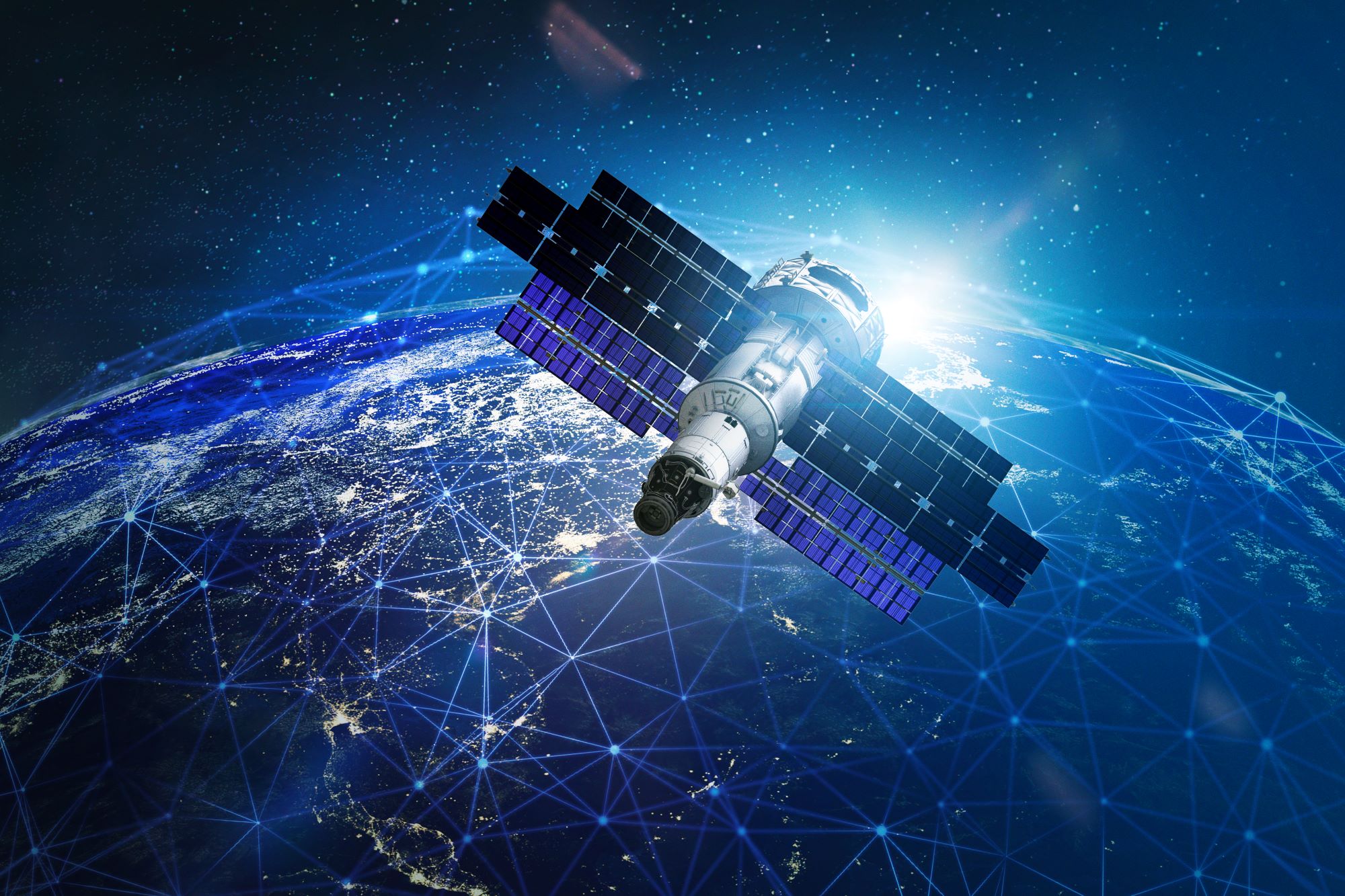
When people say “satellite,” they often picture a single object in space with solar panels and an antenna. In practice, satellite technology is a coordinated stack of systems that spans:
- Spacecraft subsystems (the “bus” that keeps the satellite alive and controllable)
- Payloads (the mission equipment that produces the value—imaging, scientific measurement, or communications)
- Orbit and propulsion (getting to the right orbit and staying there)
- Power generation and storage (operating continuously through sunlight and eclipse)
- Attitude determination and control (pointing in the right direction)
- Navigation and positioning (knowing where the satellite is and, critically, how it’s oriented)
- Communication systems (moving data and control signals between the satellite and the ground)
- Mission operations (the operational lifecycle from early orbit through end-of-life)
- Regulation and safety (treaties, spectrum, debris mitigation, launch safety, cybersecurity)
This article breaks down each component—from launch to orbit and beyond—in a way that’s useful whether you’re building an IoT solution that depends on satellites, studying space systems, or evaluating what makes one satellite mission succeed while another struggles.
Satellite subsystems and where LEO/MEO/GEO fit
Satellites are typically discussed by orbit regime, because orbit determines coverage behavior, mission constraints, and the kinds of payloads and operations that make sense.
LEO satellites (low altitude, shorter life)
LEO is commonly associated with:
- CubeSats and SmallSats
- Low altitude
- Shorter lifespan
Why it matters: LEO missions often emphasize speed of deployment and focused missions (including remote sensing and communications), while accepting shorter lifecycles.
MEO satellites (medium altitude, navigation & communications)
MEO is commonly associated with:
- Navigation
- Communications
- Medium altitude
Why it matters: MEO is strongly linked to navigation use-cases and also supports communications, balancing coverage characteristics differently than LEO or GEO.
GEO satellites (high altitude, stationary, communications & weather)
GEO is commonly associated with:
- Communications
- Weather
- High altitude
- Stationary behavior
Why it matters: GEO satellites are designed for long-duration operations and consistent coverage characteristics (often described as “stationary” relative to a location).
Materials and physical construction
Satellite construction commonly includes materials such as:
- Aluminum
- Composite
- Multi-layer insulation
Why it matters: Material choices directly affect mass, thermal performance, and survivability in the space environment—impacting everything from launch constraints to long-term operations.
Orbit & propulsion: chemical vs electric
A satellite mission is fundamentally about placing and maintaining hardware in the correct orbit regime. Propulsion is central to:
- reaching the planned orbit
- adjusting orbit (when required)
- supporting mission phases like orbit raising
Orbit types
Common orbit types include:
- LEO
- MEO
- GEO
- HEO
Each orbit regime shapes mission design: what the satellite can observe, how it communicates, and how it operates.
Chemical propulsion
Chemical propulsion commonly includes components such as:
- Apogee kick motor
- Thrusters
Where it fits: Chemical propulsion is a familiar and widely used approach for orbit changes and maneuvers where thrust events are needed.
Electric propulsion
Electric propulsion commonly includes:
- Ion thrusters
- Hall effect thrusters
Where it fits: Electric propulsion is often discussed in the context of efficient orbit adjustments and orbit-raising strategies, depending on mission goals.
Practical takeaway for system planners
Propulsion isn’t a standalone feature; it’s entangled with:
- mission operations (orbit raising and end-of-life actions)
- power systems (electric propulsion depends on available power)
- communications and control (commanding maneuvers and tracking outcomes)
When evaluating a satellite system—or designing one—treat propulsion as a mission-wide dependency, not a checkbox.
Payload types: imaging, scientific, communications
If the satellite “bus” is what keeps the spacecraft running, the payload is what creates value. Payload selection determines:
- data type and volume
- pointing requirements (ADCS implications)
- communication needs (downlink requirements)
- mission operations complexity
Imaging payloads
Imaging payloads commonly include:
- Optical
- SAR
- Hyperspectral
What this implies: Imaging payloads often drive high demands on pointing performance, data handling, and downlink strategy.
Scientific instruments
Scientific payloads commonly include:
- Spectrometers
- Radiometers
What this implies: Scientific instruments typically require careful operational planning and may generate specialized datasets that shape communication and storage decisions.
Communication payloads
Communication payloads commonly include:
- Transponders
- Antennas
What this implies: Communications payloads are deeply tied to frequency choices, antenna strategy, and mission operations (coverage, scheduling, and service continuity).
Power systems: solar arrays, batteries, and distribution
Every subsystem depends on power. Power is what turns a satellite from a passive object into an active platform capable of:
- sensing and collecting data
- maintaining pointing (ADCS)
- running onboard processing
- operating transponders and antennas
- executing mission operations across years of service
Solar arrays
Solar power commonly comes from:
- Photovoltaic cells
- Sun tracking
Sun tracking matters because maximizing energy capture supports continuous operations and power-hungry subsystems.
Batteries
Energy storage commonly includes:
- Li-ion
- NiH2
- Designed for use during eclipse
Why eclipse matters: When the satellite cannot rely on sunlight, batteries become the lifeline for core functions and safe operation.
Power generation and distribution
Power architecture includes:
- Power generation & distribution units
This layer is easy to overlook, but it’s essential. Even if you have excellent solar arrays and strong batteries, you still need reliable distribution and regulation to ensure:
- stable operation of onboard electronics
- safe handling of high-demand modes
- predictable behavior across mission phases
ADCS: attitude determination & control
One of the most important systems in satellite technology is ADCS—Attitude Determination & Control. If you can’t control orientation, you can’t reliably:
- point sensors at targets
- align antennas for communications
- manage mission modes that require stable orientation
ADCS “brain” (sensing and compute)
Core elements include:
- Microprocessors (radiation-hardened)
- Star trackers
- Sun sensors
- Magnetometers
- Gyroscopes
These components help the spacecraft determine its attitude—what direction it’s facing and how it’s rotating.
Actuators (how the satellite moves)
Control mechanisms include:
- Reaction wheels
- Thrusters
- Magnetorquers
ADCS is often where mission constraints become real: more demanding payloads (especially imaging) frequently require tighter pointing requirements, which can cascade into system complexity.
ADCS in one sentence
ADCS is the difference between “a satellite in orbit” and “a satellite that can do its job precisely.”
Navigation & positioning: GNSS, star trackers, and ground tracking
Knowing where the spacecraft is—and where it’s pointed—is essential for:
- orbit determination
- planned operations
- downlink scheduling
- mission safety and accuracy
GNSS receivers for orbit determination
Navigation and positioning commonly include:
- GNSS receivers such as GPS, Galileo, etc. for orbit determination
This supports a satellite’s ability to estimate its orbit and provide accurate context for mission operations.
Star trackers for precise orientation
Star trackers are also used for:
- precise orientation
This overlaps with ADCS but is worth calling out: accurate pointing depends on accurate measurement and consistent control.
Ground station tracking
A third pillar is:
- ground station tracking
Ground tracking supports orbit knowledge, operational commanding, and ongoing monitoring during mission phases.
Communication systems: bands, antennas, and optical links
Communication is how satellites deliver value to Earth—and how mission teams maintain control. Satellite communication systems include a mix of frequency choices, antenna types, and, in some cases, optical links.
Transponders and frequency bands
Communication payloads and systems commonly include transponders operating in bands such as:
- Ku
- Ka
- L
- S
- X
These band choices influence system design, hardware, and regulatory considerations (especially frequency allocation).
Antennas: high-gain vs low-gain
Satellite communication systems commonly include:
- High-gain antennas (dish)
- Low-gain antennas (omni)
Conceptual difference:
- High-gain antennas concentrate energy more narrowly (often used for higher performance links).
- Low-gain antennas provide broader coverage (often used for more general connectivity and robust command paths).
Optical communication
Some systems also include:
- Optical communication (laser links)
Optical links represent a distinct approach to data movement and can shape how missions think about bandwidth and connectivity strategies.
Mission operations: LEOP to end-of-life
Satellite technology isn’t only hardware; it’s also disciplined operations across phases. Mission operations generally include:
1) Launch & Early Orbit (LEOP)
Key activities include:
- Deployment
- Checkout
LEOP is when the mission confirms basic spacecraft health and begins bringing subsystems online in a controlled way.
2) Orbit raising
A phase often described as:
- Reaching final orbit
This may involve propulsion use and careful operational planning, depending on the target orbit regime.
3) Operational mission
This is the core value phase, commonly including:
- Data collection
- Communications
Operations here are defined by payload type and user needs (imaging, science, or communications service).
4) End-of-life (EOL)
End-of-life actions commonly include:
- Deorbiting
- Graveyard orbit
EOL planning is not optional—it’s part of safe, responsible space operations and directly connects to debris mitigation expectations.
Space regulation & safety: treaties, spectrum, debris, cybersecurity
Space is not a free-for-all. Satellite missions operate under a set of shared rules and safety expectations.
Space treaties and guidelines
Satellite operations are influenced by:
- Space treaties & guidelines (UN)
Frequency allocation
Communications depend on spectrum access and coordination, including:
- Frequency allocation (ITU)
Space debris mitigation
Responsible missions account for:
- Space debris mitigation
- Including end-of-life plans
Cybersecurity
Satellite missions also explicitly include:
- Cybersecurity
Cybersecurity matters across:
- command and control links
- ground station interfaces
- operations workflows
- data pipelines
Launch safety zones
Operational planning also includes:
- Launch safety zones
This is a reminder that satellite missions integrate safety considerations not only in orbit but also during launch and deployment phases.
Typical satellite specs: LEO SmallSat vs GEO ComSat
A useful way to understand satellite technology is to compare typical specs across orbit regimes. Below is a direct, practical comparison between a LEO SmallSat and a GEO ComSat.
Comparison table
| Specification | LEO SmallSat | GEO ComSat |
|---|---|---|
| Mass | 1–500 kg | 3000–7000 kg |
| Power | 10–500 W | 5–20 kW |
| Orbit altitude | 500–2000 km | 35,786 km |
| Lifespan | 1–5 years | 15+ years |
| Data rate | Mbps–Gbps | Gbps–Tbps |
What these differences imply
- Mass and power affect launch, payload size, and capability envelopes.
- Orbit altitude changes how coverage behaves and how mission operations are planned.
- Lifespan influences how you manage upgrades, risk, and long-term service commitments.
- Data rate shapes communications architecture, antenna strategy, and ground segment planning.
If you’re building IoT solutions that rely on satellite data or connectivity, this table is a fast way to sanity-check assumptions about:
- expected device-to-space link needs
- downlink throughput planning
- mission replacement cycles and continuity strategies
Real-world applications that make satellites indispensable
Satellite technology becomes easiest to understand when connected to outcomes. Common real-world applications include:
Earth observation & remote sensing
Earth observation and remote sensing enable data collection about the planet—often tied to imaging payloads and scientific instruments.
Telecommunications & broadcasting
Telecommunications and broadcasting depend on robust communications systems, including transponders, antennas, and operational continuity.
Navigation (GNSS)
Navigation is a major application area, closely tied to the use of GNSS and positioning capabilities.
Weather forecasting
Weather-focused missions and services are strongly associated with GEO satellites and specialized payload strategies.
Scientific research
Scientific research benefits from instruments like spectrometers and radiometers and the mission operations needed to sustain long-running data collection.
Defense/security
Defense and security use-cases appear as an application area where mission assurance, cybersecurity, and operational robustness are typically emphasized.
IoT perspective: how satellite systems map to connected products
IoT teams are increasingly exposed to space systems—even if they don’t build satellites directly—because satellites can extend connectivity and sensing beyond traditional infrastructure.
Here’s how core satellite building blocks map to IoT realities:
1) Payloads map to “what data exists” in your IoT product
- Imaging payloads and scientific instruments define what measurements can be produced
- Communications payloads define what connectivity services can be provided
From an IoT viewpoint, payload choice is equivalent to deciding:
- what signals your product can observe
- what services it can deliver
- what the data pipeline must support
2) ADCS maps to reliability of sensing and communication
If pointing is inconsistent, then:
- imaging quality can suffer
- communication links may be unstable or lower performance
For IoT deployments that consume satellite data, ADCS quality can influence:
- consistency of updates
- predictability of data delivery windows
- reliability assumptions in analytics pipelines
3) Power maps to duty cycles and service guarantees
Power constraints shape:
- how often a satellite can operate at peak capability
- what operational modes are feasible
- how subsystems trade off against one another
This is similar to battery life planning in edge IoT—except the “edge device” is in orbit and must survive long missions.
4) Mission operations map to lifecycle planning
IoT product teams are used to software lifecycles; satellite missions have lifecycles too:
- LEOP (deployment, checkout)
- orbit raising (reaching final orbit)
- operational mission (data collection, comms)
- end-of-life (deorbiting or graveyard orbit)
If you depend on a satellite service, understanding mission phases helps you plan for:
- commissioning periods
- service scaling over time
- planned end-of-life transitions
5) Regulation & safety map to compliance expectations
Satellite services intersect with:
- frequency allocation (communications)
- debris mitigation (end-of-life responsibility)
- cybersecurity (system protection)
For IoT organizations, this translates into practical questions like:
- Is connectivity spectrum-managed appropriately?
- Are mission and service lifecycles responsibly managed?
- Is cybersecurity part of the service design (not an afterthought)?
Frequently asked questions (FAQs)
What are the core systems that power a satellite mission?
Core systems include satellite subsystems and supporting disciplines such as orbit & propulsion, payloads, power systems, attitude determination & control (ADCS), navigation & positioning, communication systems, and mission operations—supported by regulation and safety practices.
What’s the difference between LEO, MEO, and GEO satellites?
- LEO commonly includes CubeSats/SmallSats, is low altitude, and is associated with shorter lifespan.
- MEO is medium altitude and is associated with navigation and communications.
- GEO is high altitude, often described as stationary, and is associated with communications and weather.
What is ADCS and why does it matter?
ADCS (Attitude Determination & Control) is the system that determines and controls how a satellite is oriented. It uses components such as radiation-hardened microprocessors, star trackers, sun sensors, magnetometers, and gyroscopes, and controls orientation using actuators such as reaction wheels, thrusters, and magnetorquers.
How do satellites determine their position in orbit?
Satellites can use GNSS receivers (GPS, Galileo, etc.) for orbit determination, as well as ground station tracking. Star trackers also support precise orientation.
What are common satellite communication options?
Satellite communication systems can include transponders operating in bands such as Ku, Ka, L, S, and X, using high-gain dish antennas, low-gain omni antennas, and sometimes optical communication (laser links).
What happens during mission operations?
Mission operations commonly progress through:
- Launch & Early Orbit (deployment and checkout)
- Orbit raising (reaching final orbit)
- Operational mission (data collection and communications)
- End-of-life (deorbiting or moving to a graveyard orbit)
Why are regulation and safety part of satellite technology?
Because satellite missions operate under space treaties and guidelines (UN), frequency allocation rules (ITU), debris mitigation expectations (including end-of-life plans), cybersecurity requirements, and launch safety zones.