Digital Twins have transcended the realm of futuristic concepts to become a transformative force in modern industry. Yet, despite their immense potential, many initiatives struggle to deliver on their promise. The core issue isn’t a lack of technological capability, but a fundamental misunderstanding of what a Digital Twin truly is and the journey required to unlock its full value. It’s not merely a static dashboard, a fancy 3D model, or an isolated simulation tool; it’s a progressive capability journey that transforms how an organization operates, makes decisions, and innovates.
The true power of a Digital Twin emerges as organizations move beyond basic visualization and monitoring to embrace intelligence, simulation, and ultimately, autonomous optimization. This evolution is not a linear progression but an exponential one, where each step builds upon the last, amplifying the benefits and accelerating the path to competitive advantage. For leaders navigating the complex landscape of Industry 4.0, understanding this journey is paramount. This guide lays out “The 10 Commandments of Digital Twin” – a leadership lens designed to help you transform your organization into a truly intelligent, adaptive, and self-optimizing entity.
The Strategic Gap: Understanding the Visualization Trap
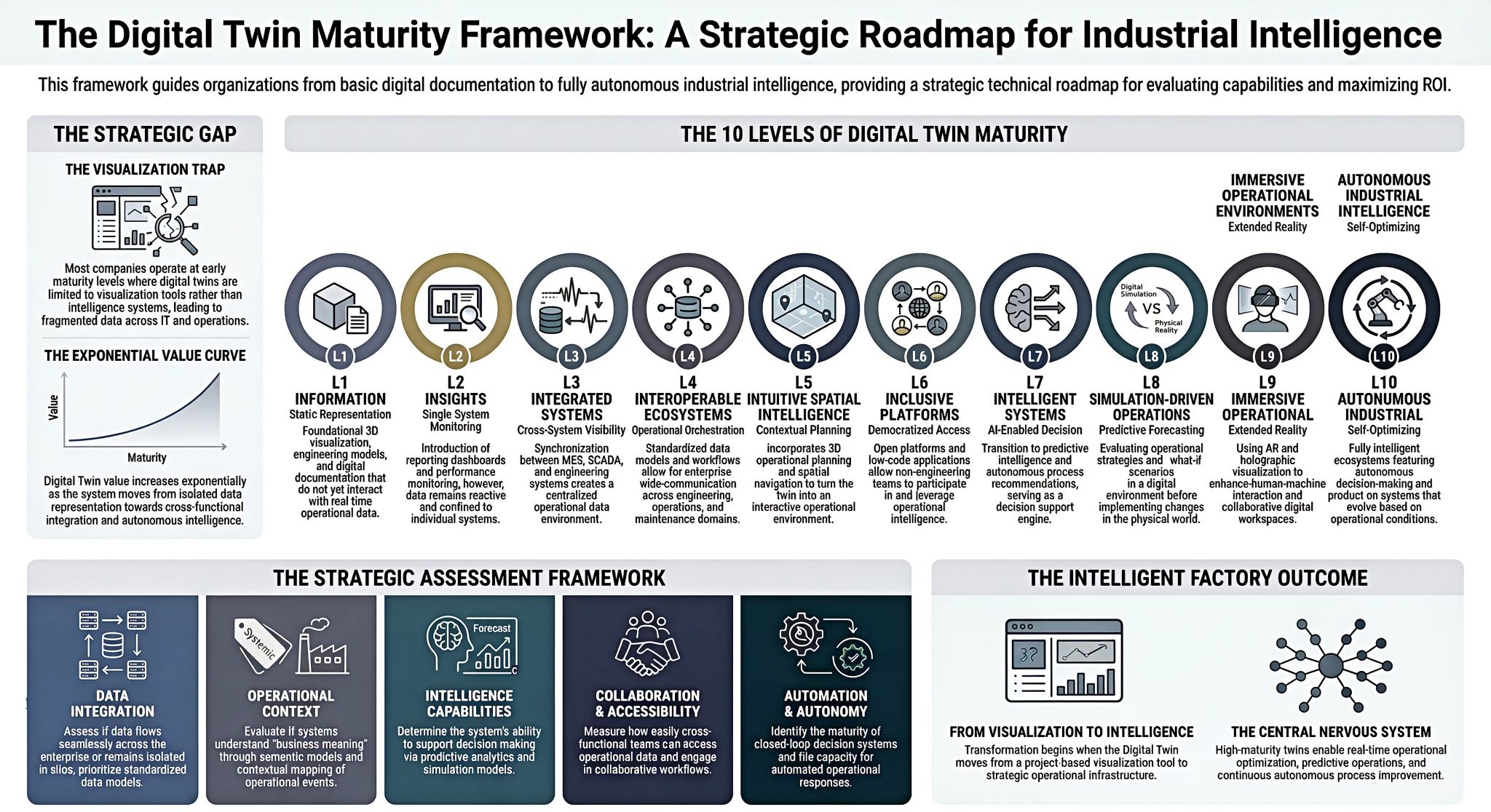
Many organizations embarking on their Digital Twin journey fall into what is commonly referred to as “The Visualization Trap.” At early maturity levels, Digital Twin initiatives are often limited to visualization tools rather than intelligence systems. This results in fragmented data across IT and operational silos, severely hindering the ability to extract meaningful insights and drive impactful change. The belief that a Digital Twin is simply a sophisticated visual representation of a physical asset leads to wasted investment and missed opportunities.
The real value of a Digital Twin, as depicted by the “Exponential Value Curve,” increases exponentially as the system moves from isolated data representation towards cross-functional integration and autonomous intelligence. This curve highlights a critical insight: organizations stuck in the initial stages of visualization and monitoring (Levels 1-3) only scratch the surface of what Digital Twins can offer. The profound impact – the ability to predict, optimize, and automate – begins to manifest significantly from Levels 6-10. This necessitates a shift in mindset from viewing a Digital Twin as a project to understanding it as a continuous organizational evolution.
L1: Information – Static Representation
The foundational level of Digital Twin maturity begins with Information – Static Representation. At this stage, organizations create basic 3D visualizations, engineering models, and digital documentation. While these provide an initial digital footprint of physical assets, they do not yet interact with real-time operational data. Think of this as a digital blueprint or a detailed instruction manual. It provides a visual and structural understanding but lacks the dynamic connection to the physical world. This is a necessary first step, establishing the digital presence of an asset, but it is far from intelligent.
L2: Insights – Single System Monitoring
Moving beyond static representation, Insights – Single System Monitoring introduces the capability for foundational monitoring. This level involves the introduction of reporting dashboards and performance monitoring for individual systems. Data is collected, but its analysis remains largely reactive and confined to isolated systems. While it offers visibility into the current state of a single asset, it doesn’t provide a holistic view or predictive capabilities. For example, a dashboard showing the temperature of a single machine falls into this category. It’s a step towards data-driven understanding, but the intelligence is still limited and siloed.
L3: Integrated Systems – Cross-System Visibility
The third level, Integrated Systems – Cross-System Visibility, marks a significant advancement by synchronizing data between various systems, such as Manufacturing Execution Systems (MES), Supervisory Control and Data Acquisition (SCADA), and engineering systems. This integration creates a centralized operational data environment, offering a broader view of interconnected processes. At this stage, data from multiple sources is brought together, allowing for a more comprehensive understanding of an operational landscape. This cross-system visibility is crucial for identifying dependencies and understanding how different parts of a system interact, but it still primarily focuses on monitoring rather than proactive intelligence.
The 10 Commandments: A Journey to Intelligence
The journey from basic visualization to true industrial intelligence is guided by “The 10 Commandments of Digital Twin.” These principles offer a leadership lens to move beyond the limitations of early-stage Digital Twin deployments and unlock the exponential value associated with higher maturity levels.
1️⃣ not confuse visualization with intelligence
The most critical commandment is to not confuse visualization with intelligence. As highlighted by the “Visualization Trap,” many organizations err by viewing Digital Twins solely as advanced 3D models or dashboards. While visualization is a component, it’s merely the interface for understanding. True intelligence comes from the underlying data, the advanced analytics, and the ability to predict, analyze, and optimize. A Digital Twin, in its evolved state, is a living, continuously updated digital representation capable of reflecting current state, historical behavior, and future outcomes, not just a pretty picture. Organizations must shift their focus from simply displaying data to extracting actionable insights and empowering decision-making.
2️⃣ build on integrated data, not isolated systems
A robust Digital Twin cannot exist in a vacuum of fragmented information. Therefore, the second commandment emphasizes the necessity to build on integrated data, not isolated systems. The “Data Integration” aspect of the Strategic Assessment Framework underscores this by calling for an assessment of data flows across the enterprise and prioritizing standardized data models. Real-world data is the lifeblood of any effective Digital Twin, and this acquisition process is multifaceted, drawing from various sources to create a comprehensive, continuously updated virtual representation. Without seamless connectivity and a unified data fabric, the Digital Twin remains a disjointed collection of information, unable to provide a holistic and accurate reflection of the physical world. This involves breaking down data silos and establishing a “digital thread” – a constant stream of connected data from sensors and other sources.
3️⃣ enable interoperability across ecosystems
Beyond integrating internal data, the third commandment stresses the importance of enabling interoperability across ecosystems. This is reflected in L4: “Interoperable Ecosystems – Operational Orchestration,” where standardized data models and workflows allow for enterprise-wide communication across engineering, operations, and maintenance domains. A truly effective Digital Twin cannot be confined to the boundaries of a single department or system. It must be able to share and receive information from external partners, suppliers, and even customers to create a comprehensive and dynamic view of the entire value chain. This interoperability fosters collaborative environments and ensures that the Digital Twin reflects the broader operational context, leading to more informed decisions and optimized processes.
4️⃣ move from monitoring to contextual understanding
The fourth commandment guides organizations from mere monitoring to achieving contextual understanding. This is where the Digital Twin moves beyond simply reporting what is happening to understanding why it’s happening and what it means within a broader operational framework. L5: “Intuitive Spatial Intelligence – Contextual Planning” incorporates 3D operational planning and spatial navigation to transform the Digital Twin into an interactive operational environment. This means embedding semantic models and contextual mapping of operational events, as highlighted in the “Operational Context” section of the Strategic Assessment Framework. A Digital Twin at this level can not only display data but also explain the relationships between different data points and their implications for operational performance, allowing leaders to understand how changes ripple across processes, documents, roles, and controls.
5️⃣ create intuitive operational environments
Moving towards more advanced intelligence, the fifth commandment focuses on creating intuitive operational environments. This objective is amplified in L9: “Immersive Operational Environments – Extended Reality,” which utilizes Augmented Reality (AR) and holographic visualization to enhance human-machine interaction and collaborative digital workspaces. The goal here is to make the complex data and insights generated by the Digital Twin accessible and understandable to a wider range of users, not just technical specialists. By presenting information in an intuitive and immersive way, organizations can empower employees at all levels to interact with the Digital Twin, gain insights, and contribute to decision-making. This fosters a more engaged and collaborative workforce, enabling them to comprehend and utilize the capabilities of the twin more effectively.
6️⃣ democratize access to intelligence
The sixth commandment, democratize access to intelligence, is a direct follow-up to creating intuitive environments. This is exemplified by L6: “Inclusive Platforms – Democratized Access,” which involves open platforms and low-code applications that enable non-engineering teams to participate in and leverage operational intelligence. The power of a Digital Twin is maximized when its intelligence isn’t confined to a select few but is accessible across the organization. By providing user-friendly interfaces and tools, organizations can empower diverse teams – from operations and maintenance to sales and marketing – to utilize the Digital Twin for their specific needs, fostering innovation and cross-functional collaboration. This democratizes the insights and analytical capabilities, making the Digital Twin a central resource for everyone.
7️⃣ embed intelligence into decision-making
Merely having intelligence is not enough; the seventh commandment dictates that organizations must embed intelligence into decision-making. This is the essence of L7: “Intelligent Systems – AI-Enabled Decision,” which focuses on the transition to predictive intelligence and autonomous process recommendations, serving as a decision support engine. The Digital Twin should actively inform and guide decisions, not just present data. By leveraging AI and machine learning, the Digital Twin can analyze complex scenarios, predict potential outcomes, and recommend optimal courses of action. This transforms decision-making from a reactive process into a proactive, data-driven strategy, leading to significant operational efficiencies and strategic advantages. Leaders can assess impact before approving change, rather than after audits or incidents.
8️⃣ simulate before executing
One of the most powerful capabilities of a mature Digital Twin is its ability to allow organizations to simulate before executing. This is the core of L8: “Simulation-Driven Operations – Predictive Forecasting,” which involves evaluating operational strategies and “what-if” scenarios in a digital environment before implementing changes in the physical world. Unlike a static simulation, a Digital Twin-driven simulation is dynamic and continuously evolves with real-world data. This risk-free sandboxing environment enables organizations to test theories, optimize processes, and predict potential failures, significantly reducing costs and accelerating innovation. For example, NASA uses Digital Twins to simulate deep space missions, anticipating failures and ensuring expensive equipment is not wasted. This capability provides decision confidence and allows for strategic planning with a much higher degree of certainty.
9️⃣ enhance human-machine collaboration
The penultimate commandment emphasizes the symbiotic relationship between humans and technology: enhance human-machine collaboration. As Digital Twins become more intelligent and autonomous, the role of human operators evolves from manual intervention to strategic oversight and collaboration. This is closely linked with L9: “Immersive Operational Environments,” where AR and holographic visualization facilitate seamless interaction between humans and the Digital Twin. The goal is not to replace human intelligence but to augment it, empowering operators with real-time insights, predictive capabilities, and immersive tools to make more effective decisions and manage complex systems with greater precision. This collaborative approach leads to a more efficient, resilient, and adaptive workforce.
1️⃣0️⃣ aim for autonomous optimization
The ultimate goal of the Digital Twin journey is autonomous optimization. This is the pinnacle of maturity, represented by L10: “Autonomous Industrial Intelligence – Self-Optimizing,” where fully intelligent ecosystems feature autonomous decision-making and product on systems that evolve based on operational conditions. At this level, the Digital Twin not only predicts and recommends but also takes proactive action to optimize processes and performance without direct human intervention. This could involve self-adjusting machinery, autonomous resource allocation, or predictive maintenance that triggers corrective actions before failures occur. Such a system becomes the “central nervous system” of the intelligent factory, enabling real-time operational optimization, predictive operations, and continuous autonomous process improvement. This represents a profound shift towards self-managing systems that continuously adapt and improve, delivering unparalleled levels of efficiency and resilience.
Leadership in the Age of Digital Twins: Moving Beyond Projects
The transition from a project-based mindset to a maturity-level approach is crucial for successful Digital Twin implementation. Leaders must recognize that a Digital Twin is not something you merely deploy; it is something your organization becomes. This transformation requires a strategic shift in how capabilities are evaluated and investments are prioritized.
Think in Maturity Levels, Not Projects
The “The 10 Levels of Digital Twin Maturity” framework provides a clear roadmap, guiding organizations from basic digital documentation to fully autonomous industrial intelligence. Leaders must embrace this framework and approach Digital Twin initiatives with a long-term vision, understanding that value accumulates incrementally and exponentially as the organization progresses through the maturity levels. Instead of focusing on short-term project deliverables, the emphasis should be on building foundational capabilities that enable advancement to higher levels of intelligence and autonomy. This involves a sustained commitment to continuous improvement and a recognition that the Digital Twin will evolve alongside the organization.
Invest in Data + Semantics First
At the heart of any effective Digital Twin lies robust data and well-defined semantics. The “Strategic Assessment Framework” highlights “Data Integration” and “Operational Context” as critical areas. Leaders must prioritize investments in collecting, integrating, and standardizing data from across the enterprise. This includes developing semantic models that provide contextual meaning to operational events, allowing the Digital Twin to understand the “business meaning” of the data rather than just processing raw numbers. Without a strong data foundation and clear semantics, even the most sophisticated algorithms will struggle to generate meaningful insights. This foundational investment is essential for accurate representation, effective analysis, and reliable decision-making.
Align IT, OT, and Business Outcomes
The successful implementation of Digital Twins requires a concerted effort to align Information Technology (IT), Operational Technology (OT), and overall business outcomes. Historically, IT and OT have operated in silos, but the convergence of these domains is critical for integrating real-time operational data with enterprise systems. Leaders must foster collaboration and communication between these traditionally disparate functions to ensure that Digital Twin initiatives are not only technically sound but also directly support strategic business objectives. This alignment ensures that the Digital Twin addresses real-world problems, drives tangible value, and contributes to the organization’s overarching goals.
Focus on Decision Impact – Not Visualization
Ultimately, the true measure of a Digital Twin’s success lies in its impact on decision-making. As the Strategic Assessment Framework points out in “Intelligence Capabilities,” the focus should be on the system’s ability to support decision-making via predictive analytics and simulation models. While compelling visualizations can be useful for communication, they are merely a means to an end. Leaders must evaluate Digital Twin investments based on their ability to provide decision confidence, enable proactive problem-solving, and drive measurable improvements in operational efficiency, cost reduction, and innovation. The goal is to move from visualizing outcomes to enabling informed, impactful decisions that transform the business. The Digital Twin is meant to support decisions, not just impress.
The Intelligent Factory Outcome: From Visualization to Intelligence
The overarching goal of embracing the Digital Twin journey is to transform the organization into an “Intelligent Factory Operating Model” where the Digital Twin moves from a project-based visualization tool to strategic operational infrastructure. This transformation results in the emergence of “The Central Nervous System” – a high-maturity Digital Twin that enables real-time operational optimization, predictive operations, and continuous autonomous process improvement.
This central nervous system acts as the brain of the intelligent factory, constantly monitoring, analyzing, predicting, and adapting to changing conditions. It provides a holistic and dynamic view of the entire operational landscape, allowing for proactive decision-making and continuous optimization. This vision represents the ultimate realization of the Digital Twin’s potential – an organization that is not only highly efficient but also inherently adaptive, resilient, and continuously evolving.
The Future is Collaborative, Predictive, and Autonomous
The future of industrial operations is inextricably linked with the evolution of Digital Twin technology. As organizations ascend the maturity ladder, they unlock increasingly sophisticated capabilities that redefine their competitive landscape. From enhancing human-machine collaboration through immersive environments to achieving fully autonomous optimization, the journey is one of continuous innovation and strategic advantage.
The impact of Digital Twins is far-reaching, spanning across diverse sectors. In healthcare, they enable the prediction of how compounds interact with biological systems, reducing the reliance on animal testing, and allow for the creation of patient-specific models to personalize care plans. In the energy sector, Digital Twins facilitate predictive maintenance of power plants, reducing downtime, and optimize the placement of wind turbines to increase yield. Across manufacturing, aerospace, and urban infrastructure, Digital Twins offer an unparalleled capability to monitor, analyze, predict, and control physical assets and systems in real-time, driving significant operational efficiencies and strategic advantages.
This evolution is fueled by powerful real-time engines and platforms that offer robust environments for building interactive, visually rich, and highly functional Digital Twin applications. These tools provide the means for creating stunning 3D visualizations, integrating diverse data sources, and enabling the dynamic interactions that bring the virtual copy of a physical system to life. As technology continues to advance, the capabilities of Digital Twins will only expand, further blurring the lines between the physical and digital worlds.
Conclusion: Becoming a Digital Twin Organization
The journey to becoming a truly intelligent and adaptive organization in the age of Industry 4.0 is a challenging yet rewarding one. It demands a fundamental shift in perception, moving away from limiting Digital Twins to simple visualization tools and embracing them as a progressive capability journey. By adhering to “The 10 Commandments of Digital Twin,” leaders can strategically navigate this path, investing in foundational data and semantics, fostering cross-functional alignment, and prioritizing decision impact over mere visual appeal.
The Digital Twin is not a silver bullet, nor is it a one-time project. It is a continuous evolution, a dynamic process of transforming how an organization understands, monitors, predicts, and optimizes its real-world systems. Ultimately, a Digital Twin is not something your organization deploys; it is something your organization becomes – a living, breathing, continuously optimized entity capable of unprecedented levels of intelligence and autonomy.
Are you ready to transform your organization’s journey from basic visualization to true industrial intelligence and autonomous optimization? Do you want to unlock the full potential of Digital Twins and build a future-proof, self-optimizing enterprise?
Take the next step in your Digital Twin journey.
Contact us today to explore how IoT Worlds can help you implement “The 10 Commandments” and achieve your strategic objectives.
Email us at info@iotworlds.com to initiate a discussion about your unique needs and how we can partner to build your intelligent future.