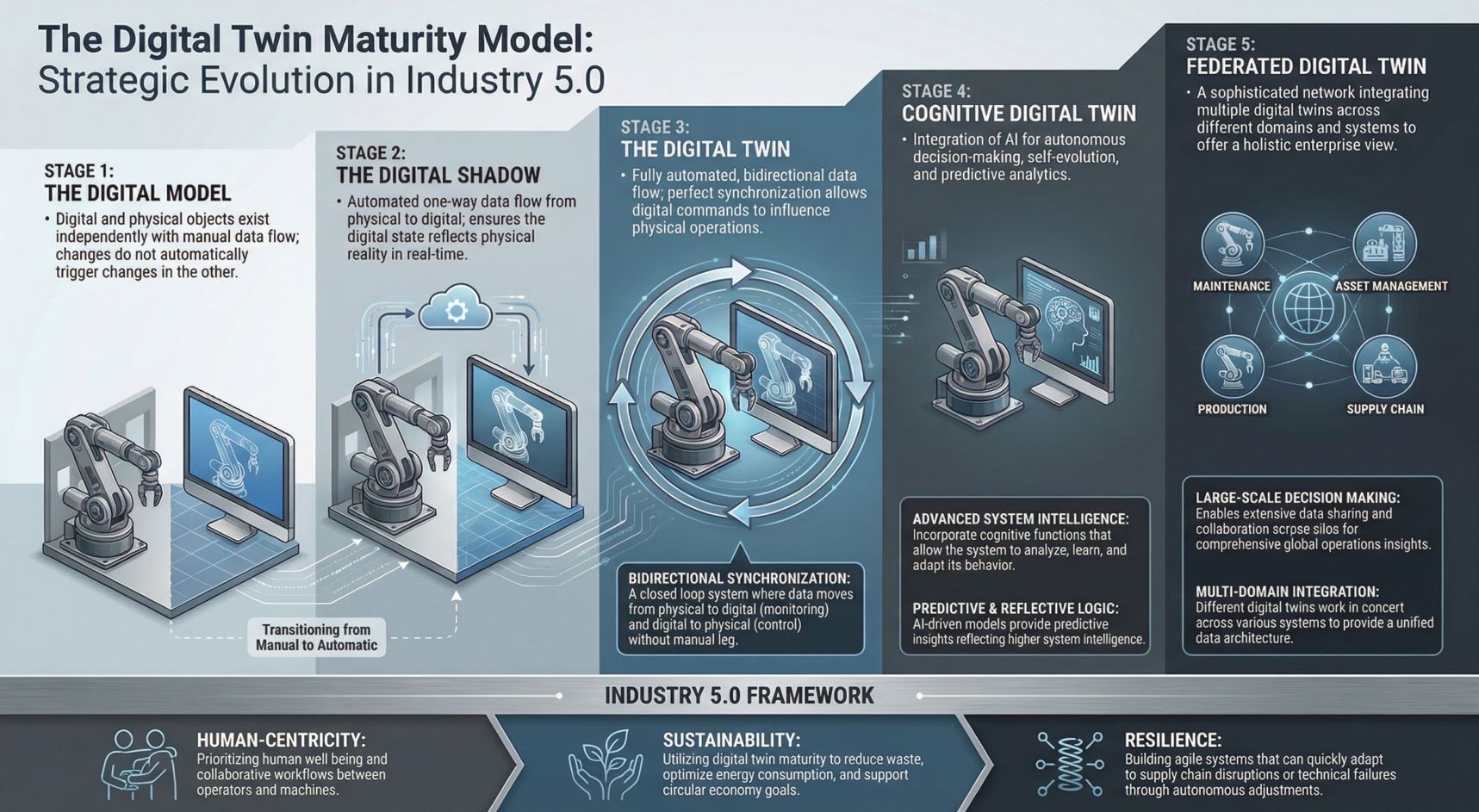
In the rapidly evolving landscape of industrial operations, the concept of a “Digital Twin” has transcended mere buzzword status to become a cornerstone of competitive advantage. However, a critical distinction remains elusive for many leaders: Is your digital representation truly a twin, or merely a shadow? This fundamental question lies at the heart of the Digital Twin Maturity Model, a framework designed to guide organizations through the strategic evolution necessary to thrive in Industry 5.0.
Many organizations believe they have achieved Digital Twin status, often investing heavily in technologies that provide real-time data from physical assets. Yet, for a significant number, this equates to being stuck in Stage 2 of the Digital Twin Maturity Model. If your data primarily flows one-way—from the machine to the screen—what you possess is not a twin, but rather a sophisticated mirror. The true leap to Industry 5.0 demands more than automation; it necessitates Advanced System Intelligence and a profound shift from passive mirroring to active, intelligent “thinking.”
This article will meticulously explore the strategic evolution every C-suite executive and operations leader needs to understand, from the foundational Digital Model to the ultimate Federate Digital Twin. It will also delve into the core values of the Industry 5.0 framework—Human-Centricity, Sustainability, and Resilience—emphasizing that the pertinent question for today isn’t simply “Do we have data?”, but rather “Does our data possess the intelligence to act?”
Demystifying the Digital Twin: Beyond the Hype
The term “digital twin” is often broadly applied, leading to confusion about its true capabilities and potential. At its core, a digital twin is a virtual replica or simulation of a physical asset, process, system, or infrastructure that is created and maintained throughout its life cycle. This definition, while encompassing, highlights a spectrum of components, properties, and capabilities. The goal of implementing a digital twin is to optimize performance, predict and prevent failures, and facilitate data-driven decision-making. Achieving this requires the integration of innovative technologies such as the Internet of Things (IoT), Artificial Intelligence (AI), machine learning, advanced analytics, and visual modeling.
A mature digital twin isn’t typically a single software platform, but rather an integrated network of multiple solutions. Understanding where an organization stands on the Digital Twin Maturity Model is crucial for assessing existing solutions and components, and for establishing a clear roadmap for future development.
The Digital Twin Maturity Model: A Five-Stage Strategic Evolution
The Digital Twin Maturity Model provides a clear pathway for organizations to understand their current capabilities and strategically plan for advancement. This model outlines a progression from basic digital representations to highly intelligent, interconnected, and autonomous systems.
Stage 1: The Digital Model – The Blueprint of Reality
At the foundational stage of the Digital Twin Maturity Model lies The Digital Model. In this initial phase, digital and physical objects exist independently. There is a digital representation of a physical asset, but the connection between the two is characterized by manual data flow. This means that any changes in the physical world do not automatically trigger corresponding updates or changes in its digital counterpart, and vice-versa.
Consider a CAD drawing of a machine or a static simulation. These are examples of digital models. They offer a valuable blueprint and a visual reference, but they lack real-time data synchronization and autonomous interaction. The process of updating the digital model to reflect changes in the physical asset, or applying insights from the digital model to the physical asset, requires significant manual intervention. This stage is primarily about establishing a digital presence for physical assets, often driven by design and documentation needs rather than operational intelligence.
Stage 2: The Digital Shadow – One-Way Illumination
Progressing from the static nature of a Digital Model, The Digital Shadow introduces automated, one-way data flow. This marks the transition from manual to automatic data acquisition. In this stage, data flows from the physical asset to its digital representation, ensuring that the digital state accurately reflects the physical reality in real-time.
An IoT dashboard providing live performance metrics of a factory floor is a prime example of a Digital Shadow. Sensors on machines collect data—temperature, pressure, vibration, output—and transmit it to a digital platform where it’s displayed and analyzed. This real-time monitoring capability allows for immediate insights into the physical asset’s status and performance. Organizations operating at this stage can detect anomalies, track progress, and make more informed decisions based on current operational data.
However, the key limitation here is the unidirectional nature of the data flow. While the physical informs the digital, the digital does not yet autonomously influence the physical. It acts as a sophisticated mirror, showing exactly what is happening, but without the capability to send commands back to the physical system to enact change. While a significant step forward from manual data entry, true closed-loop control remains out of reach. Often, leaders mistakenly believe this sophisticated monitoring constitutes a Digital Twin, when in reality, it’s a Digital Shadow.
Stage 3: The Digital Twin – Bridging the Physical and Virtual Divide
The true essence of a Digital Twin emerges at Stage 3. Here, organizations achieve fully automated, bidirectional data flow, establishing a perfect synchronization between the physical and digital realms. This is the “Closed Loop” system where digital commands can directly influence physical operations without manual intervention.
In a fully realized Digital Twin, data not only moves from the physical to the digital for monitoring, but also from the digital to the physical for control. This bidirectional synchronization enables real-time adjustments and optimization. For instance, a Digital Twin of a manufacturing robot could detect a deviation from optimal performance in its digital environment, and then automatically send commands to the physical robot to adjust its parameters, all without human input. This proactive control minimizes downtime, improves efficiency, and allows for dynamic adaptation to changing conditions.
The implementation of a Digital Twin at this stage leverages a deep integration of IoT devices, advanced analytics, and control systems. It represents a significant leap from merely observing to actively managing and optimizing physical assets through their digital counterparts. This stage is crucial for unlocking the full potential of digital transformation in operational environments.
Stage 4: The Cognitive Digital Twin – Unleashing Advanced Intelligence
Building upon the bidirectional synchronization of the Digital Twin, Stage 4 introduces The Cognitive Digital Twin. This advanced stage integrates Artificial Intelligence (AI) for autonomous decision-making, self-evolution, and sophisticated predictive analytics. This is where systems move beyond simply reacting to current conditions to anticipating future states and adapting proactively.
The Cognitive Digital Twin incorporates advanced system intelligence, endowing the system with the capacity to analyze, learn from data, and adapt its behavior over time. Machine learning algorithms process vast amounts of operational data, identifying patterns, predicting potential failures, and recommending optimized operational strategies. This predictive and reflective logic allows AI-driven models to provide insights that reflect a higher level of system intelligence.
For example, a Cognitive Digital Twin of a complex industrial process could not only monitor and control various parameters but also predict equipment failure days or weeks in advance based on subtle changes in sensor data. It could then autonomously initiate preventative maintenance schedules or adjust production flows to mitigate potential disruptions. The goal here is to create a self-optimizing system that reduces the need for human intervention in routine decision-making, frees up human operators for more complex tasks, and drives continuous improvement through intelligent automation. The move towards Cognitive Digital Twins marks a significant step towards enabling proactive, autonomous, and cognitive systems, especially in manufacturing.
Stage 5: The Federated Digital Twin – The Unified Enterprise View
The pinnacle of the Digital Twin Maturity Model is The Federated Digital Twin. This stage represents a sophisticated network that integrates multiple digital twins across different domains and systems to offer a holistic, unified enterprise view. It moves beyond individual asset or process optimization to orchestrate an entire operational ecosystem.
Large-Scale Decision Making
A Federated Digital Twin enables extensive data sharing and collaboration, breaking down silos between departments and functions. This comprehensive integration provides global operations insights, allowing for large-scale decision-making that optimizes the entire value chain.
Imagine a scenario where digital twins of individual machines, production lines, maintenance schedules, asset management systems, and even supply chain logistics are all interconnected. This allows an organization to simulate the impact of a change in raw material delivery on an entire production schedule, assess the ripple effect of a component failure on customer orders, or optimize energy consumption across multiple facilities in real-time.
Multi-Domain Integration
To achieve this, Federated Digital Twins rely on multi-domain integration. Different digital twins—each potentially at varying stages of maturity—work in concert across various systems. This requires a unified data architecture and robust communication protocols to ensure seamless information exchange and coordinated action. The integration of frameworks like the Industry 4.0 Component concept and Service-Oriented Architecture is vital, allowing for shared technical functionalities and flexible development.
The Federated Digital Twin is the ultimate goal for enterprises seeking to achieve unparalleled agility, efficiency, and resilience. It empowers strategic leaders with a comprehensive, real-time understanding of their entire operation, enabling them to make highly informed decisions that impact the bottom line and competitive positioning.
The Industry 5.0 Framework: Beyond Technology
The evolution through the Digital Twin Maturity Model is not solely a technological journey. It is deeply intertwined with the overarching principles of Industry 5.0, a framework that emphasizes human-centricity, sustainability, and resilience. These values are not optional additions but rather fundamental drivers that shape the development and deployment of advanced digital twin solutions.
Human-Centricity: Empowering the Workforce
Industry 5.0 places a strong emphasis on Human-Centricity by prioritizing the well-being of humans and fostering collaborative workflows between operators and machines. While advanced digital twins introduce significant automation, the objective is not to replace human workers but to augment their capabilities and create a more fulfilling and productive work environment.
Digital twins, particularly at the cognitive and federated stages, can offload repetitive, dangerous, or physically demanding tasks from human operators. They can provide augmented reality overlays for maintenance, intelligent decision support systems, and predictive insights that empower workers to make faster, more accurate decisions. For instance, a cognitive digital twin can alert human operators to potential issues before they become critical, allowing for proactive intervention rather than reactive troubleshooting. This collaboration leads to increased safety, reduced errors, and a more engaged workforce. The focus is on creating symbiotic relationships where the strengths of both humans and machines are leveraged for optimal outcomes.
Sustainability: Driving Eco-Conscious Operations
Sustainability is a core pillar of Industry 5.0, advocating for the utilization of digital twin maturity to reduce waste, optimize energy consumption, and support circular economy goals. Digital twins offer unprecedented capabilities for monitoring, analyzing, and optimizing resource usage across an entire operational lifecycle.
By providing real-time data and predictive analytics, digital twins can identify inefficiencies in energy consumption, pinpoint sources of material waste, and optimize production schedules to minimize environmental impact. For example, a federated digital twin connecting various production lines could dynamically adjust operational parameters to reduce energy spikes, or identify opportunities for material recycling and reuse. The ability to simulate and optimize processes virtually before physical implementation also reduces the consumption of resources associated with trial-and-error in the real world. This proactive approach to sustainability not only benefits the planet but also leads to significant cost savings and enhances an organization’s corporate social responsibility profile.
Resilience: Building Adaptive Systems
In an increasingly volatile and uncertain global environment, Resilience is paramount. Industry 5.0 aims to build agile systems that can quickly adapt to supply chain disruptions or technical failures through autonomous adjustments. Digital twins are instrumental in achieving this level of operational robustness.
A cognitive or federated digital twin can simulate various disruption scenarios, allowing organizations to test and refine their response strategies before a real event occurs. When a disruption does occur, whether it’s a natural disaster impacting a supply chain or an unexpected equipment breakdown, the digital twin can provide real-time insights into the impact and suggest optimal recovery paths. For instance, a federated digital twin could automatically re-route production to an alternative facility if one experiences an outage, or dynamically adjust inventory levels based on predicted supply chain fluctuations. This capacity for autonomous adjustment minimizes downtime, mitigates financial losses, and ensures business continuity in the face of unforeseen challenges.
The Journey to Advanced System Intelligence: From Mirroring to Thinking
The entire progression through the Digital Twin Maturity Model represents a profound journey from merely “mirroring” reality to truly “thinking” within a digital context. It is about equipping data with the intelligence to act, rather than simply informing.
From Passive Data Collection to Proactive Interpretation
In the early stages, data collection is often passive. Organizations gather information, but the interpretation and action require human analysis. As they advance through the model, and especially with the introduction of cognitive capabilities, the system itself begins to interpret data, identify patterns, and even predict future states. This shift from raw data to intelligent insight is a fundamental aspect of Advanced System Intelligence.
Consider the transition from a Digital Shadow, which tells you a machine is overheating, to a Cognitive Digital Twin, which not only alerts you to the overheating but also diagnoses the root cause, predicts when the component will fail, and autonomously initiates a cooling protocol or a maintenance request. This is the difference between simply seeing a reflection and engaging in intelligent, proactive reasoning.
The Role of AI and Machine Learning
Artificial Intelligence and Machine Learning are the engines driving this transformation. They enable digital twins to learn from vast datasets, identify complex relationships that humans might miss, and develop predictive models for future behavior. This learning capability allows the digital twin to self-evolve, becoming increasingly accurate and effective over time.
As organizations integrate more advanced AI functionalities, their digital twins gain the ability to make autonomous decisions, optimize processes in real-time, and even adapt their strategies to achieve desired outcomes. This is the essence of “thinking” within the digital realm – the ability to process information, learn, reason, and act with a degree of autonomy. The categorization of Intelligent Digital Twin maturity into predictive, prescriptive, and autonomous stages underscores this progression.
Towards a Unified and Collaborative Ecosystem
The ultimate vision of a Federated Digital Twin underscores the importance of a unified and collaborative ecosystem. Individual intelligent digital entities, each “thinking” within its domain, come together to form a larger, interconnected intelligence. This allows for optimization at an enterprise level, where disparate systems and processes work in harmony to achieve strategic objectives.
This evolution is not just about adopting new technologies, but about fundamentally reimagining how organizations operate. It requires a strategic commitment to integrate advanced analytics, AI, and comprehensive data architectures to build truly intelligent, adaptive, and resilient systems.
Key Considerations for Advancing Digital Twin Maturity
Moving through the Digital Twin Maturity Model requires a strategic approach and careful consideration of several key factors. Organizations must assess their current capabilities, identify their strategic objectives, and plan a clear roadmap for implementation and integration.
Data Infrastructure and Management
A robust data infrastructure is the backbone of any successful digital twin strategy. This includes secure data acquisition from physical assets via IoT devices, efficient data storage and processing capabilities, and reliable data transmission networks. As organizations progress to higher maturity levels, the volume, velocity, and variety of data will increase exponentially, necessitating scalable and intelligent data management solutions.
Implementing data governance policies, ensuring data quality, and establishing secure data pipelines are critical. Without clean, reliable, and accessible data, even the most sophisticated AI algorithms will fail to deliver accurate insights or effective controls. This often involves leveraging cloud computing platforms and edge computing for real-time processing.
Technology Integration and Interoperability
Digital twins are inherently integrated systems, requiring seamless interoperability between various technologies and platforms. This includes integrating IoT devices, SCADA systems, Manufacturing Execution Systems (MES), Enterprise Resource Planning (ERP), and Product Lifecycle Management (PLM) systems. The ability of different digital twins to communicate and exchange information effectively is crucial for achieving multi-domain integration and a holistic enterprise view.
Organizations should prioritize open standards and flexible architectures to avoid vendor lock-in and ensure future scalability. Designing a framework that can accommodate different technologies and allow them to work in concert is essential for success, especially in the context of Industry 4.0.
Cybersecurity Measures
As digital twins become more interconnected and gain control over physical operations, cybersecurity becomes paramount. Protecting the integrity and confidentiality of data, as well as preventing unauthorized access or manipulation of control systems, is non-negotiable. A breach in a highly mature digital twin could have catastrophic consequences, not only in terms of data loss but also physical damage and operational disruption.
Implementing robust security protocols, including encryption, access controls, intrusion detection systems, and regular security audits, is essential at every stage of digital twin deployment. It’s also important for organizations to consider the broader security implications of connecting operational technology (OT) with information technology (IT) systems.
Organizational Buy-in and Skill Development
Technological advancements alone are insufficient. Successful digital twin implementation requires strong organizational buy-in from leadership down to the operational floor. Educating employees about the benefits of digital twins, addressing concerns, and fostering a culture of innovation are crucial for adoption.
Furthermore, investing in skill development is vital. As digital twins evolve, new roles requiring expertise in data science, AI, machine learning, IoT, and cybersecurity will emerge. Upskilling the existing workforce and recruiting new talent with these specialized skills will be critical for leveraging the full potential of advanced digital twin solutions.
Strategic Roadmap and Phased Implementation
Achieving the highest levels of digital twin maturity is a long-term journey, not a single project. Organizations should develop a clear strategic roadmap, outlining phased implementation plans with measurable objectives. Starting with pilot projects, demonstrating value, and iteratively expanding capabilities can help manage complexity and ensure gradual, sustainable progress.
Each stage of the maturity model builds upon the previous one, so rushing ahead without solidifying foundational capabilities can lead to significant challenges. A well-defined roadmap allows organizations to prioritize investments, allocate resources effectively, and continuously align their digital twin strategy with their overarching business goals.
The Future is Now: Industry 5.0 and Beyond
The Digital Twin Maturity Model is more than just a theoretical framework; it’s a practical guide for navigating the complexities of modern industrial transformation. As industries worldwide embrace the principles of Industry 5.0, the question is no longer whether organizations will adopt digital twins, but to what extent they will evolve their digital representations to wield true intelligence and proactive capabilities.
The shift from simple data echoing (the Digital Shadow) to bidirectional control (the Digital Twin) and further to autonomous, learning systems (the Cognitive Digital Twin) ultimately culminates in interconnected, enterprise-wide intelligence (the Federated Digital Twin). This progression promises not just efficiency gains but a fundamental rethinking of how industries operate, interact with their environments, and leverage human potential.
The ultimate goal for 2026 and beyond is to move past merely possessing data. It is about ensuring that this data is imbued with the intelligence and capabilities to act autonomously, proactively, and collaboratively across entire ecosystems. This is the essence of strategic evolution in Industry 5.0.
Unlock Your Digital Twin Potential
Is your organization truly harnessing the power of Digital Twins, or are you still relying on a Digital Shadow? The path to Industry 5.0 requires a clear understanding of your current maturity level and a strategic roadmap to unlock advanced system intelligence.
IoT Worlds specializes in guiding businesses just like yours through this transformative journey. Our expert consultants can help you assess your existing digital infrastructure, identify opportunities for advancement, and design a customized strategy to elevate your digital twin capabilities. From implementing bidirectional synchronization to integrating advanced AI for cognitive functions and federating your digital ecosystem for enterprise-wide insights, we provide the expertise to turn your data into intelligent action.
Don’t let your competition outpace you in the era of advanced industrial intelligence. Take the definitive step towards a truly resilient, sustainable, and human-centric future.
To learn more about how IoT Worlds can accelerate your Digital Twin maturity and drive your strategic evolution in Industry 5.0, send an email to info@iotworlds.com today. Let us help you transform your operations from mirroring to truly “thinking.”