Large language models have become the workhorse of modern AI, but simply calling a huge model for every task is not sustainable for real‑world IoT and edge deployments. Latency, GPU cost, and data‑privacy constraints all push against the “one‑big‑model” approach.
The paper “ToolOrchestra: Elevating Intelligence via Efficient Model and Tool Orchestration” from NVIDIA and the University of Hong Kong introduces a different pattern: use a small orchestrator model that intelligently routes tasks to a wide range of tools and larger LLMs.
For readers of iotworlds.com, this is directly relevant. Smart factories, energy grids, transportation systems, and OT/ICS security all need agentic AI that can coordinate sensors, databases, simulators, and control systems. ToolOrchestra shows how to do this efficiently and reliably.
From Monolithic Models to Orchestrated Systems
Most current “AI agents” look like this:
- one powerful LLM (for example GPT‑5 or Claude Opus),
- add a few tools like web search or a code interpreter,
- prompt the model to decide when to use which tool.
The ToolOrchestra team shows this is fragile:
- When GPT‑5 is prompted to orchestrate other models, it overwhelmingly calls GPT‑5‑mini.
- When Qwen3‑8B is the orchestrator, it delegates to GPT‑5 in the majority of cases.
In other words, off‑the‑shelf models display strong biases: they overuse their own variants or the strongest available model, regardless of cost or user preference. That is a problem if you are running hundreds of agents across an IoT fleet.
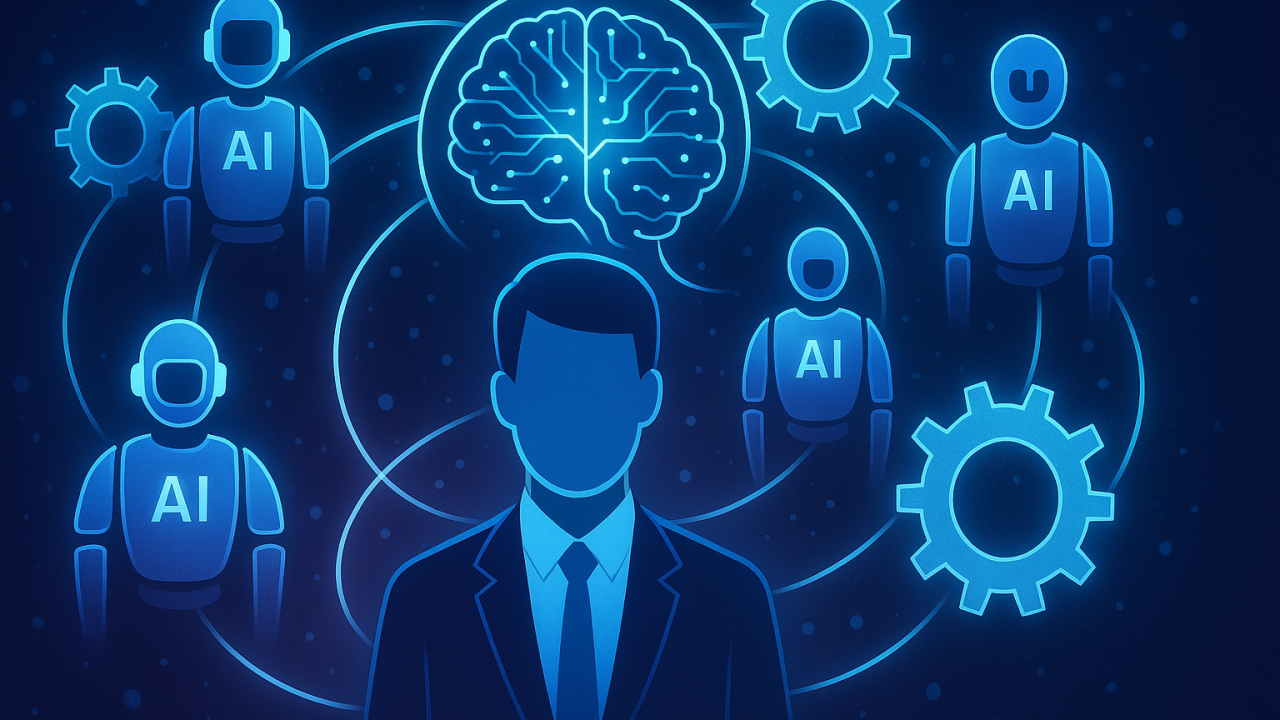
The orchestration paradigm proposed in the paper treats intelligence as a composite system:
- A small LLM, the Orchestrator, is the “brain”.
- Around it is a rich toolbox:
- basic tools such as web search, local search, code interpreter, and domain functions like
get_flight_status, - specialized LLMs for coding and math,
- powerful generalist LLMs including GPT‑5, Claude Opus 4.1, and Qwen3‑series models.
- basic tools such as web search, local search, code interpreter, and domain functions like
The orchestrator decides, step by step, which tool to call and how to combine tool outputs into a final answer.
How ToolOrchestra Trains the Orchestrator
Unified tool interface
Every tool is described through a common JSON schema: name, description, and typed parameters. Even LLMs are treated as tools with natural‑language descriptions of their strengths and weaknesses. This unified interface is exactly what an IoT platform can mirror for internal services, device APIs, and digital‑twin simulators.
Multi‑turn reasoning loop
For each user query, Orchestrator‑8B performs a multi‑turn loop:
- Reason about the current state and plan the next move.
- Call a tool (an API, a math model, a general LLM, and so on).
- Observe the result, which is fed back into the context.
- Repeat until a termination condition is reached or a turn limit is hit.
This is the same pattern you would use to build an operations assistant for an industrial plant: analyze alarms, query historians, consult procedures, propose actions.
Reinforcement learning with outcome, efficiency, and preferences
The key innovation is how this behavior is trained. ToolOrchestra uses reinforcement learning with three reward dimensions:
- Outcome: did the trajectory actually solve the task? A separate judge model checks the final answer.
- Efficiency: how much money and wall‑clock time did this sequence of tool calls consume?
- User preferences: how well did the tool choices respect a preference profile, for example:
- “Prefer local search and on‑prem models, avoid external APIs.”
- “Maximize accuracy, even if cost goes up.”
- “Minimize latency for interactive use.”
Only successful solutions receive a reward, which is scaled up or down based on cost and alignment with the preference vector. This creates a small model that not only reasons but also optimizes for a deployment‑specific objective.
ToolScale: synthetic but realistic environments
To train at scale, the authors build ToolScale, a synthetic dataset covering ten domains such as finance, medicine, travel, and e‑commerce. For each domain they generate:
- a database and domain‑specific tools,
- rich natural‑language tasks (for example “cancel this booking and refund the difference according to policy”),
- ground‑truth tool sequences and evaluation criteria.
This gives the RL system thousands of verifiable multi‑turn tasks to learn from.
Results: Orchestrator‑8B Beats Frontier Models at Lower Cost
The paper evaluates Orchestrator‑8B on three demanding benchmarks:
- Humanity’s Last Exam (HLE) – PhD‑level questions across many disciplines,
- FRAMES – a factual reasoning and retrieval‑augmented generation benchmark,
- Tau‑Squared Bench – a function‑calling benchmark for conversational agents.
Across all three, Orchestrator‑8B consistently outperforms or matches GPT‑5, Claude Opus 4.1, and large Qwen3 models while using only around 30% of the cost and significantly lower latency.
For example:
- On HLE, Orchestrator‑8B scores higher than GPT‑5, despite being much smaller.
- On Tau‑Squared Bench, it achieves the best accuracy with roughly one‑third of GPT‑5’s cost.
- Tool‑usage analysis shows that Orchestrator‑8B uses a balanced mix of tools, instead of over‑relying on a single heavyweight model.
The orchestrator also generalizes well to new tools and pricing schemes it never saw during training and adheres more faithfully to user preferences than frontier monolithic models.
Why This Matters for IoT and Edge Deployments
For IoT Worlds readers, ToolOrchestra points to a practical architecture for agentic systems:
- Run a compact orchestrator on site (factory, substation, building, vehicle).
- Provide it with a catalog of tools:
- device APIs,
- historians and telemetry stores,
- digital‑twin and optimization engines,
- small local LLMs,
- optionally, remote frontier models for occasional heavy reasoning.
- Encode business and safety requirements as preference profiles.
- Use reinforcement learning or imitation learning to optimize the orchestrator for your environment.
Instead of streaming all data to one giant cloud model, you gain:
- lower bandwidth and GPU cost,
- better latency for time‑critical operations,
- stronger data‑sovereignty and governance,
- and an AI system that you can steer using explicit preferences and policies.
Takeaway
ToolOrchestra shows that the future of AI for IoT is not about ever‑larger monolithic models. It is about smart orchestration: small, efficient brains that know how to combine many tools and models into robust, cost‑effective solutions.
If you are designing the next generation of IoT platforms, digital‑twin systems, or OT/ICS automation, incorporating an orchestration layer like Orchestrator‑8B may be the fastest route to scalable, controllable, and economically viable AI.