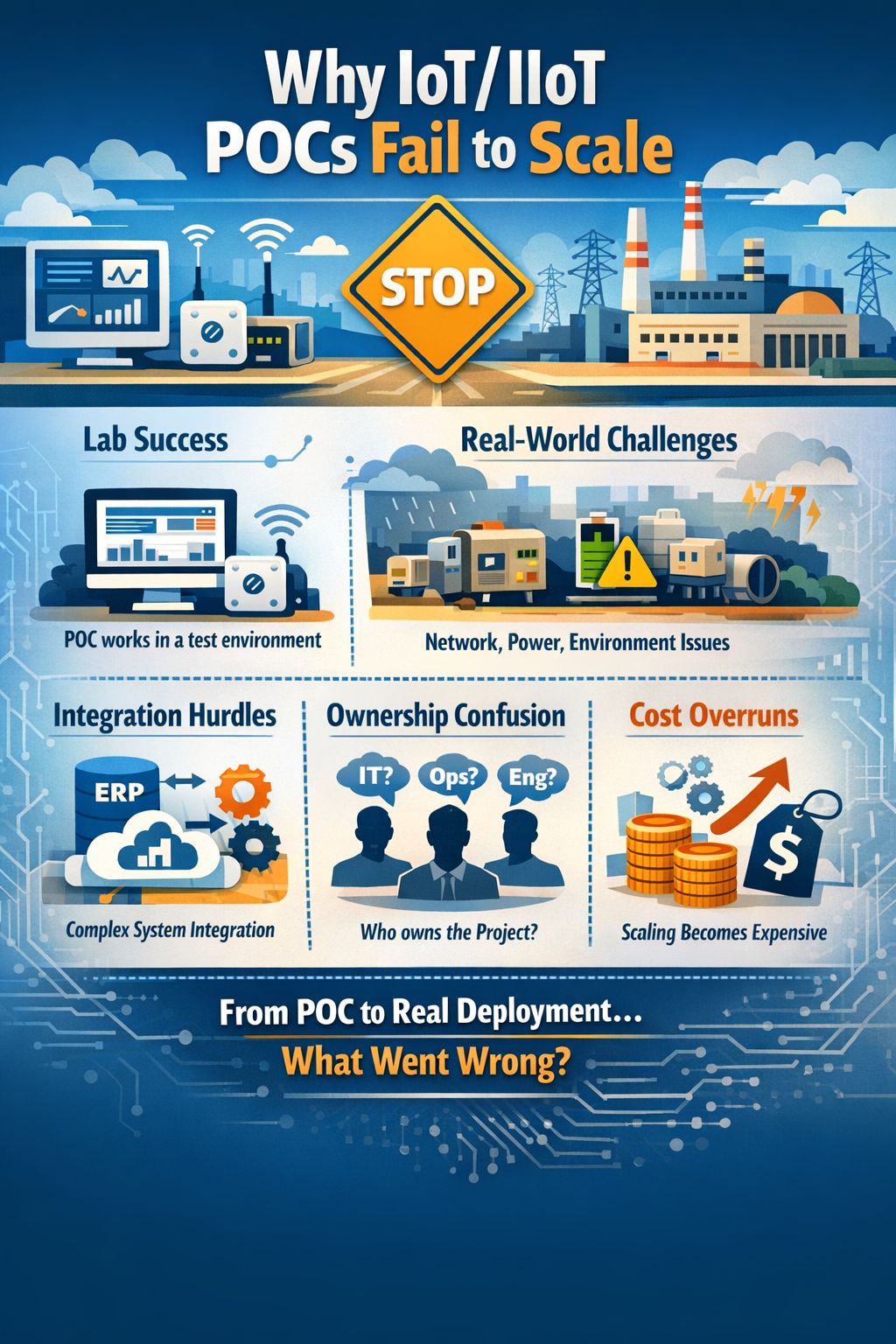
The promise of the Internet of Things (IoT) and Industrial Internet of Things (IIoT) is vast, offering unprecedented opportunities for efficiency, cost savings, and innovation. Organizations across industries are eager to harness the power of connected devices, sensors, and data analytics. This enthusiasm often leads to the development of Proofs of Concept (POCs) – small-scale, experimental projects designed to validate an IoT solution’s technical feasibility and potential value.
Many of these POCs – whether demonstrating remote asset monitoring, predictive maintenance, or smart factory automation – often succeed in their initial, controlled environments. Stakeholders are impressed, dashboards glow with data, and the path to a brighter, connected future seems clear.
Then, something unexpected happens. The project stalls. Despite a technically successful POC, the transition from a promising experiment to a full-scale, real-world deployment proves to be an insurmountable hurdle for many organizations. This phenomenon, often referred to as “pilot purgatory,” “pilot trap,” or the “IoT chasm,” is a common and frustrating reality. Indeed, reports suggest that over 70% of IoT initiatives never move beyond the pilot stage. A 2018 McKinsey survey highlighted that 84% of companies involved in IoT were stuck in pilot mode, with 28% languishing there for over two years.
So, what goes wrong between a brilliant POC and a lackluster real-world deployment? This article delves into the critical factors that cause many IoT and IIoT POCs to fail in scaling, transforming from exciting possibilities into stalled initiatives.
The Allure of Lab Success vs. The Harshness of Real-World Challenges
The journey of an IoT project typically begins in a controlled environment – a lab, a small test bed, or a focused pilot location. Here, a handful of devices, often one or two, operate under ideal conditions: stable Wi-Fi, perfect power supply, and carefully managed parameters. The POC thrives in this insulated world, generating compelling data and proving the concept’s viability. This initial success, while validating the technological core, often builds a “prototype bias,” where decisions are made for speed and simplicity rather than real-world resilience.
The Controlled Environment Fallacy
In a lab, the primary goal is to demonstrate that the technology can work. This focus on “can it work?” rather than “can it work at scale, reliably, and profitably?” leads to several overlooked aspects that become critical once outside the lab.
For instance, connectivity is often assumed to be constant and robust. Firmware is treated as static. These assumptions, while valid for a prototype, crumble under real-world conditions.
Real-World Challenges Exposed by Scale
The true test of an IoT solution begins when it moves beyond the controlled environment to a wider deployment of hundreds, thousands, or even tens of thousands of devices. It’s at this stage that the “operational reality gap” becomes alarmingly apparent.
Network Reliability: The Achilles’ Heel of IoT
One of the most underestimated risks in IoT is connectivity. In a lab, a strong, stable internet connection is a given. In the field, especially in industrial settings, rural areas, or distributed environments, network conditions are rarely perfect.
- Intermittent Connectivity: Real-world networks are prone to outages, fluctuations, and varying signal strengths. Devices might operate in areas with poor Wi-Fi coverage, reliance on cellular networks with dead zones, or even in locations where internet access is simply unavailable for extended periods. A system that doesn’t account for offline states, bounded retries, and local decision-making will quickly fall apart.
- Latency and Packet Loss: High latency or significant packet loss can severely impact the real-time data needs of many IoT applications, leading to outdated information and delayed actions.
- Protocol Selection: Selecting the wrong communication protocol for the given environment and data requirements can also lead to inefficiencies and unreliability.
Power Management and Battery Life: Beyond the Wall Socket
In a lab, devices are often conveniently plugged into a power outlet. In real-world deployments, especially for remote sensors or mobile assets, this is rarely an option.
- Battery Dependency: Many IoT devices rely on batteries, and optimizing power consumption for extended battery life is paramount. A POC might run for a few days, but a scaled deployment needs devices to operate for months or even years without manual intervention. Poor power design is a common hardware-level failure.
- Energy Harvesting: Exploring alternative power sources like solar or kinetic energy, and carefully designing power-efficient hardware and firmware, are critical considerations often overlooked in the POC stage.
Hardware Durability in Harsh Environments: The Physical Layer Failure
The physical integrity of IoT devices is often a major blind spot during initial pilots. A device that performs flawlessly on a workbench can quickly succumb to the rigors of an industrial plant, an outdoor setting, or a harsh climate.
- Environmental Stressors: Heat, cold, vibration, moisture, dust, electromagnetic interference, and corrosive substances can all degrade device performance and longevity. A lack of environmental testing during the pilot phase is a significant problem.
- Sensor Selection: The choice of sensors must not only be accurate but also robust enough to withstand the operational environment. Incorrect sensor selection can lead to unreliable data or premature device failure.
- Vendor-Specific Limitations: Relying on vendor-specific hardware without understanding its limitations for large-scale, diverse environments can create unforeseen challenges.
Firmware Updates and Remote Management: The Forgotten Lifecycle
In a small pilot, manual updates or infrequent firmware adjustments are manageable. With thousands of devices, this becomes an operational nightmare.
- Over-the-Air (OTA) Updates: A robust OTA update mechanism is essential for patching security vulnerabilities, introducing new features, and fixing bugs across a distributed fleet of devices. Without a well-designed update strategy, devices can become obsolete, insecure, or simply break down over time. Firmware is rarely static in the field.
- Remote Monitoring and Diagnostics: The ability to remotely monitor device health, diagnose issues, and troubleshoot without physical access is crucial for maintaining uptime and reducing operational costs.
Integration Hurdles: The System That Rarely Lives Alone
One of the most significant complexities in scaling an IoT solution is its inherent need to integrate with existing enterprise systems and data ecosystems. An IoT system rarely lives in isolation; its true value is unlocked when its data informs and interacts with other critical business processes.
Connecting to the Enterprise Ecosystem
The data generated by IoT devices is most valuable when it can be fed into, and sometimes influenced by, an organization’s core operational and IT systems.
- Enterprise Resource Planning (ERP) Systems: Integrating IoT data with ERP systems can provide real-time insights into inventory levels, production schedules, asset utilization, and supply chain logistics, leading to optimized resource allocation and operational efficiency.
- Existing Industrial Machines (OT Systems): In IIoT, integration with legacy Operational Technology (OT) systems – such as SCADA, DCS, and PLCs – is crucial. This often involves navigating diverse machine languages, varying standards, and equipment of different ages and origins. The complexity of integrating with these often closed and proprietary systems can be immense.
- Cloud Platforms and Data Analytics Tools: IoT solutions typically rely on cloud infrastructure for data storage, processing, and advanced analytics. Seamless integration with these platforms, including data lakes, AI/ML services, and visualization tools, is essential for extracting actionable intelligence from the raw data.
The Complexity of Data Integration
Beyond simply connecting systems, the challenge extends to the integration of data itself.
- Data Quality and Context: Bad data leads to bad decisions. Without proper validation, standardization, and contextualization, raw sensor data can be inconsistent, incomplete, or misleading. Missing timestamps, inconsistent formats, and sensor noise all pollute analytics efforts.
- Semantic Interoperability: Ensuring that data from various sources is understood and interpreted consistently across different systems is a significant challenge. This often requires robust data models, ontologies, and translation layers.
- APIs and Middleware: Developing and managing APIs (Application Programming Interfaces) and middleware solutions to facilitate secure and efficient data exchange between disparate systems adds layers of technical complexity and development effort.
Ownership Confusion: The Unclaimed System
A technically sound and well-integrated IoT solution can still fail to scale if there’s no clear answer to a fundamental question: “Who owns this system?” Operational ownership, often an afterthought during the exciting pilot phase, becomes a critical roadblock in production.
The Blurry Lines Between IT, Operations, and Engineering
In many organizations, IoT solutions straddle the traditional boundaries of several departments:
- IT Team: Traditionally responsible for network infrastructure, cybersecurity, data management, and enterprise applications. They might see IoT as an extension of their domain, particularly for data handling and cloud integration.
- Operations Team: Directly responsible for the assets, processes, or environments that the IoT solution is monitoring or controlling. They understand the practical operational needs but might lack IT expertise.
- Engineering Team: Involved in the design, development, and maintenance of the physical devices and potentially the embedded software. They have deep technical knowledge of the IoT hardware but may not be equipped for long-term operational support.
Without a clear delineation of responsibilities, accountability for the IoT system can fall into a bureaucratic void. This creates confusion regarding:
- Maintenance and Support: Who troubleshoots device failures, manages software updates, or responds to alerts?
- Security Management: Who is responsible for patching vulnerabilities, monitoring for threats, and ensuring compliance?
- Data Governance: Who defines data retention policies, ensures data privacy, and manages access controls?
- Performance Monitoring: Who monitors the system’s performance, identifies bottlenecks, and ensures it’s delivering the expected value?
The Importance of a Dedicated IoT Strategy and Team
Escaping “pilot purgatory” often requires a fundamental shift in organizational thinking about IoT. This includes establishing clear leadership and a dedicated team or framework for managing IoT initiatives across their entire lifecycle. This might involve:
- Cross-Functional Teams: Creating teams with representation from IT, OT, and business units to ensure holistic planning and execution.
- Defined Roles and Responsibilities: Clearly outlining who is responsible for each aspect of the IoT solution, from hardware deployment to data analysis and operational support.
- Training and Skill Development: Investing in training existing staff or hiring new talent with the specialized skills needed to manage and maintain complex IoT systems.
Cost Overruns: The Unexpected Price of Scaling
The initial investment for an IoT POC can be relatively low, thanks to accessible hardware, open-source software, and cloud provider incentives. This ease of entry can create a deceptive impression of scalability costs. What appears inexpensive in a small-scale pilot can quickly escalate into a prohibitive major investment when deployed at scale.
The Hidden Costs of Production Deployment
Several factors contribute to these often-surprising cost overruns:
- Hardware Manufacturing and Procurement: Moving from a few prototype devices to mass production involves significant costs associated with manufacturing, quality control, packaging, and logistics. The unit cost that made sense for 10 devices might not hold for 10,000. Vendor-specific hardware limitations also become more costly at scale.
- Connectivity Costs: While a few SIM cards or Wi-Fi connections are cheap, scaling to thousands of devices incurs substantial recurring costs for cellular data plans, satellite connectivity, or dedicated network infrastructure. Choosing the wrong protocol or network type can make connectivity too expensive for large deployments.
- Cloud Infrastructure and Data Processing: Storing, processing, and analyzing vast quantities of data from thousands of devices leads to significant cloud computing costs. This includes expenses for data storage, compute instances, database services, and network egress charges, which can grow exponentially with data volume.
- Installation and Deployment: Physically installing and commissioning hundreds or thousands of devices across geographically dispersed locations involves substantial labor, travel, and logistics costs.
- Maintenance and Support: Ongoing maintenance, troubleshooting, field service, and customer support for a large-scale IoT deployment represent a considerable operational expenditure. This includes managing firmware updates, device replacements, and addressing connectivity issues.
- Security Infrastructure: Robust security measures, including endpoint protection, network security, data encryption, and regular security audits, are essential for large-scale deployments and can add significant cost. Security is often relaxed during pilots but becomes critical for production.
Proving the Business Case for Scale
A key reason for stalled projects is the “business case blind spot”. While a POC might demonstrate technical metrics, it often fails to clearly articulate the tangible financial returns or operational benefits at scale. Without a robust business case that quantifies ROI, securing the necessary capital for full-scale deployment becomes impossible.
Organizations need to move beyond simply asking “Can we monitor temperature?” to “If this works, how will we deploy it to 500 sites, who will manage it daily, and what specific financial impact must it have?”.
What Went Wrong? From POC to Real Deployment
The transition from a successful POC to a real-world, scalable IoT deployment is fraught with challenges that, when unaddressed, lead to project stagnation. The core issue is often a misalignment between the design principles of a pilot and the requirements of production.
The “Science Project” Pilot
Many POCs are designed merely to answer the question, “Can the technology work?” They leverage boutique, non-industrial hardware, rely on custom-coded dashboards, and are often managed by vendor engineers. This “science project” approach proves feasibility but provides no blueprint for actual operational rollout. When prototype assumptions are carried forward without re-evaluation, the system eventually breaks down under real-world conditions.
Missing Business Goals
Ultimately, many IoT projects fail not due to technical malfunction, but because they don’t meet schedule, cost, or business outcome expectations. A significant gap exists between demonstrating technical capability and delivering consistent, enhanced business value—whether through cost reduction, increased productivity, improved safety, or new revenue streams.
The Biggest Lesson: Beyond Technology
The overarching lesson from countless IoT deployments is that a successful IoT project is not solely about technology. While advanced sensors, robust connectivity, and sophisticated analytics are crucial, they are merely components. True success hinges on a confluence of strategic, operational, and planning elements:
- Strong Business Alignment: The project must be tightly aligned with clear business objectives, demonstrating a tangible return on investment and addressing critical pain points. The “scale thesis” must be defined before the pilot even begins, outlining target deployment volume, management responsibilities, and required financial impact.
- Clear Operational Ownership: Defined roles, responsibilities, and processes for managing the IoT system throughout its lifecycle are indispensable.
- Scalable Architecture: The solution must be designed from the ground up with scalability in mind, anticipating real-world challenges related to network, power, environment, and integration. This involves architecting for reality, explicitly designing for connectivity intermittency, and planning for ongoing firmware management.
- Long-Term Maintenance Planning: Proactive strategies for maintenance, support, security, and updates are critical for the sustained performance and longevity of the IoT deployment.
A Proof of Concept proves that something can work. But scaling it into a “real project” demands a much broader, more detailed, and strategically integrated approach. Ignoring these critical factors transforms promising POCs into expensive, time-consuming exercises stuck in “pilot purgatory.”
The Path Forward: Escaping Pilot Purgatory
Moving an IoT initiative from a successful POC to a thriving, scalable deployment requires a proactive and holistic strategy that addresses the pitfalls discussed above. It’s about designing for reality, not just for the lab.
Defining the “Scale Thesis” From Day One
Before even embarking on a pilot, organizations should articulate a clear “scale thesis.” This means defining the end goal at a concrete level. Instead of just asking, “Can this technology monitor asset health?” ask: “If this asset health monitoring system works, how many assets across how many sites will we deploy it to? Who will manage it day-to-day? What specific financial benefits or operational improvements must it deliver to justify a $X million investment over Y years?” This forces a long-term perspective and ensures that the pilot’s success metrics are tied to business outcomes, not just technical feasibility.
Architecting for Real-World Conditions
Designing for scalability means making architectural decisions that account for the unpredictable nature of real-world environments.
Connectivity Resilience
- Offline First Strategies: Implement mechanisms for devices to store data locally and continue functioning when connectivity is lost, uploading data when a connection is re-established.
- Dynamic Network Selection: Design devices to seamlessly switch between available network types (e.g., Wi-Fi, cellular, LPWAN) based on signal strength and cost.
- Bounded Retries and Error Handling: Build sophisticated retry logic with exponential backoffs to prevent devices from overwhelming networks during connectivity issues.
Robust Power Management
- Energy Budgeting: Conduct thorough energy consumption analyses for both the device hardware and firmware, optimizing for the expected battery life requirements.
- Harsh Environment Testing: Subject prototype hardware to rigorous environmental testing (temperature extremes, humidity, vibration, dust ingress) to validate durability before mass production.
- Selecting Industrial-Grade Components: Prioritize components and devices manufactured to industrial standards (e.g., IP ratings for dust/water resistance, wider operating temperature ranges) over consumer-grade alternatives.
Secure and Manageable Firmware Lifecycle
- Over-the-Air (OTA) Updates: Integrate a secure and robust OTA update mechanism from the outset, allowing for remote patching of vulnerabilities, feature enhancements, and bug fixes across the entire device fleet.
- Device Management Platforms: Utilize specialized IoT device management platforms to remotely monitor device health, configure settings, and push firmware updates efficiently.
- Security by Design: Embed security considerations into every layer of the architecture, from hardware root of trust to secure boot, encrypted communications, and regular vulnerability assessments. Security failures are a major blocker for scaling.
Streamlining Integration Strategies
A pragmatic approach to integration is crucial for avoiding expensive and complex roadblocks.
- API-First Design: Develop IoT solutions with well-documented and standardized APIs to facilitate easier integration with existing ERP, CRM, and other enterprise systems.
- Standardized Data Models: Define clear and consistent data models to ensure semantic interoperability between IoT data and other organizational data sources. This includes ensuring data is clean, contextual, and consistent.
- Middleware and Integration Platforms: Leverage purpose-built IoT integration platforms or enterprise middleware solutions to abstract integration complexities and provide a unified data flow.
- Phased Integration: Plan integration in manageable phases, prioritizing the most critical connections first and iteratively expanding as the project matures.
Establishing Clear Governance and Ownership
Addressing ownership confusion requires establishing a clear governance structure for the entire IoT program.
- Dedicated IoT Center of Excellence (CoE): Consider establishing a cross-functional CoE that includes representatives from IT, OT, business units, and security. This CoE can set standards, define best practices, facilitate knowledge sharing, and arbitrate ownership disputes.
- Service Level Agreements (SLAs): Define clear SLAs between the different departments involved in operating the IoT solution, outlining responsibilities for uptime, data availability, security, and support.
- Training and Upskilling: Invest in comprehensive training programs to equip IT, OT, and engineering teams with the necessary skills to manage, maintain, and secure IoT systems effectively.
- Change Management: Implement robust change management processes to handle organizational shifts, technology updates, and evolving business requirements throughout the IoT solution’s lifecycle.
Realistic Cost Modeling and ROI Calculation
Preventing cost overruns requires a transparent and comprehensive financial model that goes beyond the pilot phase.
- Total Cost of Ownership (TCO) Analysis: Develop a detailed TCO model that includes all aspects of scaling: hardware production, connectivity, cloud infrastructure, installation, maintenance, support, and security for the expected lifespan of the deployment.
- Phased Investment Strategy: Plan for a phased investment approach, where subsequent funding rounds are contingent on achieving specific, predefined ROI milestones from earlier phases.
- Value-Driven Design: Continuously link every feature and component of the IoT solution back to its direct impact on key business KPIs (e.g., reduced downtime, lower energy costs per unit, increased asset utilization). This “hard currency link” is vital for securing capital for scale.
- Negotiating at Scale: When procuring hardware, connectivity, and cloud services, negotiate contracts based on anticipated large-volume usage to secure better pricing.
Conclusion: Bridging the IoT Chasm
The gap between a compelling IoT POC and a fully operational, scalable solution is significant, often described as the “IoT Chasm”. It’s a chasm that many organizations repeatedly fall into, wasting valuable resources and dampening enthusiasm for transformative technologies.
The good news is that these failures are rarely inevitable. They stem from a common set of foundational weaknesses—in hardware resilience, connectivity design, data quality, security posture, and organizational alignment—that are simply hidden during the controlled conditions of a pilot. By anticipating these challenges, designing for reality from the outset, and focusing on a holistic view that encompasses technology, people, and processes, organizations can successfully navigate the complexities of IoT deployment.
The shift in mindset is critical: treat the pilot not as an isolated “science project” but as the critical first step in building a sustainable, scalable foundation. Success in IoT isn’t just about making a device connect or a dashboard display data; it’s about systematically unlocking business value at scale, reliably, securely, and profitably, year after year.
Don’t let your promising IoT / IIoT POC get stuck in “pilot purgatory.” If your organization is struggling to bridge the gap between proof of concept and full-scale deployment, or if you need expert guidance to architect a truly scalable and robust IoT solution, IoT Worlds is here to help. Our seasoned experts understand the intricacies of real-world IoT challenges and can guide you through every stage, from strategic planning and architecture design to implementation and ongoing management.
Take the first step towards realizing the full potential of your IoT investment. Send an email to info@iotworlds.com today to discuss how we can help your projects become real, impactful successes.