If 5G was about connecting everything, 6G will be about making everything intelligent.
By the early 2030s, 6G networks are expected to:
- operate in new frequency bands such as FR3 (7–24GHz) and potentially sub‑THz
- support sensing and communication in the same waveform
- serve billions of connected devices, robots, and digital agents
- and act as distributed computers that run AI models at radio speed.
This vision can’t be realized with traditional “hand‑crafted” signal‑processing stacks alone. 6G must be AI‑native: artificial intelligence is not an add‑on, but a core building block of the radio access network (RAN).
NVIDIA’s AI Aerial platform is one of the most ambitious efforts to make that happen. It combines:
- GPU‑accelerated software for 5G/6G RAN,
- an open‑source, differentiable library for 6G research (Sionna),
- physically accurate RF digital twins using NVIDIA Omniverse,
- and hardware platforms and testbeds for over‑the‑air validation.
For IoT Worlds readers building IoT and edge‑AI systems, understanding this stack is crucial. 6G will be the foundation on which future smart factories, cities, vehicles, and devices run. This article gives you a deep, practical tour of:
- What makes 6G different from 5G
- Why 6G must be AI‑native
- The NVIDIA AI Aerial software and hardware portfolio
- Sionna and the Sionna Research Kit: open platforms for 6G research
- Aerial Omniverse Digital Twin: RF‑accurate digital twins for wireless networks
- AI‑RAN and neural receivers
- Real‑world 6G/AIoT use cases
- How developers and operators can start preparing today
1. From 5G to 6G: What Really Changes?
Before we dive into NVIDIA’s tools, we should clarify what 6G is expected to bring.
Standards bodies such as 3GPP are still shaping Releases 20 and 21, with commercial 6G rollouts expected around 2030. But industry consensus already points to several pillars:
1.1 Spectrum and performance
- FR3 (7–24GHz) and possibly sub‑THz bands will complement today’s sub‑6GHz and mmWave spectrum. These bands promise multi‑Gbps throughput but are very sensitive to blockage and environment.
- Latency targets drop into the sub‑millisecond range for certain control loops—much tighter than typical 5G URLLC.
- Dense deployments, intelligent reflecting surfaces, and advanced MIMO will be necessary to keep links robust.
1.2 Integrated sensing and communication
6G waveforms are being designed to sense the environment (objects, motion, even human gestures) while communicating. This opens applications such as:
- high‑precision positioning in factories and warehouses
- traffic monitoring without dedicated radars
- privacy‑preserving occupancy sensing in smart buildings.
1.3 AI as a core network function
5G already uses machine learning for traffic prediction and optimization, but the baseband processing chain is still largely deterministic.
In contrast, 6G roadmaps assume:
- AI‑based channel estimation, equalization, and decoding,
- adaptive beamforming and resource allocation driven by AI agents,
- self‑optimizing RANs that continuously retrain on live data,
- and AI‑powered spectrum sharing and interference management.
To make this work, we need platforms that can build, train, simulate, and deploy AI models directly inside the RAN, with strict latency and reliability guarantees. That is exactly where NVIDIA AI Aerial comes in.
2. Why 6G Has to Be AI‑Native
Not all AIs are created equal. Different AI applications demand wildly different response times and compute per sample.
On one end of the spectrum:
- AI‑native RAN functions (such as channel estimation or scheduling) must respond in microseconds to sub‑millisecond timelines, with tight real‑time constraints and high reliability.
On the other end:
- Reasoning‑heavy tasks like AI tutors or research assistants can take seconds or minutes.
Between them lie conversational AI, video search, and “physical AI” for robots and vehicles, which operate at human reaction times (tens to hundreds of milliseconds).
To embed AI into the RAN itself—as 6G requires—we must:
- Co‑design AI algorithms and wireless protocols
- Run them on accelerated hardware that can meet telco‑grade determinism
- And validate them in realistic RF environments before deployment.
NVIDIA’s AI Aerial portfolio is built precisely around this triad: Build/Train → Simulate → Deploy.
3. Inside NVIDIA AI Aerial: Software Portfolio for 6G
Conceptually, it consists of three major layers:
- Sionna – AI‑native algorithm research and rapid prototyping
- Aerial – product‑grade RAN development and deployment
- Aerial Omniverse Digital Twin – large‑scale RF‑accurate simulation
These layers are connected through an “Aerial Framework” that takes prototypes in Python or MATLAB and turns them into high‑performance CUDA pipelines running on GPU‑accelerated RAN platforms.
Let’s examine each piece.
3.1 Sionna: Open‑Source Library for 6G Research
Sionna is NVIDIA’s open‑source, GPU‑accelerated library for communication‑system research. Built originally on TensorFlow and now evolving with broader differentiable‑programming backends, it is explicitly positioned as a 6G research toolkit.
Key characteristics:
- Differentiable end‑to‑end: Every block in the communication chain—from encoding and mapping to channel modeling and decoding—supports automatic differentiation. This lets researchers optimize parameters or even neural network components using gradient‑based methods.
- Multi‑level simulation:
- Link‑level PHY simulations,
- System‑level abstractions,
- Integrated ray tracing via Sionna RT for accurate radio propagation modeling in 3D environments.
- Modular building blocks: Components like encoders, modulators, MIMO channels, and decoders can be combined, swapped, or extended easily.
- GPU acceleration: All simulations leverage NVIDIA GPUs, making even complex Monte Carlo experiments and large neural models feasible.
In the context of 6G, Sionna enables:
- research on neural receivers, AI‑based channel estimation and equalization,
- exploration of new waveforms and coding schemes,
- realistic simulations in FR3 and beyond using ray tracing.
NVIDIA reports that the open‑source Sionna library has been downloaded over 200,000 times and cited in hundreds of research papers, highlighting its emerging role as a de‑facto standard toolkit for AI‑native PHY research.
3.2 Aerial Framework and CUDA‑Accelerated RAN
Moving from lab experiments to deployable RAN code requires more than Python notebooks. That’s where the Aerial Framework and Aerial CUDA‑Accelerated RAN enter.
According to NVIDIA’s documentation and recent announcements:
- The Aerial Framework converts high‑level descriptions of RAN pipelines (written in Python or MATLAB) into optimized CUDA code. It also provides a runtime engine that executes these pipelines on AI Aerial hardware platforms.
- Aerial CUDA‑Accelerated RAN is a set of CUDA libraries for real‑time Layer 1 and Layer 2 processing in 5G/6G RANs. It’s designed to meet telco‑grade latency and determinism while being fully software‑defined.
In late 2025, NVIDIA announced that it would open‑source Aerial, including CUDA‑Accelerated RAN, Aerial Framework, and the Aerial Omniverse Digital Twin, under an Apache 2.0 license. The goal is to democratize AI‑RAN and 6G research so that universities, startups, and operators can inspect, modify, and extend the full stack.
This combination effectively lets you take an AI‑enhanced receiver or scheduler built in Sionna, refactor it through Aerial Framework, and run it as a production‑ready component on GPU‑powered RAN computers.
3.3 Aerial Omniverse Digital Twin
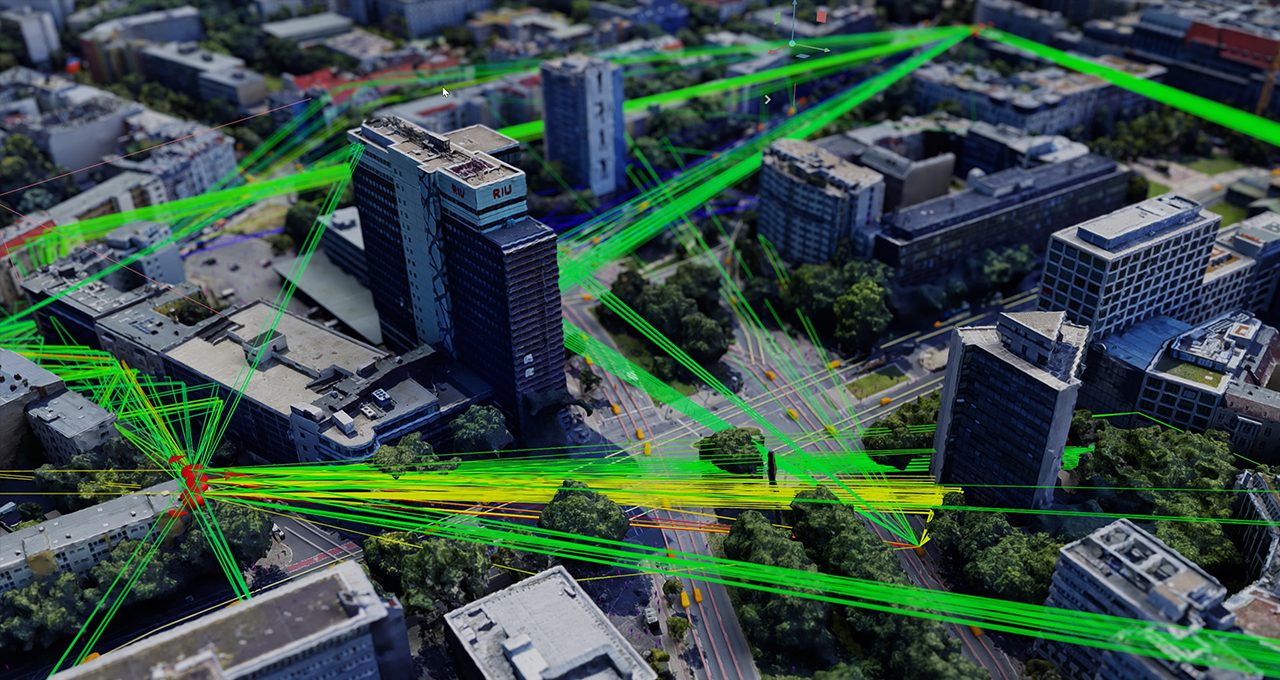
The third pillar, Aerial Omniverse Digital Twin (AODT), tackles the “simulate” stage. It uses NVIDIA’s Omniverse platform to create physically accurate digital twins of wireless networks, ranging from a single cell to entire cities.
AODT provides:
- High‑fidelity RF environments: Using advanced ray‑tracing and real‑world maps, it mimics reflection, diffraction, and scattering at various frequencies, including FR3.
- Real‑time data fabric: RAN software stacks can connect to the digital twin via low‑latency interfaces, creating a closed‑loop simulation where AI models react to realistic RF changes in real time.
- Scenario authoring: Planners can model buildings, vehicles, foliage, user mobility, and even weather to assess how a new site or algorithm will behave before touching physical infrastructure.
For 6G, where new bands and integrated sensing make physical tests expensive and time‑consuming, such a digital twin becomes indispensable. Rather than deploying experimental algorithms on live towers, teams can iterate in the twin, then “fast‑forward” the best candidates into field trials.
4. Hardware Platforms: From Lab to Live Network
AI‑native 6G needs specialized hardware that blurs the line between data center, lab bench, and cell site. NVIDIA’s AI Aerial ecosystem offers several platforms, some of which appear in your second image.
4.1 Sionna Research Kit
The Sionna Research Kit (SRK) is described as a “lab in a box” for AI‑native 6G research:
- Built atop an NVIDIA DGX Spark system with unified GPU/CPU memory.
- Uses OpenAirInterface (OAI) to implement a complete 5G base station and core network in software, running in real time.
- Connects to commercial 5G modems through a software‑defined radio (USRP) front end.
- Fully open source, allowing you to inspect and modify every layer of the telecom stack.
Developers can:
- Prototype algorithms in Sionna,
- Integrate them into the SRK RAN,
- Test performance over the air using real user equipment.
This makes the SRK ideal for universities and R&D labs that want to experiment with next‑generation AI‑RAN without building custom hardware from scratch.
4.2 Aerial Testbed (ARC‑OTA) and ARC‑Pro
For operators and vendors, Aerial Testbed (ARC‑OTA) and the Aerial RAN Computer (ARC) family serve as production‑focused platforms.
- ARC‑OTA combines Aerial CUDA‑Accelerated RAN with OAI L2+ software and a 5G core, running on powerful GPUs such as NVIDIA GH200 or DGX Spark, and connects to radio units over the air. It’s used to validate AI‑RAN solutions end to end.
- ARC‑Pro and related systems are telco‑optimized servers (built around GPUs like Blackwell RTX Pro and networking silicon such as Spectrum‑X and BlueField‑3) designed for deployment at cell sites or aggregation points.
These platforms blur the line between “cloud” and “RAN”:
- They can run both traditional baseband functions and higher‑level AI workloads (such as generative AI for customer services) on the same hardware.
- NVIDIA’s AI‑RAN Orchestrator and Cloud Functions provide the control plane to allocate GPU resources dynamically across workloads.
4.3 Omniverse Digital Twin Infrastructure
On the simulation side, Aerial Omniverse Digital Twin typically runs on:
- RTX or OVX servers,
- or even large clusters like DGX SuperPOD, as shown in your slides.
These deliver the massive GPU horsepower needed to simulate thousands of users, beams, and reflections in real time.
5. Sionna Research Flow: From Python to the Air
5.1 GPU‑Accelerated Differentiable Communication Chains
Within Sionna, a communication system is modeled as:
- Transmitter: encoding → mapping → (optional neural components) → OFDM or other modulation
- Channel: Sionna RT ray‑traced propagation or standard 3GPP models
- Receiver: demodulation → equalization → decoding (which can be classical or neural)
Because every step is differentiable, you can treat the whole chain as a neural network and optimize parameters end to end, either:
- replacing classic blocks (like LMMSE equalizers) with learned counterparts, or
- adding neural “assistants” that correct residual errors.
5.2 Sionna Research Kit workflow
The Sionna Research Kit outlines a two‑side workflow:
- In simulation
- Use Sionna’s link‑level, ray‑tracing, or system‑level components inside Jupyter notebooks.
- Design and train neural models for particular tasks (e.g., channel estimation, resource allocation).
- In the real world
- Compile and deploy those models to the SRK, which acts as a 5G/6G base station.
- Gather real‑world logs and feedback, then feed them back into Sionna for further training.
This closed loop between sim and reality is key for AI‑native 6G, where models must adapt continually to evolving RF conditions.
6. Neural Receivers and AI‑Native RAN
One of the flagship examples NVIDIA showcases is the neural receiver—a 5G NR‑compliant, multi‑user MIMO receiver where several traditional blocks are replaced or augmented by neural networks.
Traditionally, a receiver performs:
- Channel estimation (e.g., least‑squares or MMSE),
- Equalization,
- Demapping and decoding.
In an AI‑native design:
- A neural network learns to perform joint channel estimation and equalization, or even entire “soft‑demapping” directly from raw I/Q samples.
- Gradients are propagated through the Sionna‑modeled channel, which may include ray‑traced multipath profiles or 3GPP channel models.
- The network is trained to minimize bit‑error rate or block‑error rate under realistic conditions (mobility, interference, hardware impairments).
This can yield:
- better performance in highly nonlinear or interference‑dominated environments,
- adaptability to changing spectrum and hardware (since the AI can be retrained),
- potential energy savings (fewer iterations, simpler heuristics).
For IoT devices, improved receiver performance can translate into longer range, lower transmit power, or greater robustness for tiny sensors in harsh environments.
7. Three‑Computer Solution for AI‑Native 6G
A recent NVIDIA technical blog introduces the concept of a “three‑computer solution” for AI‑native 6G development:
- Design & Training Computer
- Typically a DGX or DGX Spark system.
- Runs Sionna, Aerial Framework, and machine‑learning pipelines for model training and algorithm design.
- Simulation Computer
- Runs the Aerial Omniverse Digital Twin.
- Connects to the AI‑RAN stack via low‑latency fabric to provide a physically accurate RF environment.
- Deployment Computer
- An Aerial RAN Computer (ARC) deployed in the field.
- Executes the AI‑enhanced RAN functions in live networks.
This mirrors the modern AI development life cycle:
- Train models on GPU clusters,
- Validate them in high‑fidelity simulations,
- Deploy them with CI/CD pipelines into production.
For 6G and AI‑RAN, this approach allows continuous improvement of the wireless network—a radical shift from the once‑per‑standardization‑cycle upgrades of previous generations.
8. 6G + AI Aerial for IoT and Edge Use Cases
How does all of this relate to IoT and edge developers? Let’s explore some concrete scenarios.
8.1 Industrial IoT and Smart Factories
6G promises deterministic wireless links, integrated sensing, and extreme capacity—ideal for Industry 4.0 environments. Examples:
- Ultra‑reliable wireless for motion control in robotic cells.
- High‑precision positioning to track tools, pallets, and workers with centimeter accuracy.
- RF sensing for safety zones around autonomous vehicles.
With AI Aerial:
- Sionna and AODT can simulate factories, including metallic structures and moving machinery, to test how 6G FR3 signals propagate.
- Engineers can design AI‑based beam management and handover strategies tailored to each facility before deployment.
- On ARC hardware, AI‑RAN functions can prioritize low‑latency traffic from robots while offloading non‑critical telemetry to background slices.
This reduces deployment risk and accelerates ROI for industrial 6G networks.
8.2 Autonomous Vehicles, Drones, and “Physical AI”
The “Physical AI” category—robots, drones, self‑driving cars—demands reaction times below one second, often much lower. 6G can:
- provide high‑bandwidth connectivity for sensor sharing (e.g., LiDAR offload),
- enable cooperative perception between vehicles and roadside units,
- support remote supervision of fleets.
AI Aerial’s digital twin can model entire cityscapes with moving vehicles and pedestrians, letting traffic agencies and telcos test:
- how beamforming and handover algorithms handle dense intersections,
- whether integrated sensing can augment vehicle radars,
- how AI agents can allocate spectrum dynamically as traffic patterns evolve.
8.3 Smart Cities and Infrastructure
Smart lighting, environmental monitoring, connected utilities, and public‑safety cameras all stand to benefit from 6G’s increased capacity and integrated sensing.
Using the Aerial Omniverse Digital Twin, city planners can:
- evaluate optimal 6G site placement to cover both communication and sensing needs,
- test how reflections from new buildings or solar panels impact coverage,
- and design AI‑based energy‑saving schemes.
Furthermore, 6G combined with AI‑native RAN can support network slicing that isolates municipal IoT services from consumer traffic, ensuring reliability during emergencies.
8.4 Healthcare and Telepresence
Remote surgery and augmented‑reality telemedicine require:
- very low end‑to‑end latency,
- extremely reliable connections,
- and potentially integrated sensing to monitor patient vitals.
6G and AI‑RAN can deliver these through:
- dedicated slices optimized for latency,
- AI‑based congestion control and scheduling.
Testing such sensitive scenarios in AODT before real‑world rollout minimizes risk.
8.5 New Classes of IoT Devices
6G’s integrated sensing and AI‑RAN features open possibilities for:
- battery‑less tags that harvest RF energy and rely on network‑side AI for decoding weak backscatter signals,
- environmental twins, where thousands of low‑cost sensors feed into digital models of buildings, rivers, or forests,
- metaverse‑ready wearables streaming high‑resolution audio‑visual data.
By prototyping and simulating device behavior with Sionna and AODT, manufacturers can tune designs for optimal performance before mass production.
9. NVIDIA AI Aerial Ecosystem and the AI‑RAN Stack
6G will not be built by one company alone. NVIDIA is positioning AI Aerial as the foundation of a broad ecosystem:
- The 6G Developer Program already counts over 2,000 members across industry and academia.
- The open‑sourcing of Aerial and Sionna encourages collaboration and transparency.
In October 2025, NVIDIA and several U.S. telecom leaders—including Booz Allen, Cisco, MITRE, ODC, and T‑Mobile—announced an “All‑American AI‑RAN stack” built on AI Aerial to accelerate the path to 6G.
This stack demonstrates early 6G applications such as:
- Multimodal integrated sensing and communications for public safety,
- AI‑driven spectrum agility that senses interference and reconfigures channels automatically,
- new revenue models for operators built around AI services.
For IoT solution providers, this sort of ecosystem means:
- easier access to advanced 6G capabilities via APIs,
- greater interoperability between device, network, and application vendors,
- and a healthier innovation pipeline with open reference stacks to build on.
10. Getting Started: A Practical Path for Developers and Operators
If you’re an IoT developer, telco engineer, or researcher in late 2025, how can you start engaging with 6G and AI Aerial today?
10.1 Join the NVIDIA 6G Developer Program
NVIDIA’s 6G Developer Program provides:
- access to AI Aerial software (Sionna, Aerial Framework, CUDA‑Accelerated RAN, AODT),
- documentation, tutorials, and sample code,
- early access to updates and community forums.
This is the gateway to experimenting with AI‑RAN and digital twins.
10.2 Experiment With Sionna (No Hardware Required)
You can start by installing Sionna on a workstation or cloud GPU and exploring:
- PHY‑layer simulations,
- differentiable ray tracing with Sionna RT,
- neural receiver tutorials and notebooks.
This step helps you grasp how AI can be embedded directly into communication chains.
10.3 Deploy a Sionna Research Kit
For labs and advanced developers, ordering a Sionna Research Kit or building your own equivalent testbed enables real‑time 5G/6G experiments:
- Start with the open‑source instructions (cloning the Sionna RK repo, preparing the system, and launching OAI‑based stacks).
- Connect commercial user devices and try out AI‑enhanced PHY functions.
This environment is ideal to validate concepts like neural receivers, AI‑based scheduling, or federated learning across cells.
10.4 Explore Aerial Omniverse Digital Twin
City planners, industrial operators, and telcos can begin modeling:
- factories or campuses in AODT,
- FR3 propagation characteristics with ray tracing,
- handover and beam‑management algorithms.
Because AODT is being open‑sourced and offered as a service, it will become increasingly accessible even for mid‑sized organizations.
10.5 Plan a 5G‑to‑6G Upgrade Path
Most organizations will not jump straight to 6G. But AI‑native 5G deployments using AI Aerial already provide benefits:
- energy‑efficient scheduling,
- dynamic spectrum sharing,
- AI‑powered anomaly detection.
By deploying AI‑RAN features on current 5G sites—using ARC hardware and Aerial software—operators build the muscle memory and infrastructure that will later extend to 6G bands and use cases.
11. Strategic Considerations for the 6G Era
As you plan your roadmap toward 6G and AI‑native IoT, keep these strategic points in mind.
11.1 Treat the network as a programmable computer
In AI‑native 6G, the RAN is essentially a distributed GPU cluster with radios attached. That means:
- network APIs need to expose not just connectivity, but compute and sensing capabilities,
- orchestration stacks must balance AI workloads with baseband processing,
- developers will think in terms of deploying “RAN apps” (for sensing, optimization, or vertical services).
NVIDIA’s AI‑RAN Orchestrator and Cloud Functions are early examples of such programmability.
11.2 Embrace open ecosystems and open source
With Aerial and Sionna moving under Apache 2.0 licenses, 6G innovation will increasingly happen in the open:
- operators can audit and customize RAN algorithms;
- startups can build specialized AI models for specific verticals;
- academics can reproduce and extend results more easily.
For IoT vendors, aligning with these open stacks increases interoperability and reduces integration friction.
11.3 Prepare for AI governance at radio speed
Embedding AI in the RAN raises new governance questions:
- How do you validate and certify AI models that affect safety‑critical connectivity?
- What monitoring and rollback mechanisms are needed if an AI component misbehaves?
- How do you ensure fairness and neutrality in AI‑driven spectrum sharing?
Borrow practices from MLOps and software engineering:
- automated testing in digital twins,
- staged deployments with canaries,
- anomaly detection on model outputs,
- and strong observability.
AI Aerial’s three‑computer solution and CI/CD‑oriented design provide a viable framework for this governance.
11.4 Link 6G plans to sustainability goals
6G networks must be far more energy‑efficient than earlier generations. AI can help:
- optimize transmit power and beamforming,
- switch off under‑utilized cells,
- choose spectrum dynamically to minimize interference and re‑transmissions.
GPU‑accelerated AI‑RAN initially seems power‑hungry, but when well optimized it can increase spectral efficiency and reduce overall network energy per bit—an essential KPI for regulators and enterprise customers alike.
12. Looking Ahead: 6G as the Nervous System of the AI‑Powered World
By the early 2030s, when 6G standardization matures and commercial deployments ramp up, we can expect:
- IoT and AI to be inseparable: from tiny sensors to autonomous factories, every device will both sense and compute.
- Networks to behave like adaptive organisms: learning from their environment, self‑healing, and optimizing resources in milliseconds.
- Digital twins to precede physical build‑outs: cities, factories, and infrastructures will be designed and stress‑tested in simulation long before cranes arrive on site.
NVIDIA’s AI Aerial platform—spanning Sionna, CUDA‑Accelerated RAN, Omniverse Digital Twin, and the ARC hardware family—is one of the most comprehensive attempts to make this future real. Together with a growing ecosystem of operators, researchers, and vendors, it is laying the software‑defined foundation for AI‑native 6G.
For IoT Worlds readers, the key takeaway is simple:
6G is not “just faster 5G.” It is an AI platform with radios, and now is the time to learn how to build on it.
Start small—explore Sionna, join the 6G Developer Program, prototype a use case in a digital twin. The organizations that begin this journey today will be the ones shaping what 6G actually becomes when the standards catch up.
And when that happens, the Internet of Things will evolve into something bigger: an Internet of Intelligent Things, powered end‑to‑end by AI‑native 6G networks.