

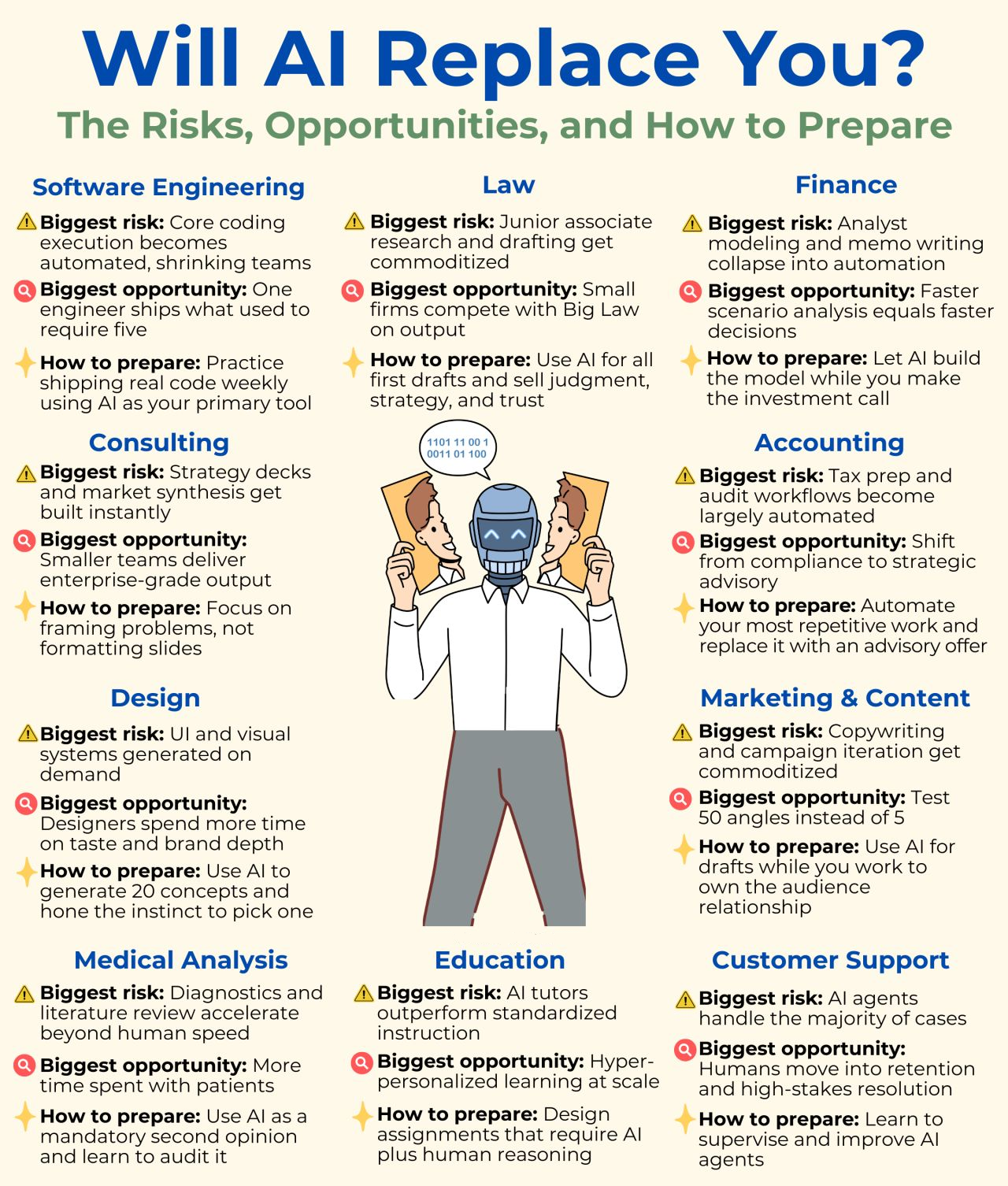
The landscape of work is undergoing a seismic shift, unlike anything we’ve witnessed before. For too long, the conversation around AI and job displacement has been relegated to a distant future, a theoretical “someday.” However, that someday is now, and the impact is already being felt across industries. If your job primarily involves cognitive tasks performed on a screen, consider yourself within the blast radius of this impending transformation. The speed of this change will not be slow, nor will it be uniform.
The recent advancements in AI capabilities, particularly in large language models, have served as a stark wake-up call for many. The leap in performance was not incremental but rather a “threshold moment,” hinting at the profound changes to come. While software engineering has been an early adopter and beneficiary (and casualty) of AI, this phenomenon is rapidly expanding its reach into sectors previously thought insulated. Law, finance, accounting, consulting, marketing, design, healthcare, and education are all now facing their own “wake-up calls.” The key to navigating this era isn’t panic, but proactive preparation. This article will dissect the specific risks and opportunities across various industries and provide actionable strategies to not just survive, but thrive in the age of AI.
The Inevitable Wave: Understanding AI’s Impact on Cognitive Labor
For years, the discourse around AI and employment often involved reassuring predictions about new jobs emerging to offset those lost. While some new roles will undoubtedly arise, the current reality suggests a much more immediate and disruptive transition. The fundamental nature of cognitive labor is being redefined, as AI is increasingly capable of performing tasks that were once exclusively human domains.
AI’s Rapid Ascent: Beyond Software Engineering
The initial visible impact of AI was heavily concentrated in software engineering. This was not a random occurrence; software development, with its structured logic and quantifiable outcomes, proved a fertile ground for early AI applications. However, the subsequent advancements have demonstrated AI’s ability to tackle more nuanced and complex cognitive tasks, moving it beyond the confines of code. The implication is clear: no sector relying heavily on screen-based, cognitive work is entirely immune.
Displacement vs. Replacement: A Crucial Distinction
It’s vital to differentiate between job displacement and outright job replacement. While AI may not fully eliminate every role, it will undoubtedly displace significant portions of existing job functions. This displacement creates competitive pressure, making it harder for individuals and organizations that do not embrace AI to keep pace. The opportunity lies in understanding this gap and leveraging AI to augment human capabilities, rather than fearing outright substitution. We emphasize that “Workers who use AI won’t replace all workers. But workers who use AI will replace workers who don’t.” This highlights the importance of AI tool adoption as the single largest controllable factor in reducing personal risk.
Industry-Specific Transformations: Risks, Opportunities, and Preparation Strategies
The impact of AI will vary by industry, yet a common thread runs through all: the need for humans to adapt, collaborate with AI, and focus on uniquely human skills. Let’s delve into the specifics for several key sectors.
Software Engineering: From Coder to Architect
Software engineering has been at the forefront of AI integration, experiencing both significant upheaval and immense potential.
Biggest Risk: Automated Core Coding Execution
The most immediate risk for software engineers is the automation of core coding execution. AI models are becoming increasingly proficient at generating code, debugging, and even performing complex refactoring. This capability threatens to shrink engineering teams as the output per engineer dramatically increases. The traditional role of a “coder” focused solely on writing lines of code is rapidly evolving.
Biggest Opportunity: The Multiplier Effect
The flip side of this risk is a massive opportunity: one engineer, augmented by AI, can now ship what traditionally required five. AI acts as a powerful co-pilot, accelerating development cycles, improving code quality, and freeing up engineers to focus on higher-level architectural design and problem-solving. This isn’t about replacing engineers but empowering them to achieve unprecedented levels of productivity.
How to Prepare: Master AI as Your Primary Tool
The best way for software engineers to prepare is to embrace AI as their primary tool. This means actively practicing shipping real code weekly, utilizing AI for code generation, testing, and optimization. Learning to prompt effectively, review AI-generated code critically, and integrate AI into your workflow will be paramount. The focus shifts from rote coding to understanding complex systems, designing elegant architectures, and leveraging AI to bring those designs to life efficiently.
Law: Redefining Legal Expertise
The legal profession, traditionally rooted in extensive research and drafting, is ripe for AI-driven transformation.
Biggest Risk: Commoditization of Junior Associate Tasks
Junior associate research and drafting are at high risk of commoditization. AI can rapidly analyze vast legal databases, summarize cases, identify relevant precedents, and even draft initial legal documents with remarkable speed and accuracy. This significantly reduces the need for entry-level tasks that once formed the backbone of a junior lawyer’s training.
Biggest Opportunity: Leveling the Playing Field for Small Firms
Paradoxically, this presents a substantial opportunity for smaller law firms to compete with larger, well-resourced “Big Law” firms on output. By leveraging AI for research and drafting, smaller firms can achieve a similar output volume and quality with significantly fewer resources, offering more competitive services.
How to Prepare: Sell Judgment, Strategy, and Trust
The strategy for lawyers is to use AI for all first drafts. This allows them to spend less time on repetitive tasks and more time on what AI cannot replicate: legal judgment, strategic thinking, client relationships, and building trust. The human element of understanding client needs, navigating complex legal nuances, and presenting persuasive arguments will become even more valuable.
Finance: From Data Cruncher to Strategic Advisor
The finance industry, with its heavy reliance on data analysis and modeling, is also experiencing a profound shift.
Biggest Risk: Automation of Analyst Modeling and Memo Writing
Analyst modeling and memo writing are highly susceptible to automation. AI can process vast amounts of financial data, identify trends, build sophisticated predictive models, and even generate comprehensive reports and memos in a fraction of the time it would take a human. This automation could lead to a reduction in the demand for traditional analyst roles.
Biggest Opportunity: Faster Scenario Analysis, Faster Decisions
The primary opportunity in finance lies in much faster scenario analysis, leading to quicker and more informed decisions. AI can model countless variables and predict outcomes with greater precision, empowering financial professionals to explore more strategies and respond to market changes with agility.
How to Prepare: Focus on Investment Calls, Not Model Building
Financial professionals should leverage AI to build the complex models. Their role then transforms into making the critical investment calls, interpreting the AI’s output, and applying human judgment to mitigate risks and capitalize on opportunities. The focus shifts from the mechanics of data manipulation to the art and science of strategic financial decision-making.
Accounting: From Compliance to Advisory
The accounting profession, often seen as process-driven, is also undergoing a fundamental change.
Biggest Risk: Automation of Tax Prep and Audit Workflows
Tax preparation and audit workflows are significant candidates for automation. AI can rapidly process invoices, reconcile accounts, identify discrepancies, and even flag potential compliance issues. This streamlines much of the repetitive, rule-based work traditionally performed by accountants.
Biggest Opportunity: Shifting to Strategic Advisory
This automation creates a powerful opportunity for accountants to shift from mere compliance to strategic advisory. With routine tasks handled by AI, accountants can dedicate more time to providing high-value insights, forecasting, and business strategy to their clients.
How to Prepare: Automate Repetitive Work, Offer Advisory
Accountants must proactively automate their most repetitive work. This frees them to replace those tasks with advisory offers, positioning themselves as indispensable strategic partners rather than just number crunchers. Developing strong client communication skills, business acumen, and a deep understanding of financial strategy will be paramount.
Consulting: From Slide Deck Creator to Problem Framer
Consulting, a field often characterized by extensive research and presentation creation, is also seeing AI redefine its core activities.
Biggest Risk: Instant Strategy Decks and Market Synthesis
The biggest risk is that strategy decks and market synthesis can now be built almost instantly by AI. AI can rapidly synthesize market data, identify trends, and even generate compelling presentation content. This challenges the traditional consulting model where much of the value was derived from this analytical and presentation creation effort.
Biggest Opportunity: Small Teams Delivering Enterprise-Grade Output
This capability offers a profound opportunity: smaller, agile consulting teams can now deliver enterprise-grade output. By leveraging AI for research, data synthesis, and initial content generation, fewer consultants can achieve the same impact as much larger teams, making high-quality consulting more accessible.
How to Prepare: Frame Problems, Not Format Slides
Consultants should prepare by focusing on framing problems effectively, rather than spending countless hours formatting slides. Their value shifts to understanding organizational challenges, asking the right questions, and guiding clients through complex decision-making processes. AI handles the heavy lifting of data analysis and content presentation, allowing human consultants to focus on strategic insights and client relationships.
Design: Cultivating Taste and Brand Depth
The creative field of design might seem immune to AI, but its analytical and generative capabilities are already making significant inroads.
Biggest Risk: UI and Visual Systems Generated on Demand
The biggest risk for designers is the ability of AI to generate UI (User Interface) and entire visual systems on demand. AI can create countless design variations, layouts, and even entire branding elements based on specifications, reducing the need for manual design iteration.
Biggest Opportunity: Deeper Focus on Taste and Brand
This automation allows designers to spend significantly more time on cultivating taste and understanding brand depth. Instead of laboring over countless variations, designers can focus on the strategic aspects of aesthetics, emotional resonance, and how design truly aligns with brand identity and user experience.
How to Prepare: Hone Your Instinct for Selection
Designers should use AI to generate a multitude of concepts—perhaps 20 or more for a single brief. Their skill then becomes the critical ability to review, select, and refine the best option, honing their instinct and judgment. The role shifts from pure creation to curation, critical evaluation, and strategic refinement.
Medical Analysis: Enhancing Diagnostics and Patient Care
Healthcare, particularly in areas requiring extensive data analysis, is experiencing transformational changes due to AI.
Biggest Risk: Accelerated Diagnostics and Literature Review
The biggest risk lies in AI’s ability to accelerate diagnostics and literature review far beyond human speed. AI can rapidly analyze medical images, patient data, and vast scientific literature to identify patterns and suggest diagnoses or treatment plans, potentially outpacing human diagnosticians.
Biggest Opportunity: More Time Spent with Patients
The immense opportunity is that medical professionals will have more time to spend with patients. By offloading data analysis and literature review to AI, doctors can focus on crucial human aspects of care: empathy, communication, complex decision-making, and building trust.
How to Prepare: Learn to Audit AI as a Second Opinion
Medical professionals should prepare by using AI as a mandatory second opinion. They must learn to audit its suggestions, understand its limitations, and integrate AI’s insights into their diagnostic and treatment processes. This doesn’t replace their expertise but enhances it, making them more effective and precise.
Education: From Standardized Instruction to Personalized Learning
The education sector, striving for effectiveness and personalization, is also embracing AI-driven solutions.
Biggest Risk: AI Tutors Outperforming Standardized Instruction
The biggest risk in education is that AI tutors can outperform standardized instruction. AI can provide personalized learning paths, instant feedback, and adapt to individual student needs in a way that traditional one-size-fits-all teaching often struggles to achieve. This could fundamentally alter the role of the human educator in many contexts.
Biggest Opportunity: Hyper-Personalized Learning at Scale
The massive opportunity for education is hyper-personalized learning at scale. AI can cater to the unique learning styles and paces of millions of students simultaneously, making high-quality, individualized education accessible to a far broader audience.
How to Prepare: Design Assignments Requiring AI Plus Human Reasoning
Educators should prepare by designing assignments that require not just AI, but AI plus human reasoning. This means creating tasks that demand critical thinking, creativity, ethical considerations, and collaborative problem-solving skills that AI alone cannot fully replicate. The educator’s role shifts to guiding complex inquiry and fostering higher-order thinking using AI as a powerful learning tool.
Customer Support: Elevating Human Interaction
Customer support, often a high-volume, repetitive task, is seeing AI revolutionize its efficiency and scope.
Biggest Risk: AI Agents Handling Majority of Cases
The biggest risk is that AI agents will increasingly handle the majority of customer support cases. With advancements in natural language processing and understanding, AI can resolve common queries, troubleshoot issues, and guide customers through processes efficiently, reducing the need for human intervention for routine interactions.
Biggest Opportunity: Humans Focus on Retention and High-Stakes Resolution
This shift presents a significant opportunity: human customer support personnel can move into roles focused on retention and high-stakes resolution. Complex problems, emotionally charged situations, and strategic customer relationships will become the domain of human agents, elevating the value of their interpersonal and problem-solving skills.
How to Prepare: Supervise and Improve AI Agents
Customer support professionals should prepare by learning to supervise and improve AI agents. This involves understanding how AI handles various scenarios, training AI models with new information, and stepping in for complex cases. The role evolves into a hybrid of AI management and advanced human escalation, ensuring a seamless and effective customer experience.
The Broader Implications: A Societal Shift
The patterns observed across these industries paint a clear picture of a broader societal shift. AI is not just changing individual jobs; it’s reshaping the fundamental structure of work itself. This “Great Remaking,” as Mario Thomas describes it, is not merely the next wave of technological progress; it’s a qualitatively different transformation that impacts how organizations think, decide, create, and deliver.
Beyond Prediction: A Lived Reality
As noted by David Priede, the AI “threat” is no longer a prediction; it’s a lived reality for professionals whose core skills are already being automated. The value of cognitive labor is collapsing, turning it into an abundant, cheap utility. The human advantage now lies in imagination, judgment, and courage—qualities that many traditional organizational structures are not designed to foster.
The Accelerating Pace of Change
Joseph Logan’s analysis suggests that AI-driven job elimination is accelerating now, with the trend indicating widespread job loss and a pause in the creation of new roles. While this may sound grim, he maintains an optimistic view, seeing this as a necessary reset that will ultimately benefit both individuals and businesses. The crucial takeaway is the need for speed in adaptation. Those who experiment early become multipliers; those who wait become observers.
Generative Engine Optimization (GEO): A New Frontier for Visibility
As AI transforms how information is accessed and consumed, new strategies for visibility emerge. Traditional SEO (Search Engine Optimization) focused on ranking websites on search result pages. However, with the rise of AI search engines like OpenAI’s ChatGPT and Perplexity AI, the focus shifts to Generative Engine Optimization (GEO).
What is GEO?
GEO is about optimizing content so AI search engines can understand it and use it in their direct, AI-generated answers. When an AI tool provides a clear answer to a user’s question, if your content is well-optimized for GEO, your information (and potentially your brand) can be directly integrated into that answer. This leads to increased brand trust, visibility, and traffic, even if users don’t directly click your link.
Why GEO Matters Now
AI search engines are more advanced, understanding user intent, context, and natural language far better than traditional keyword-focused search engines. They prioritize meaning, clear explanations, and helpful content. For businesses, this means crafting content that is not only keyword-rich but also genuinely informative, well-structured, and directly answers potential user questions. This ensures your expertise is recognized and utilized by AI aggregators, maintaining your presence in the evolving search landscape.
Strategies for Personal and Professional Resilience
The overarching theme for navigating this era is not fear, but adaptation and augmentation. The following principles apply across all professions.
Embrace Continuous Learning and Skill Development
The half-life of skills is shrinking. What was relevant yesterday may be obsolete tomorrow. A commitment to continuous learning, particularly in AI tools and their application to your field, is no longer optional but essential. Seek out courses, workshops, and practical projects that allow you to experiment with AI and understand its capabilities firsthand. We identifie AI tool adoption as the most significant factor in reducing displacement risk.
Cultivate Uniquely Human Skills
While AI excels at cognitive tasks, many uniquely human skills remain beyond its current capabilities. These include:
- Creativity and Innovation: Generating novel ideas, artistic expression, and unconventional solutions.
- Critical Thinking and Judgment: Evaluating complex situations, making nuanced decisions, and applying ethical considerations.
- Emotional Intelligence and Empathy: Understanding and responding to human emotions, building rapport, and fostering strong relationships.
- Complex Problem Solving: Addressing ill-defined problems that require interdisciplinary approaches and abstract reasoning.
- Strategic Thinking: Vision casting, long-term planning, and understanding systemic interdependencies.
Focus on developing and showcasing these skills, as they will become increasingly valuable in an AI-augmented workforce.
Become an AI-Augmented Worker
The goal isn’t to compete against AI, but to collaborate with it. Position yourself as an “AI-augmented worker”—someone who understands how to leverage AI to enhance their productivity, creativity, and decision-making. This means:
- Learning to Prompt Effectively: AI is a tool, and like any tool, its effectiveness depends on the user’s skill. Master the art of crafting clear, precise, and contextual prompts to get the best results from AI models.
- Auditing AI Output: Develop a critical eye for reviewing AI-generated content, code, or analysis. Understand its limitations, biases, and potential inaccuracies. Your expertise will be in validating and refining AI’s work.
- Integrating AI into Workflows: Identify opportunities to embed AI tools directly into your daily tasks, streamlining processes and automating mundane elements.
Understand Your Specific Risk and Opportunity Profile
Taking a personalized approach to assessing your risk and identifying opportunities is crucial. This involves:
- Analyzing Your Current Role: Break down your job into its constituent tasks. Which parts are repetitive, rule-based, and performed on a screen? These are prime candidates for AI automation.
- Identifying High-Value Human Tasks: What aspects of your job require creativity, emotional intelligence, strategic thinking, or complex problem-solving? These are your areas of growth.
- Exploring Industry-Specific AI Applications: Research how AI is being applied in your specific industry. Are there emerging tools or platforms that could enhance your capabilities?
The Portfolio Career and Labor Elasticity
The concept of a “portfolio career,” where individuals take on multiple roles or projects simultaneously, and “labor elasticity,” the ability to adapt to changing job demands, are becoming dominant themes. This means diversifying your skill set, building a strong professional network, and being prepared to pivot to new opportunities as industries evolve. The future workforce will value adaptability and multi-faceted expertise.
The Time to Act is Now
This isn’t a message designed to instill panic, but rather a strategic call to action. The opportunity to position yourself at the forefront of this AI revolution is available right now. The choices you make today—to experiment, to learn, and to adapt—will determine your trajectory in the coming years. Those who embrace AI as a powerful co-pilot will find themselves empowered, becoming multipliers of their own capabilities. Those who delay risk becoming mere observers, caught in the wake of an irreversible transformation.
The future of work is not about humans versus machines; it’s about humans with machines. By proactively engaging with AI, understanding its nuances, and focusing on the uniquely human attributes that it cannot replicate, you can not only secure your professional future but also unlock unprecedented levels of productivity and innovation.
Is your organization ready to navigate the complexities of AI integration and harness its transformative power?
At IoT Worlds, we specialize in guiding businesses through these seismic shifts. Whether you need assistance in understanding your AI displacement risk, implementing cutting-edge AI solutions, or developing strategies to train your workforce for an AI-augmented future, our experts are here to help. Don’t be an observer in this “Great Remaking.” Partner with us to turn the risks of AI into unparalleled opportunities for growth and innovation.
To learn more about how IoT Worlds can empower your business in the age of AI, email us today:
