

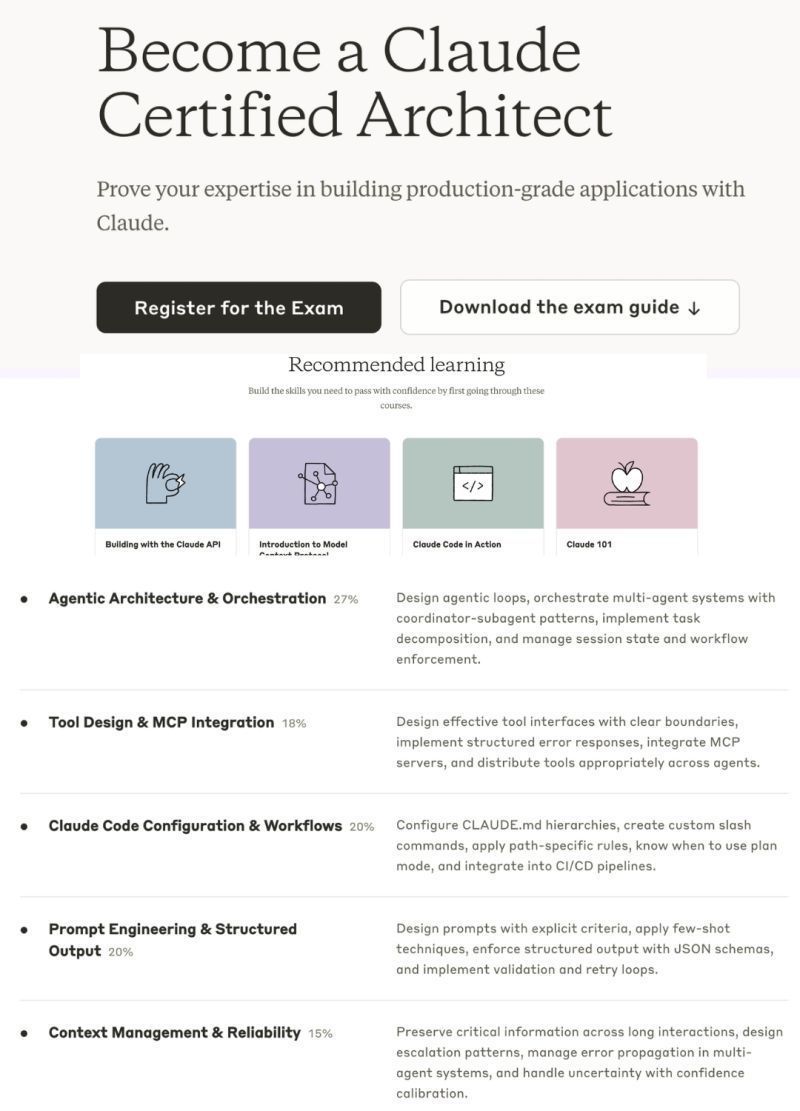
The artificial intelligence landscape is evolving at an unprecedented pace, and with that evolution comes a pressing need for validated expertise. Anthropic, a leader in AI safety and development, has stepped up to meet this demand with the launch of its first official AI certification: the Claude Certified Architect (CCA). This certification, launched on March 12, 2026, marks a significant milestone for the industry, providing a rigorous benchmark for professionals aiming to build production-grade applications with Claude.
In a world increasingly driven by AI, the ability to effectively design, develop, and deploy intelligent systems is becoming a core competency for architects and engineers. The CCA credential is more than just a badge; it’s a testament to a deep understanding of Anthropic’s Claude AI, encompassing everything from advanced architectural patterns to crucial considerations for reliability and ethical AI development. This article will delve into every facet of the Claude Certified Architect certification, equipping you with a comprehensive understanding of its importance, what it covers, and why it’s poised to become a gold standard in the AI community.
The Genesis of a New Standard: Why AI Certification Now?
The proliferation of AI technologies, particularly large language models like Claude, has opened up new frontiers for innovation across every sector. From automating complex workflows to enhancing customer experiences and driving data-driven insights, the potential of AI is immense. However, realizing this potential requires a skilled workforce capable of navigating the intricacies of AI system design and implementation.
As with any nascent but rapidly maturing technology, a gap can emerge between the theoretical understanding of AI and its practical application in real-world scenarios. This gap is precisely what certifications like the Claude Certified Architect aim to bridge. They provide a structured framework for validating an individual’s ability to not just understand AI concepts, but to apply them effectively to solve complex business problems.
The Need for Production-Grade Expertise
Building AI applications in a laboratory setting differs significantly from deploying them in production environments. Production applications demand robustness, scalability, security, and a keen understanding of how AI systems interact with existing infrastructure and data pipelines. The CCA focuses explicitly on validating “real production architecture decisions,” indicating a shift in the industry towards practical, deployment-ready AI skills.
This emphasis reflects a broader trend where organizations are moving beyond experimental AI projects to integrate AI deeply into their core operations. Such integration necessitates architects who can design systems that are not only intelligent but also reliable, maintainable, and ethically sound.
Anthropic’s Commitment to Responsible AI
Anthropic’s mission is deeply rooted in the development of safe and beneficial AI. This commitment is reflected in the design of the CCA, which undoubtedly incorporates principles of responsible AI development throughout its curriculum. While the specific ethical components are not explicitly listed in the provided topic, it’s reasonable to infer that the certification implicitly encourages architects to consider the societal impact, fairness, and transparency of the AI systems they build. This aligns with Anthropic’s overarching philosophy of developing AI that is helpful, harmless, and honest.
Deconstructing the Claude Certified Architect: What You Need to Know
The Claude Certified Architect (CCA) is a proctored, 60-question exam designed to rigorously test a candidate’s practical expertise. It’s not merely a test of memorization but an assessment of the foundational knowledge and architectural acumen required to build sophisticated AI applications using Claude.
The exam is structured around five core domains, each weighted to reflect its importance in the overall architecture of Claude-powered systems. Understanding these domains is paramount for anyone aspiring to achieve this certification.
1. Agentic Architecture & Orchestration (27%)
This domain constitutes the largest portion of the exam, a clear indicator of Anthropic’s vision for the future of AI. “Agentic architecture” refers to the design of AI systems that are composed of multiple, interacting agents, each with specific roles and responsibilities. These agents work collaboratively to achieve a larger goal, often mimicking complex human organizational structures.
The Rise of AI Agents
The concept of AI agents is gaining significant traction because it allows for the creation of more modular, resilient, and sophisticated AI systems. Instead of a monolithic AI model attempting to perform all tasks, an agentic system breaks down complex problems into smaller, more manageable sub-problems, with specialized AI agents handling each part.
Key aspects within this domain include:
- Designing agentic loops: This involves creating iterative processes where agents can continuously gather information, make decisions, take actions, and receive feedback, leading to refined outcomes.
- Orchestrating multi-agent systems with coordinator-subagent patterns: This speaks to the hierarchical organization of agents, where a primary “coordinator” agent delegates tasks to specialized “subagents” and integrates their outputs. This pattern is crucial for managing complexity and ensuring efficient task distribution.
- Implementing task decomposition: The ability to break down a large, ambiguous task into a series of smaller, well-defined tasks that can be individually addressed by agents.
- Managing session state: In multi-turn interactions or long-running processes, maintaining context and state across multiple agent interactions is critical for coherent and effective system behavior.
- Workflow enforcement: Ensuring that agents adhere to predefined rules, sequences, and constraints within a given workflow to guarantee predictable and reliable operations.
The prominence of agentic architecture in the CCA syllabus signals a significant shift in AI development. It suggests that the industry is moving beyond single-shot AI models towards more dynamic, autonomous, and interconnected AI systems. For any aspiring Claude Certified Architect, a deep understanding of designing, building, and managing these multi-agent ecosystems is non-negotiable.
2. Tool Design & MCP Integration (18%)
AI models, particularly large language models, are powerful, but their capabilities are amplified significantly when they can interact with external tools and systems. This domain focuses on the design and integration of such tools, enabling Claude to extend its functionalities beyond its internal knowledge base.
The Power of Tooling
Tools allow AI models to perform actions in the real world, retrieve up-to-date information, execute code, interact with databases, and connect with other APIs. This effectively turns a language model into a highly intelligent control plane for a vast array of digital functionalities.
Key areas covered include:
- Designing effective tool interfaces with clear boundaries: This involves defining precise specifications for how Claude can interact with external tools, ensuring unambiguous inputs and outputs, and minimizing potential errors.
- Implementing structured error responses: When tools encounter errors, Claude needs to be able to interpret these errors accurately and respond appropriately, whether by retrying the operation, seeking clarification, or escalating the issue.
- Integrating MCP servers: While “MCP” is not immediately obvious without further context, it likely refers to a specific type of server or framework that facilitates communication and data exchange between Claude and external tools. This could involve message queuing protocols, API gateways, or specialized microservices. The focus here is on seamless and robust integration.
- Distributing tools appropriately across agents: In an agentic architecture, different agents might require access to different sets of tools depending on their specialized functions. This aspect of the domain addresses how to effectively manage and distribute tool access to optimize agent performance and security.
Mastery of tool design and integration is crucial for building AI applications that are not just intelligent but also highly functional and capable of real-world interaction. It transforms Claude from a conversational engine into a comprehensive action-oriented system.
3. Claude Code Configuration & Workflows (20%)
This domain dives into the practical aspects of working with Claude’s underlying code and integrating it within development workflows. It emphasizes the operational side of AI development, ensuring that Claude applications are robust, maintainable, and fit seamlessly into existing software engineering practices.
Code as the Canvas for AI
For AI architects, understanding how to configure and manage the code that powers Claude applications is as important as understanding the models themselves. This domain covers:
- Configuring
CLAUDE.mdhierarchies: This suggests a specific markdown-based configuration system used by Anthropic, likely for defining agent behaviors, tool specifications, or prompt templates. Understanding its structure and how to effectively manage these hierarchies is essential for organizing complex Claude applications. - Creating custom slash commands: Slash commands provide a concise way to invoke specific actions or functionalities within a Claude interaction. Architecting and implementing these custom commands enhances user experience and streamlines interactions.
- Applying path-specific rules: This refers to defining rules or policies that apply to specific execution paths or decision branches within a Claude workflow. This ensures that the AI adheres to predefined logic and constraints under different circumstances.
- Knowing when to use plan mode: “Plan mode” likely refers to a specific operational mode within Claude or its associated tools where the AI is tasked with generating a sequence of actions or a plan to achieve a goal. Architects need to understand when and how to leverage this mode effectively.
- Integrating into CI/CD pipelines: Continuous Integration and Continuous Deployment (CI/CD) are cornerstones of modern software development. This aspect emphasizes the ability to integrate Claude application development, testing, and deployment into automated CI/CD pipelines, ensuring rapid and reliable delivery of updates and new features.
This domain highlights the importance of treating AI development as a software engineering discipline. It underscores the need for architects to possess strong coding skills and an understanding of modern DevOps practices to build scalable and maintainable Claude applications.
4. Prompt Engineering & Structured Output (20%)
Prompt engineering has emerged as a critical skill in the age of large language models. This domain explicitly recognizes its importance, focusing on the art and science of crafting effective prompts to elicit desired responses from Claude, particularly in producing structured, machine-readable output.
The Art and Science of Prompting
The way a question is phrased or a task is presented to an AI model can dramatically impact its output quality and relevance. Prompt engineering is not just about writing clear instructions; it’s about understanding the model’s capabilities, limitations, and how to effectively guide its generative process.
Key topics include:
- Designing prompts with explicit criteria: This involves incorporating clear, unambiguous instructions and constraints within the prompt to guide Claude towards specific types of responses or outcomes.
- Applying few-shot techniques: Few-shot learning involves providing the model with a few examples of desired input-output pairs within the prompt itself. This helps the model quickly adapt to new tasks or output formats without extensive retraining.
- Enforcing structured output with JSON schemas: For many AI applications, the output needs to be in a machine-readable format, such as JSON, to be easily parsed and processed by other systems. This involves designing prompts that explicitly instruct Claude to generate JSON output conforming to a predefined schema.
- Implementing validation and retry loops: Even with well-engineered prompts, AI models can sometimes generate suboptimal or invalid output. This aspect covers strategies for validating Claude’s output against expected formats or conditions and implementing retry mechanisms to guide the model towards correct responses.
This domain is crucial for ensuring that Claude applications can seamlessly integrate with other software components and deliver predictable, usable results. It emphasizes the transition from natural language generation to precise data generation.
5. Context Management & Reliability (15%)
Building reliable and trustworthy AI systems requires careful consideration of how context is managed and how the system behaves under various conditions, especially in the face of uncertainty or errors. This domain focuses on these critical aspects, ensuring Claude applications are robust and predictable.
The Pillars of Trustworthy AI
Reliability in AI systems encompasses aspects like error handling, consistent performance, and the ability to maintain context over prolonged interactions.
Key considerations include:
- Preserving critical information across long interactions: In multi-turn conversations or extended processes, Claude needs to remember crucial details from previous interactions to maintain coherence and relevance. This involves strategies for managing the “memory” of the AI system.
- Designing escalation patterns: When an AI system encounters a situation it cannot resolve (e.g., an unanswerable question, a critical error), appropriate escalation mechanisms are needed to inform human operators or trigger alternative processes.
- Managing error propagation in multi-agent systems: In intricately connected agentic architectures, an error in one agent can potentially propagate and affect others. This domain addresses strategies for containing errors and preventing system-wide failures.
- Handling uncertainty with confidence calibration: AI models often provide responses with varying degrees of certainty. This involves understanding how to interpret and act upon these confidence levels, perhaps by seeking human verification for low-confidence assertions or adjusting system behavior accordingly.
This domain underscores the importance of designing AI systems that are not only intelligent but also resilient, transparent, and capable of operating reliably in complex, dynamic environments.
The Industry’s Direction: Agentic Architecture Leads the Way
The weighting of these domains offers a compelling insight into “exactly where the industry is heading.” With 27% dedicated to Agentic Architecture & Orchestration, Anthropic is signaling a strong belief that the future of advanced AI systems lies in distributed, cooperative, and highly organized intelligent agents.
This shift moves beyond the current paradigm of single-model interactions towards a more sophisticated framework where AI systems can:
- Perform complex, multi-step tasks: By breaking down problems for specialized agents.
- Adapt to dynamic environments: Through iterative feedback loops and agent coordination.
- Achieve greater autonomy: As agents can independently execute sub-tasks and make localized decisions.
- Scale more effectively: By distributing computational load and responsibilities across multiple agents.
For professionals working with AI, especially those in architectural or engineering roles, investing in a deep understanding of agentic systems will be crucial for staying ahead of the curve. The CCA provides a formal pathway to validate this critical skill set, setting a new benchmark for excellence in AI application design.
How to Access the Claude Certified Architect Program
Anthropic has made the CCA program accessible through a two-pronged approach, catering to both learning and assessment needs:
Prep Courses: Free for Everyone on Anthropic Academy
Anthropic is committed to fostering AI talent development. To support aspiring Claude Certified Architects, they offer free prep courses through the Anthropic Academy. This is a significant advantage, as it democratizes access to high-quality learning materials necessary to prepare for the rigorous certification exam.
These prep courses likely cover the theoretical foundations and practical applications related to each of the five core domains. They will empower individuals worldwide to acquire the knowledge and skills needed, regardless of their financial resources, aligning with Anthropic’s mission to make advanced AI accessible and beneficial.
Exam: Free Via the Claude Partner Network
While the prep courses are universally accessible, the exam itself is offered for free through the Claude Partner Network. This is a strategic move by Anthropic.
The Claude Partner Network Advantage
Organizations can join the Claude Partner Network, enabling their employees or associates to take the CCA exam at no cost. This provides several benefits:
- For Organizations: It allows companies to upskill their workforce in Claude AI at a reduced cost, ensuring they have certified experts capable of building cutting-edge AI solutions. It also fosters a deeper engagement with Anthropic’s ecosystem.
- For Individuals: It provides a pathway to a free certification, removing a significant financial barrier to professional development in a high-demand field. This encourages broader participation and accelerates the growth of the Claude developer community.
The combination of free prep courses and free exam access through the partner network demonstrates Anthropic’s commitment to building a robust ecosystem of skilled professionals who can effectively leverage Claude to drive innovation. This approach is likely to accelerate the adoption of Claude AI across various industries and applications.
The Strategic Importance of the Claude Certified Architect Credential
For individuals and organizations alike, the Claude Certified Architect certification holds immense strategic importance in the rapidly evolving AI landscape.
For Individuals: Elevating Your AI Career
- Validated Expertise: The CCA serves as a formal validation of your skills in building production-grade AI applications with Claude. This distinguishes you in a competitive job market.
- Career Advancement: Holding an official certification from a leading AI research organization like Anthropic can open doors to new career opportunities, promotions, and higher earning potential.
- Industry Recognition: It signifies your commitment to professional development and mastery of cutting-edge AI technologies, earning you recognition among peers and employers.
- Confidence in Building with Claude: The preparation process and successful completion of the exam will equip you with the practical knowledge and confidence to tackle complex AI projects.
- Staying Current: Given the rapid pace of AI innovation, certifications like the CCA ensure that your skills remain relevant and aligned with the latest industry best practices and Anthropic’s evolving capabilities.
For Organizations: Building a Future-Ready AI Workforce
- Mitigating Risk: Certified architects are better equipped to design robust, reliable, and secure AI applications, reducing the risks associated with deploying complex AI systems in production.
- Accelerating Innovation: A team of certified experts can more efficiently develop and deploy innovative AI solutions, driving business growth and competitive advantage.
- Ensuring Quality and Best Practices: The certification ensures that your team adheres to Anthropic’s recommended best practices for building with Claude, leading to higher quality and more maintainable AI applications.
- Strategic Partnerships: For organizations within the Claude Partner Network, having certified architects deepens their strategic relationship with Anthropic, potentially leading to preferential access to new features, support, and collaboration opportunities.
- Recruitment and Retention: Offering pathways to certifications like the CCA can be a powerful tool for attracting and retaining top AI talent, demonstrating a commitment to employee growth and cutting-edge technology.
- Interoperability and Standardization: As more organizations adopt Claude, a standardized certification promotes a common understanding of architectural principles, fostering better collaboration and interoperability across the ecosystem.
Looking Ahead: The Evolution of AI Architecture with Claude
The launch of the Claude Certified Architect certification is not merely about assessing current skills; it’s about shaping the future of AI architecture. By emphasizing agentic systems, robust tool integration, code best practices, meticulous prompt engineering, and unwavering reliability, Anthropic is setting a clear direction for how advanced AI applications should be designed and built.
As AI models become more capable and complex, the role of the AI architect will become increasingly critical. These architects will be responsible for:
- Designing sophisticated multi-agent systems: Orchestrating numerous AI agents to collectively solve problems far beyond the scope of a single model.
- Integrating AI seamlessly into diverse ecosystems: Connecting Claude with a wide array of external tools, databases, and enterprise systems.
- Ensuring ethical and responsible AI development: Building systems that are fair, transparent, and aligned with human values.
- Optimizing for performance and scalability: Designing AI architectures that can handle increasing data volumes and user demands efficiently.
- Guiding the evolution of AI applications: Staying abreast of new breakthroughs and integrating them into existing and future systems.
The CCA will likely evolve over time, potentially introducing advanced levels or specialized certifications as the capabilities of Claude and the AI landscape continue to expand. This foundational certification is just the beginning, providing a solid stepping stone for professionals to grow alongside the advancements in AI.
Conclusion: Seizing the Opportunity in the AI Era
The launch of the Claude Certified Architect certification by Anthropic unequivocally marks a new era in professional AI development. It serves as a beacon for individuals seeking to validate their expertise and for organizations striving to build cutting-edge, reliable, and responsible AI applications. In a world where AI is rapidly transforming industries, possessing a certification like the CCA will not just be an advantage but a necessity for those who wish to lead the charge.
The certification’s focus on agentic architecture, tool integration, and practical deployments highlights a clear industry trend: AI is moving beyond the theoretical into the realm of robust, production-ready systems. Anthropic’s thoughtful approach to providing free prep courses and offering the exam via its Partner Network ensures that this critical knowledge and validation are accessible to a broad audience, fostering a vibrant and skilled community around Claude.
Investing in this certification is investing in your future and the future of your organization in the AI-powered world. It’s an opportunity to solidify your understanding of advanced AI concepts, demonstrate your practical skills, and position yourself at the forefront of this transformative technology.
Ready to transform your business with cutting-edge AI solutions and expert guidance?
At IoT Worlds, we specialize in helping businesses navigate the complexities of AI, from strategic planning to robust implementation. Whether you’re looking to leverage the power of Claude AI, build sophisticated agentic systems, or optimize your data strategies, our team of experts is here to assist.
Don’t let the future of AI pass you by. Contact us today to explore how we can help you achieve your AI ambitions. Send an email to info@iotworlds.com and let’s start a conversation about empowering your enterprise with intelligent solutions.
