

The relentless march of urbanization presents both unprecedented opportunities and formidable challenges. As metropolises swell, so too does the complexity of managing their intricate ecosystems – from traffic flow and resource distribution to public safety and environmental sustainability. In this era of rapid evolution, smart cities have emerged as a beacon of hope, leveraging advanced technologies to foster efficiency, livability, and resilience. At the heart of this transformation lies an innovation that is rapidly reshaping how we understand, interact with, and optimize our urban environments: the Digital Twin.
The Dawn of Digital Twins in Urban Landscapes
A Digital Twin isn’t merely a static 3D model of a city; it’s a dynamic, real-time virtual replica of physical infrastructure, systems, and processes. Powered by the Internet of Things (IoT), an intricate web of sensors, and sophisticated data analytics, these digital counterparts mirror the real world with astonishing fidelity. They allow city planners, operators, and decision-makers to continuously monitor, analyze, simulate, and ultimately optimize urban systems before real-world interventions are implemented. This paradigm shift from reactive management to proactive foresight is profound, empowering cities to become more adaptable, sustainable, and responsive to the needs of their inhabitants.
Defining the Digital Twin for Smart Cities
At its core, a smart city Digital Twin is a continuously evolving, data-rich representation of an urban space. It integrates information from countless sources, including:
- Environmental Sensors: Tracking air quality, temperature, humidity, noise levels, and other ecological parameters.
- Infrastructure Monitoring: Gauging the performance and structural integrity of bridges, roads, buildings, and utilities.
- Traffic and Transportation Data: Collecting real-time information on vehicle movement, public transit occupancy, and pedestrian flows.
- Utility Networks: Monitoring water pipelines, energy grids, and waste management systems.
- Human Activity Data: Aggregating anonymous data on population density and movement patterns to understand urban dynamics.
This deluge of real-time data is then ingested into sophisticated analytical platforms, often leveraging artificial intelligence (AI) and machine learning (ML), to create a living, breathing digital counterpart of the city.
The Fundamental Components of a Smart City Digital Twin
Building an effective Digital Twin for a smart city requires a synergistic integration of several key elements:
- Physical Assets & Systems: This encompasses everything from individual buildings and traffic lights to entire transportation networks and utility grids.
- Sensors & IoT Devices: These are the eyes and ears of the Digital Twin, continuously collecting real-time data from the physical world. The denser and more diverse the sensor network, the more accurate and comprehensive the Digital Twin becomes.
- Data Connectivity: Robust and reliable communication networks (5G, fiber optics, LPWAN) are essential to transmit the vast quantities of data from sensors to the digital platform.
- Data Platform & Analytics: This is where the magic happens. A powerful cloud-based or edge computing platform houses and processes the incoming data, applying advanced analytics, AI, and ML algorithms to derive insights, predict outcomes, and generate actionable intelligence.
- Virtual Modeling & Simulation: Advanced 3D modeling and simulation tools create the visual and functional representation of the city, allowing users to interact with the Digital Twin, run scenarios, and visualize the impact of potential decisions.
- User Interface & Visualization: Intuitive dashboards, augmented reality (AR) interfaces, and virtual reality (VR) environments enable city officials, planners, and even citizens to access and understand the complex information presented by the Digital Twin.
Why Digital Twins Matter in Smart City Projects: Unlocking Unprecedented Value
The transformative power of Digital Twins in smart cities stems from their ability to provide a comprehensive, real-time, and predictive view of urban operations. This leads to a myriad of tangible benefits that directly address the core challenges of modern city management.
Real-time Monitoring of City Infrastructure
Traditional infrastructure management often relies on periodic inspections and reactive maintenance. Digital Twins revolutionize this process by enabling continuous, real-time monitoring of critical assets. Sensors embedded in bridges, roads, public buildings, and utility networks constantly feed data into the Digital Twin, providing an up-to-the-minute status report on their condition and performance.
Enhanced Situational Awareness
City operators gain an unparalleled level of situational awareness. They can instantly visualize the status of any piece of infrastructure, identify anomalies, and understand interdependencies between different systems. For example, a sudden drop in water pressure in one part of the city might be instantly linked to a detected leak in a specific pipeline section.
Proactive Problem Identification
Instead of waiting for a system failure to occur, Digital Twins allow for proactive identification of potential issues. Subtle changes in vibration patterns in a bridge or gradual pressure drops in a water pipe can signal nascent problems, enabling early intervention before they escalate into major disruptions.
Predictive Maintenance to Reduce Failures
One of the most significant advantages of Digital Twins is their ability to enable predictive maintenance. By analyzing historical data, current sensor readings, and applying machine learning algorithms, the Digital Twin can forecast when specific assets are likely to fail.
Optimized Maintenance Schedules
This predictive capability allows city maintenance teams to move away from rigid, time-based maintenance schedules to more efficient, condition-based strategies. Resources can be deployed precisely where and when they are needed most, optimizing labor, equipment, and material costs.
Minimizing Downtime and Service Disruptions
By addressing potential failures before they happen, Digital Twins significantly reduce unexpected downtime and service disruptions. This translates into smoother city operations, fewer inconveniences for citizens, and sustained levels of critical services. Imagine preventing a major power outage or a water main burst before it impacts thousands of residents.
Data-driven Decision Making
In a smart city, data is the new currency. Digital Twins aggregate and contextualize vast amounts of urban data, transforming raw information into actionable intelligence that underpins robust decision-making.
Evidence-Based Policy Formulation
City planners and policymakers can leverage the insights from the Digital Twin to formulate evidence-based policies. Whether it’s planning new transportation routes, allocating resources for public safety, or developing environmental protection measures, decisions are no longer based on assumptions but on real-time data and predictive models.
Stakeholder Collaboration and Transparency
Digital Twins can serve as a common operational picture for multiple city departments and stakeholders. This centralized data source fosters better collaboration, breaks down departmental silos, and enhances transparency in urban management processes.
Cost Optimization and Efficiency Improvement
The intelligent insights provided by Digital Twins directly translate into significant cost savings and efficiency improvements across various city operations.
Resource Allocation Optimization
From energy consumption in public buildings to the deployment of waste management vehicles, Digital Twins help optimize resource allocation. By understanding actual demand and operational patterns, cities can avoid overspending and ensure resources are utilized effectively.
Reduced Operational Expenses
Predictive maintenance reduces the costs associated with emergency repairs and catastrophic failures. Optimized traffic management reduces fuel consumption and wear-and-tear on vehicles. Energy optimization lowers utility bills for public infrastructure. These efficiencies collectively lead to substantial reductions in overall operational expenses.
Enhanced Return on Investment (ROI) for Smart City Initiatives
By demonstrating clear and measurable improvements in efficiency, sustainability, and livability, Digital Twins help justify investments in smart city technologies, ensuring a stronger return on investment for innovative urban development projects.
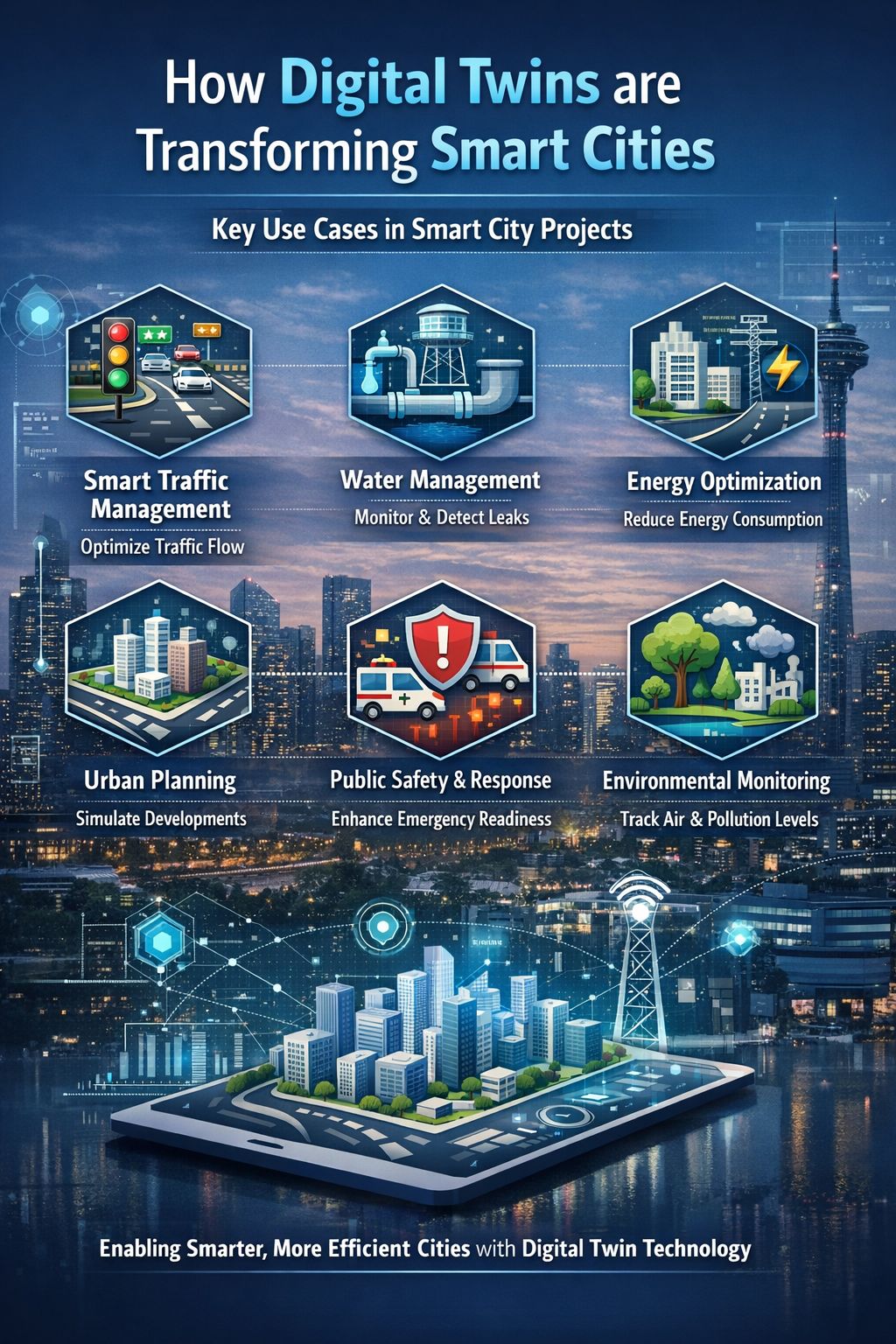
Key Use Cases in Smart Cities: Bringing Digital Twins to Life
The versatility of Digital Twins allows for their application across a wide spectrum of urban challenges, each yielding substantial benefits.
Smart Traffic Management
Urban mobility is a perpetual headache for many cities. Congestion, pollution, and inefficient public transport systems plague daily life. Digital Twins offer a powerful solution to these multifaceted problems.
Simulating Traffic Flow and Optimizing Signal Timing
A traffic management Digital Twin integrates real-time data from traffic cameras, inductive loops, GPS trackers in public transit, and even aggregated anonymous data from mobile devices. This data feeds into a virtual model of the city’s road network, allowing for dynamic simulation of traffic flow under various conditions. City operators can then test different signal timing strategies or rerouting plans in the Digital Twin to identify the most effective solutions for reducing congestion.
Predictive Modeling for Traffic Events
Beyond real-time optimization, these Digital Twins can predict traffic conditions based on historical patterns, weather forecasts, and upcoming events. This enables proactive measures, such as adjusting traffic light sequences in anticipation of a major sports event or an unexpected road closure.
Intersection with Autonomous Vehicles
As autonomous vehicles become more prevalent, Digital Twins will play a crucial role in managing their integration into the urban fabric. They can simulate the impact of self-driving cars on traffic patterns, identify potential conflicts, and optimize their routing for maximum efficiency and safety.
Water Management Systems
Water is a precious resource, and its efficient management is critical for urban sustainability. Digital Twins are transforming how cities monitor, distribute, and conserve water.
Monitoring Pipelines and Detecting Leaks Early
A water management Digital Twin creates a virtual representation of the entire water infrastructure, including pipes, pumps, reservoirs, and treatment plants. Sensors embedded throughout the network continuously monitor pressure, flow rates, and water quality. Any deviations from normal parameters can trigger alerts, allowing for the early detection and localization of leaks, bursts, or blockages.
Optimizing Water Distribution and Reducing Waste
By understanding real-time demand and supply across the city, the Digital Twin can optimize pumping schedules and distribution paths, minimizing energy consumption for water delivery and reducing water loss due to inefficiencies. This also helps in managing water resources during periods of drought or high demand.
Predictive Quality Monitoring
Advanced sensors can monitor water quality parameters, and the Digital Twin can predict potential contamination events by analyzing trends and correlating data with other factors like weather patterns or industrial activity, ensuring public health and safety.
Energy Optimization
Cities are major consumers of energy, contributing significantly to carbon emissions. Digital Twins offer a powerful pathway to greater energy efficiency and sustainability.
Tracking Energy Usage Across Buildings and Infrastructure
An energy optimization Digital Twin monitors energy consumption in real-time across public buildings, streetlights, transportation systems, and other city infrastructure. This granular data provides a clear picture of energy demand and identifies areas of inefficiency.
Optimizing Consumption for Sustainability
By analyzing consumption patterns, weather data, and peak demand periods, the Digital Twin can suggest strategies for optimizing energy use. This might include dynamically adjusting lighting levels in public spaces, optimizing HVAC systems in municipal buildings, or scheduling energy-intensive operations during off-peak hours.
Integrating Renewable Energy Sources
Digital Twins are instrumental in integrating renewable energy sources into the urban grid. They can simulate the performance of solar panels and wind turbines under various weather conditions, optimize battery storage, and predict energy output, thereby balancing demand with renewable supply.
Urban Planning & Infrastructure
The long-term development and evolution of a city are perhaps where Digital Twins demonstrate their most strategic value. They provide an unprecedented platform for visionary urban planning.
Testing New Developments Virtually Before Actual Construction
Before a single brick is laid, a Digital Twin can simulate the impact of new buildings, road networks, or public spaces on the existing urban environment. Planners can assess factors like traffic flow changes, sunlight exposure, shadow casting, wind patterns, and the aesthetic impact of new structures. This iterative virtual testing allows for design refinement and problem identification long before costly physical construction begins.
Scenario Planning for Future Growth
Cities are dynamic entities. Digital Twins enable planners to conduct extensive scenario planning, modeling the effects of population growth, climate change, or economic shifts on the city’s infrastructure and resources. This foresight facilitates resilient and sustainable urban development.
Optimizing Public Spaces
Digital Twins can help design and optimize public spaces by simulating pedestrian flows, accessibility for people with disabilities, and the comfort levels of parks and squares under different environmental conditions, leading to more inclusive and enjoyable urban environments.
Public Safety & Emergency Response
Ensuring the safety and security of citizens is a paramount responsibility of any city. Digital Twins dramatically enhance a city’s capabilities in public safety and emergency preparedness.
Analyzing Scenarios and Improving Response Strategies for Emergencies
In the event of a natural disaster (e.g., flood, earthquake), a major accident, or a public health crisis, a public safety Digital Twin can provide real-time situational awareness. It integrates data from emergency services, surveillance cameras, traffic sensors, and IoT devices to create a comprehensive picture of the incident. Emergency responders can use the Digital Twin to simulate different response strategies, assess the quickest evacuation routes, predict the spread of hazardous materials, or allocate resources effectively.
Predictive Public Safety
By analyzing historical crime data, social patterns, and environmental factors, Digital Twins can even contribute to predictive policing strategies, helping to identify high-risk areas or predict potential hotspots for certain types of incidents, enabling proactive deployment of resources.
Integrated Communication and Coordination
During an emergency, seamless communication and coordination are vital. The Digital Twin can serve as a centralized platform for all emergency services, providing a shared operational picture and facilitating rapid, informed decision-making.
Environmental Monitoring
As concerns about climate change and urban pollution intensify, environmental monitoring has become a critical function of smart cities. Digital Twins provide the tools to understand and mitigate environmental impacts.
Tracking Air Quality, Pollution Levels, and Climate Conditions in Real-time
A dedicated environmental monitoring Digital Twin integrates data from a network of air quality sensors, weather stations, and even satellite imagery. It visualizes pollution levels across the city in real-time, identifies pollution hotspots, and tracks the dispersal of pollutants.
Understanding Urban Heat Island Effects
Digital Twins can model the urban heat island effect, identifying areas where temperatures are significantly higher due to built infrastructure. This information can then inform urban planning decisions, such as the strategic planting of trees or the use of cool pavements to mitigate heat.
Guiding Green Infrastructure Development
By simulating the impact of green infrastructure initiatives (e.g., green roofs, urban forests) on air quality, stormwater management, and biodiversity, Digital Twins help cities plan and implement effective ecological solutions.
The Technological Underpinnings: What Makes Digital Twins Possible
The emergence of sophisticated Digital Twins for smart cities is not a singular technological breakthrough, but rather the convergence and maturation of several critical technologies.
The Internet of Things (IoT): The Senses of the City
Without IoT devices, Digital Twins would be blind and deaf. IoT sensors, embedded everywhere from traffic lights and lampposts to water pipes and building facades, are the primary conduits for real-time data collection. They continuously measure, monitor, and transmit vital information about the physical world into the digital realm. The exponential growth in the deployment of these inexpensive, energy-efficient sensors is a cornerstone of Digital Twin development.
Big Data and Advanced Analytics: Making Sense of the Deluge
The sheer volume, velocity, and variety of data generated by a smart city’s IoT network constitute a “Big Data” challenge. Digital Twins rely on advanced data platforms capable of ingesting, storing, processing, and analyzing this data in real-time. Analytical techniques, including statistical modeling, pattern recognition, and anomaly detection, transform raw data into meaningful insights.
Artificial Intelligence (AI) and Machine Learning (ML): The Brains of the Operation
AI and ML algorithms are central to the predictive capabilities of Digital Twins. They learn from historical data, identify complex relationships, and forecast future conditions. For example, ML algorithms can predict traffic congestion based on current flow and past patterns, or anticipate infrastructure failures by detecting subtle anomalies in sensor readings. AI also plays a role in automating responses and optimizing city systems.
Cloud Computing and Edge Computing: The Processing Powerhouse
The computational demands of a Digital Twin are immense. Cloud computing provides the scalable infrastructure necessary to store and process vast datasets and run complex simulations. Edge computing, which processes data closer to its source (the IoT devices), complements cloud services by enabling faster real-time responses for critical applications, reducing latency and bandwidth requirements.
5G Connectivity: The High-Speed Nervous System
The advent of 5G networks is a game-changer for Digital Twins. Its ultra-low latency, massive connectivity, and high bandwidth capabilities are essential for transmitting real-time data from millions of IoT devices and enabling instantaneous communication between the physical and digital realms. This robust connectivity ensures that the Digital Twin remains a truly live and responsive entity.
Geospatial Information Systems (GIS): The Spatial Foundation
GIS technology provides the foundational spatial context for Digital Twins. It maps and organizes data geographically, allowing for the visualization and analysis of urban phenomena in their real-world locations. GIS integrates satellite imagery, cadastral data, and other spatial information to create a comprehensive and accurate digital representation of the urban landscape.
Building a Smart City Digital Twin: A Phased Approach
Implementing a Digital Twin for an entire city is a monumental undertaking that requires careful planning, strategic investment, and a phased approach.
Defining Scope and Objectives
The first step is to clearly define the scope and objectives of the Digital Twin. Will it initially focus on a specific sector like smart traffic or water management, or will it be a more holistic representation of the entire city? Understanding the key challenges to be addressed and the desired outcomes will guide the entire implementation process.
Data Collection and Integration
This phase involves deploying the necessary IoT sensors and integrating existing data sources (e.g., from public utilities, transportation authorities, environmental agencies). Establishing robust data governance frameworks and ensuring data quality are paramount.
Platform Selection and Development
Choosing the right Digital Twin platform is critical. This involves selecting software and hardware that can handle the scale, complexity, and real-time demands of urban data. Custom development may also be required to tailor the platform to specific city needs.
Modeling and Simulation Development
Creating the virtual models of physical assets and developing simulation capabilities is a core aspect. This often involves 3D modeling, physics-based simulations, and the integration of AI/ML algorithms for predictive analysis.
Pilot Projects and Phased Rollout
It is advisable to start with pilot projects in specific areas or for particular use cases to test the Digital Twin’s efficacy and refine its functionalities. Lessons learned from pilot projects can then inform a phased rollout across the entire city.
Continuous Improvement and Expansion
A Digital Twin is never truly “finished.” It is a dynamic system that requires continuous maintenance, updates, and expansion as new technologies emerge, city needs evolve, and more data becomes available.
Challenges and Considerations in Digital Twin Implementation
While the benefits are immense, the journey to a fully functional smart city Digital Twin is not without its hurdles.
Data Security and Privacy Concerns
The collection and processing of vast amounts of urban data raise significant concerns about data security and citizen privacy. Robust cybersecurity measures, anonymization techniques, and strict adherence to data protection regulations are essential to build public trust.
Interoperability and Data Silos
Cities often suffer from fragmented data systems and a lack of interoperability between different departments and agencies. Integrating these disparate data sources into a unified Digital Twin platform is a major challenge that requires standardized protocols and collaborative efforts.
Cost and Investment
The initial investment for deploying a comprehensive Digital Twin infrastructure can be substantial. This includes the cost of sensors, connectivity, software platforms, and skilled personnel. Cities need to demonstrate a clear return on investment to secure funding and public support.
Technical Expertise and Talent Gap
Developing, maintaining, and operating a sophisticated Digital Twin requires specialized technical expertise in areas like IoT, AI/ML, data science, and urban modeling. Bridging the talent gap and investing in human capital development are crucial for successful implementation.
Public Acceptance and Engagement
Gaining public acceptance and fostering citizen engagement are vital. Addressing concerns about surveillance, explaining the benefits, and involving citizens in the co-creation of smart city solutions can help build support for Digital Twin initiatives.
The Future is Now: The Evolving Landscape of Smart Cities with Digital Twins
As technology continues to advance at an astonishing pace, the capabilities of Digital Twins in smart cities will only grow. We can anticipate several exciting developments on the horizon.
Hyper-Realistic and Immersive Experiences
Advances in rendering technologies and virtual/augmented reality (VR/AR) will lead to increasingly hyper-realistic and immersive Digital Twin experiences. City planners might “walk through” proposed developments in VR, while citizens could visualize the impact of policy changes in an interactive AR environment.
Autonomous Urban Management
The long-term vision for Digital Twins includes enabling a higher degree of autonomous urban management. AI-powered Digital Twins could autonomously optimize traffic flows, manage energy grids, or even dispatch maintenance crews based on predictive insights, with human oversight.
Citizen-Centric Digital Twins
Future Digital Twins will likely empower citizens with more direct access to urban data and decision-making processes. Imagine a citizen interacting with a Digital Twin on their smartphone, accessing real-time information about air quality in their neighborhood, or even suggesting improvements for local infrastructure.
Integration with Other Emerging Technologies
Digital Twins will continue to integrate with other cutting-edge technologies, such as blockchain for secure data management, quantum computing for complex simulations, and advanced robotics for automated maintenance and logistics.
Conclusion: A Smarter Tomorrow, Built Digitally
Digital Twins are no longer a concept of science fiction; they are a tangible reality that is fundamentally reshaping how we build, manage, and experience our cities. By providing a real-time, intelligent, and predictive understanding of urban environments, they empower cities to become more efficient, sustainable, resilient, and responsive to the needs of their inhabitants. From optimizing traffic and conserving water to enhancing public safety and enabling visionary urban planning, Digital Twins are the indispensable tool for crafting the smart cities of tomorrow. The journey toward a digitally mirrored city is a complex one, but the rewards – a more livable, sustainable, and prosperous urban future – are undeniably worth the investment.
Ready to unlock the full potential of Digital Twins for your city? Discover how IoT Worlds can help you design, implement, and optimize cutting-edge smart city solutions. Our experts are ready to guide you through every step of the transformation journey.
Contact us today to learn more: info@iotworlds.com
