In an era defined by hyperconnectivity and digital transformation, the boundaries between information technology (IT) and operational technology (OT) have blurred. This convergence, while driving unprecedented efficiency and innovation, has simultaneously ushered in a new era of complex cybersecurity challenges. Securing these interwoven environments is no longer a mere technicality; it’s a strategic imperative for any organization operating critical infrastructure or manufacturing facilities. The traditional “air-gap” security model for OT is a relic of the past, replaced by a layered, interconnected digital nervous system where every sensor, PLC, SCADA system, and enterprise resource planning (ERP) component now participates in a unified ecosystem. This pervasive connectivity means that every single layer, from the physical process floor to internet-facing demilitarized zones (DMZs), represents a potential attack surface.
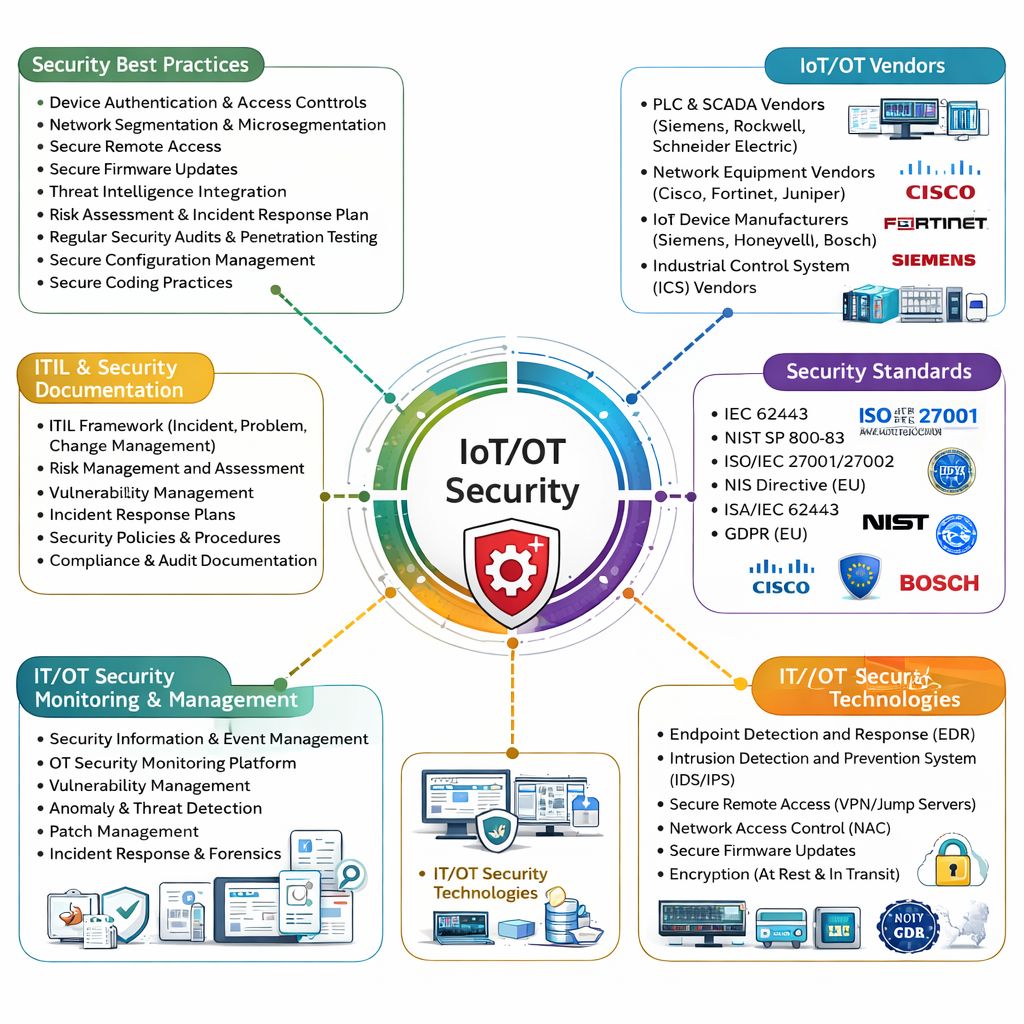
This article presents a structured overview of IoT/OT Security architecture, integrating critical domains required to protect modern industrial and connected environments. It demonstrates how technical controls, governance frameworks, operational monitoring, and vendor ecosystems coalesce into a holistic and adaptive defense strategy.
The Core: IoT/OT Security
At the heart of this comprehensive framework lies IoT/OT Security, a specialized discipline focused on safeguarding the unique assets and operations within industrial and connected environments. Unlike traditional IT security, which primarily deals with data confidentiality, integrity, and availability, OT security prioritizes safety, reliability, and the continuous operation of physical processes. An attack on an OT system can have significant real-world consequences, from production downtime and financial losses to environmental damage and even loss of life. Therefore, a robust IoT/OT security strategy demands a deep understanding of both IT and OT domains.
This core security objective is achieved through the careful orchestration of various elements, including security best practices, adherence to industry standards, the strategic deployment of specialized technologies, effective monitoring and management, collaboration with key vendors, and meticulous documentation and governance. Together, these components form a resilient shield against the ever-evolving threat landscape.
Pillar 1: Security Best Practices
Implementing a strong foundation of security best practices is paramount to protecting IoT/OT environments. These practices form the bedrock upon which sophisticated defenses are built, addressing common vulnerabilities and establishing a secure operational posture.
Device Authentication & Access Controls
Controlling who or what can access your critical IoT/OT devices and systems is fundamental. This involves:
- Strong Authentication Mechanisms: Implementing multi-factor authentication (MFA) wherever possible for human users and robust machine-to-machine authentication (e.g., certificates, secure tokens) for devices. This significantly reduces the risk of unauthorized access due to compromised credentials.
- Principle of Least Privilege: Granting users and devices only the minimum necessary permissions to perform their designated functions. This limits the potential damage if an account or device is compromised.
- Role-Based Access Control (RBAC): Assigning permissions based on defined roles within the organization, simplifying management and ensuring consistent application of access policies.
Network Segmentation & Microsegmentation
Network segmentation involves dividing large, flat networks into smaller, isolated segments. This limits the lateral movement of attackers if one segment is breached. Microsegmentation takes this a step further, creating granular security perimeters around individual workloads or devices.
- Purdue Model: Traditionally, the Purdue Enterprise Reference Architecture has been the mental model for industrial control system (ICS) and OT network segmentation. It helped separate business systems from control systems, reducing the blast radius of attacks. In modern OT network architecture, the Purdue Model is best treated as a conceptual segmentation guide, often combined with IEC 62443 zones and conduits.
- IEC 62443 Zones and Conduits: The IEC 62443 standards provide a practical structure for OT segmentation using “zones” (groups of assets with similar security needs) and “conduits” (controlled communication paths between zones). This approach enables defense in depth by limiting trust, restricting traffic, detecting abnormal behavior, and reducing the blast radius, without relying on a single perimeter.
- VLANs and Firewalls: Virtual Local Area Networks (VLANs) and firewalls are essential tools for implementing network segmentation, controlling traffic flow between different segments.
Secure Remote Access
Remote access is a business requirement for vendors, OEMs, integrators, and corporate support in modern OT environments. However, it also introduces significant security risks. Secure remote access involves:
- Virtual Private Networks (VPNs): Encrypting all traffic between remote users and the OT network, creating a secure tunnel.
- Jump Servers (Bastion Hosts): Dedicated, hardened servers that act as an intermediary for all remote connections to sensitive OT systems. This provides an additional layer of control and monitoring.
- Strong Authentication: Requiring MFA for all remote access attempts.
- Session Monitoring and Recording: Logging and monitoring remote access sessions to detect suspicious activity and provide an audit trail.
Secure Firmware Updates
Firmware is the low-level software that controls IoT and OT devices. Vulnerabilities in firmware can be exploited to gain control of devices or disrupt operations. Secure firmware update processes include:
- Tamper Detection: Ensuring that firmware updates are digitally signed and verified to prevent the installation of malicious or unauthorized firmware.
- Secure Delivery Mechanisms: Using encrypted channels for firmware distribution to prevent interception and modification.
- Rollback Capabilities: Allowing for a safe rollback to a previous, known-good firmware version in case of issues with a new update.
Threat Intelligence Integration
Staying ahead of attackers requires understanding their tactics, techniques, and procedures (TTPs). Threat intelligence provides valuable insights into current and emerging threats relevant to IoT/OT environments.
- Feeds and Sources: Integrating threat intelligence feeds from reputable sources, including industry-specific ISACs (Information Sharing and Analysis Centers) and security vendors.
- Proactive Defense: Using threat intelligence to proactively update security controls, identify potential vulnerabilities, and enhance detection capabilities.
Risk Assessment & Incident Response Plan
A proactive security posture includes understanding potential risks and having a clear plan for what to do when an incident occurs.
- Regular Risk Assessments: Identifying, analyzing, and evaluating risks to critical IoT/OT assets. This helps prioritize security investments and mitigation strategies.
- Incident Response Planning: Developing detailed procedures for detecting, analyzing, containing, eradicating, recovering from, and post-incident review of security incidents. This plan should be regularly tested and updated.
Regular Security Audits & Penetration Testing
Independent verification of security controls is crucial to identify weaknesses before attackers do.
- Security Audits: Formal examinations of an organization’s security posture, policies, and controls to ensure they meet defined standards and best practices.
- Penetration Testing: Ethical hacking exercises designed to simulate real-world attacks to identify vulnerabilities and assess the effectiveness of defensive measures. This includes both network and application-level testing specific to OT protocols and devices.
Secure Configuration Management
Many security vulnerabilities arise from misconfigurations. Secure configuration management ensures that all IoT/OT devices and systems are configured according to robust security baselines.
- Hardening Guidelines: Implementing security hardening guidelines for operating systems, applications, and network devices.
- Configuration Templates: Using standardized configuration templates to ensure consistency and reduce manual errors.
- Configuration Drift Detection: Monitoring configurations to detect and remediate unauthorized changes.
Secure Coding Practices
For organizations developing custom applications or firmware for IoT/OT devices, secure coding practices are essential to prevent the introduction of vulnerabilities.
- OWASP Top 10: Following secure coding guidelines like the OWASP Top 10 for web applications and similar principles for embedded systems.
- Code Reviews: Conducting peer code reviews to identify and correct security flaws early in the development lifecycle.
- Static and Dynamic Analysis: Utilizing automated tools for static application security testing (SAST) and dynamic application security testing (DAST) to uncover vulnerabilities.
Pillar 2: Security Standards
Adhering to recognized security standards provides a common language, a structured approach, and a benchmark for achieving a robust security posture in IoT/OT environments. These frameworks help guide organizations in implementing effective controls and demonstrating compliance.
IEC 62443
The IEC 62443 series of standards (often written as ISA/IEC 62443) is a family of standards specifically designed for securing industrial automation and control systems (IACS), which most teams refer to as OT/ICS.
- Comprehensive Coverage: It provides requirements that span the lifecycle: policies, system design, component capabilities, and operations.
- Zones and Conduits: A key contribution is its zones and conduits model, which gives a practical structure for OT segmentation and trust boundaries.
- Risk-Based Approach: It promotes a risk-based way to think about industrial cybersecurity, moving organizations from “best effort security” to repeatable, defensible security engineering.
NIST SP 800-83
While the specific NIST Special Publication 800-83 (Guide to Industrial Control Systems Security) may be less commonly cited than others like NIST SP 800-82 (Guide to Operational Technology Security), NIST frameworks in general are crucial for cybersecurity. NIST SP 800-82r3, for instance, proposes several defense-in-depth architecture models for various industrial setups like DCS, SCADA, and IIoT-integrated environments.
- Industry Agnostic: NIST frameworks are widely adopted across various sectors and provide flexible, risk-based approaches to cybersecurity.
- Cybersecurity Framework (CSF): The NIST Cybersecurity Framework is particularly notable for its five core functions: Identify, Protect, Detect, Respond, and Recover, offering a strategic approach to managing cybersecurity risk.
ISO/IEC 27001/27002
These international standards are globally recognized for information security management systems (ISMS).
- ISO/IEC 27001: Specifies the requirements for establishing, implementing, maintaining, and continually improving an ISMS within the context of the organization’s overall business risks.
- ISO/IEC 27002: Provides a code of practice for information security controls, offering
best practices and general guidance on information security management. While not directly tailored for OT, its principles are highly relevant and adaptable to the IT/OT converged environment.
NIS Directive (EU)
The Network and Information Security (NIS) Directive is the first piece of EU-wide legislation on cybersecurity. It aims to achieve a high common level of security of network and information systems across the Union.
- Critical Infrastructure Focus: It applies to Operators of Essential Services (OES) in critical sectors like energy, transport, health, banking, and digital infrastructure, as well as Digital Service Providers (DSPs). This directly impacts many OT environments.
- Incident Reporting and Risk Management: Requires OES and DSPs to take appropriate security measures and report significant incidents to national authorities.
ISA/IEC 62443
(See IEC 62443 above – often used interchangeably or to denote the standard’s origin from the International Society of Automation (ISA) before its international adoption by IEC.)
GDPR (EU)
The General Data Protection Regulation (GDPR) is a comprehensive data protection law in the European Union and the European Economic Area. While primarily focused on personal data, it has implications for IoT/OT environments, especially where personal data might be collected or processed by connected devices.
- Data Minimization: Encourages minimizing the collection and processing of personal data.
- Security by Design: Requires organizations to incorporate data protection principles into their systems and processes from the outset.
- Impact on IoT Devices: Devices collecting personal data (e.g., location, biometric data) must comply with GDPR’s strict requirements for consent, data security, and individual rights.
Pillar 3: IT/OT Security Technologies
The effective deployment of specialized security technologies is crucial for protecting the unique landscape of converged IT/OT environments. These tools provide the technical muscle needed to enforce policies, detect threats, and respond to incidents.
Endpoint Detection and Response (EDR)
EDR solutions provide advanced capabilities for monitoring endpoints (e.g., workstations, servers, HMIs) within the OT network.
- Comprehensive Visibility: Collects and analyzes data from endpoints to detect suspicious activities, identify anomalies, and uncover sophisticated threats that might evade traditional antivirus.
- Advanced Threat Detection: Utilizes machine learning and behavioral analysis to detect malware, fileless attacks, and insider threats.
- Response Capabilities: Enables rapid investigation, containment, and remediation of security incidents on compromised endpoints.
Intrusion Detection and Prevention System (IDS/IPS)
IDS and IPS are network security tools that play a critical role in monitoring and protecting network traffic.
- Intrusion Detection System (IDS): Monitors network or system activities for malicious activity or policy violations and alerts when such activity is detected. It’s like a silent alarm.
- Intrusion Prevention System (IPS): Not only detects but also actively blocks or prevents detected threats from reaching their target. It’s like an alarm system that can also lock the doors.
- OT Protocol Awareness: Specialized IDS/IPS solutions are needed for OT environments to understand and analyze industrial protocols (e.g., Modbus, DNP3, Ethernet/IP) for anomalies and known attack signatures.
Secure Remote Access (VPN/Jump Servers)
As previously discussed under Security Best Practices, the technology underpinning secure remote access is critical.
- Virtual Private Networks (VPNs): Create secure, encrypted tunnels over public networks, protecting data in transit.
- Jump Servers (Bastion Hosts): Provide a controlled gateway for accessing sensitive systems, centralizing access control and logging.
- Multi-Factor Authentication (MFA) Integration: Essential for reinforcing the security of remote access mechanisms.
Network Access Control (NAC)
NAC solutions regulate access to a network based on device compliance and user authentication.
- Device Posture Assessment: Checks the security posture of devices attempting to connect to the network, ensuring they have up-to-date antivirus, patches, and proper configurations.
- Policy Enforcement: Enforces access policies based on user roles, device types, and security compliance, segmenting non-compliant devices.
- Guest Access Management: Provides secure ways to onboard and manage temporary or guest connections without compromising network security.
Secure Firmware Updates
From a technology perspective, secure firmware updates involve specific tools and platforms.
- Secure Boot and Trusted Platform Modules (TPMs): Hardware-based security features that ensure only authorized firmware can boot and verify the integrity of the boot process.
- Centralized Update Management Systems: Platforms that manage the secure distribution, verification, and deployment of firmware updates across a fleet of devices.
- Cryptographic Libraries: Underlying cryptographic technologies for digital signatures, hashing, and encryption to ensure the authenticity and integrity of firmware.
Encryption (At Rest & In Transit)
Encryption is a fundamental security control for protecting data confidentiality and integrity.
- Data At Rest: Encrypting data stored on devices, servers, and storage media within the OT environment to prevent unauthorized access if the physical device is compromised.
- Data In Transit: Encrypting data as it travels across networks using protocols like TLS/SSL for communications, VPNs for network tunnels, and encrypted industrial protocols where available, protecting against eavesdropping and tampering.
Pillar 4: IoT/OT Vendors
The vendor ecosystem plays a crucial role in enabling and securing IoT/OT environments. Understanding the landscape of these providers, from core industrial equipment manufacturers to specialized network and security vendors, is essential for building a robust architecture.
PLC & SCADA Vendors
Programmable Logic Controllers (PLCs) and Supervisory Control and Data Acquisition (SCADA) systems are the backbone of many industrial operations. Their vendors are key players in the OT security landscape.
- Key Players: Siemens, Rockwell Automation, and Schneider Electric are prominent examples.
- Security by Design: Modern PLC and SCADA vendors are increasingly focusing on embedding security features into their products, including secure boot, authentication, and encrypted communications.
- Patch Management: Collaboration with these vendors for timely security patches and firmware updates is critical for maintaining the security of control systems.
Network Equipment Vendors
These vendors provide the hardware and software that forms the communication infrastructure of both IT and OT networks.
- Key Players: Cisco, Fortinet, and Juniper are leading providers.
- Secure Infrastructure: Their products, such as firewalls, switches, routers, and wireless access points, are fundamental for network segmentation, access control, and secure connectivity within and between IT/OT environments.
- OT-Aware Networking: Some vendors offer specialized networking solutions designed to operate reliably within harsh industrial environments and understand OT protocols.
IoT Device Manufacturers
This category encompasses a vast array of manufacturers producing the “things” that connect to industrial and enterprise networks.
- Key Players: Siemens, Honeywell, and Bosch produce a wide range of IoT devices used in industrial settings.
- Security Lifespan: Ensuring that IoT devices are designed with security in mind from the outset (secure by design) and receive ongoing security support and updates throughout their lifecycle is a significant challenge and responsibility.
- Vulnerability Disclosure: Collaboration with these manufacturers for responsible vulnerability disclosure and timely patching is vital.
Industrial Control System (ICS) Vendors
ICS vendors provide the overarching systems that manage and monitor industrial processes, often integrating components from PLC and SCADA vendors.
- System Integrators: Often, these are system integrators that combine hardware and software from various sources to create bespoke ICS solutions.
- Holistic Security: Their role encompasses ensuring the security of the entire integrated system, from the lowest-level sensors to the Human-Machine Interfaces (HMIs) and data historians.
Pillar 5: ITIL & Security Documentation
Robust documentation and adherence to IT Infrastructure Library (ITIL) principles provide the framework for managing security as an ongoing process, ensuring consistency, accountability, and continuous improvement. This pillar bridges technical controls with operational governance.
ITIL Framework (Incident, Problem, Change Management)
ITIL is a widely adopted framework for IT service management. Its principles are highly adaptable to managing security processes within converged environments.
- Incident Management: Defining clear procedures for reporting, triaging, investigating, and resolving security incidents, ensuring minimal disruption to operations.
- Problem Management: Proactively identifying and addressing the root causes of recurring security incidents or vulnerabilities to prevent future occurrences.
- Change Management: Establishing a controlled process for implementing changes to IoT/OT systems, ensuring security implications are assessed and approved before deployment, thereby preventing new vulnerabilities.
Risk Management and Assessment
As noted under best practices, formalizing risk management within an ITIL-like structure ensures it’s an ongoing, structured process.
- Risk Identification: Systematically identifying assets, threats, and vulnerabilities within the IoT/OT landscape.
- Risk Analysis and Evaluation: Assessing the likelihood and impact of identified risks to prioritize mitigation efforts.
- Risk Treatment: Developing and implementing strategies to mitigate, transfer, avoid, or accept identified risks.
Vulnerability Management
A systematic approach to identifying, prioritizing, and remediating vulnerabilities is crucial in the dynamic IoT/OT landscape.
- Asset Inventory: Maintaining an accurate and up-to-date inventory of all IoT/OT assets, including hardware, software, and firmware versions.
- Vulnerability Scanning: Regularly scanning networks and devices for known vulnerabilities.
- Patch Management: Developing and executing a robust patch management program, considering the unique challenges of OT systems (e.g., uptime requirements, vendor support cycles).
Incident Response Plans
Detailed, well-documented incident response plans are essential for minimizing the impact of security breaches.
- Roles and Responsibilities: Clearly defining who is responsible for what during an incident.
- Communication Protocols: Establishing internal and external communication channels and procedures.
- Containment and Recovery Steps: Outlining specific steps for containing an incident and restoring normal operations, understanding the need for rapid recovery in OT environments.
Security Policies & Procedures
Formalizing security expectations and guidelines through detailed policies and procedures is critical for consistent implementation.
- Acceptable Use Policies: Defining how users can and cannot interact with IoT/OT systems.
- Configuration Standards: Documenting baseline security configurations for various devices and systems.
- Data Handling Procedures: Outlining how sensitive data collected by IoT/OT devices should be stored, processed, and transmitted.
Compliance & Audit Documentation
Maintaining thorough documentation is essential for demonstrating compliance with internal policies, industry standards (like IEC 62443), and regulatory requirements (like GDPR or NIS Directive).
- Audit Trails: Ensuring that all security-relevant actions and events are logged and auditable.
- Evidence Collection: Maintaining records of security assessments, penetration tests, incident responses, and policy reviews.
- Reporting: Generating regular reports on security posture, compliance status, and risk levels for stakeholders.
Pillar 6: IT/OT Security Monitoring & Management
Effective security in converged environments demands continuous vigilance. This pillar focuses on the operational aspects of security, ensuring ongoing detection, analysis, and response to threats and vulnerabilities across the IT and OT domains.
Security Information & Event Management (SIEM)
A SIEM system is a centralized platform for collecting, analyzing, and correlating security-related data from various sources across the IT and OT network.
- Log Aggregation: Gathers logs from firewalls, servers, endpoints, ICS devices, and other security tools.
- Threat Detection & Alerting: Uses rules, correlation engines, and behavioral analytics to identify potential security incidents and generate alerts.
- Compliance Reporting: Assists in generating reports for compliance audits by providing a unified view of security events.
- OT Integration: Integrating OT alerts into a SIEM without breaking the plant requires careful planning and specialized solutions that understand OT protocols and contexts.
OT Security Monitoring Platform
These platforms are specialized tools designed to provide visibility and threat detection specifically within Operational Technology networks.
- Passive Monitoring: Often utilize passive (non-intrusive) listening to network traffic to identify devices, communication patterns, and anomalies without impacting sensitive control processes.
- Deeper Protocol Insight: Offer deeper understanding of industrial protocols, allowing for more precise detection of malicious or suspicious activities specific to OT.
- Asset Inventory & Vulnerability Identification: Can automatically discover OT assets, map network connections, and identify known vulnerabilities within industrial devices.
Vulnerability Management
(As previously discussed, this is a continuous operational process supported by monitoring.)
- Continuous Scanning: Automated tools for regularly scanning internal and external-facing systems for known vulnerabilities.
- Risk Prioritization: Using threat intelligence and business context to prioritize the patching and remediation of vulnerabilities.
- Remediation Tracking: Managing the lifecycle of vulnerabilities from discovery to remediation and verification.
Anomaly & Threat Detection
Beyond signature-based detection, anomaly and threat detection focuses on identifying unusual or suspicious behaviors that may indicate a sophisticated attack.
- Behavioral Analytics: Establishing baselines of normal operating behavior for devices, users, and network traffic, then flagging deviations as potential threats.
- Machine Learning (ML) & Artificial Intelligence (AI): Increasingly used to analyze vast amounts of data and uncover subtle patterns indicative of advanced persistent threats (APTs) or zero-day exploits. AI is both a security enabler and a new attack vector to be secured.
- Contextual Awareness: Understanding the functional context of OT operations to reduce false positives and accurately identify critical anomalies.
Patch Management
Patching is a critical component of vulnerability management but requires careful consideration in OT environments.
- Staged Rollouts: Implementing patches in a controlled, phased manner, often starting with non-critical systems, due to the high availability requirements of OT.
- Vendor Coordination: Close collaboration with OT vendors for patch availability, testing, and deployment guidance.
- Downtime Planning: Carefully planning and scheduling downtime for patching critical systems, often requiring maintenance windows.
- Alternative Mitigations: Sometimes, patching isn’t always the answer in OT security, and compensating controls or other mitigation strategies may be necessary.
Incident Response & Forensics
The incident response plan, once documented, needs to be actively executed. Forensics provides the capabilities to understand what happened after an incident.
- Rapid Response Teams: Having trained personnel ready to activate and manage security incidents.
- Digital Forensics: The process of collecting, preserving, analyzing, and presenting digital evidence related to a cyberattack for post-incident analysis and legal purposes.
- Lessons Learned: Conducting post-incident reviews to identify areas for improvement in security controls, policies, and response procedures.
The Interconnectedness of the Architecture
This complete IoT/OT security architecture model doesn’t operate as disconnected silos; rather, its strength lies in the continuous interaction and interdependence of its pillars.
- Standards Drive Best Practices: Security standards like IEC 62443 inform and validate the specific security best practices an organization should adopt, providing a structured approach to critical areas like network segmentation and secure remote access.
- Technologies Enable Monitoring: The IT/OT Security Technologies—such as EDR, IDS/IPS, and encryption—are the fundamental tools that feed data into the IT/OT Security Monitoring & Management pillar, enabling effective SIEM, anomaly detection, and vulnerability management.
- Vendors Provide the Foundation: IoT/OT Vendors supply the actual PLC, SCADA, ICS, and networking equipment, and their commitment to security by design and providing timely updates directly impacts the effectiveness of the overall security architecture, especially in terms of secure firmware updates and patch management.
- Documentation Governs Operations: The ITIL & Security Documentation pillar ensures that all aspects—from incident response and risk management to security policies and compliance—are formally defined, understood, and consistently applied across the organization, guiding the operational activities within the monitoring and management phases.
- Continuous Feedback Loop: Threat intelligence gathered through monitoring informs updates to security best practices and policies. Audit findings from compliance documentation lead to adjustments in technological deployments or operational procedures. This creates a dynamic, self-improving security posture.
The Converged Industrial Stack: A New Attack Surface
The modernization of industrial operations, driven by Industry 4.0 initiatives and the quest for real-time insights, has blurred the lines between Information Technology (IT) and Operational Technology (OT). This convergence has created a complex, multi-layered architecture where digital and physical worlds intertwine. Understanding each layer’s role and its inherent vulnerabilities is crucial. The traditional “air-gap” security model for OT is a relic of the past, replaced by a layered, interconnected digital nervous system. Every device, from the physical process floor to enterprise resource planning (ERP) components, now participates in this unified ecosystem. This pervasive connectivity means that every single layer represents a potential attack surface.
The Purdue Model, for example, once a cornerstone, is now complemented by frameworks like IEC 62443 “zones and conduits” for more granular and resilient segmentation. Concepts such as DMZs between IT and OT, critical for isolating sensitive control networks, have evolved to host cybersecurity servers, remote access gateways, and authentication systems. The operations management level (Level 3) now includes OT authentication servers, redundant control servers, and data historians, demanding robust protection. The field level (Levels 0-2), encompassing sensors, actuators, PLCs, and HMIs, requires specialized security principles like least functionality and separate authentication domains.
Conclusion: A Unified Defense Strategy for the Future
The shift from isolated OT systems to hyperconnected, intelligent, and AI-enabled environments presents unprecedented challenges and opportunities. A truly mature security posture emerges from the intelligent integration of various frameworks, allowing for a holistic and adaptive defense.
This IoT/OT Security Architecture Overview serves as a comprehensive reference map for engineers, security analysts, architects, and industrial cybersecurity professionals. By diligently implementing best practices, adhering to established standards, leveraging advanced technologies, engaging with the vendor ecosystem, and maintaining rigorous documentation and monitoring, organizations can build a resilient defense against the ever-evolving threat landscape. Proactive and sophisticated cybersecurity strategies are no longer optional but essential for maintaining operational integrity, business continuity, and national security in our increasingly connected world.
Take Control of Your IoT/OT Security Today
Navigating the complexities of converged IT/OT environments requires expert guidance. Don’t leave your critical infrastructure vulnerable. Whether you’re just starting your IoT/OT security journey or looking to strengthen your existing defenses, IoT Worlds offers comprehensive solutions and unparalleled expertise.
Connect with our cybersecurity specialists to design a resilient IoT/OT security architecture tailored to your unique needs. Email us at info@iotworlds.com to schedule a consultation and secure your operational future.