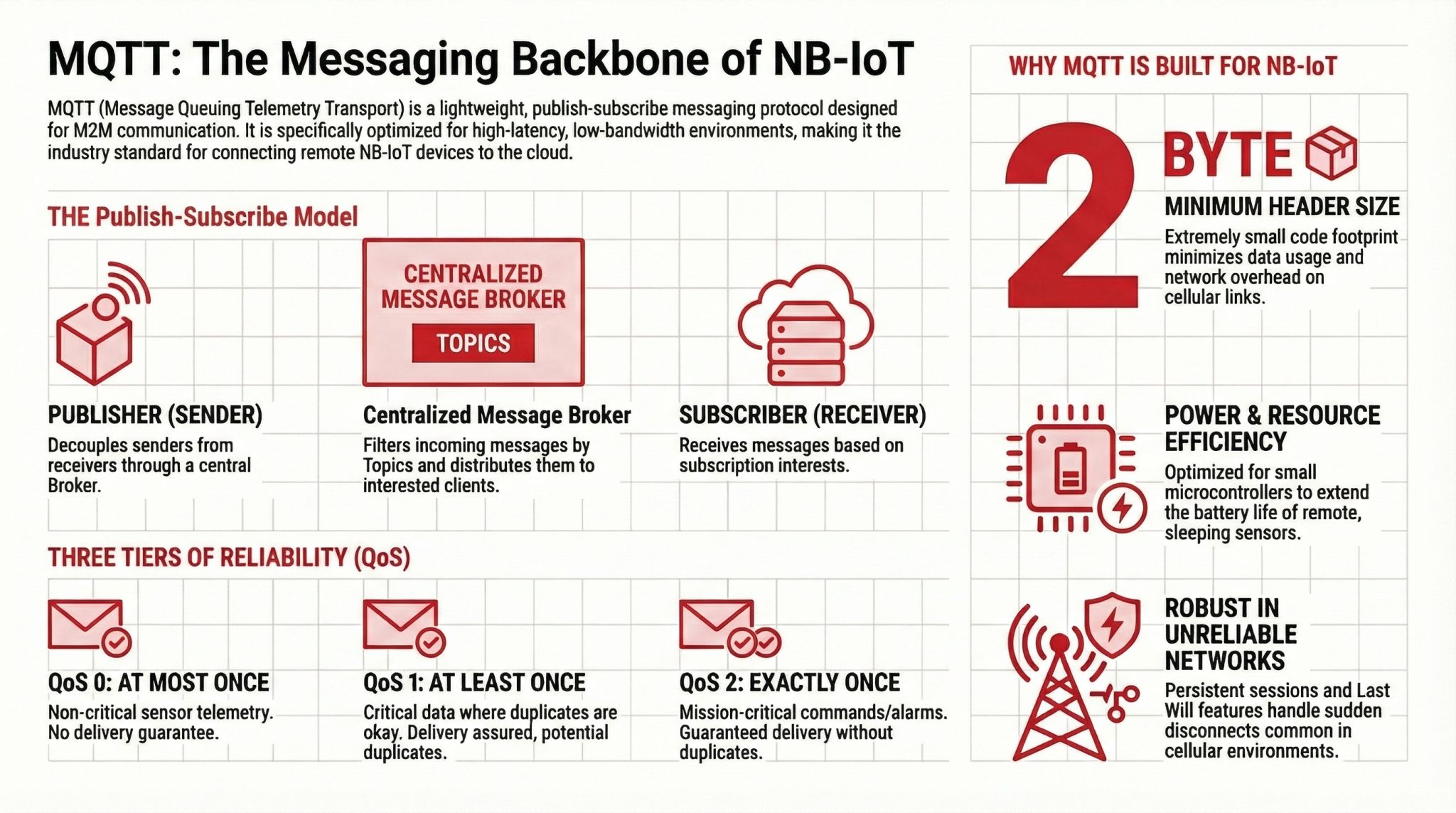
In the rapidly expanding universe of the Internet of Things (IoT), where countless devices are constantly generating and exchanging data, the messaging protocol chosen to facilitate this communication is paramount. While many IoT applications demand high-speed data transfer, a significant and growing segment prioritizes reliability, power efficiency, and the ability to operate within constrained network environments. This is precisely where Message Queuing Telemetry Transport (MQTT) shines, establishing itself as the indispensable messaging backbone for Narrowband IoT (NB-IoT) deployments.
NB-IoT, a Low-Power Wide-Area Network (LPWAN) technology, is engineered for devices that need to send small amounts of data infrequently over long distances, often from challenging locations. Think of smart meters buried underground, environmental sensors in remote agricultural fields, or asset trackers deep within a factory. These devices operate on limited power, have minimal processing capabilities, and rely on cellular networks that might experience intermittent connectivity. MQTT is purpose-built to thrive in such conditions, making it an ideal partner for NB-IoT.
This comprehensive guide will delve into what makes MQTT so uniquely suited for NB-IoT. We will explore its publish-subscribe model, dissect its critical Quality of Service (QoS) levels, and examine the inherent efficiencies and robust features that have cemented its status as the industry standard for connecting remote NB-IoT devices to the cloud. If you are building anything in the connected device space, especially applications demanding longevity, reliability, and cost-effectiveness in low-bandwidth cellular links, understanding MQTT is not just beneficial—it’s essential.
Understanding the Landscape: NB-IoT and Its Demands
Before we dive deep into MQTT, it’s crucial to understand the environment in which it operates so effectively: Narrowband IoT (NB-IoT). NB-IoT is not about streaming high-definition video or enabling real-time voice calls. Instead, it’s a cellular technology developed by 3GPP specifically for the Internet of Things, focusing on use cases where devices need to operate for years on a single battery, send small data packets, and reach challenging locations.
What is NB-IoT?
Narrowband IoT, often referred to as LTE Cat-NB1 or LTE Cat-NB2, is a low-power wide-area (LPWA) technology that connects a vast number of devices over existing mobile networks. Its core design principles are centered around:
- Low power consumption: Devices are optimized for years-long battery life, crucial for remote deployments where frequent battery changes are impractical. This is achieved through features like Power Saving Mode (PSM) and extended Discontinuous Reception (eDRX), allowing devices to sleep for long periods and only wake up to transmit data.
- Extended coverage and deep indoor penetration: NB-IoT signals can penetrate deep into buildings and reach remote areas, overcoming obstacles that traditional cellular signals struggle with. This makes it ideal for applications like smart metering in basements or asset tracking within industrial facilities.
- Low cost: Both the modules and the operational costs of NB-IoT are designed to be low, enabling the deployment of massive numbers of devices cost-effectively.
- Support for massive connectivity: A single NB-IoT cell can support tens of thousands of connected devices, facilitating large-scale IoT deployments.
- Small data packets: NB-IoT is primarily designed for transmitting small, infrequent bursts of data, such as sensor readings or status updates. Its data rates are relatively low, typically in the range of tens of kilobits per second (kbps).
Why NB-IoT Devices Need a Specialized Messaging Protocol
Given these characteristics, traditional messaging protocols built for high-bandwidth, always-on connections are ill-suited for NB-IoT. The demands of NB-IoT devices pose several challenges for communication:
- Limited bandwidth: With data rates designed for “drips of data,” every byte transmitted incurs a cost in terms of power and airtime. An efficient protocol is essential to minimize overhead.
- High latency: Due to power-saving mechanisms like PSM and eDRX, NB-IoT devices might not be constantly listening for incoming messages, leading to higher latency compared to always-connected devices. The protocol must be able to handle these delays gracefully.
- Unreliable network conditions: NB-IoT operates in cellular environments where connectivity can be intermittent, especially in deep indoor or remote locations. The messaging protocol needs mechanisms to ensure data delivery even when conditions are unstable.
- Constrained hardware: NB-IoT devices often use small, low-power microcontrollers with limited memory and processing power. The protocol’s footprint must be minimal.
- Long battery life: Minimizing power consumption during communication is critical. This means reducing the number of transmissions, the duration of each transmission, and the processing required by the device.
It is against this backdrop of unique requirements that MQTT emerges not just as a compatible protocol but as a fundamental enabler for the success of NB-IoT applications. Its design directly addresses these challenges, making it the de facto standard for reliable, efficient, and robust communication in this specific segment of the IoT.
The Foundation of Efficiency: Why MQTT is Built for NB-IoT
MQTT, or Message Queuing Telemetry Transport, is a lightweight, publish-subscribe messaging protocol engineered for machine-to-machine (M2M) communication. Its design philosophy directly aligns with the operational constraints and requirements of NB-IoT, making it an optimal choice for connecting remote devices to the cloud. Several core characteristics highlight why MQTT is so perfectly synchronized with the needs of NB-IoT.
Minimal Header Size: Less Data, More Efficiency
One of MQTT’s most significant advantages for NB-IoT is its incredibly small code footprint and minimal header size. This aspect is crucial for environments where every byte transmitted has a direct impact on power consumption and network usage.
- Extremely small code footprint: MQTT clients and brokers are designed to be lightweight, requiring minimal processing power and memory. This is ideal for the inexpensive, resource-constrained microcontrollers typically found in NB-IoT devices. A smaller code footprint means less memory occupied, reducing the cost of the device and its power draw.
- Minimized data usage: The protocol headers for MQTT messages can be as small as 2 bytes. To put this into perspective, many other communication protocols have significantly larger headers, which can quickly add up when sending small data packets. For an NB-IoT device sending a simple temperature reading, the overhead of a large header could easily outweigh the actual data payload. MQTT ensures that the majority of the transmitted data is the actual, useful information.
- Reduced network overhead on cellular links: Every byte sent over a cellular network consumes energy and contributes to data plan usage. By minimizing header size, MQTT drastically reduces the network overhead, leading to lower operational costs and extended battery life for NB-IoT devices. This directly translates into greater efficiency and sustainability for large-scale deployments.
This focus on minimizing data usage and code footprint is not merely a design choice; it is a fundamental pillar that enables devices to operate for months or even years on a single battery, a critical requirement for most NB-IoT applications.
Power & Resource Efficiency: Sustaining Remote Sensors
Beyond minimal data usage, MQTT is inherently designed for maximum power and resource efficiency, which is paramount for battery-powered, remote sensors.
- Optimized for small microcontrollers: As mentioned, MQTT clients are very small. This allows them to run effectively on low-cost, low-power microcontrollers without demanding significant computational resources. Complex processing tasks that would quickly drain a battery are avoided.
- Extending battery life: The combination of small message size, efficient communication patterns, and low processing requirements directly contributes to extending the battery life of devices. By reducing the time the radio is active and the CPU is working, MQTT helps conserve precious energy. For remote devices where manual battery replacement is costly or impossible (e.g., smart meters embedded in concrete or sensors in inaccessible locations), this extended lifespan is a game-changer.
- Supporting sleeping sensors: Many NB-IoT devices spend the vast majority of their time in a deep sleep state to conserve power. They only wake up periodically to send data or check for commands. MQTT, with its session persistence features (discussed later), is well-suited to handle these intermittent connections, ensuring that messages are delivered when the device becomes active, without requiring continuous polling or keeping an open connection that would rapidly deplete the battery.
In essence, MQTT allows NB-IoT devices to operate like highly efficient, long-distance couriers: they pick up their small package, deliver it with precision, and then return to a dormant state, consuming minimal resources throughout the process.
The Publish-Subscribe Model: Decoupling for Scale and Agility
One of the most powerful and distinguishing features of MQTT is its publish-subscribe messaging model, which fundamentally differs from traditional client-server communication. This design brings immense flexibility, scalability, and efficiency, especially in complex IoT ecosystems like those enabled by NB-IoT.
Publishers, Subscribers, and the Centralized Message Broker
In a conventional client-server model, clients directly request information from a server, or servers send information directly to specific clients. This creates tight coupling, where clients need to know the server’s address, and the server needs to know the client’s address. MQTT elegantly solves this with a three-component architecture:
- Publisher (Sender): A publisher is any device or application that sends messages. In the context of NB-IoT, this would typically be a sensor device (e.g., a temperature sensor, a water meter, an asset tracker) that collects data and publishes it to the MQTT network. Crucially, a publisher does not need to know who (if anyone) will receive its messages. It simply publishes data to a specific “topic.”
- Decoupling: Publishers are entirely decoupled from receivers. They don’t need to know the IP address, status, or even existence of any subscriber. This simplifies device design and deployment.
- Subscriber (Receiver): A subscriber is any device or application that wants to receive messages. This could be a cloud application, a dashboard, an analytics engine, or even another IoT device. Subscribers express their interest in specific “topics.”
- Interest-based delivery: Subscribers only receive messages for the topics they have explicitly subscribed to. They don’t need to know who published the message or where it originated.
- Centralized Message Broker: This is the heart of the MQTT system. The broker acts as an intermediary, facilitating all communication between publishers and subscribers.
- Topic-based filtering: When a publisher sends a message to a specific topic, the broker receives it. It then filters these incoming messages based on their topics.
- Distribution to interested clients: The broker maintains a list of all active subscribers and their subscribed topics. When a message arrives for a particular topic, the broker distributes that message to all clients who have subscribed to that topic.
The Power of Topics
Topics are hierarchical strings that act as labels for messages, allowing for intuitive organization and flexible filtering. They are central to how the publish-subscribe model operates.
- Hierarchical Structure: Topics resemble file paths, using
/as a separator (e.g.,building1/floor2/room1/temperature). This allows for granular control over subscriptions. A subscriber could subscribe tobuilding1/floor2/#to receive all messages from floor 2, or specifically tobuilding1/floor2/room1/temperaturefor a single data stream. - Flexible Routing: Topics enable sophisticated message routing without complex configurations on individual devices. Devices just need to know their own topics for publishing and subscribing.
Benefits for NB-IoT Deployments
The publish-subscribe model offers several profound benefits for NB-IoT architectures:
- Scalability: The decoupling of publishers and subscribers means that the system can scale almost infinitely. You can add new sensors (publishers) or new applications (subscribers) without needing to reconfigure existing components. The broker handles the routing efficiently.
- Flexibility and Agility: Changes in the system are easy to manage. If a new application needs a particular data stream, it simply subscribes to the relevant topic. If a sensor changes location, its topic can be updated without affecting other parts of the system.
- Reduced Network Traffic: Devices only receive messages they are interested in. This prevents unnecessary data transmission to devices, further conserving bandwidth and power. A sensor doesn’t need to constantly poll a server for commands; it can subscribe to its command topic and the broker will deliver messages only when they are available.
- Simplified Device Logic: NB-IoT devices don’t need complex logic for addressing and routing. Their task is simply to publish data to a defined topic or subscribe to a specific command topic. This reduces the processing overhead on resource-constrained devices.
- “One-to-Many” and “Many-to-One” Communication: The model naturally supports scenarios where one sensor’s data is consumed by multiple applications, or where multiple sensors contribute data to a single analytical platform.
In essence, the MQTT publish-subscribe model transforms a potentially chaotic mesh of direct connections into an organized, efficient, and highly scalable information highway, perfectly suited for the diverse and numerous devices in an NB-IoT ecosystem.
Three Tiers of Reliability (QoS): Tailoring Delivery to Your Needs
In data communication, not all messages are created equal. Some sensor readings are mere telemetry, where the occasional loss of a data point is inconsequential. Others, like critical alarms or control commands, demand absolute certainty of delivery. MQTT understands this nuanced reality and provides three Quality of Service (QoS) levels, allowing developers to choose the exact level of reliability required for each message. This capability is particularly vital in NB-IoT environments where network conditions can be variable and power consumption is a constant concern.
QoS 0: At Most Once (Fire and Forget)
- Description: This is the lowest level of QoS, often referred to as “fire and forget.” When a publisher sends a message with QoS 0, it transmits the message once and assumes it has been received by the broker. There is no acknowledgment from the receiver, and no retry mechanism.
- Delivery Guarantee: No delivery guarantee. The message might arrive, or it might not. Duplicates are generally not a concern because retries are not performed.
- Use Cases for NB-IoT: Ideal for non-critical sensor telemetry where occasional data loss is acceptable and the highest throughput with minimal overhead is desired. Examples include:
- Ambient temperature readings that are sent every few minutes. If one reading is lost, the next one will provide sufficient data for trend analysis.
- Periodic status updates that are not mission-critical.
- Environmental monitoring where slight data gaps do not impact the overall outcome.
- Advantages: This level requires the least overhead in terms of network traffic and device processing, making it the most power-efficient option. It’s perfect for maximizing battery life for devices sending frequent, but non-critical, data bursts.
QoS 1: At Least Once (Assured Delivery, Potential Duplicates)
- Description: When a publisher sends a message with QoS 1, it ensures that the message is delivered to the broker at least once. The publisher will keep retransmitting the message until it receives a
PUBACK(Publish Acknowledgment) packet from the broker. The broker, in turn, will ensure the message is deliveredat least onceto subscribers by also tracking acknowledgements. - Delivery Guarantee: Delivery assured, but there is a possibility of duplicate messages. If the
PUBACKfrom the broker is lost, the publisher might retransmit the message, leading to the broker (and thus subscribers) receiving the same message twice. Applications need to be able to handle potential duplicates (e.g., by using unique message IDs or idempotent processing). - Use Cases for NB-IoT: Suitable for critical data where delivery is essential, and duplicates are tolerable or can be managed by the application. Examples include:
- Critical sensor readings where data integrity is important (e.g., pressure alarms, security breach alerts).
- Metering data where every reading needs to be recorded, even if an occasional duplicate requires filtering later.
- Minor commands that can be re-executed without negative consequences if a duplicate occurs.
- Advantages: Provides a good balance between guaranteed delivery and reasonable overhead. It’s more reliable than QoS 0 and consumes less power/bandwidth than QoS 2.
QoS 2: Exactly Once (Guaranteed, Duplicate-Free Delivery)
- Description: This is the highest level of QoS, guaranteeing that a message is delivered to the broker and then to interested subscribers exactly once. This involves a four-way handshake between the publisher and the broker, and a similar handshake between the broker and each subscriber.
- Step 1 (Publisher to Broker): Publisher sends
PUBLISH(QoS 2). - Step 2 (Broker to Publisher): Broker responds with
PUBREC(Publish Received). - Step 3 (Publisher to Broker): Publisher sends
PUBREL(Publish Release). - Step 4 (Broker to Publisher): Broker responds with
PUBCOMP(Publish Complete).
- Step 1 (Publisher to Broker): Publisher sends
- Delivery Guarantee: Guaranteed delivery exactly once, without any duplicates. This is the most robust level of reliability.
- Use Cases for NB-IoT: Essential for mission-critical commands or alarms where absolutely no data loss or duplication can be tolerated. Examples include:
- Control commands to actuators (e.g., ‘open valve’, ‘shut down machine’).
- Firmware Over-The-Air (FOTA) updates, where every packet must be delivered accurately and exactly once.
- Billing data from smart meters, where every transaction must be precisely accounted for.
- Security alarms that must not be missed or triggered multiple times unnecessarily.
- Advantages: Offers the highest level of assurance, making it suitable for transactions and critical control signals.
- Disadvantages: This level incurs the most significant overhead in terms of network traffic and device processing due to the multi-step handshake. For NB-IoT devices, this translates to higher power consumption and potentially longer radio-on times. Therefore, QoS 2 should be used judiciously, only for messages where its strict guarantees are truly necessary.
Strategic Selection for NB-IoT
The ability to select the appropriate QoS level per message is a crucial design philosophy when working with NB-IoT. By strategically choosing QoS 0, 1, or 2, developers can fine-tune the balance between reliability, power efficiency, and bandwidth usage for different types of data. This granular control allows for highly optimized IoT solutions that meet specific application requirements while maximizing the longevity of constrained devices. For instance, an NB-IoT smart meter might send its hourly routine readings with QoS 1, but its critical tampering alarm with QoS 2, and maybe a non-essential diagnostic log with QoS 0. This intelligent allocation of resources is a cornerstone of efficient NB-IoT deployments powered by MQTT.
Built for Constrained Hardware: The Microcontroller’s Best Friend
The operational reality for many NB-IoT devices is that they are small, low-cost, and packed with minimalist hardware. Unlike powerful servers or even typical smartphones, these devices often feature basic microcontrollers with limited RAM, ROM, and processing speed. MQTT’s design directly caters to these constraints, ensuring that the protocol remains a viable and high-performing option even under severe hardware limitations.
Optimized for Microcontrollers
- Small Memory Footprint: MQTT client libraries are typically very compact. This means they require minimal Flash memory (for program storage) and RAM (for runtime data), leaving more resources available for the device’s core application logic and data buffering. This directly contributes to lower hardware costs for the NB-IoT module.
- Low Processing Demands: The protocol’s simplicity translates into low CPU utilization. Operations like parsing headers, managing connections, and handling QoS handshakes are computationally light. This allows devices to perform their communication tasks quickly and efficiently, then return to a low-power sleep state, further extending battery life.
- Event-Driven Architecture: MQTT client libraries are often asynchronous and event-driven. This means the microcontroller doesn’t have to dedicate continuous cycles to managing the network connection. Instead, it can respond to network events (like a message arriving or an acknowledgment needed) as they occur, spending more time in energy-saving modes.
Designed for Devices Running on Battery for Months or Years
The paramount goal for many NB-IoT deployments is extreme longevity on battery power. MQTT supports this directly through its inherent efficiencies and features:
- Minimal “Radio-On” Time: Because messages are compact (small headers, efficient payloads) and the processing is fast, the device’s radio module needs to be active for significantly shorter durations compared to protocols with higher overhead. The radio transceiver is one of the most power-hungry components of an IoT device, so minimizing its active time is critical for battery longevity.
- Efficient Sleep Cycles: MQTT’s ability to operate with intermittent connections (e.g., through features like persistent sessions, discussed below) means devices can enter deep sleep modes for extended periods, waking up only to transmit data or receive scheduled commands. The protocol does not demand constant network presence, which would quickly deplete batteries.
- Simplicity Reduces Defects: A simpler protocol implementation means fewer bugs and less complex code, leading to more stable and reliable operation over long periods in the field without requiring interventions or restarts, which can consume significant power.
Comparison to Other Protocols
To fully appreciate MQTT’s suitability, consider alternatives:
- HTTP: While ubiquitous for web communication, HTTP is conversational (request-response), full-duplex, and has much larger headers. Each transaction involves establishing a connection, sending a request, waiting for a response, and then typically closing the connection. This “chattiness” and overhead make it highly inefficient for small, infrequent data bursts from battery-powered devices.
- CoAP (Constrained Application Protocol): CoAP is another lightweight protocol designed for constrained environments. It’s also often used with UDP, which can offer lower overhead than TCP. However, CoAP is primarily a request/response protocol (similar to HTTP but highly optimized) and lacks MQTT’s inherent publish/subscribe decoupling and advanced QoS guarantees through its broker-centric architecture. For many event-driven IoT scenarios, MQTT’s publish/subscribe model is more natural and efficient.
In essence, MQTT is crafted with the understanding that many IoT devices are not miniature computers but rather specialized, power-stingy sensors. Its efficiency on constrained hardware is not an accidental byproduct but a core design principle, making it a reliable and economical choice for the long-term deployment of NB-IoT devices in the field.
Resilient by Design: MQTT in Unreliable Networks
NB-IoT operates within cellular environments that, while offering wide coverage, can be characterized by varying signal strength, potential disconnections, and high latency, especially in deep indoor or remote locations. For devices that need to operate autonomously for prolonged periods, the ability of their communication protocol to gracefully handle these “unreliable” network conditions is paramount. MQTT’s design incorporates features that specifically address these challenges, ensuring data integrity and operational continuity.
Persistent Sessions: Bridging Connectivity Gaps
One of MQTT’s strongest resilience features is its concept of persistent sessions, also known as “clean session” flags. When an MQTT client connects to a broker, it can request a persistent session.
- How it Works: If a client (e.g., an NB-IoT device) connects with a persistent session enabled and then unexpectedly disconnects (due to signal loss, battery depletion, or scheduled sleep), the MQTT broker will remember that client’s subscriptions and any QoS 1 or QoS 2 messages that were pending delivery to it.
- The Benefit: When the device eventually reconnects (even hours or days later), the broker will re-establish the session and immediately deliver all retained messages that were queued for that client while it was offline. Similarly, any QoS 1 or QoS 2 messages that the client attempted to send but didn’t receive a final acknowledgment for will be re-sent upon reconnection.
- Impact on NB-IoT: This is critical for NB-IoT devices that frequently enter deep sleep mode or operate in areas with intermittent connectivity. A device can wake up, connect, publish its data, receive any queued commands, and then go back to sleep. The broker acts as a reliable buffer, ensuring that no critical messages are lost just because the network connection was temporary. This significantly enhances the reliability of communication without requiring constant, power-draining connections.
Last Will and Testament (LWT): Notifying Absence Gracefully
The Last Will and Testament (LWT) feature in MQTT provides a mechanism for a client to proactively notify other subscribers if it unexpectedly disconnects without properly sending a DISCONNECT message.
- How it Works: When an MQTT client first connects to the broker, it can register a “Will Topic” and a “Will Message.” If the broker detects that the client has disconnected abnormally (i.e., without sending a
DISCONNECTmessage indicating a graceful shutdown), it will automatically publish the “Will Message” to the specified “Will Topic.” - The Benefit: This acts as a ‘dead man’s switch’ or an ‘unannounced disengagement’ notification. Other devices or applications subscribed to the “Will Topic” will immediately be informed of the unexpected disconnection of the client.
- For example, an NB-IoT asset tracker might register an LWT message like “Tracker X offline” to the topic
asset/trackerX/status. If the tracker loses power or goes out of coverage without a clean disconnect, the broker publishes this message, alerting monitoring systems.
- For example, an NB-IoT asset tracker might register an LWT message like “Tracker X offline” to the topic
- Impact on NB-IoT: In environments where NB-IoT devices might unexpectedly lose connectivity due to dead zones, battery failure, or physical damage, the LWT feature provides crucial information for operational awareness. It allows monitoring systems to quickly detect device failures or critical status changes, enabling timely intervention or investigation, even if the device itself cannot communicate its demise. This enhances the overall robustness and observability of the NB-IoT deployment.
Handling Sudden Disconnects in Cellular Environments
Cellular networks, by their nature, can be less predictable than wired connections. Factors like cell tower handover, signal interference, environmental obstructions, and device mobility can all lead to sudden, temporary disconnections. MQTT’s design explicitly accounts for this:
- Automatic Reconnection: Most robust MQTT client libraries include automatic reconnection mechanisms. When a connection drops, the client library will attempt to reconnect to the broker after a specified interval, often with exponential backoff to conserve power.
- Minimizing Impact: By combining persistent sessions (to retain messages during the downtime) and LWT (to signal unexpected disconnections), MQTT minimizes the adverse impact of sudden network drops. Data sent from devices is buffered, and critical status changes are communicated, safeguarding the integrity of the IoT application.
Together, persistent sessions and Last Will and Testament features make MQTT an exceptionally resilient protocol, capable of maintaining reliable communication channels even when the underlying network infrastructure is prone to interruptions, which is a common reality in large-scale NB-IoT deployments. This built-in robustness ensures that valuable data is delivered and critical operational states are known, making MQTT truly indispensable for devices in often challenging cellular environments.
Real-World Applications: Where MQTT and NB-IoT Shine
The synergistic capabilities of MQTT and NB-IoT are not theoretical; they are driving innovation across myriad industries. Their combined strengths enable practical, scalable, and cost-effective solutions for connecting devices that demand reliability without high-speed data. Here’s a look at key application areas:
Remote Sensors
Many critical applications rely on collecting data from sensors deployed in challenging or remote locations. NB-IoT provides the necessary wide-area coverage, while MQTT ensures the efficient and reliable transport of that data.
- Environmental Monitoring: Sensors tracking air quality, water levels, soil moisture, or temperature in agriculture, remote wilderness, or urban environments. These sensors send small packets of data periodically, and MQTT’s QoS levels ensure vital readings are not missed, even in areas with intermittent cellular coverage.
- Infrastructure Monitoring: Monitoring the structural health of bridges, pipelines, or other critical infrastructure. NB-IoT provides connectivity for sensors that detect vibrations, strain, or corrosion. MQTT’s efficiency ensures these devices can operate for years on battery, sending data to a central platform for analysis.
- Industrial Plant Sensors: In large industrial facilities, temperature, pressure, or flow sensors might be spread across vast areas, often in locations difficult to reach with Wi-Fi or wired connections. NB-IoT offers the reach, and MQTT delivers the telemetry efficiently without constant power supply.
Smart Infrastructure
The concept of smart cities and intelligent infrastructure heavily relies on interconnected devices. NB-IoT and MQTT are foundational to many of these initiatives.
- Smart Metering: One of the most prominent applications. Gas, water, and electricity meters (often in basements or difficult-to-reach locations) use NB-IoT for connectivity and MQTT for sending consumption data. MQTT’s QoS 1 and QoS 2 are often used here to ensure accurate billing data and critical anomaly alerts are delivered reliably. The long battery life enabled by MQTT’s efficiency means these meters can operate for a decade without maintenance.
- Smart Street Lighting: Individual streetlights can be equipped with NB-IoT modules to report status, detect faults, and receive dimming commands. MQTT efficiently handles these small control messages and status updates, allowing for optimized energy consumption and proactive maintenance.
- Smart Waste Management: Bins equipped with fill-level sensors use NB-IoT to report their status. MQTT’s publish-subscribe model allows multiple subscribers (e.g., waste collection routes, city management dashboards) to receive this data, optimizing collection routes and reducing operational costs.
Industrial IoT (IIoT)
In industrial settings, every piece of data contributes to operational efficiency and safety. MQTT and NB-IoT enable the connection of a vast array of industrial assets.
- Asset Tracking: Tracking high-value assets, equipment, or even shipping containers. NB-IoT provides the wide-area tracking capability, while MQTT sends location updates or status alerts. The “Last Will” feature is particularly useful here, notifying if an asset tracker unexpectedly stops reporting.
- Predictive Maintenance: Sensors on industrial machinery send data (e.g., vibration, temperature) via NB-IoT and MQTT to cloud platforms. AI/ML algorithms analyze this data to predict potential equipment failures, enabling proactive maintenance and preventing costly downtime.
- Supply Chain Visibility: From manufacturing plants to warehouses, monitoring inventory levels, environmental conditions (e.g., temperature for sensitive goods), and component locations. MQTT ensures these data points are delivered efficiently from often mobile or remote points within the supply chain.
- Building Management: Monitoring various aspects of commercial or residential buildings, such as HVAC systems, security sensors, and access control. NB-IoT ensures coverage even in large structures, and MQTT facilitates the exchange of small data packets with minimal overhead.
Precision Agriculture
Modern agriculture increasingly relies on data to optimize yields and conserve resources.
- Crop Monitoring: Sensors measure soil moisture, nutrient levels, and local weather conditions. NB-IoT provides connectivity in often remote fields, and MQTT transports this data to farm management systems, enabling precision irrigation and fertilization.
- Livestock Tracking: GPS trackers on livestock use NB-IoT to report locations. MQTT handles these updates, helping farmers monitor animal welfare and prevent loss.
In each of these scenarios, the common thread is the need for reliable, efficient communication over constrained or intermittent networks, often with devices designed for extreme longevity. MQTT’s features—minimal footprint, publish-subscribe architecture, customizable QoS, and resilience—directly address these needs, solidifying its role as the messaging backbone for NB-IoT. It allows developers to focus on the application logic rather than wrestling with the intricacies of low-level network management in challenging environments.
The Design Philosophy: MQTT as More Than Just a Protocol
When we consider MQTT’s widespread adoption in NB-IoT, it becomes clear that it’s more than just a set of rules for data exchange. It embodies a design philosophy—a set of principles that guide how connected devices should interact, particularly in the realm of constrained resources and challenging network conditions. This philosophy simplifies development, enhances scalability, and ensures long-term viability for IoT deployments.
Simplicity at the Edge
A core tenet of the MQTT design philosophy is to keep the “edge” (the device itself) as simple and barebones as possible.
- Reduced Complexity: Instead of burdening individual devices with complex networking stacks, routing tables, and direct addressing logic, MQTT offloads much of this complexity to the centralized broker. The device merely needs to connect to the broker and understand topics.
- Lower Development Effort: For embedded systems developers, writing an MQTT client is significantly simpler than implementing many other protocols. This reduces development time and potential for error, especially for teams working with limited resources and expertise in network protocols.
- Ease of Deployment: Mass deployment of NB-IoT devices is streamlined because each device’s configuration primarily involves knowing the broker’s address and its specific topics, rather than complex peer-to-peer relationships.
Scalability Through Decoupling
The publish-subscribe model, as discussed, is a cornerstone of this philosophy, championing decoupling as the key to scalability.
- Future-Proofing: An MQTT-based system can evolve significantly over time without requiring wholesale redesigns. As new sensors come online, they simply publish to relevant topics. As new applications need data, they subscribe. This agility is vital in the fast-paced IoT landscape.
- Independent Development: Different teams can develop publishers and subscribers independently, knowing that the broker will handle the intermediary communication, provided they adhere to agreed-upon topics. This compartmentalization speeds up development cycles.
- Massive Device Counts: The broker is designed to handle thousands, even millions, of concurrent connections and messages, making it suitable for the sheer volume of devices projected for NB-IoT deployments.
Reliability Without Continuous Connection
MQTT’s philosophy recognizes that “always-on” connectivity is often impractical or undesirable for battery-powered IoT devices.
- Intermittent Connectivity is Planned: Instead of treating disconnections as errors to be avoided at all costs, MQTT incorporates features like persistent sessions and LWT to gracefully manage and even leverage intermittent connectivity. Devices are encouraged to disconnect and sleep, saving power, knowing that messages will be buffered and delivered upon reconnection.
- Adaptive QoS: The tiered QoS system exemplifies this adaptability. It’s an acknowledgment that different data has different reliability requirements, and the protocol should allow the developer to match the communication overhead precisely to the criticality of the information. This prevents unnecessary resource expenditure on less important data.
Bridging the Physical and Digital
In essence, MQTT acts as a highly efficient, intelligent translator between the physical world of sensors and actuators, and the digital realm of cloud platforms, analytics, and applications. It allows remote, often austere, physical devices to become active participants in complex digital ecosystems, providing real-time insights and enabling remote control.
For anyone working on remote sensors, smart infrastructure, or industrial IoT, adopting MQTT isn’t merely selecting a communication protocol. It’s embracing a design philosophy that prioritizes efficiency, scalability, and resilience, which are the foundational pillars for successful and sustainable deployments in the new era of hyperconnected, low-power IoT. It’s about designing systems that think like constrained devices, maximizing their potential within their inherent limitations.
What’s Next: Integrating MQTT into Your NB-IoT Strategy
The compelling match between MQTT and NB-IoT is clear. For enterprises looking to deploy large-scale IoT solutions, particularly those involving remote, battery-powered devices in areas with challenging cellular coverage, MQTT isn’t just an option—it’s a strategic imperative. Understanding its capabilities and integrating it effectively into your IoT architecture will be a key differentiator.
Key Considerations for Implementation
When planning your MQTT-enabled NB-IoT deployment, focus on these critical areas:
- Broker Selection: Choose a robust, scalable MQTT broker. Cloud providers (like AWS IoT Core, Google Cloud IoT Core, Azure IoT Hub) offer managed MQTT brokers that can scale to millions of devices. Self-hosted options like Mosquitto or EMQ X are also available for specific needs. Consider features like authentication, authorization, bridging capabilities, and integration with other services.
- Security: Implement strong security measures. While MQTT itself provides some security features (like TLS/SSL for encryption and username/password for authentication), ensure your overall solution adheres to best practices. This includes secure device onboarding, certificate-based authentication, and granular access control policies on your broker to prevent unauthorized topic access.
- Topic Hierarchy Design: Carefully design your MQTT topic hierarchy. A well-structured topic system is crucial for efficient message routing, scalability, and simplified subscription management. Think about location, device type, and data type (e.g.,
location/building/floor/device_type/device_id/data_stream). - QoS Strategy: Develop a clear QoS strategy for different types of messages. Don’t overuse QoS 2 if QoS 1 or even QoS 0 suffices, as higher QoS levels consume more power and bandwidth. Balance reliability needs with power budget.
- Error Handling and Reconnection Logic: Implement robust error handling and reconnection logic in your client applications. Leverage MQTT’s persistent sessions to ensure messages are queued during disconnections. Fine-tune reconnection attempts and delays to conserve power.
- Payload Optimization: Even with minimal MQTT headers, aim for the smallest possible message payloads. Use efficient data formats (e.g., concise JSON, Protocol Buffers, or even custom binary formats) to reduce the total data transmitted per message.
- Device Management: Consider how MQTT fits into your broader device management strategy for NB-IoT. This includes initial provisioning, remote configuration updates, and firmware over-the-air (FOTA) updates, which can leverage MQTT’s reliable delivery.
The Power of Partnership
Navigating the complexities of NB-IoT deployments, integrating MQTT seamlessly, ensuring robust security, and building scalable cloud backends requires specialized expertise. Many organizations find immense value in partnering with IoT solution providers who specialize in these converged technologies. Such partnerships can accelerate time-to-market, mitigate risks, and maximize the return on investment for your IoT initiatives.
Secure Your Intelligent Industrial Future with IoT Worlds
The era of hyperconnected, intelligent devices is here, and with NB-IoT and MQTT at its heart, the potential for innovation is boundless. From optimizing remote operations to revolutionizing smart infrastructure, these technologies offer the foundation for a more efficient and data-driven world. However, harnessing this power requires not just understanding the protocols, but also strategically implementing them within a secure, scalable, and resilient architecture.
Is your organization ready to proactively secure its intelligent industrial future?
At IoT Worlds, we specialize in guiding businesses through the complexities of IoT deployments, IT/OT convergence, and the integration of cutting-edge communication protocols like MQTT with NB-IoT. Our expert consultants help you assess your current posture, design resilient architectures, implement cutting-edge security solutions, and build the strategic governance required to protect your critical operations in an AI-driven, hyperconnected world. Don’t let the expanded cyber attack surface put your operations at risk, or miss the opportunity to unlock the full potential of your connected devices.
Contact us today for a personalized consultation: info@iotworlds.com