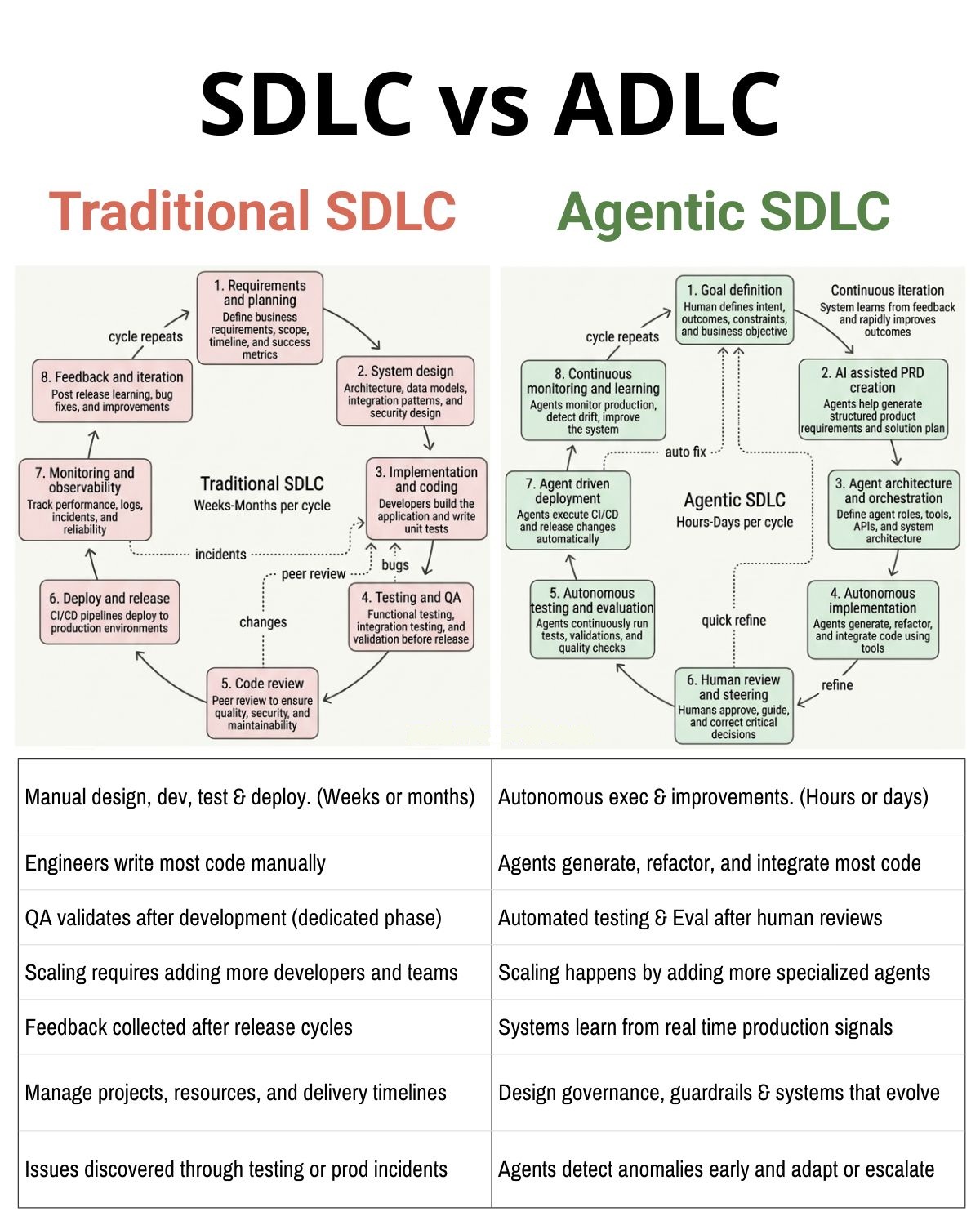
The software development landscape is undergoing its most profound transformation in six decades. For generations, our focus has been on optimizing human engineers to write code more efficiently. Today, that paradigm is shifting dramatically. We are entering an era where AI agents are not just assisting in code generation but are autonomously building and optimizing entire systems. This isn’t merely an incremental improvement; it’s a fundamental re-architecture of how software is conceived, created, and deployed.
The traditional Software Development Life Cycle (SDLC) is characterized by manual human intervention at every stage, leading to lengthy development cycles, bottlenecks, and the unfortunate reality that many innovative ideas never see the light of day due to prohibitive costs. However, the rise of AI agents is quietly rewriting this playbook, ushering in the Agentic Development Life Cycle (ADLC). This new era promises accelerated development, parallel execution, and the ability to pursue projects previously deemed unviable.
This comprehensive guide will delve into the core differences between the Traditional SDLC and the emergent Agentic SDLC (ADLC). We will explore the critical skills necessary to navigate this shifting landscape and provide a roadmap for embracing the future of software engineering.
The Old Guard: Understanding the Traditional SDLC
For decades, the Traditional SDLC has been the bedrock of software engineering. It’s a structured approach, typically involving a series of sequential phases, each requiring significant human effort and coordination.
The Linear Workflow: Weeks to Months Per Cycle
The Traditional SDLC operates on a linear, human-centric model. Each step is typically a discrete phase, with handovers between teams and individuals often creating delays and communication overhead.
1. Requirements and Planning
This initial phase involves defining the business requirements, scope, timeline, and success metrics for the software project. This is a critical step, as any ambiguity here can have cascading effects down the line. It’s a phase heavily reliant on human communication, negotiation, and documentation.
2. System Design
Once requirements are clear, architects and designers craft the system’s architecture, define data models, integration patterns, and establish security designs. This is where the blueprint for the software is created, often through extensive documentation and collaboration.
3. Implementation and Coding
This is the core development phase where engineers manually write every line of code and unit tests. This process can be labor-intensive and is often the longest phase in the traditional SDLC. Quality and speed are highly dependent on individual developer skill and team coordination.
4. Testing and QA
Following implementation, a dedicated Quality Assurance (QA) team performs functional testing, integration testing, and validation to identify bugs and ensure the software meets the specified requirements before release. This can be an iterative process involving bug reports and fixes.
5. Code Review
Before merging code into the main branch, peer reviews are conducted to ensure code quality, security, and maintainability. This human-driven step is crucial for catching errors and ensuring adherence to coding standards.
6. Deploy and Release
After successful testing and code review, the software is deployed to production environments, typically through Continuous Integration/Continuous Delivery (CI/CD) pipelines. Even with automation, human oversight and approval are often required.
7. Monitoring and Observability
Once in production, the software’s performance, logs, incidents, and reliability are tracked. This proactive monitoring helps identify issues and ensure the system operates as expected.
8. Feedback and Iteration
Post-release, learning from bug fixes, user feedback, and performance data informs future improvements and iterations. This iterative loop, while present, can be slow due to the inherent manual nature of its preceding stages.
Inherent Challenges of the Traditional SDLC
The traditional approach, while proven, presents several challenges in today’s rapidly evolving technological landscape:
- Manual Development Bottleneck: Engineers writing every line of code manually is a significant limiting factor in terms of speed and scalability.
- Weeks-to-Months Development Cycles: The sequential nature and manual effort involved mean that development cycles are often measured in weeks or even months, delaying time to market for new features.
- Cross-Team Bottlenecks: Handovers between different teams (e.g., development, QA, operations) often create communication and coordination overhead, killing momentum.
- Scaling Pain Points: Scaling development typically requires adding more developers and teams, which comes with increased management overhead and diminishing returns in terms of efficiency.
- Delayed Feedback Loops: Feedback from production environments is collected after release cycles, meaning issues might persist longer before being addressed.
- Reactive Issue Resolution: Issues are primarily discovered through testing or production incidents, leading to a reactive rather than a proactive approach to problem-solving.
- High Cost of Innovation: The extensive manual effort makes many good ideas too expensive to pursue, stifling innovation.
The “Copilot Era” introduced tools like GitHub Copilot and ChatGPT, serving as advanced assistants for human developers. While valuable, these tools are fundamentally reactive, waiting for human prompts and suggesting code, rather than autonomously driving the development process.
The New Frontier: Embracing the Agentic SDLC (ADLC)
The Agentic SDLC, or ADLC, represents a profound shift from human execution to agent execution. It’s a paradigm where AI agents assume ownership of significant portions of the software lifecycle, enabling unprecedented speed, efficiency, and innovation.
Autonomous Loops: Hours to Days Per Cycle
The ADLC fundamentally redefines the workflow, moving from linear pipelines to continuous, autonomous loops. This is often described as an “OODA” Loop (Observe, Orient, Decide, Act), initially a military strategy concept now applied to autonomous software engineering.
1. Goal Definition
Instead of defining granular requirements, humans define the overarching intent, desired outcomes, constraints, and business objectives. This higher-level guidance sets the stage for the agents’ autonomous work.
2. AI-Assisted PRD Creation
AI agents leverage the defined goals to assist in generating structured Product Requirement Documents (PRDs) and solution plans. This phase significantly accelerates the initial planning by automating the translation of high-level objectives into actionable plans.
3. Agent Architecture and Orchestration
Here, humans focus on defining agent roles, specifying the tools and APIs they can use, and designing the overall system architecture within which agents will operate. This is about setting up the autonomous ecosystem.
4. Autonomous Implementation
This is where the magic happens. AI agents generate, refactor, and integrate most of the code using the specified tools and architectural guidelines. They don’t just suggest code; they write, test, and integrate it autonomously.
5. Autonomous Testing and Evaluation
Agents continuously run tests, validations, and quality checks. This integrated and continuous testing eliminates the dedicated QA phase of the traditional SDLC, providing immediate feedback on code quality.
6. Human Review and Steering
While agents handle much of the implementation, human developers provide critical oversight. They approve changes, guide agents in complex scenarios, and make critical decisions that require human judgment. This is a supervised autonomy model.
7. Agent-Driven Deployment
Agents execute CI/CD pipelines and release changes automatically, often without direct human intervention for routine deployments. This further accelerates the deployment process.
8. Continuous Monitoring and Learning
Agents continuously monitor production environments, detect drift (deviations from expected behavior), and learn from real-time production signals to improve the system autonomously. This creates a continuous iteration loop, rapidly improving outcomes based on live data.
The Transformative Power of ADLC
The shift to ADLC brings a wave of transformative benefits:
- Autonomous Execution and Improvement: Agents don’t just assist; they take ownership. They execute tasks, identify areas for improvement, and implement solutions autonomously.
- Accelerated Cycles (Hours to Days): The automation of significant portions of the SDLC drastically reduces development cycles from weeks or months to hours or days.
- Agent-Generated Code: Agents generate, refactor, and integrate most of the code, freeing human engineers from the rote task of typing.
- Automated Testing and Evaluation: Testing becomes an continuous, integrated process performed by agents, providing rapid feedback and quality assurance.
- Scalability Through Specialization: Scaling no longer solely relies on adding more human developers. Instead, it happens by adding more specialized agents, each designed for specific tasks.
- Real-time Learning from Production: Systems learn and adapt based on real-time production signals, enabling continuous optimization and proactive issue resolution.
- Enhanced Governance and Evolution: Human efforts shift towards designing governance, establishing guardrails, and architecting systems that can evolve autonomously.
- Proactive Anomaly Detection: Agents are designed to detect anomalies early, adapt to changes, or escalate critical issues to human oversight.
Gartner predicts that 33% of enterprise software applications will contain agentic AI by 2028, a significant jump from less than 1% in 2024. Deloitte estimates that 25% of businesses intending to employ GenAI will roll out agentic pilots in the next five years, focusing on planning, implementation, and objective achievement with minimal oversight.
SDLC vs. ADLC: A Comparative Overview
| Feature | Traditional SDLC | Agentic SDLC (ADLC) |
|---|---|---|
| Development Cycle | Weeks to months per cycle | Hours to days per cycle |
| Code Generation | Engineers write most code manually | Agents generate, refactor, and integrate most code |
| Quality Assurance | QA validates after development (dedicated phase) | Automated testing & evaluation after human reviews (continuous) |
| Scaling | Requires adding more developers and teams | Happens by adding more specialized agents |
| Feedback Loop | Collected after release cycles | Systems learn from real-time production signals |
| Project Management | Manage projects, resources, and delivery timelines manually | Design governance, guardrails, and systems that evolve |
| Issue Detection | Discovered through testing or production incidents | Agents detect anomalies early and adapt or escalate proactively |
| Human Role | Executor, Coder, Tester, Manager | Architect, Orchestrator, Supervisor, Problem Framer, Decision-Maker |
This comparative table highlights the fundamental shift in responsibilities and processes. The ADLC moves software development from a human-centric, reactive endeavor to an agent-driven, proactive, and continuously evolving system.
The Agentic Shift: Redefining the Enterprise SDLC from Assistance to Autonomy
The transition from the Copilot Era, characterized by AI assistance, to the Agentic Era, defined by autonomy, is redefining the enterprise Software Development Life Cycle. Generative AI increased the typing speed of individual developers; Agentic AI, however, fundamentally changes the physics of the SDLC. It shifts the entire cognitive workflow, from requirements analysis to quality assurance.
The “First Responder” Workflow
AI agents are becoming the “first responders” in the SDLC, managing the heavy lifting and allowing developers to evolve into system architects and supervisors.
Eliminating Cognitive Idle Time
In a traditional sprint, a task might sit in a “To Do” state for days. With an autonomous agent, the moment a ticket is assigned, the clock starts. The agent performs a semantic analysis of the ticket, syncs relevant repositories, and makes a binary decision: request clarification if ambiguity exists or proceed with implementation. This can lead to a Pull Request being generated in under 15 minutes, pushing the backlog to be a high-pressure environment where tickets must be sufficiently detailed for agents to act upon them.
Autonomous Iteration and Feedback Management
The bottleneck of code reviews, often a “ping-pong” of comments and revisions, is also transformed. When a human reviewer leaves a comment on an agent-generated PR, the agent analyzes the intent and either responds or pushes a new commit instantly. This autonomous feedback management reduces review latency from hours to seconds, keeping human developers in a “flow state” of high-level supervision.
The Death of the “Typing” Developer
The long-held perception of a software engineer as someone who “types code into a computer” is rapidly becoming obsolete. In the Agentic Era, syntax is no longer the bottleneck. When an AI agent can generate thousands of lines of functional, tested code in seconds, the value of a human “typist” diminishes significantly. The developer of the near future will be an editor and an architect.
Imagine a world where:
- Deployment is handled by agents that monitor real-time user metrics and roll back code before a human even sees the alert.
- Execution is done by agents spinning up ephemeral environments to test hypotheses.
- Planning is done by agents analyzing user feedback and technical debt.
Mastering the New Paradigm: 7 Essential Skills for the Agentic Era
To thrive in this agentic future, developers, architects, and leaders must cultivate a new set of skills. These are not about writing more code but about orchestrating intelligence, critical thinking, and strategic design.
1. Problem Framing: Surgical Precision in Defining Intent
In an agentic world, the quality of the output is directly proportional to the clarity of the input. Engineers must develop surgical precision in defining the intent behind a software project. This goes beyond traditional requirements gathering; it involves articulating high-level goals, desired outcomes, constraints, and acceptance criteria in a way that AI agents can unambiguously understand and act upon.
- Why it’s critical: Agents lack intuition. Vague instructions lead to suboptimal or incorrect outputs. Precise problem framing sets the foundation for successful autonomous execution.
- Developing the skill: Practice articulating problems with extreme clarity. Use structured formats, define edge cases explicitly, and think deeply about the “why” behind every feature.
2. Context Engineering: Designing Durable AI Systems
Context engineering involves designing the robust and adaptable environments in which AI agents operate. This includes defining the data sources, tools, APIs, and communication protocols that agents will use. It’s about building the “nervous system” of your autonomous software factory.
- Why it’s critical: Agents need reliable and relevant context to function effectively. A poorly engineered context can lead to agents making incorrect assumptions or failing to integrate properly.
- Developing the skill: Gain expertise in API design, data modeling, microservices architecture, and understanding how different software components interact. Think about how to make systems “AI-operable.”
3. Agent Delegation: Coordinating Parallel Workflows
The ability to delegate tasks effectively to multiple AI agents, coordinating their parallel workflows, is paramount. This involves breaking down complex problems into smaller, manageable sub-problems that can be assigned to specialized agents, and then orchestrating their collaboration.
- Why it’s critical: True autonomous development involves multiple agents working concurrently. Effective delegation minimizes bottlenecks and maximizes throughput.
- Developing the skill: Study distributed systems, learn about multi-agent systems, and practice decomposing complex problems. Experiment with different agent coordination strategies.
4. Critical Judgment: Quality and Risk Evaluation
Even with autonomous agents, human critical judgment remains indispensable. This involves evaluating the quality of agent-generated code, assessing potential risks, and making strategic decisions that agents cannot. It’s about discerning when to trust an agent’s output and when to intervene.
- Why it’s critical: Agents can make mistakes, and their outputs need human oversight, especially for critical systems.
- Developing the skill: Enhance your understanding of software architecture, security best practices, performance optimization, and ethical AI implications. Cultivate a skeptical yet open mindset.
5. Verification Design: Automated Quality Gates
As agents take over more of the development and testing, designing sophisticated automated quality gates becomes crucial. This involves creating robust test suites, validation frameworks, and monitoring mechanisms that can autonomously verify the correctness, performance, and security of agent-generated code.
- Why it’s critical: Automated verification ensures high-quality output and provides confidence in the agents’ work, reducing the need for manual checks.
- Developing the skill: Master test-driven development (TDD), behavior-driven development (BDD), performance testing, security testing, and the design of advanced CI/CD pipelines with integrated quality checks.
6. Toolchain Architecture: AI-Operable Infrastructure
The underlying infrastructure must be designed to be “AI-operable.” This means creating toolchains, platforms, and environments that agents can seamlessly interact with, deploy to, and monitor. It’s about building an infrastructure that speaks the language of AI.
- Why it’s critical: Agents need a standardized, accessible, and programmable environment to perform their tasks efficiently.
- Developing the skill: Deepen your knowledge of DevOps, cloud computing, Infrastructure as Code (IaC), containerization, and platform engineering. Think about how to expose infrastructure capabilities as APIs for agents.
7. Intelligence Orchestration: Human-AI Symbiosis
This is the ultimate skill: orchestrating a seamless symbiosis between human intelligence and AI agents. It involves designing workflows where humans and AIs collaborate effectively, leveraging the strengths of each. It’s about building intelligent systems where the whole is greater than the sum of its parts.
- Why it’s critical: The future isn’t about replacing humans but augmenting them. Effective human-AI collaboration unlocks unprecedented levels of productivity and innovation.
- Developing the skill: Focus on human-computer interaction (HCI), user experience (UX) design for agent-based systems, and understanding the cognitive biases and strengths of both humans and AI.
The Uncomfortable Choice: Adapt or Fall Behind
The gap between organizations embracing agentic AI and those clinging to traditional methods is widening every week. The ability to ship software 97% faster is not a minor advantage; it’s a paradigm shift that will redefine competitive landscapes. Your uncomfortable choice is clear: either continue operating with the traditional playbook, risking obsolescence, or proactively acquire these essential skills before the gap becomes permanent.
The future of software development is not just about tools; it’s about a fundamental change in how we think, design, and create. It’s about moving from an era of human-driven execution to one of intelligent, autonomous, and continuously improving systems.
Embrace the Agentic Future with IoT Worlds
At IoT Worlds, we understand the profound implications of the Agentic Shift for businesses across all industries. Our expertise in AI, IoT, and advanced software engineering can guide your organization through this transformative period, helping you leverage the power of Agentic AI to drive innovation, accelerate development, and maintain a competitive edge.
From architecting AI-operable infrastructures to designing sophisticated agentic workflows, we provide the strategic insights and practical solutions you need to master the ADLC. Don’t be left behind in the greatest shift in software development in 60 years.
To learn more about how Agentic AI can revolutionize your software development lifecycle and to explore our services, send an email to info@iotworlds.com.