NVIDIA has moved far beyond being “just a GPU company”.
We see something much bigger:
- Dozens of cloud and colocation partners delivering GPU compute
- Autonomous‑vehicle and robotics (for example humanoids) companies building on DRIVE and Isaac
- Foundation‑model labs, LLM platforms, and AI research houses
- Enterprise‑software vendors embedding NVIDIA acceleration
- Quantum‑computing startups, semiconductor partners, and OEMs
- Healthcare, industrial digital‑twin, and video‑analytics
It’s a guide to the IoT + AI stack that will power smart factories, connected vehicles, digital cities, precision healthcare, next‑generation consumer devices and much more.
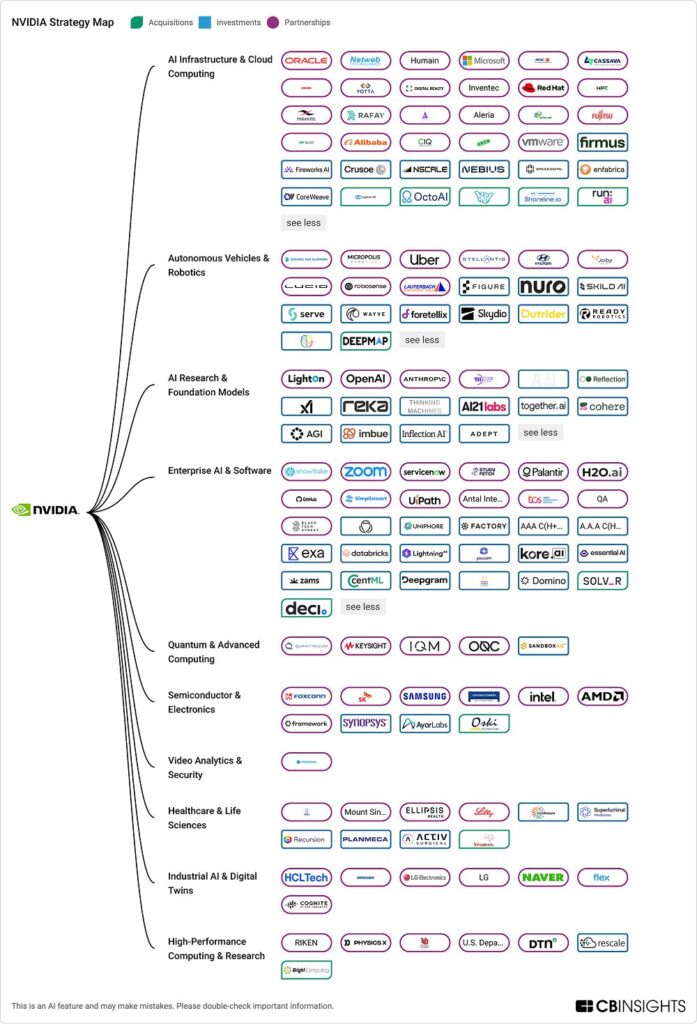
Here the NVIDIA Strategy Map:
1. Why NVIDIA’s Ecosystem Matters for IoT and AI
Before dissecting the segments, it’s worth understanding why NVIDIA sits at the center of so many AI and IoT strategies.
1.1 From Graphics to General‑Purpose Acceleration
NVIDIA started with GPUs for gaming and graphics. But once researchers realized that GPUs are extremely good at parallel math, NVIDIA built:
- CUDA – a programming model that lets developers run general‑purpose code on GPUs
- cuDNN, TensorRT, and other libraries – optimized building blocks for neural networks and numerical computing
As a result, almost every deep‑learning framework and many HPC codes can be accelerated on NVIDIA GPUs. This made NVIDIA the default hardware layer for AI.
1.2 Platforms, Not Just Chips
Over the last decade, NVIDIA has evolved into a platform company:
- Datacenter: A100/H100 (H200) GPUs, DGX and HGX systems, networking (InfiniBand, Ethernet), and full AI supercomputers
- Edge & IoT: Jetson modules, IGX, DRIVE for autonomous vehicles, and Clara for healthcare
- Software & Services: CUDA, TensorRT, cuOpt, cuQuantum, NeMo for LLMs, Omniverse for digital twins, NVIDIA AI Enterprise, DGX Cloud
Companies plug into these platforms with:
- Cloud services
- Pre‑built applications
- Domain‑specific solutions
- Systems integration and consulting
For IoT builders, this means you don’t have to start from scratch. You can assemble solutions out of compatible hardware, SDKs, and partner products.
2. AI Infrastructure & Cloud Computing: Where IoT Data Meets GPU Power
The top segment of the strategy map is AI Infrastructure & Cloud Computing. Here you see hyperscalers, GPU clouds, data‑center operators, and orchestration platforms.
2.1 Hyperscaler Clouds
Major cloud providers appear on the map—companies like:
- Large global clouds (e.g., AWS, Microsoft, Google Cloud, Oracle, Alibaba)
- Regional providers and telecoms offering GPU instances
These partners provide:
- On‑demand GPU compute – ideal for training deep‑learning models, simulation, and large‑scale analytics
- Managed AI services – AutoML, vision APIs, speech, and LLM endpoints all accelerated by NVIDIA GPUs
- Hybrid solutions – where organizations combine on‑prem DGX/HGX systems with cloud bursting
Why this matters for IoT:
- IoT deployments generate massive time‑series and media data (video, audio, lidar).
- Training accurate models for anomaly detection, forecasting, or perception generally happens in the cloud.
- Hyperscalers + NVIDIA allow you to scale up to clusters of thousands of GPUs when needed, then scale down.
2.2 GPU Cloud Specialists and Colocation Providers
The map also shows:
- GPU‑cloud startups and specialists providing bare‑metal or virtualized GPU clusters.
- Colocation and data‑center companies that offer NVIDIA‑certified infrastructure where enterprises can host their own gear.
These players matter when:
- You need dedicated performance and predictable costs beyond general‑purpose clouds.
- Regulatory or data‑sovereignty requirements mean you must keep data in specific regions or facilities.
- Latency is critical for IoT backends serving autonomous vehicles, trading systems, or AR/VR.
2.3 Orchestration and Infrastructure Software
Partners building:
- Kubernetes and AI‑cluster management with GPU awareness
- MLOps and data‑pipeline orchestration optimized for GPU workloads
- Tools for utilization tracking, cost management, and scheduling
Together, this segment ensures that no matter where your IoT workloads live, you can access NVIDIA acceleration in a cloud‑native way.
3. Autonomous Vehicles & Robotics: NVIDIA DRIVE and Isaac
The second major cluster is Autonomous Vehicles & Robotics. Here you’ll find:
- Autonomous‑vehicle companies (robotaxis, trucking, last‑mile delivery)
- Robotics startups (manipulation, warehouse, humanoids)
- Mapping and simulation providers
- Industrial‑automation and AMR (autonomous mobile robot) platforms
3.1 NVIDIA DRIVE for AVs
NVIDIA’s DRIVE platform provides:
- High‑performance SoCs (e.g., DRIVE Orin, DRIVE Thor)
- A full software stack for perception, localization, planning, and driver‑monitoring
- Simulation tools for validating autonomous systems
Partners on the map collaborate with NVIDIA to:
- Build robotaxi fleets and self‑driving trucks
- Integrate advanced ADAS features into passenger vehicles
- Create HD maps and localization services
- Deploy Level 2+ to Level 4 autonomy in specific domains (highways, urban cores, depots)
IoT connection: Every autonomous vehicle is essentially a rolling IoT super‑node:
- Dozens of cameras, radars, lidars, and ultrasonic sensors
- Vehicle telemetry, V2X communication, and cloud connectivity
- Over‑the‑air (OTA) updates and remote diagnostics
NVIDIA’s role is to provide the on‑board compute and AI models that can process all of this data in real time.
3.2 Isaac for Robotics
NVIDIA Isaac is its robotics platform, consisting of:
- Isaac Sim – robotics simulation in Omniverse
- Isaac ROS and Isaac SDK – perception, mapping, and control packages
- Pre‑trained models for vision and manipulation tasks
Robotics partners in the map use these tools to:
- Develop warehouse robots, factory cobots, humanoid robots, and inspection drones
- Train policies and validate them in simulation before deployment
- Run high‑performance inference on Jetson or other embedded GPUs
For IoT Worlds readers, this is where industrial IoT and robotics meet:
- Robots become both actuators in IoT systems and sources of rich telemetry.
- Factory and warehouse operators integrate robot data into MES, WMS, and digital‑twin platforms.
- Edge AI (on NVIDIA SoCs) is essential because connectivity is not always reliable or low‑latency.
4. AI Research & Foundation Models: The Brains of the Ecosystem
Another section on the strategy map highlights AI Research & Foundation Models:
- LLM labs and foundation‑model providers
- Startups training multimodal models (text, image, code, speech, video)
- Companies like OpenAI, Anthropic, and others building next‑generation AI systems
4.1 Foundation Models as Infrastructure
Foundation models—large language models (LLMs), vision‑language models, code models—are quickly becoming a new kind of infrastructure:
- Teams fine‑tune or prompt them for diverse tasks: support, analytics, planning, code generation.
- IoT developers use them as reasoning engines on top of sensor and operations data.
NVIDIA supports this layer with:
- NeMo and NVIDIA AI Enterprise for training/fine‑tuning;
- DGX Cloud for large‑scale training;
- Optimized inference runtimes (TensorRT‑LLM) for serving at scale.
Partners in this segment:
- Train state‑of‑the‑art models on NVIDIA hardware.
- Provide APIs that others can call.
- Collaborate on techniques like retrieval‑augmented generation (RAG) and agentic workflows.
4.2 Impact on IoT and Edge Applications
For IoT, foundation models unlock:
- Natural‑language interfaces to complex systems (“Why is line 3 underperforming today?”).
- Code generation for PLC logic, edge‑analytics pipelines, or dashboard queries.
- Multimodal understanding of video feeds, sensor anomalies, maintenance logs, and manuals.
NVIDIA’s partnerships ensure these models run efficiently on its GPUs from cloud to edge.
5. Enterprise AI & Software: Turning GPU Power Into Business Value
Moving down the strategy map, we reach Enterprise AI & Software—a dense cluster filled with:
- Data‑cloud and data‑warehouse platforms
- Workflow and productivity apps
- CRM, ERP, and vertical SaaS providers
- Low‑code, automation, and RPA tools
- MLOps, analytics, and data‑science platforms
5.1 Data Platforms and Analytics
Partners here integrate NVIDIA acceleration to:
- Speed up SQL analytics, dashboards, and BI at massive scale
- Power recommendation engines, personalization, and fraud detection
- Run feature‑engineering and machine‑learning pipelines faster and cheaper
Examples include:
- Data‑warehouse vendors accelerating queries on GPU
- Lakehouse and MLOps providers optimizing training and inference
IoT perspective:
- Industrial and IoT deployments generate petabytes of data.
- Traditional CPU‑only analytics struggle to keep up; GPU‑accelerated data platforms can handle high‑cardinality, high‑velocity time‑series.
- Enterprise AI stacks built on NVIDIA reduce the lag between data collection and business decisions.
5.2 Workflow and Business‑Application Partners
You’ll also see:
- Collaboration and video‑conferencing apps accelerating background effects, transcription, and summarization
- CRM and ERP systems embedding AI copilots for sales, support, and finance
- RPA and automation platforms using GPUs to process documents, images, and conversations
These integrations matter for IoT in two ways:
- Operational Efficiency: IoT insights need to flow into human workflows—maintenance tickets, purchase orders, capacity planning. AI‑enhanced enterprise apps help close that loop.
- Customer‑Facing Services: Insurers, utilities, logistics firms, and manufacturers can build connected‑product experiences where AI copilots help users interpret sensor data or control devices.
6. Quantum & Advanced Computing: Preparing for the Next Wave
The strategy map includes a smaller but important category: Quantum & Advanced Computing.
6.1 Why NVIDIA Cares About Quantum
Quantum computing is still early, but NVIDIA’s strategy is to:
- Provide simulation environments where quantum algorithms can be developed and tested on GPUs.
- Partner with quantum‑hardware vendors integrating with CUDA‑like toolchains.
- Explore hybrid quantum‑classical workflows where GPUs handle classical-heavy parts.
For IoT and AI developers:
- Most workloads remain classical in the near term, but research into optimization, materials, chemistry, and cryptography may eventually leverage quantum accelerators.
- NVIDIA’s involvement means future quantum systems will likely plug into existing AI and HPC workflows.
7. Semiconductor & Electronics: Extending the Hardware Stack
The Semiconductor & Electronics segment shows:
- Foundries and chip manufacturers
- OEMs integrating NVIDIA GPUs into systems
- EDA (electronic‑design‑automation) software providers
7.1 Partnering Across the Silicon Supply Chain
NVIDIA relies on these partners to:
- Fabricate its most advanced GPUs and SoCs.
- Build reference designs and OEM systems for servers, workstations, and edge devices.
- Use NVIDIA acceleration inside EDA tools themselves to design next‑generation chips faster.
For IoT builders:
- Many industrial gateways, embedded boards, and edge servers feature NVIDIA Jetson or discrete GPUs provided through these OEMs.
- Understanding this hardware ecosystem helps you choose reliable platforms with long lifecycle support and industrial temperature ratings.
8. Video Analytics & Security: Seeing the World With AI
Another dedicated slice on the strategy map: Video Analytics & Security.
8.1 From IP Cameras to Smart Video Platforms
Traditional CCTV generated enormous amounts of footage that humans rarely watched. With NVIDIA GPUs and partner solutions, use cases include:
- Real‑time object detection (people, vehicles, packages)
- License‑plate recognition and parking management
- Perimeter and intrusion detection
- Safety monitoring in factories, warehouses, and construction sites
- Retail analytics (footfall, dwell time, queue length)
8.2 IoT and Smart‑City Implications
Video analytics is one of the heaviest IoT workloads:
- A single 1080p camera streaming at 30 fps generates huge data volumes.
- Processing at the edge—using Jetson modules or GPU‑equipped NVRs—is essential to avoid saturating networks.
NVIDIA’s partners provide:
- Pre‑trained models and pipelines optimized for their GPUs
- VMS (video‑management systems) integrated with AI analytics
- Industrial‑grade hardware for transport, city infrastructure, and critical sites
9. Healthcare & Life Sciences: Drug Discovery and Smart Hospitals
The Healthcare & Life Sciences section of the strategy map includes:
- Academic medical centers and hospitals
- Biotech and pharma companies
- Imaging‑AI startups and digital‑pathology vendors
9.1 Medical Imaging and Diagnostics
NVIDIA’s Clara platform focuses on:
- Radiology (CT, MRI, X‑ray), cardiology, and ultrasound
- Digital pathology and whole‑slide imaging
- Federated‑learning frameworks so hospitals can collaborate without sharing raw data
Partners build:
- AI models for tumor detection, organ segmentation, and triage
- Workflow tools integrated with PACS/RIS/HIS systems
- Edge appliances for on‑prem inference and privacy preservation
9.2 Drug Discovery and Genomics
In life sciences, NVIDIA GPUs accelerate:
- Molecular dynamics and docking simulations
- Genomic alignment and variant calling
- AI‑driven molecule design and protein‑structure prediction
Biotech and pharma partners on the map leverage NVIDIA DGX systems and cloud GPUs to shorten R&D cycles.
9.3 IoT Angle: Connected Medical Devices and Hospitals
- Many imaging systems, patient monitors, and lab instruments now include embedded GPUs or connect to GPU‑accelerated servers.
- Smart‑hospital projects integrate AI imaging, patient‑flow analytics, and building management into unified dashboards.
- Remote‑monitoring devices and wearables feed data into AI models running on NVIDIA infrastructure.
10. Industrial AI & Digital Twins: Omniverse for the Physical World
The Industrial AI & Digital Twins segment points to a critical NVIDIA bet: Omniverse and simulation.
10.1 What Is a Digital Twin?
A digital twin is a dynamic virtual replica of a real‑world asset, process, or system:
- A factory, warehouse, or production line
- A power plant or substation
- A robot fleet or autonomous‑vehicle environment
- A city district, port, or transportation network
Digital twins combine:
- 3D geometry and physics
- Real‑time IoT data (sensors, PLCs, telemetry)
- AI models predicting behavior and optimizing decisions
10.2 NVIDIA Omniverse
NVIDIA Omniverse provides:
- A simulation and collaboration environment built on open USD (Universal Scene Description).
- Connectors to CAD, BIM, and PLM tools.
- Physically accurate rendering and simulation (materials, lighting, physics).
- Integration with AI models for perception, control, and optimization.
Partners in this segment deliver:
- Industrial‑IoT platforms feeding data into Omniverse.
- Vertical solutions for manufacturing, logistics, energy, and cities.
- Consulting and integration for large enterprises.
IoT impact:
- Instead of just storing sensor data in dashboards, organizations visualize and experiment with it in a twin.
- Scenario planning (what‑if analysis) becomes interactive and data‑driven.
- Autonomous systems (robots, AGVs, drones) can be trained and validated in the twin before deployment.
11. High‑Performance Computing & Research: AI + Scientific Discovery
At the bottom of the map you see High‑Performance Computing (HPC) & Research:
- National labs and research institutes
- Weather‑forecasting and climate‑modeling centers
- Universities and government agencies
11.1 HPC Meets AI
These organizations use NVIDIA GPUs for:
- Climate and weather simulation
- Astrophysics, cosmology, and particle physics
- Computational fluid dynamics (CFD) and structural analysis
- Materials science and chemistry
- Fusion‑energy and nuclear modeling
Increasingly, they also run:
- AI surrogate models that accelerate or augment classical simulations
- Hybrid workflows where HPC codes generate training data for deep‑learning models
For IoT and smart‑infrastructure projects, HPC comes into play when:
- Modeling power grids, traffic systems, or environmental dynamics at large scale
- Creating high‑fidelity twins of regions, buildings, or industrial assets
- Running optimization at city or national level (energy dispatch, logistics planning)
12. What the NVIDIA Strategy Map Means for IoT Builders
Now that we’ve walked through each segment, how should IoT business leaders, developers, product managers, and architects interpret this strategy map?
12.1 NVIDIA Is Building a “Full‑Stack AI Utility”
From chips and boards to cloud platforms, digital twins, and domain‑specific SDKs, NVIDIA aims to be a one‑stop AI stack.
For IoT:
- You can design sensor‑rich devices that speak directly to NVIDIA edge platforms (Jetson, IGX, DRIVE).
- You can send data to GPU‑accelerated clouds for training and heavy analytics.
- You can visualize and optimize systems in Omniverse‑based twins.
- You can plug into partner applications in verticals like healthcare, automotive, manufacturing, and energy.
12.2 Ecosystem > Single Vendor
The map emphasizes partnerships and investments, not only acquisitions. NVIDIA knows:
- Domain expertise (insurance, retail, healthcare, energy) lives with partners.
- Successful IoT projects require hardware + software + services.
- Standards and interoperability are key for adoption.
As an IoT builder, you’re not limited to NVIDIA‑branded solutions. You can:
- Choose from a broad range of partners that are already optimized for NVIDIA hardware.
- Avoid lock‑in at the application level while still benefiting from a strong hardware/software base.
12.3 Edge–Cloud Continuum
Most IoT architectures need both edge and cloud:
- Edge: low latency, local control, privacy
- Cloud: heavy compute, large‑scale learning, central management
NVIDIA’s strategy map shows alignment across this continuum:
- Jetson and DRIVE at the edge
- DGX, HGX, and GPUs in clouds and colos
- Software stacks (CUDA, TensorRT, NeMo, Omniverse) operating seamlessly across both
13. Practical Guidance: How to Plug Into the NVIDIA Ecosystem
13.1 For Startups
If you’re building a startup in IoT, robotics, or AI:
- Pick the right hardware tier
- For embedded/edge: Jetson modules (Nano, Orin variants) or DRIVE/IGX for safety‑critical use.
- For training and simulation: cloud GPUs or rentable DGX instances.
- Leverage NVIDIA SDKs
- DeepStream for video analytics
- Isaac for robotics
- DRIVE for autonomous driving
- Metropolis frameworks for smart cities and retail
- Omniverse for digital twins
- Seek ecosystem programs
- NVIDIA Inception for startups offers credits, marketing support, and technical resources.
- Many cloud and colocation partners also run accelerator programs.
- Design for portability
- Use containers (e.g., Docker with NVIDIA runtime) and Kubernetes where possible.
- Abstract hardware specifics so you can scale across multiple GPU providers.
13.2 For Enterprises
If you’re in a large enterprise—manufacturing, energy, logistics, healthcare:
- Map your use cases to NVIDIA segments
- Robotics and AMRs → Autonomous Vehicles & Robotics segment
- Smart buildings, plants, or grids → Industrial AI & Digital Twins + Video Analytics
- Connected products and customer analytics → Enterprise AI & Software
- Engage both NVIDIA and its partners
- NVIDIA provides platform guidance.
- Partners bring domain knowledge, integration, and managed services.
- Plan for governance and skills
- Train internal teams on GPU programming, MLOps, and data‑engineering.
- Establish AI ethics, security, and compliance frameworks, especially for regulated industries.
- Think in phases
- Start with observability (collecting and storing IoT data).
- Move to insight (dashboards, anomaly detection).
- Then to autonomy and optimization (closed‑loop control, digital twins, robotics).
13.3 For Developers and Engineers
On a practical level:
- Learn CUDA basics and how to use high‑level frameworks (PyTorch, TensorFlow, Triton Inference Server) on NVIDIA GPUs.
- Experiment with Jetson developer kits for edge AI.
- Explore Omniverse and Isaac Sim if you work with robotics or digital twins.
- Use NGC (NVIDIA GPU Cloud) containers as starting points for AI workflows.
15. FAQ: NVIDIA Strategy Map and IoT
What is the NVIDIA Strategy Map?
The NVIDIA Strategy Map is a visualization of the company’s partnerships, investments, and acquisitions across key AI and computing domains, including AI infrastructure, autonomous vehicles, robotics, foundation models, enterprise AI, quantum computing, semiconductors, healthcare, industrial digital twins, and more.
Why is NVIDIA so important for IoT and edge AI?
NVIDIA provides a full stack—GPUs, embedded modules, networking, SDKs, and software platforms—that accelerates AI workloads. IoT deployments rely on AI for perception, prediction, optimization, and automation. NVIDIA’s hardware and ecosystem make it easier to run these workloads both at the edge (Jetson, DRIVE, IGX) and in the cloud (DGX, HGX, GPU instances).
How does NVIDIA support autonomous vehicles and robotics?
Through its DRIVE platform (for vehicles) and Isaac (for robotics), NVIDIA offers specialized SoCs, reference algorithms, simulation tools, and software stacks for perception, localization, planning, and control. Many autonomous‑vehicle companies, robot manufacturers, and logistics operators build their systems on these platforms.
What role do foundation‑model partners play in NVIDIA’s strategy?
Foundation‑model labs and LLM providers train their models on NVIDIA GPUs and often collaborate on optimization and deployment. These models become core building blocks for enterprise AI, including IoT applications that need natural‑language interfaces, multimodal understanding, or agentic reasoning.
What is Omniverse and why is it relevant to IoT?
NVIDIA Omniverse is a platform for building and operating 3D digital twins of real‑world systems. IoT data from factories, power plants, cities, and vehicles can be streamed into Omniverse to create live, interactive twins. This enables scenario planning, optimization, and training of autonomous systems in realistic virtual environments.
Do I need to use only NVIDIA hardware to benefit from this ecosystem?
No. Many partners on the strategy map support multiple hardware vendors. However, NVIDIA’s ecosystem is designed to be deeply integrated; using NVIDIA GPUs and SDKs often simplifies compatibility, performance tuning, and access to specialized features like TensorRT, NeMo, or Omniverse.
How should a new IoT startup approach the NVIDIA ecosystem?
Startups should:
- Choose the NVIDIA edge or datacenter hardware that matches their performance and cost needs.
- Adopt relevant SDKs (DeepStream, Isaac, DRIVE, Clara, etc.).
- Join NVIDIA’s startup programs (such as Inception) for credits and support.
- Build on top of existing partner solutions where possible instead of reinventing infrastructure.
16. Final Thoughts: NVIDIA as a Backbone of the IoT + AI Era
The NVIDIA Strategy Map shows a simple truth:
The future of IoT with AI will not be built by a single company, but by an interconnected ecosystem—and NVIDIA aims to be its backbone.
By partnering across cloud providers, robotics firms, enterprise‑software vendors, research labs, and industry verticals, NVIDIA is positioning its GPUs and platforms as the default engine behind:
- Smart and autonomous vehicles
- Intelligent factories, logistics hubs, and power grids
- Digital‑twin simulations of buildings, cities, and supply chains
- AI‑assisted healthcare and scientific research
- Rich, real‑time analytics on top of IoT data streams
For IoT Worlds readers, understanding this ecosystem is not academic. It guides where to invest, which platforms to master, and which partners to collaborate with.
As you design your next IoT or AI project—whether it’s a robot fleet, a smart‑city camera network, a digital‑twin of a refinery, or a healthcare‑monitoring platform—ask:
- Which pieces of NVIDIA’s stack are most relevant?
- Which partners on the strategy map already operate in my vertical?
- How can I use this ecosystem to go from prototype to production faster, with better performance and lower risk?
Answering those questions is the first step toward building solutions that are not only connected, but truly intelligent, powered by one of the most significant ecosystems in the history of computing.