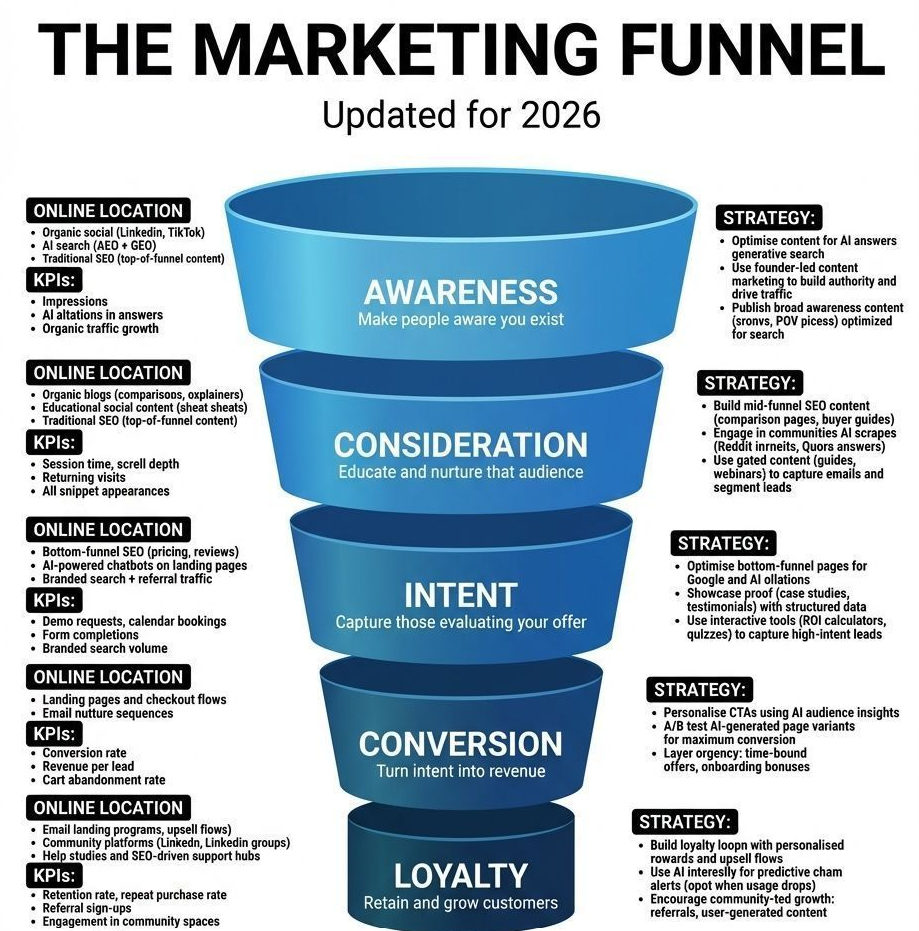
The digital marketing landscape is perpetually evolving, but 2026 marks a pivotal shift unlike any before. The rise of Artificial Intelligence (AI) and particularly large language models (LLMs) has fundamentally reshaped how consumers discover, evaluate, and ultimately purchase. What worked even a year or two ago is rapidly becoming obsolete. Many marketers are still crafting content primarily for human consumption, unaware that a significant, and growing, percentage of their “audience” is now composed of AI systems. These LLMs are the gatekeepers, the intelligence deciding what information people see, trust, and ultimately where they direct their buying power.
If your marketing funnel isn’t explicitly built to engage with these AI intermediaries, you’re already at a disadvantage. Continuing to operate with a 2018 marketing funnel in 2026 is akin to navigating with a paper map in an era of GPS. You’re not just falling behind; you’re actively losing demand to agile brands that have embraced this new paradigm. This comprehensive guide will dissect the AI-ready marketing funnel every business needs to thrive in 2026.
AI: The New Top of the Funnel
The traditional marketing funnel, with its linear progression from awareness to conversion, has been a cornerstone of marketing strategy for decades. However, AI, particularly generative AI, has blurred these lines and introduced a new, critical intermediary at every stage. For businesses aiming for sustained growth and relevance, understanding and adapting to this change is non-negotiable. AI is no longer just a tool; it’s a primary audience, and, critically, it’s becoming the new top of the funnel.
This isn’t about simply optimizing for AI search engines; it’s about optimizing for the entire ecosystem where AI interacts with and mediates information. From AI-powered search overviews to conversational assistants and curated content feeds, AI is increasingly the first point of contact for potential customers. If your content doesn’t resonate with these systems, it simply won’t reach your human audience. This means that Generative Engine Optimization (GEO) has become not just a buzzword, but a strategic imperative.
The Paradigm Shift: From Human-First to AI-Smart Content
Historically, marketers crafted content with human readability, engagement, and conversion in mind. While these elements remain crucial, the preliminary step now involves making content digestible, verifiable, and authoritative for AI. AI systems analyze user intent, context, and natural language far more adeptly than traditional keyword-focused search engines. They prioritize meaning, clear explanations, and genuinely helpful content. This necessitates a strategic pivot: content must be AI-smart before it can be human-engaging.
According to a 2025 survey, 35% of B2B marketers prioritize GEO as their top success metric, surpassing traditional SEO at 29%. This underscores the critical importance of adapting content strategies to cater to AI-driven discovery. The traditional buyer journey, a sequential progression through awareness, consideration, and intent, is being compacted and often entirely subsumed within AI interactions. Brand discovery, evaluation, and vendor comparison can now occur almost simultaneously within a single AI conversation or overview.
Why Traditional SEO Alone Is No Longer Enough
Traditional SEO, with its focus on keywords, backlinks, and ranking on search results pages, is still important. It provides the foundational structure and visibility that allows AI systems to crawl and index content. However, it’s no longer the sole arbiter of visibility. GEO extends these principles by focusing on optimizing content so that AI search engines can understand and confidently use it in their direct answers and generative responses. The goal shifts from getting a click to getting a brand mention, a citation, or even having your content directly integrated into an AI-generated answer.
This also means that the metrics of success are evolving. While traditional SEO tracks organic traffic and click-through rates, GEO introduces new KPIs such as AI citations, mentions within generative answers, and the overall visibility of your brand within AI-driven discovery platforms.
Awareness: Making People Aware You Exist
The top of the funnel – Awareness – has always been about casting a wide net to introduce your brand and solutions to a potential audience. In 2026, this stage is radically redefined by AI’s role in information dissemination. It’s no longer just about being found; it’s about being understood and recommended by AI.
Online Location and AI’s Influence
In 2026, the primary online locations for driving awareness have expanded significantly, with AI playing a central role:
- Organic Social (LinkedIn, TikTok): Platforms like LinkedIn and TikTok are not just for direct human engagement; their content increasingly feeds into AI models that influence trends, recommendations, and information summaries.
- AI Search (AEO + GEO): This is the game-changer. AI search engines like Google AI Overviews, OpenAI ChatGPT, and Perplexity AI are giving direct answers, often synthesizing information from various sources. Optimizing for these AI-generated responses (Generative Engine Optimization or GEO) is paramount.
- Traditional SEO (top-of-funnel content): While AI search is prominent, traditional search engines still direct traffic, and foundational top-of-funnel SEO remains essential for visibility. This includes broad informational content that addresses common pain points and questions.
Key Performance Indicators (KPIs) for Awareness
Measuring success at the awareness stage in an AI-driven landscape requires a nuanced approach:
- Impressions: This classic metric still indicates the reach of your content across various platforms.
- AI Citations / Mentions in Answers: This is a critical new KPI for GEO. If your brand or content is cited or mentioned within an AI-generated answer, it signifies direct AI endorsement and significantly boosts brand trust and visibility.
- Organic Traffic Growth: While AI might summarize answers, it often still provides links for users to explore further, especially for more complex inquiries. Robust organic traffic indicates successful traditional and AI-influenced discovery.
Strategies for AI-Driven Awareness
To effectively make people aware of your existence in 2026, implement these strategies:
- Optimize Content for AI Answers and Generative Search: This is the core of GEO. Focus on clear, concise, well-structured content that directly answers common questions. Use schema markup to help AI understand your content’s context and entities. Content should be factual, authoritative, and easily extractable by AI systems.
- Utilize Founder-Led Content Marketing to Build Authority and Drive Traffic: AI systems place a high value on credible sources. Content from industry leaders and founders, often embodying unique perspectives and deep expertise, signals authority to both humans and AI. This can involve thought leadership articles, interviews, and social media commentary.
- Publish Broad Awareness Content (Strong Point-of-View Pieces) Optimized for Search: Beyond direct answers, AI is excellent at synthesizing broader perspectives. Develop content that articulates strong viewpoints on industry trends, challenges, and futures. This type of content, when well-researched and authoritative, can establish your brand as a thought leader and increase its likelihood of being referenced by AI.
Consideration: Educate and Nurture That Audience
Once prospective customers are aware of your brand, the consideration stage is about educating them further and nurturing their interest. In 2026, AI plays an instrumental role not just in answering direct questions, but in curating information and guiding users through the evaluation process. This means content must be structured to provide in-depth information that AI can confidently use to elaborate on solutions and comparative analyses.
Online Location and AI’s Role in Education
The online locations for educating and nurturing your audience are now heavily influenced by AI’s ability to synthesize and present information:
- Organic Blogs (Comparisons, Explainers): In-depth blog posts that compare solutions, explain complex concepts, or offer detailed guides are invaluable. AI systems are adept at extracting key information from these for summaries and recommendations.
- Educational Social Content (Cheat Sheets, Infographics): Easily digestible educational content on social platforms can be quickly absorbed by AI for generating snippets or providing quick answers.
- Traditional SEO (mid-funnel content): This includes content designed to capture users who are actively researching solutions. While traditional SEO for this content remains important, its primary goal is increasingly to provide rich, structured data for AI consumption.
Key Performance Indicators (KPIs) for Consideration
Measuring effectiveness at the consideration stage now incorporates AI-centric metrics:
- Session Time, Scroll Depth: These metrics indicate user engagement with your content, suggesting that humans are finding it valuable and relevant.
- Returning Visits: Elevated returning visits suggest that users are finding your resources useful enough to revisit, reinforcing brand authority.
- All Snippet Appearances: This refers to your content appearing in “featured snippets” or other AI-generated summaries at the top of search results. These brief, direct answers are often a result of well-structured and authoritative content that AI trusts. This is a direct indicator of successful GEO at the consideration stage.
Strategies for AI-Powered Consideration
To effectively educate and nurture your audience in 2026, employ these strategic approaches:
- Build Mid-Funnel SEO Content (Comparison Pages, Buyer Guides): Create detailed, objective comparison pages that weigh the pros and cons of different solutions (including your own), and comprehensive buyer guides that walk users through the decision-making process. These types of content are highly valued by AI for generating balanced overviews and recommendations.
- Engage in Communities AI Scrapes (Reddit, Quora, Forums): AI systems frequently scrape public forums and communities like Reddit and Quora for real-world opinions, discussions, and answers to user questions. Active, helpful engagement in these communities—providing valuable insights and subtly referencing your expertise—can lead to AI systems picking up on your brand as a credible source.
- Use Gated Content (Guides, Webinars) to Capture Emails and Segment Leads: While AI is crucial, direct lead capture remains vital. Offer valuable, in-depth gated content (e-books, whitepapers, webinars) in exchange for contact information. This allows you to segment leads based on their interests and nurture them through more personalized channels, leveraging AI insights for smarter targeting.
Intent: Capture Those Evaluating Your Offer
At the Intent stage, potential customers are actively evaluating specific solutions and making decisions. In 2026, AI plays an increasingly critical role by providing detailed evaluations, comparisons, and direct recommendations. Your content strategy here must focus on demonstrating credibility, offering proof, and making it easy for AI to understand the unique value proposition of your offer.
Online Location and AI’s Influence on Intent
The online locations where intent is captured are increasingly integrated with AI-driven assistance:
- Bottom-Funnel SEO (Pricing, Reviews): Content focusing on specific products, pricing, and customer reviews is crucial. AI models frequently analyze this type of content to provide comparative information to users.
- AI-Powered Chatbots on Landing Pages: Interactive chatbots, fueled by AI, can engage with users directly on your landing pages, answering specific questions about pricing, features, and use cases, guiding them towards a decision.
- Branded Search + Referral Traffic: Users actively searching for your brand name or being referred through trusted channels are showing high intent. AI models can also guide users toward your brand when they perceive it as a strong solution to their specific needs.
Key Performance Indicators (KPIs) for Intent
Measuring success at the intent stage goes beyond simple traffic, focusing on direct indicators of potential purchase:
- Demo Requests, Calendar Bookings, Form Completions: These are direct actions indicating a user’s readiness to engage further and explore your solution.
- Branded Search Volume: An increase in users directly searching for your brand name suggests that your awareness and consideration efforts are successfully building direct interest.
Strategies for Capturing AI-Driven Intent
To effectively capture the intent of evaluating buyers in 2026, implement these strategies:
- Optimize Bottom-Funnel Pages for Google and AI Allusions: Ensure your pricing pages, product pages, and solution pages are crystal clear, easy to navigate, and provide all necessary information. Use schema markup for product data, FAQs, and reviews to make this information highly accessible and understandable for AI systems. The goal is for AI to accurately and confidently summarize your offerings.
- Showcase Proof (Case Studies, Testimonials) with Structured Data: AI systems value verifiable proof points. Embed case studies and testimonials directly into your intent-driven pages, and use structured data (like
Schema.org/RevieworSchema.org/CaseStudy) to make this information easily digestible for AI. This helps AI systems validate your claims and confidently recommend your product or service. - Use Interactive Tools (ROI Calculators, Quizzes) to Capture High-Intent Leads: Interactive content not only engages humans but also provides valuable data for AI. ROI calculators help users visualize the value of your product, while quizzes can segment interests and recommend appropriate solutions. These tools can capture high-intent leads by offering direct, personalized value while simultaneously providing data that AI can analyze to understand user preferences and behaviors.
Curious how AI can transform your digital strategy from awareness to loyalty?
The future of marketing is here, and it’s powered by AI. At IoT Worlds, our team of experts understands the nuances of Generative Engine Optimization (GEO) and how to seamlessly integrate AI into every stage of your marketing funnel. Don’t let 2026 take you out of the game. We can help you build an AI-ready strategy that drives real-world impact and delivers measurable results.
Ready to future-proof your marketing? Send an email to info@iotworlds.com today and let’s start the conversation about how our consultancy services can help your business thrive in the age of AI.
Conversion: Turn Intent Into Revenue
The Conversion stage is where intent crystallizes into actual revenue. In 2026, AI is no longer just informing the earlier stages; it’s actively influencing the final decision-making process, personalizing experiences, and optimizing conversion paths. The focus here is on removing friction, instilling urgency, and ensuring a seamless transition from evaluation to purchase.
Online Location and AI’s Role in Conversion
The online locations driving conversion are increasingly intelligent and adaptive:
- Landing Pages and Checkout Flows: These are the critical touchpoints where purchases occur. AI can optimize elements of these pages in real-time, based on user behavior and preferences.
- Email Nurture Sequences: Personalized email sequences, often powered by AI, follow up with interested leads, providing relevant information, addressing objections, and guiding them toward conversion.
Key Performance Indicators (KPIs) for Conversion
Measuring the effectiveness of your conversion efforts requires clear, revenue-focused metrics:
- Conversion Rate: The percentage of visitors who complete a desired action, such as making a purchase or signing up for a service.
- Revenue Per Lead: This metric highlights the efficiency of your lead generation and nurturing processes in terms of direct financial return.
- Cart Abandonment Rate: A high cart abandonment rate indicates friction in the checkout process, an area where AI can provide valuable insights for optimization.
Strategies for AI-Enhanced Conversion
To maximize your conversion rates in 2026, leverage AI with these strategies:
- Personalize CTAs Using AI Audience Insights: AI can analyze vast amounts of user data – browsing history, previous interactions, demographic information – to create highly personalized Calls to Action (CTAs). Instead of a generic “Buy Now,” an AI-informed CTA might be “Get Your Custom IoT Solution Today” tailored to a specific user’s inferred needs.
- A/B Test AI-Generated Page Variants for Maximum Conversion: AI can rapidly generate multiple variations of landing page elements (headlines, images, copy, layout) that are predicted to perform well based on historical data and user psychology. A/B testing these AI-generated variants allows for continuous optimization and identifies the most effective combinations for conversion. This iterative process, driven by AI, can dramatically improve performance.
- Layer Urgency: Time-Bound Offers, Onboarding Bonuses: While AI personalizes, human psychology still responds to urgency. Strategically incorporate time-sensitive promotions, limited-stock alerts, or special onboarding bonuses to encourage immediate action. AI can help identify the optimal moment and presentation for these urgency levers based on user engagement patterns and previous conversion data.
Loyalty: Retain and Grow Customers
The traditional marketing funnel often ended at conversion, but in the modern, AI-driven landscape of 2026, Loyalty is a critical, continuous stage. Retaining existing customers and fostering their growth is exponentially more cost-effective than acquiring new ones. AI plays a transformative role here, enabling hyper-personalization, proactive problem-solving, and community-driven growth.
Online Location and AI’s Influence on Loyalty
The online locations where loyalty is nurtured are dynamic and often personalized by AI:
- Email Landing Programs, Upsell Flows: Personalized email communications, often managed by AI, continue to engage customers with relevant content, upsell opportunities, and exclusive offers.
- Community Platforms (LinkedIn, Specific Groups): Dedicated community spaces, whether on LinkedIn or private platforms, foster a sense of belonging and provide opportunities for user-generated content and peer support. AI can analyze discussions to identify common issues or areas for improvement.
- Help Studies and SEO-Driven Support Hubs: Comprehensive support documentation and help centers, optimized for SEO, allow customers to find answers to their questions independently, reducing support load and increasing satisfaction. AI can power personalized help suggestions or direct users to the most relevant articles.
Key Performance Indicators (KPIs) for Loyalty
Measuring customer loyalty and growth requires a focus on long-term relationships:
- Retention Rate, Repeat Purchase Rate: These classic metrics directly indicate how successful you are at keeping customers and encouraging repeat business.
- Referral Sign-ups: Loyal customers are often your best advocates. Tracking referral sign-ups quantifies their willingness to promote your brand.
- Engagement in Community Spaces: Active participation in your brand communities signals strong customer loyalty and affinity.
Strategies for Building AI-Powered Loyalty
To cultivate strong customer loyalty and drive growth in 2026, implement these AI-centric strategies:
- Build Loyalty Loops with Personalized Rewards and Upsell Flows: AI can analyze customer usage patterns, preferences, and purchase history to create highly personalized loyalty programs. This means offering tailored rewards that resonate with individual customers and suggesting upsell or cross-sell opportunities that align with their specific needs and progression.
- Use AI Intelligently for Predictive Churn Alerts (When Usage Drops): One of AI’s most powerful applications in loyalty is predicting churn. By monitoring customer engagement, usage data, and behavioural patterns, AI can identify early warning signs of disengagement. These “predictive churn alerts” allow your customer success teams to proactively reach out with targeted interventions, special offers, or support, preventing churn before it occurs.
- Encourage Community-Led Growth: Referrals, User-Generated Content: Foster vibrant customer communities where users can support each other, share experiences, and provide feedback. Encourage referrals through automated programs, and empower users to create content (testimonials, reviews, how-to guides). AI can monitor these communities for sentiment, identify influential users, and even help moderate discussions, amplifying the power of authentic user-generated content.
The Holistic AI-Ready Funnel: A Continuous Feedback Loop
The updated marketing funnel for 2026 isn’t merely a series of discrete stages; it’s a dynamic, continuously optimizing ecosystem. AI serves as the connective tissue, informing and refining strategies at every level. Data gathered from conversion and loyalty loops feed back into awareness and consideration, enabling more precise targeting, richer content creation, and more effective lead nurturing.
This holistic approach means:
- Integrated Data Flows: AI thrives on data. Ensuring seamless data flow across all stages of your funnel—from initial impressions to post-purchase engagement—is critical. This allows AI to build comprehensive customer profiles and deliver truly personalized experiences.
- Continuous Optimization: The volatility of AI environments, where AI citation sources can change significantly month-to-month, necessitates constant monitoring and adaptation. AI-powered analytics tools can track performance indicators in real-time, identifying areas for improvement and suggesting adjustments to content and strategy.
- A Culture of Experimentation: The AI landscape is rapidly evolving. Marketers in 2026 must embrace a culture of experimentation, constantly testing new AI tools, platforms, and content formats to discover what resonates most effectively with both AI systems and human audiences.
Why This Matters for IoT Businesses
For businesses in the Internet of Things (IoT) space, an AI-ready marketing funnel is particularly crucial. IoT products and services often involve complex technologies, long sales cycles, and a need for in-depth education. AI can cut through this complexity by:
- Simplifying AI-Driven Discovery: Explaining intricate IoT solutions in a way that AI can easily understand and summarize, making them accessible to a broader audience.
- Personalizing Technical Education: Delivering tailored information about IoT use cases, benefits, and implementation based on a prospect’s specific context and industry.
- Building Trust Through Authority: Establishing your brand as an authoritative voice in the crowded IoT landscape, making AI systems more likely to cite and recommend your expertise.
- Optimizing the Customer Journey: Guiding customers through the intricacies of IoT adoption, from initial awareness to ongoing support and upsells, with AI-powered assistance.
The integration of AI isn’t an option; it’s a necessity for survival and growth in the competitive IoT market. By prioritizing GEO and adapting your entire marketing funnel to engage with AI as a primary audience, you’re not just preparing for the future—you’re actively shaping it.
Ready to unlock the full potential of AI in your IoT marketing strategy?
The complexities of the IoT market demand a sophisticated, AI-driven approach. At IoT Worlds, we specialize in helping businesses like yours navigate the evolving digital landscape, crafting bespoke strategies that leverage Generative Engine Optimization and AI at every stage of the funnel. From boosting your AI citations to cultivating unwavering customer loyalty, our consultancy services are designed to deliver tangible results. Don’t get left behind in the rapidly changing world of 2026.