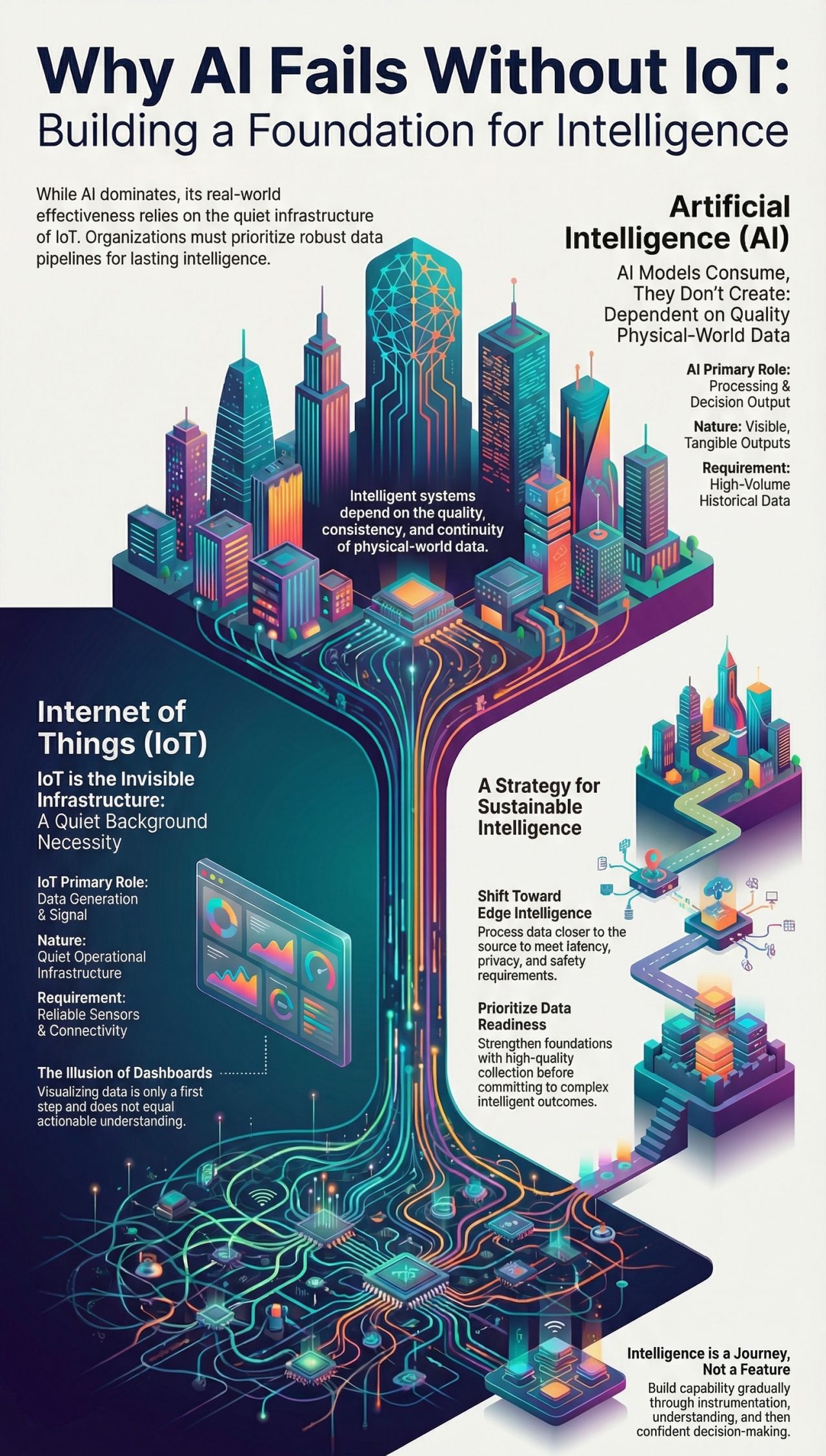
Artificial Intelligence (AI) has captured the world’s imagination, promising breakthroughs across every industry. From optimizing supply chains to revolutionizing healthcare and powering smart cities, the potential of AI seems limitless. Yet, beneath the dazzling dashboards and predictive models, an uncomfortable truth often remains unspoken: AI, in isolation, is an empty vessel. Its real-world effectiveness, its very ability to generate intelligence, hinges entirely on a less-heralded, yet profoundly crucial, partner: the Internet of Things (IoT).
While AI dominates headlines and executive discussions, its true power in tangible applications relies on the robust, quiet infrastructure of IoT. AI models are not creators of knowledge; they are sophisticated consumers of data. And the most valuable, transformative data that fuels genuine intelligence comes from the physical world – from the machines, vehicles, buildings, farms, factories, and cities that comprise our daily existence. Without this constant influx of rich, real-world data, AI is essentially flying blind, its potential severely curtailed. Organizations aspiring to leverage AI for lasting intelligence must, therefore, prioritize the development and maintenance of robust IoT data pipelines.
This article delves into the symbiotic relationship between AI and IoT, revealing why one cannot truly succeed without the other, and outlining the foundational steps necessary to build a truly intelligent future.
The AI Paradox: Consuming, Not Creating Intelligence
Artificial Intelligence, in its essence, is a powerful processing and decision-making engine. It takes raw information, analyzes it with complex algorithms, identifies patterns, makes predictions, and outputs insights. These outputs are often visible, tangible, and designed to drive action – whether it’s an optimized route, a preventative maintenance alert, or a personalized recommendation. However, it’s critical to understand that AI models consume data; they do not create it. Their intelligence is directly dependent on the quality, volume, and consistency of the data they are fed.
The primary requirement for effective AI is access to high-volume historical and real-time physical-world data. Without this continuous stream, even the most advanced algorithms are left with insufficient fuel to learn, adapt, and provide meaningful insights. Imagine a brilliant chef with no ingredients; their skill is undeniable, but their ability to produce a meal is nil. Similarly, AI’s brilliance remains theoretical without the essential ingredients provided by IoT.
IoT: The Invisible Infrastructure, A Quiet Necessity
If AI is the brain, then IoT is the nervous system, providing the sensory input from the physical world. IoT is the invisible infrastructure, operating quietly in the background, yet serving as a fundamental necessity for any meaningful AI implementation. Its primary role is fundamentally to generate data and signals from the environment. This data comes from countless sensors and devices embedded in everything from industrial machinery to smart agricultural systems, from connected vehicles to intelligent buildings.
The nature of IoT is that it’s a quiet, operational infrastructure. It’s not always in the spotlight, but its continuous functioning is non-negotiable. The fundamental requirement for effective IoT is reliable sensors and robust connectivity. If sensors fail, or if connectivity is intermittent, the data stream is compromised, directly impacting the AI’s ability to “see” and “understand” the world. As one expert succinctly puts it, “You can use AI, but only if you have good IoT solutions. The goal of IoT is to get quality data. That’s the foundation to build an AI model”.
Data Generation and Signal Pathways
IoT devices act as the sensory organs of the digital world. They measure temperature, pressure, vibration, location, humidity, light, motion, and countless other physical parameters. Each measurement, each event detected, is a signal. These signals, when aggregated, cleaned, and contextualized, become the raw data that feeds AI models.
Consider the precision required in manufacturing. IoT sensors on a production line might monitor machine vibration and acoustic signatures. These continuous data streams allow AI to detect subtle anomalies that could indicate impending equipment failure, enabling predictive maintenance rather than reactive repairs, thereby minimizing downtime and optimizing operational efficiency. Without these detailed signals, AI would be guessing, not predicting.
The Foundation of Real-World Context
One of the greatest challenges for AI is understanding real-world context. A picture of a car means little without knowing its speed, location, direction, and surrounding traffic conditions. IoT provides this context by collecting environmental data. Smart city deployments, for instance, utilize IoT sensors to monitor air quality, traffic flow, and waste levels. AI can then process this data to optimize resource allocation, manage congestion, and improve urban living, all based on a real-time understanding of the city’s pulse.
The Illusion of Dashboards: Beyond Visualization to Actionable Understanding
Many organizations, in their eagerness to embrace AI, jump straight to the visible outputs: the dashboards, the analytics platforms, the sophisticated visualizations. While dashboards are valuable for presenting data, they represent only a first step. Visualizing data, no matter how elegant, does not inherently equal actionable understanding or genuine intelligence. A beautiful graph showing a trend is informative, but true intelligence comes from understanding why the trend exists, what it predicts, and what actions should be taken as a result.
The danger lies in mistaking data presentation for intelligence generation. Without the underlying, high-quality data pipelines from IoT, these dashboards can become misleading, showing incomplete or inaccurate pictures. They can create a false sense of control and understanding, leading to poor decisions based on flawed inputs. True intelligence requires the ability to delve deeper, to leverage AI to process the raw IoT data, identify patterns that are not immediately obvious in a chart, and derive predictions that can guide strategic and operational choices.
A Strategy for Sustainable Intelligence: Building Blocks of AIoT
Achieving sustainable intelligence through AI is not an overnight transformation; it’s a strategic journey built on solid foundational principles. It requires a rethink of traditional data architectures, moving from an “AI on top of data” mindset to an “AI-First” approach where intelligence is an intrinsic part of the system. Two key components of this strategy are shifting toward edge intelligence and prioritizing data readiness.
Shift Toward Edge Intelligence
Processing data closer to its source, at the “edge” of the network, is becoming increasingly critical. This shift addresses several key concerns:
- Latency: For real-time applications, such as autonomous vehicles or critical industrial control, sending all data to a centralized cloud for processing introduces unacceptable delays. Edge intelligence allows for immediate analysis and faster decision-making, crucial for safety and responsiveness.
- Privacy: In many sectors, particularly healthcare and sensitive industrial operations, data privacy is paramount. Processing sensitive data at the edge can minimize the need to transmit it to the cloud, reducing exposure and enhancing compliance with regulations.
- Safety Requirements: In environments like smart factories or energy grids, local processing can ensure that critical operations continue even if cloud connectivity is disrupted. This resilience is vital for maintaining safety and preventing catastrophic failures.
The “edge vs. cloud” debate is a false dichotomy; they are complementary layers in a hybrid intelligence model. IoT devices are the “nervous endings” of this system, and edge computing provides localized processing power, acting as a mini-brain near the data source. Only when the intelligence is distributed effectively can the entire AIoT system operate with optimal efficiency and resilience.
Prioritize Data Readiness
Before embarking on complex AI projects, organizations must strengthen their foundations with high-quality data collection. This involves several critical steps:
- Instrument the World: This is the absolute first step. It means deploying the right IoT sensors and devices in the right places to collect the relevant signals. This isn’t just about quantity, but about acquiring data that holds real value and context.
- Ensure Reliable Sensors and Connectivity: The integrity of the entire AIoT system hinges on the reliability of the data sources. Investing in robust, industrial-grade sensors and ensuring stable, secure connectivity is non-negotiable. Poor connectivity is a significant barrier to AI and machine learning initiatives, with a substantial percentage of businesses reporting it as a hindrance.
- Consistent Data Streams: Intelligence requires continuity. Sporadic or inconsistent data streams lead to gaps in understanding and unreliable AI models. Systems must be designed to ensure continuous, uninterrupted data flow.
- High-Quality Historical Datasets: AI learns from experience. The quality and volume of historical data are paramount for training effective AI models. This means not only collecting data, but also storing it effectively, ensuring its integrity, and making it accessible for analysis and model development.
Only after these foundational data readiness steps are firmly established can an organization confidently commit to developing complex intelligent outcomes. Attempting to deploy advanced AI on a shaky data foundation is akin to building a skyscraper on sand.
The Intelligence Journey: A Gradual Evolution
Intelligence is not a feature you can simply purchase and plug in. It is a journey, a gradual accumulation of capability that progresses through distinct stages:
- Instrumentation: This is the initial phase of deploying IoT devices to collect raw data and signals from the physical world. It’s about establishing the sensory layer.
- Understanding: Once data is collected, it needs to be processed, cleaned, and contextualized. This stage involves transforming raw data into meaningful information through analytics and initial AI models, moving beyond mere visualization to grasp patterns and trends.
- Confident Decision-Making: The ultimate goal. With robust data, clear understanding, and sophisticated AI models, organizations can make rapid, accurate, and confident decisions, often autonomously, leading to optimized operations, predictive capabilities, and new strategic advantages.
This journey highlights the iterative nature of building intelligence within an enterprise. Each stage builds upon the last, reinforcing the critical dependency of AI on a well-orchestrated IoT ecosystem.
The Role of Agentic AI and Hybrid Intelligence
The evolution of AI further emphasizes the need for strong IoT foundations. The concept of Agentic AI, for instance, describes AI systems that can plan, act, and learn autonomously towards high-level goals. Instead of just responding to single prompts, these systems coordinate tools, services, and other agents over time, utilizing memory, feedback, and safety mechanisms. For Agentic AI to function effectively in the physical world – orchestrating sensors, actuators, and analytics – it relies entirely on the underlying IoT infrastructure.
Furthermore, the realization that neither edge nor cloud can exclusively house all intelligence leads to the adoption of a hybrid intelligence model. This model acknowledges that intelligence needs to reside where it’s most effective – sometimes on the factory floor for immediate action, and sometimes in a central data center for broader analytical insights and model retraining. The seamless interaction between these layers is facilitated by robust IoT connectivity and data management practices.
Industry-Specific Impact: AIoT in Action
The synergy between AI and IoT, or AIoT, is transforming industries across the board.
- Manufacturing: IoT sensors monitor everything from machine health to product quality. AI analyzes this data for predictive maintenance, optimizing production schedules, and identifying defects in real-time, drastically reducing downtime and waste.
- Healthcare: Wearable IoT devices and embedded sensors in medical equipment collect continuous patient data. AI processes this information to enable timely healthcare interventions, offer personalized treatment recommendations, and predict health deterioration, ultimately improving patient outcomes.
- Logistics and Supply Chain: IoT trackers provide real-time location and condition monitoring of goods. AI utilizes this data to optimize routes, predict delivery times, and manage inventory more efficiently, leading to faster, more cost-effective logistics.
- Smart Cities: IoT sensors monitor traffic, air quality, waste levels, and energy consumption. AI then uses this aggregated data to manage urban infrastructure more effectively, from optimizing public transport to enhancing waste collection routes and forecasting energy needs.
- Agriculture (Agritech): IoT sensors provide crucial data on soil moisture, nutrient levels, and crop health. AI analyzes this to optimize irrigation, fertilizer application, and pest control, leading to higher yields and more sustainable farming practices.
In each scenario, the principle remains constant: IoT provides the rich, contextual data from the physical world, and AI transforms that data into actionable intelligence, driving efficiency, safety, and innovation. Without the underlying IoT infrastructure, these ambitious AI applications remain theoretical at best, or prone to failure at worst.
The Future is AIoT: Transforming Data into Decisions
The future is not merely about AI; it is fundamentally about AIoT – where connected systems and intelligent algorithms work together to transform raw data into confident decisions. This powerful combination unlocks a new era of proactive operations, personalized experiences, and unprecedented efficiency across every domain.
The journey toward this intelligent future always starts with one simple, yet profound, step: Collect the right data. This means a strategic focus on robust IoT deployments, ensuring reliable sensors, consistent data streams, and high-quality historical datasets. Only then can AI truly begin to detect patterns, predict outcomes, and support the better decisions that drive progress.
Are you ready to unlock the true potential of AI by building a robust IoT foundation? Do you want to move beyond the illusion of dashboards and create truly intelligent systems that drive real-world impact?
Contact IoT Worlds today to discuss how we can help you instrument your world, build resilient data pipelines, and transform your data into actionable intelligence.
Email us at info@iotworlds.com and let’s build your intelligent future together.