The Internet of Things (IoT) landscape is constantly evolving, demanding ever-faster, more reliable, and more efficient wireless connectivity solutions. As devices become smarter, more interconnected, and generate vast amounts of data, the underlying communication infrastructure must keep pace. This is particularly true for applications requiring high throughput, low latency, and robust performance in increasingly crowded wireless environments.
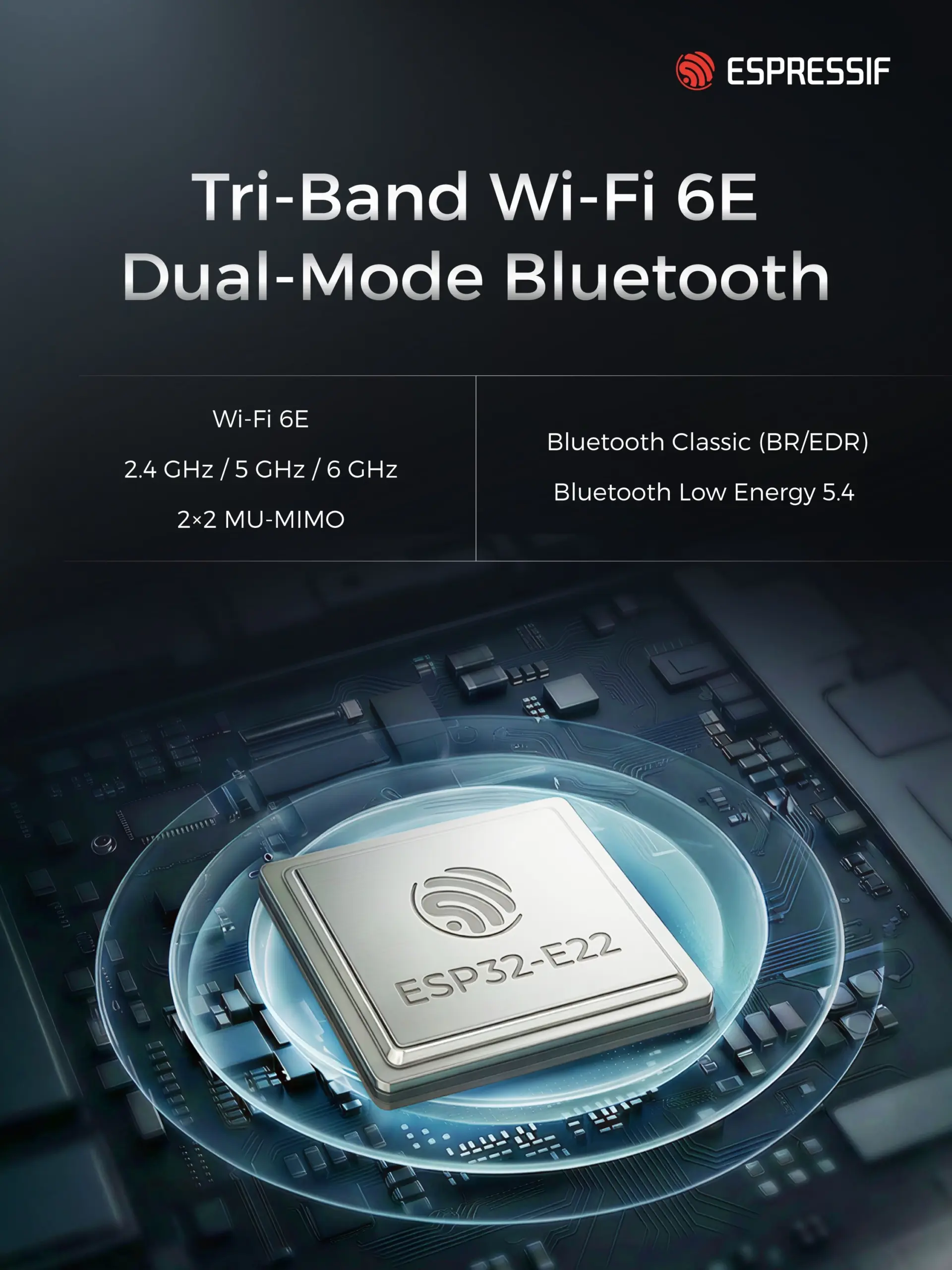
Into this dynamic arena steps Espressif, a long-standing innovator in Wi-Fi and Bluetooth solutions for IoT, with its latest groundbreaking offering: the ESP32-E22. This new Wi-Fi 6E connectivity co-processor is not just an incremental update; it represents a significant leap forward, designed to address the escalating demands of next-generation IoT applications. By integrating tri-band Wi-Fi 6E, dual-mode Bluetooth 5.4, and high-speed host interfaces, the ESP32-E22 is poised to become the cornerstone of high-performance wireless connectivity across a multitude of industries.
This comprehensive article will delve deep into the capabilities of the ESP32-E22, exploring its technical specifications, architectural advantages, and the transformative impact it promises for various IoT sectors. We will examine how this co-processor offloads critical networking tasks from host processors, enabling developers to focus on core application logic and unlock unprecedented levels of performance and efficiency.
The Evolution of Wireless Connectivity in IoT
To fully appreciate the significance of the ESP32-E22, it’s essential to understand the journey of wireless connectivity in the IoT space. From early, relatively low-bandwidth applications to today’s complex ecosystems, the demand for faster, more reliable, and more spectrum-efficient wireless technologies has been a constant driving force.
Early IoT and the Rise of Wi-Fi and Bluetooth
The initial wave of IoT devices often relied on standard Wi-Fi (Wi-Fi 4, also known as 802.11n) and Bluetooth (Classic and later, Low Energy – BLE) for connectivity. While these technologies served their purpose for many applications, they also presented limitations. Wi-Fi, while offering high data rates, could be power-intensive for battery-operated devices and its 2.4 GHz band was often congested. Bluetooth, particularly BLE, addressed power concerns but typically offered lower throughput and shorter ranges.
Addressing Congestion: Beyond 2.4 GHz and 5 GHz
As the number of Wi-Fi devices proliferated, the 2.4 GHz and 5 GHz bands became increasingly crowded. This congestion led to reduced performance, higher latency, and decreased reliability, particularly in dense deployments. The need for more spectrum, coupled with advancements in wireless communication techniques, paved the way for newer Wi-Fi standards.
Espressif, a key player in this evolution, has consistently pushed the boundaries of what’s possible with its popular ESP32 and ESP8266 series, offering highly integrated and cost-effective solutions that have powered countless IoT products. Their earlier Wi-Fi 6 (802.11ax) offerings, such as the ESP32-C6, provided a significant boost in efficiency and performance in the 2.4 GHz and 5 GHz bands.
The Genesis of Wi-Fi 6E: Unlocking the 6 GHz Band
The advent of Wi-Fi 6 (802.11ax) brought substantial improvements in efficiency, capacity, and performance over its predecessors. Key features like Orthogonal Frequency-Division Multiple Access (OFDMA) and Multi-User Multiple-Input Multiple-Output (MU-MIMO) revolutionized how devices share airtime and access bandwidth more efficiently. However, these improvements were largely confined to the existing 2.4 GHz and 5 GHz bands.
The true breakthrough came with Wi-Fi 6E. Recognizing the pressing need for more pristine spectrum, regulatory bodies worldwide began to open up the 6 GHz band for unlicensed Wi-Fi use. Wi-Fi 6E extends all the benefits of Wi-Fi 6 into this new, expansive frequency range, providing significantly more channels and much wider channel bandwidths (up to 160 MHz). This essentially creates a “fast lane” for Wi-Fi traffic, dramatically reducing congestion and enabling unprecedented levels of throughput and ultra-low latency.
The Role of Co-Processors in Modern IoT Design
With the increasing complexity of wireless protocols and the growing demands of IoT applications, offloading connectivity tasks from the main application processor has become a crucial design strategy. This is where dedicated connectivity co-processors like the ESP32-E22 shine.
Instead of burdening the host MCU or CPU with the intricacies of managing Wi-Fi and Bluetooth stacks (including security, authentication, scanning, roaming, and Bluetooth host functionality), a co-processor handles these functions autonomously. This architecture allows the host processor to dedicate its resources to core application logic, leading to:
- Improved application performance: The host is free to execute application code without interruption from network management overhead.
- Reduced latency: Dedicated hardware and optimized firmware within the co-processor can handle wireless communication more efficiently.
- Simplified development: Developers can interact with the co-processor through high-speed interfaces, abstracting away much of the wireless complexity.
- Flexible system design: Different host processors can be paired with the co-processor, offering greater flexibility in system architecture.
- Enhanced power efficiency: Optimized co-processor designs can manage power consumption for wireless modules more effectively.
This co-processor approach is particularly beneficial for high-performance IoT applications where every millisecond and every CPU cycle counts.
Introducing the ESP32-E22: A Deep Dive into its Capabilities
Espressif’s ESP32-E22 is positioned as their first Wi-Fi 6E System-on-Chip (SoC) specifically designed as a connectivity co-processor. This strategic designation highlights its role in providing cutting-edge wireless communication without dictating the choice of the main application processor.
Tri-Band Wi-Fi 6E: Unlocking Unprecedented Spectrum Access
The most salient feature of the ESP32-E22 is its tri-band Wi-Fi 6E capability. This means it operates across all three primary Wi-Fi frequency bands:
- 2.4 GHz: The traditional band, suitable for longer range and penetrating obstacles, albeit often congested.
- 5 GHz: A faster, less congested band than 2.4 GHz, ideal for higher data rates over shorter to medium distances.
- 6 GHz: The newly opened, pristine band unique to Wi-Fi 6E, offering the widest channels and lowest congestion.
The ability to leverage the 6 GHz band is a game-changer. It provides access to up to 1200 MHz of additional spectrum in many regions, translating directly into:
- Vastly increased bandwidth: More available channels, including wide 160 MHz channels.
- Reduced interference: The 6 GHz band is less crowded with legacy Wi-Fi and other wireless devices.
- Lower latency: Less congestion means faster transmission and reception of data packets.
- Higher throughput: Theoretical peak data rates can reach an impressive 2.4 Gbps.
Furthermore, the ESP32-E22 supports advanced Wi-Fi 6/6E features such as:
- 160 MHz channel bandwidth: Maximizing data transfer speeds.
- 2×2 MU-MIMO (Multi-User Multiple-Input Multiple-Output): Enabling simultaneous communication with multiple devices, improving network efficiency in dense environments.
- Beamforming: Directing Wi-Fi signals more efficiently towards client devices, enhancing range and reliability.
- Link-layer scheduling: Optimizing data transmission for lower latency, especially critical in real-time applications.
- 1024-QAM (Quadrature Amplitude Modulation): A higher-order modulation scheme that packs more data into each transmission, contributing to the high data rates.
These combined features make the ESP32-E22 an ideal choice for applications demanding serious bandwidth and low-latency communication.
Dual-Mode Bluetooth 5.4: Comprehensive Short-Range Connectivity
Beyond its stellar Wi-Fi capabilities, the ESP32-E22 also integrates a comprehensive dual-mode Bluetooth 5.4 radio. This includes support for:
- Bluetooth Classic (BR/EDR): For traditional Bluetooth connections, often used for audio streaming, human interface devices (HIDs), and file transfer.
- Bluetooth Low Energy (BLE 5.4): The power-efficient standard ideal for battery-powered devices, beacons, and sensor networks. BLE 5.4 brings further enhancements in features relevant for IoT applications, including faster connections and improved data throughput.
A crucial aspect of integrating both Wi-Fi and Bluetooth is ensuring their harmonious operation. The ESP32-E22 incorporates coexistence algorithms specifically designed to manage simultaneous Wi-Fi and Bluetooth transmissions and receptions. This intelligent management prevents interference between the two radios, ensuring optimal performance for both communication standards even when active concurrently. This capability is vital for devices that need to interact with various peripherals and networks simultaneously.
High-Speed Interfaces for Seamless Host Connectivity
As a co-processor, the ESP32-E22 needs robust and high-bandwidth interfaces to communicate effectively with a host processor. Espressif has equipped it with leading high-speed options, ensuring that the bottleneck doesn’t lie in the connection to the main system:
- PCI Express (PCIe) 2.1: A high-performance serial expansion bus widely used for demanding peripherals. PCIe 2.1 offers significantly higher throughput than older interfaces, making it suitable for applications requiring rapid data exchange between the host and the Wi-Fi 6E module.
- Secure Digital Input Output (SDIO) 3.0: A common interface for connecting Wi-Fi modules, offering a good balance of speed and simplicity. SDIO 3.0 provides sufficient bandwidth for many high-throughput wireless applications.
The availability of both PCIe and SDIO gives product designers flexibility in choosing the most appropriate interface based on their host processor capabilities and application requirements. This ensures that the high data rates achievable with Wi-Fi 6E can be effectively transferred to and from the host system.
RISC-V Architecture: Espressif’s Commitment to Open Source
At the heart of the ESP32-E22 lies Espressif’s in-house dual-core RISC-V processor, clocked at up to 500 MHz [hackster.io]. This continues Espressif’s strong commitment to the open-source RISC-V instruction set architecture, moving away from proprietary core designs.
The choice of RISC-V offers several advantages:
- Flexibility and Customization: The open nature of RISC-V allows for greater flexibility and potential for customization.
- Community Support: A growing global community is contributing to the development and ecosystem around RISC-V.
- Long-term Viability: Being an open standard, RISC-V is not subject to licensing fees or single-vendor control, ensuring its long-term viability and innovation.
These powerful RISC-V cores are specifically tasked with managing the complex Wi-Fi 6E and Bluetooth 5.4 protocol stacks, cryptography, and network operations. By offloading these demanding computations, the ESP32-E22 ensures that the host processor remains optimally utilized for application-specific tasks.
Transformative Applications of the ESP32-E22
The advanced capabilities of the ESP32-E22 open up a new realm of possibilities for high-performance IoT applications across various industries. Its ability to deliver high throughput, low latency, and robust connectivity makes it suitable for scenarios where traditional Wi-Fi solutions might struggle.
High-Bandwidth Streaming and Media Devices
With peak data rates of 2.4 Gbps and ultra-low latency afforded by Wi-Fi 6E’s 6 GHz band, the ESP32-E22 is perfectly suited for:
- 4K/8K Video Streaming: Ensuring smooth, buffer-free playback for high-resolution content on smart TVs, streaming sticks, and media hubs.
- Augmented Reality (AR) and Virtual Reality (VR) Accessories: Providing the low-latency, high-bandwidth connections essential for truly immersive experiences, minimizing motion sickness and improving responsiveness.
- High-Fidelity Audio Streaming: Delivering uncompressed, multi-channel audio over Wi-Fi with minimal delay.
Smart Hubs and Gateways
Next-generation smart home and industrial IoT hubs often need to manage a vast array of devices and aggregate massive amounts of data. The ESP32-E22’s capabilities empower these hubs to:
- Simultaneously connect to numerous smart devices: Leveraging MU-MIMO and OFDMA for efficient communication with many clients.
- Process and route high volumes of sensor data: Essential for industrial automation, smart city infrastructure, and complex building management systems.
- Provide robust backhaul connectivity: Ensuring reliable and fast communication to cloud services for data analytics and remote control.
Industrial Automation and Robotics
In industrial settings, reliability, speed, and low latency are paramount. The ESP32-E22 can dramatically enhance:
- Real-time control of robotic systems: Facilitating precise movements and immediate response times critical for manufacturing and logistics.
- Wireless sensor networks for critical infrastructure: Transmitting high-volume operational data with minimal delay, enabling predictive maintenance and proactive issue resolution.
- Automated Guided Vehicles (AGVs) and Autonomous Mobile Robots (AMRs): Providing dependable, high-speed communication for navigation, fleet management, and sensor data offload.
Gaming Peripherals and Wearables
For gaming, input lag is the enemy of performance. For wearables, seamless connectivity without draining valuable battery life is key. The ESP32-E22 offers:
- Ultra-low latency wireless gaming controllers: Delivering a wired-like experience for competitive gaming.
- Advanced wearables with high-bandwidth data needs: Such as augmented sports trackers or medical monitoring devices that require continuous, high-rate data transmission.
- Headsets and accessories: Seamlessly integrating with console or PC gaming setups with minimal lag and robust audio.
Edge Computing and AI Proliferation
As AI moves from the cloud to the edge, devices need powerful local processing capabilities coupled with high-speed connectivity for data ingestion and model updates. The ESP32-E22 enables:
- Fast offload of processed data to cloud for further analysis: Essential for edge AI cameras performing real-time object detection or facial recognition.
- Rapid deployment of AI model updates: Ensuring edge devices are always running the latest, most optimized algorithms.
- Distributed AI inference: Where multiple edge devices collaborate and synchronize via high-speed wireless links.
Automotive Systems
Modern vehicles are increasingly connected, relying on high-speed wireless for infotainment, telematics, and advanced driver-assistance systems (ADAS). The ESP32-E22 could play a role in:
- In-vehicle entertainment systems: Providing seamless Wi-Fi 6E connectivity for passengers.
- Over-the-air (OTA) software updates: Fast and reliable updates for vehicle firmware and mapping data.
- Vehicle-to-everything (V2X) communication (potentially in future applications): Supporting dense, reliable communication between vehicles and infrastructure.
The common thread across these applications is the need for a connectivity solution that not only meets current demands but is also future-proof, capable of handling the ever-increasing data rates and complexity of tomorrow’s IoT. The ESP32-E22, with its tri-band Wi-Fi 6E and robust feature set, is precisely that solution.
The Technical Edge: Why ESP32-E22 Stands Out
Beyond the headline features, several underlying technical advantages make the ESP32-E22 a compelling choice for engineers and product developers.
Power Efficiency in a High-Performance Package
While Wi-Fi 6E offers unprecedented performance, the challenge traditionally has been managing power consumption, especially for battery-constrained devices. Espressif’s expertise in low-power design, honed over generations of ESP chips, is likely integrated into the ESP32-E22.
Key Wi-Fi 6 features that contribute to power efficiency, even at high performance, include:
- Target Wake Time (TWT): Allows devices to negotiate when they will wake up to send or receive data, significantly reducing power consumption by allowing them to sleep for longer periods.
- OFDMA and MU-MIMO: More efficient use of airtime means devices can complete transmissions faster and return to a low-power state.
By intelligently managing these features alongside its powerful RISC-V cores, the ESP32-E22 aims to offer high performance without excessively taxing the device’s power budget.
Security and Reliability: Foundations of Trust in IoT
In any IoT deployment, security and reliability are paramount. As a connectivity co-processor, the ESP32-E22 is implicitly responsible for handling secure communication protocols. While specific details would be in the datasheet, Espressif’s track record suggests robust security features, including:
- Hardware-accelerated cryptography: Efficiently handling encryption and decryption for secure communication protocols like WPA3.
- Secure boot and flash encryption: Protecting the device firmware from unauthorized access and tampering.
- Trusted execution environments (TEE): Potentially isolating sensitive operations to enhance security.
Reliability is also built into the core design. Features like beamforming enhance signal integrity, and the coexistence algorithms ensure stable operation even when both Wi-Fi and Bluetooth are active. This robustness is critical for industrial, medical, and automotive applications where communication failures can have significant consequences.
Development Ecosystem and Support
One of Espressif’s greatest strengths lies in its comprehensive and developer-friendly ecosystem. This typically includes:
- ESP-IDF (Espressif IoT Development Framework): A robust and well-documented SDK that supports C/C++ development for ESP series chips.
- Extensive documentation and examples: Facilitating quick ramp-up for new projects.
- Active community forums and support: Providing a network for troubleshooting and sharing knowledge.
- Integration with popular development tools: Including Arduino IDE and PlatformIO.
While the ESP32-E22 is a new product, it will undoubtedly benefit from this established ecosystem, allowing developers to integrate its advanced capabilities into their products with relative ease. The availability of engineering samples signals that Espressif is ready to engage with lead customers to optimize designs and gather feedback.
The Future Landscape: ESP32-E22’s Role in Next-Gen IoT
The introduction of the ESP32-E22 is particularly timely, aligning with several major trends shaping the future of IoT.
The Proliferation of the Digital Twin
The concept of a “digital twin”—a virtual replica of a physical asset, process, or system—is gaining traction across industries. Digital twins rely heavily on real-time data from their physical counterparts. The high-throughput, low-latency connectivity provided by the ESP32-E22 is crucial for constantly updating these digital models, enabling more accurate simulations, predictive maintenance, and operational optimization.
The Rise of Immersive Technologies
As AR/VR and mixed reality applications move beyond entertainment into enterprise training, remote assistance, and complex design, the demand for seamless, lag-free wireless communication becomes non-negotiable. The ESP32-E22’s Wi-Fi 6E capabilities are a cornerstone for enabling these truly immersive and interactive experiences.
Industry 4.0 and Beyond
Industrial IoT (IIoT) is a demanding environment where uptime, safety, and efficiency directly impact profitability. The ESP32-E22’s ability to handle dense deployments, provide reliable real-time data, and support high-bandwidth sensor networks makes it an ideal fit for the future evolution of Industry 4.0 and the emerging concepts of Industry 5.0, where human-robot collaboration and hyper-connectivity are key.
Smart Cities and Smart Infrastructure
From smart streetlights and traffic management systems to environmental monitoring and public safety applications, smart cities require a resilient and high-capacity communication backbone. The ESP32-E22 can contribute to building this infrastructure, enabling faster data collection, more responsive urban services, and the deployment of advanced sensor networks.
Design Considerations for Integrating ESP32-E22
For product developers and engineers considering the ESP32-E22, there are several key design considerations to keep in mind to maximize its potential.
Host Processor Selection
The choice of host processor will depend on the application’s specific processing requirements. Since the ESP32-E22 offloads the wireless stack, the host can be optimized for application logic, graphics rendering, or other specialized tasks. High-end microcontrollers or even application processors might be paired with the E22 via PCIe or SDIO.
Antenna Design and Placement
To fully leverage tri-band Wi-Fi 6E, careful antenna design is critical. Operating in the 6 GHz band often requires more precise antenna tuning and consideration of line-of-sight. Proper antenna placement within the product enclosure is crucial for maximizing signal strength and range across all three bands.
Power Management Strategy
Even with the ESP32-E22’s inherent power efficiencies, a well-thought-out power management strategy for the overall system is essential. This includes understanding the power profiles of different operational states (e.g., active transmission, idle, deep sleep) and optimizing transitions between them.
Regulatory Compliance and Certification
Operating in the 6 GHz band (Wi-Fi 6E) has specific regulatory requirements that vary by region. Product developers will need to ensure that their designs comply with local regulations and obtain the necessary certifications before market deployment. Espressif typically provides support and guidance in this area.
Thermal Management
While the ESP32-E22 is designed for efficiency, high-performance operation, especially with continuous high-throughput data transfer, generates some heat. Adequate thermal management, including proper PCB layout and potentially heatsinks in constrained enclosures, may be necessary to ensure long-term reliability and optimal performance.
Software Integration and Firmware Development
Leveraging the ESP-IDF or other relevant SDKs will be key to integrating the ESP32-E22. Developers will need to familiarize themselves with the co-processor’s API (Application Programming Interface) for controlling Wi-Fi and Bluetooth functionalities, configuring network parameters, and handling data transfer.
A Comparative Look: ESP32-E22 vs. Other Espressif Offerings
Espressif offers a broad portfolio of Wi-Fi and Bluetooth-enabled chips, each tailored for different application segments. Understanding where the ESP32-E22 fits helps clarify its unique value proposition.
For example, the ESP32-C6 also features Wi-Fi 6 and Bluetooth 5 (LE), but it is a single-chip SoC designed to run the entire application. The ESP32-E22, on the other hand, is explicitly designed as a co-processor and uniquely features Wi-Fi 6E (tri-band, including 6 GHz). This distinction is critical:
- ESP32-C6 (or similar SoCs like ESP32-S3, ESP32-P4): Ideal for applications where a single chip can handle both application processing and wireless connectivity. These are often more cost-effective for simpler IoT nodes or devices where the processing demands are moderate.
- ESP32-E22: Best suited for high-performance applications where a more powerful host processor (which might run Linux, a complex RTOS, or have specific processing accelerators) is needed, and the wireless stack should be entirely offloaded. This architecture allows developers to combine the best-in-class application processing with leading-edge Wi-Fi 6E connectivity.
The ESP32-E22 signals Espressif’s strategy to cater to the highest end of connectivity requirements, complementing their existing portfolio rather than replacing it. It provides an option for product designers who need specialized, powerful application processors in tandem with the very latest in wireless technology.
The Economic and Strategic Impact for IoT Product Developers
Beyond the technical specifications, the ESP32-E22 carries significant economic and strategic implications for companies involved in IoT product development.
Reduced Time-to-Market
By offering a pre-integrated and optimized wireless subsystem, the ESP32-E22 can significantly reduce development complexity and accelerate time-to-market. Developers don’t need to spend extensive resources on tailoring Wi-Fi and Bluetooth stacks to their host processor or dealing with the intricacies of RF design from scratch.
Cost-Effectiveness Through Specialization
While a co-processor adds another chip to the BOM, the overall system cost can be optimized. By enabling the use of a host processor perfectly matched to the application’s needs (without the overhead of wireless protocols), and offloading the demanding RF and baseband processing to a specialized, high-volume chip, the total cost of ownership and development can be favorable, particularly for complex systems.
Future-Proofing Products
Investing in Wi-Fi 6E connectivity ensures that products are future-proofed against increasing network congestion and demand for bandwidth. As more Wi-Fi 6E access points become available, devices equipped with the ESP32-E22 will be able to leverage the benefits of the 6 GHz band, providing a competitive advantage and extended product lifespan.
Enhanced User Experience
Ultimately, the best technology translates to a better user experience. The high throughput, low latency, and robust connectivity delivered by the ESP32-E22 will result in faster downloads, smoother streaming, more responsive devices, and more reliable connections, leading to higher customer satisfaction.
Conclusion: Espressif’s Vision for the Hyper-Connected Future
The ESP32-E22 stands as a testament to Espressif’s continuous innovation and its clear vision for the future of IoT. By introducing its first Wi-Fi 6E connectivity co-processor, Espressif is not just offering a new component; it’s providing a critical enabler for the next generation of high-performance, hyper-connected devices.
From streaming entertainment and immersive AR/VR experiences to precise industrial automation and the burgeoning field of edge AI, the demand for fast, reliable, and efficient wireless communication is insatiable. The ESP32-E22, with its tri-band Wi-Fi 6E, dual-mode Bluetooth 5.4, and powerful RISC-V architecture, rises to meet this challenge head-on. It allows product developers to focus on their core competencies, offloading the complexities of advanced wireless protocols to a dedicated, optimized subsystem.
As engineering samples become available, we anticipate a rapid proliferation of innovative products leveraging the ESP32-E22’s capabilities, further solidifying Espressif’s position at the forefront of IoT connectivity. The era of high-performance, low-latency, and virtually congestion-free wireless is here, and the ESP32-E22 is leading the charge.
Ready to explore how the ESP32-E22 or other cutting-edge IoT technologies can transform your product development? Our experts at IoT Worlds are here to help you navigate the complexities of the IoT landscape, from hardware selection and system architecture to software integration and deployment strategies. For a consultation tailored to your specific needs, reach out to us at info@iotworlds.com. Let’s build the future of connected devices together.