

The world of robotics is on the cusp of a profound transformation, and at its heart is the relentless pursuit of intelligent autonomy. For years, the dream of robots that can not only perform tasks but also truly understand and adapt to their environments has driven researchers and engineers alike. Today, that dream takes a significant leap forward with the unveiling of Google DeepMind’s Gemini Robotics-ER 1.6. This groundbreaking “reasoning-first” model promises to redefine the capabilities of robotic systems, ushering in an era of unprecedented spatial understanding, intricate task planning, and sophisticated interaction with the physical world.
The Paradigm Shift: Reasoning-First Robotics
Traditionally, robotic control often relied on meticulously programmed sequences or end-to-end visuomotor control approaches, where direct sensory input was mapped to motor outputs. While effective for specific tasks, these methods often struggled with adaptability, unexpected scenarios, and complex decision-making. Gemini Robotics-ER 1.6 represents a fundamental departure from this paradigm.
This new model champions a “reasoning-first” approach, positioning itself as the high-level cognitive engine of a robotic system. Instead of directly controlling actuators, Gemini Robotics-ER 1.6 focuses on understanding the environment, formulating complex plans, and making intelligent decisions. It then orchestrates the execution of these plans by calling upon a suite of specialized tools, much like a human brain delegates tasks to various parts of the body or external resources. This architecture offers unparalleled flexibility and power, allowing robots to tackle previously insurmountable challenges.
The Power of High-Level Planning
At its core, Gemini Robotics-ER 1.6 excels at high-level planning. This means it can analyze a given situation, break down complex goals into manageable sub-tasks, and strategize the most efficient and effective path to achieve them. Imagine a robot in a cluttered warehouse; instead of simply reacting to obstacles, Gemini Robotics-ER 1.6 would first comprehend the layout, identify the target object, plan a collision-free route, and then determine the optimal grasping strategy. This hierarchical approach, where high-level reasoning guides lower-level execution models, is a significant advancement over end-to-end visuomotor control systems like π0 (PiZero) and GEN-1, offering greater transparency, debuggability, and adaptability.
Orchestrating Intelligence: Tool-Calling Capabilities
One of the most compelling features of Gemini Robotics-ER 1.6 is its ability to act as a sophisticated “tool caller.” This means it can dynamically invoke various functionalities based on the demands of the task. These tools can range from readily available resources to highly specialized, user-defined functions:
- Google Search Integration: For situations requiring external knowledge or up-to-date information, Gemini Robotics-ER 1.6 can seamlessly query Google Search, leveraging the vast repository of human knowledge to inform its decisions. This capability is invaluable for tasks involving unfamiliar objects, procedures, or environmental factors.
- Vision-Language-Action Models (VLAs): For more nuanced interactions with the environment, the model can engage specialized VLAs. These models bridge the gap between visual perception, linguistic understanding, and actionable commands, allowing robots to interpret complex instructions and execute fine-grained manipulations.
- Third-Party User-Defined Functions: The flexibility extends to integrating any custom-built functions or specialized algorithms developed by users. This open-ended architecture empowers developers to extend the capabilities of Gemini Robotics-ER 1.6 to suit unique applications and industry-specific requirements.
This tool-calling paradigm transforms robots from mere automated machines into intelligent agents capable of learning, adapting, and leveraging a diverse ecosystem of computational resources.
Unleashing New Capabilities: Spatial Reasoning and Multi-View Understanding
The true brilliance of Gemini Robotics-ER 1.6 lies in its profound understanding of the physical world, particularly its advanced capabilities in spatial reasoning and multi-view understanding. These are not merely incremental improvements but foundational advancements that unlock a new spectrum of robotic functionality.
Spatial Reasoning: Seeing Beyond the Surface
Robots operating in complex environments require more than just object recognition; they need to comprehend the spatial relationships between objects, understand their relative positions, and anticipate how interactions will affect the environment. Gemini Robotics-ER 1.6 excels in this regard, with sophisticated spatial reasoning capabilities that allow it to:
- Precision Object Detection and Counting: Accurately identify and count objects within a scene, even in crowded or partially obscured environments. This is crucial for inventory management, quality control, and assembly tasks.
- Relational Logic: Understand the relationships between objects, such as “on top of,” “next to,” “inside,” or “supporting.” This enables robots to infer contextual information and make more informed decisions about manipulation and interaction.
- Motion Reasoning: Predict the trajectories of moving objects and understand the implications of its own movements within the environment. This is vital for navigating dynamic spaces and interacting safely with humans or other robots.
- Constraint Compliance: Adhere to defined physical constraints, such as keeping objects within a specific area, avoiding collisions, or operating within designated safety zones. This ensures both effectiveness and safety in robotic operations.
Multi-View Understanding: The Power of Perspective
The ability to process and synthesize information from multiple camera streams is a hallmark of truly intelligent perception. Gemini Robotics-ER 1.6 significantly advances multi-view reasoning, allowing robots to:
- Synthesize Information from Diverse Viewpoints: Integrate data from various cameras positioned at different angles, providing a comprehensive and robust understanding of the environment. This overcomes the limitations of single-camera perspectives, which can suffer from occlusions or restricted fields of view.
- Navigate Dynamic and Occluded Environments: Maintain a coherent understanding of the scene even when objects are moving, or parts of the environment are temporarily obscured. By combining information from multiple views, the model can infer hidden details and predict future states.
- Understand Relationships Between Views: Recognize that different camera feeds are observing the same physical space, and intelligently correlate information across them. This is crucial for tasks requiring precise coordination and manipulation in complex settings.
The combination of advanced spatial reasoning and multi-view understanding empowers Gemini Robotics-ER 1.6 to build a richer, more accurate internal model of the world, leading to more intelligent and adaptable robotic behaviors.
Unlocking New Applications: From Instrument Reading to Enhanced Dexterity
The theoretical advancements of Gemini Robotics-ER 1.6 translate directly into tangible new capabilities and a broadening of robotic applications across diverse industries.
Instrument Reading: A Collaboration with Boston Dynamics
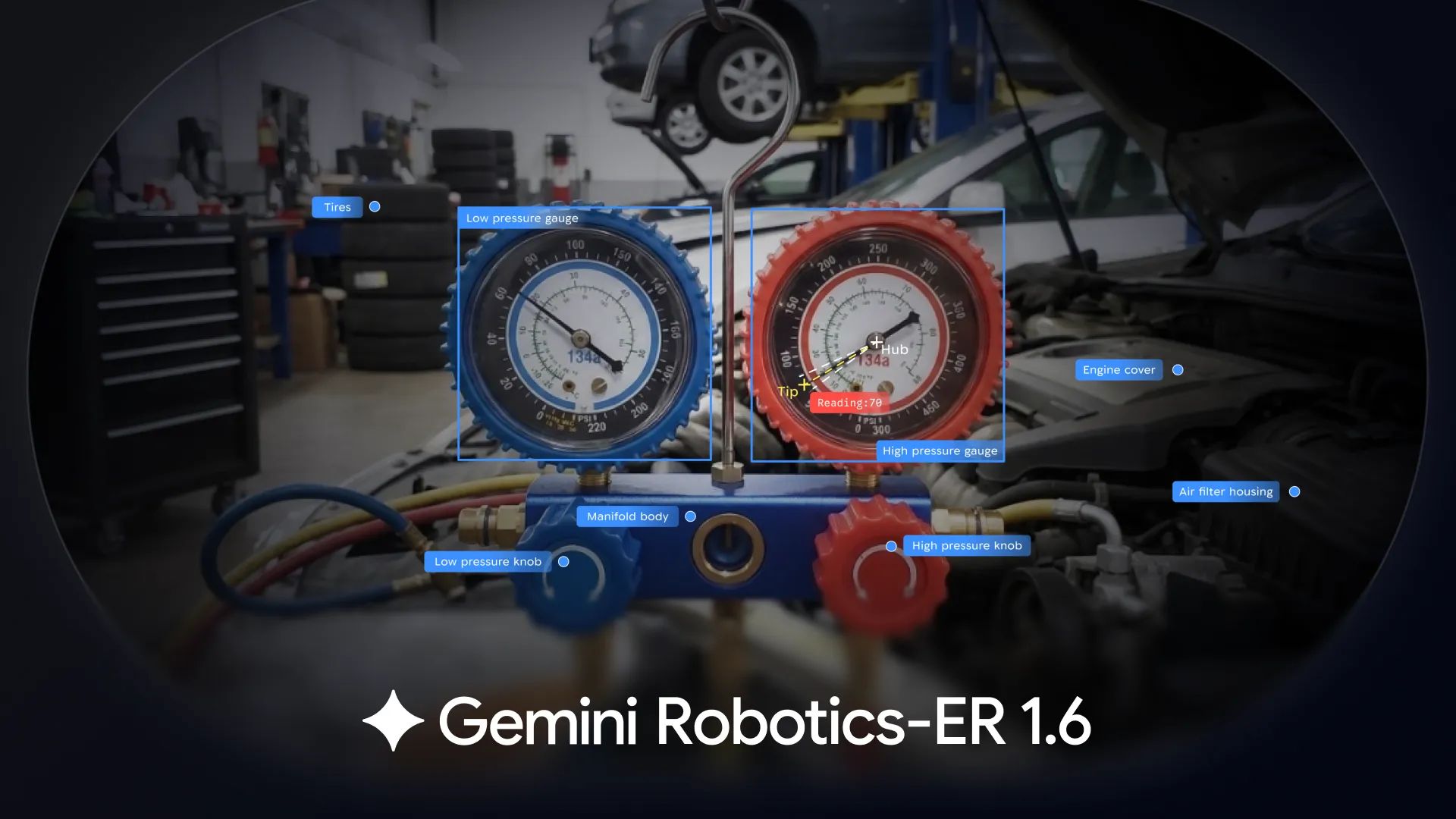
One particularly exciting development, born from a collaboration with industry leader Boston Dynamics, is the capability for instrument reading. This allows robots to accurately interpret complex gauges and sight glasses, a task previously requiring human intervention or highly specialized, purpose-built sensors.
- Reading Analog Gauges: Robots can now precisely read and record values from analog gauges, which often present challenges due to variations in dial design, lighting conditions, and partial occlusions. This has significant implications for industrial monitoring, preventative maintenance, and quality control.
- Interpreting Sight Glasses: The ability to interpret fluid levels or other visual indicators in sight glasses opens doors for automated inspection in chemical processing, manufacturing, and energy sectors. This reduces the need for human presence in potentially hazardous environments and increases operational efficiency.
This specific capability highlights the practical impact of Gemini Robotics-ER 1.6’s refined visual and spatial understanding, making robots more versatile and valuable in a wide range of industrial settings.
Precision Object Detection and Counting: Enhancing Efficiency Across Industries
The enhanced precision in object detection and counting offers immediate benefits across numerous applications:
- Inventory Management: In warehouses and logistics, robots can accurately count and track inventory, minimizing errors and streamlining supply chain operations.
- Quality Control: Manufacturers can deploy robots to inspect products for defects, ensuring consistency and adherence to quality standards with unprecedented accuracy.
- Assembly and Kitting: Robots can precisely identify and select components for assembly, improving efficiency and reducing human error in complex manufacturing processes.
Relational Logic and Motion Reasoning: Empowering Collaborative Robotics
The advancements in relational logic and motion reasoning pave the way for more sophisticated collaborative robotics:
- Human-Robot Collaboration: Robots can better understand their proximity to human co-workers, predict their movements, and adjust their own actions to ensure safety and seamless collaboration.
- Multi-Robot Coordination: In environments with multiple robots, Gemini Robotics-ER 1.6 enables better coordination and task allocation, optimizing workflow and preventing conflicts.
- Autonomous Navigation in Complex Environments: Robots can navigate crowded and dynamic spaces more effectively, avoiding collisions and adapting to changing conditions in real-time.
Constraint Compliance: Ensuring Safety and Precision in Every Task
The emphasis on constraint compliance ensures that robots operate not just efficiently but also safely and within defined parameters.
- Safe Manipulation: Robots can make safer decisions about which objects can be manipulated, considering factors like fragility, weight, and environmental hazards.
- Adherence to Operational Protocols: In sensitive environments, robots can strictly adhere to operational protocols and safety regulations, minimizing risks and ensuring compliance.
- Precise Execution: By understanding and adhering to constraints, robots can execute tasks with greater precision, reducing errors and improving overall quality.
The Inner Workings: Points as Intermediate Steps for Complex Tasks
A key innovation underpinning Gemini Robotics-ER 1.6’s ability to reason about complex tasks is its use of “points as intermediate steps.” Instead of rigidly defined trajectories or pre-programmed movements, the model can conceptualize and manipulate abstract “points” in space to guide its reasoning.
Imagine a robot needing to grasp a delicate object within a cluttered shelf. Instead of defining a precise path for its gripper, Gemini Robotics-ER 1.6 can first identify a series of virtual points: a point to clear an obstacle, a point to approach the object from the optimal angle, and a point that represents the precise grasping location. It then uses its internal models to connect these points, generating a fluid and adaptive execution plan.
This approach offers several advantages:
- Flexibility and Adaptability: Robots can dynamically adjust their plans based on real-time sensory input, even if the environment changes unexpectedly.
- Problem Decomposition: Complex tasks can be broken down into smaller, more manageable sub-problems, each addressed by reaching a specific intermediate point.
- Robustness to Uncertainty: By operating with abstract points, the model is less susceptible to minor deviations or uncertainties in the environment, making its plans more robust.
This innovative use of intermediate points elevates the model’s ability to tackle highly complex and nuanced tasks, moving beyond simple input-output mappings to a more profound understanding of goal-oriented actions.
Resilience and Progress: Intelligent Retry and Success Detection
In the unpredictable world of robotics, failures are inevitable. What distinguishes an intelligent system is its ability to learn from these failures and adapt. Gemini Robotics-ER 1.6 demonstrates advanced resilience through its intelligent decision-making capabilities regarding failed attempts.
Intelligent Choice: Retry or Progress?
When a robotic action or sub-task fails, Gemini Robotics-ER 1.6 doesn’t simply give up. Instead, it can intelligently analyze the situation and decide whether to:
- Retry the Failed Attempt: If the failure is deemed temporary or easily rectifiable, the model can initiate a retry, perhaps with a slight modification to its approach or parameters. This is crucial for overcoming minor impediments without needing a complete re-evaluation of the entire task.
- Progress to the Next Stage: If the failure is systemic, the current approach is infeasible, or a retry would be unproductive, the model can choose to bypass the failed step and progress to the next logical stage of the task. This demonstrates a higher level of strategic thinking, allowing the robot to maintain momentum and achieve its overarching goal through alternative means.
This “retry or progress” decision-making mechanism is deeply intertwined with the model’s comprehensive understanding of success detection.
Robust Success Detection
To make informed decisions about retries or progression, Gemini Robotics-ER 1.6 incorporates robust success detection mechanisms. It doesn’t merely assume success after executing a command; it actively monitors the environment and its own actions to confirm whether the intended outcome has been achieved.
- Visual Confirmation: Through its advanced visual perception, the model can verify the completion of tasks, such as confirming that an object has been successfully grasped or a component has been correctly placed.
- Haptic Feedback: In conjunction with robotic manipulators equipped with haptic sensors, the model can interpret tactile feedback to confirm successful contact, pressure, or object manipulation.
- Environmental State Monitoring: By tracking changes in the environment, the model can infer success or failure based on the overall state of the workspace.
This sophisticated combination of intelligent retry logic and robust success detection imbues robots powered by Gemini Robotics-ER 1.6 with a remarkable degree of autonomy and resilience, allowing them to navigate unforeseen challenges and achieve their goals even in dynamic and unpredictable environments.
Prioritizing Safety: A Foundation for Autonomous Operations
As robots become more intelligent and integrated into our lives and industries, safety becomes paramount. Google DeepMind has clearly prioritized safety in the development of Gemini Robotics-ER 1.6, incorporating a suite of features designed to ensure secure and compliant operation. The “🚧” in the introduction is not merely an emoji; it signifies a deep commitment to building trustworthy and safe robotic systems.
Superior Compliance with Safety Policies
Gemini Robotics-ER 1.6 is engineered to adhere to safety policies with unwavering consistency. This involves:
- Rule-Based Conformance: The model can absorb and interpret complex safety regulations and operational guidelines, ensuring its actions always remain within specified boundaries. This is critical in sensitive environments where strict compliance is non-negotiable.
- Dynamic Policy Adaptation: As environmental conditions or operational requirements change, the model can dynamically adjust its behavior to maintain compliance with updated safety policies, showcasing its adaptability and responsiveness.
Better Adherence to Physical Safety Constraints
Beyond abstract policies, the model demonstrates enhanced adherence to real-world physical safety constraints. This translates into tangible, safer decision-making regarding object manipulation and interaction with the environment.
- Safer Object Manipulation Decisions: When manipulating objects, particularly in environments with humans or other fragile items, the model considers factors like object fragility, potential for injury, and necessary force, making decisions that prioritize safety above all else. This includes dynamically adjusting grip strength, approach speed, and trajectory based on the perceived safety implications.
- Collision Avoidance and Proximity Awareness: Leveraging its advanced spatial reasoning and multi-view understanding, the model can maintain safe distances from obstacles and humans, actively avoiding collisions and responding intelligently to unexpected intrusions into its workspace.
Improved Hazard Identification
A critical component of proactive safety is the ability to identify potential hazards before they escalate. Gemini Robotics-ER 1.6 includes enhanced capabilities for hazard identification.
- Anomalous State Detection: The model can recognize abnormal or potentially dangerous environmental states, such as unusual temperatures, unexpected spills, or misplaced objects that could pose a risk.
- Risk Assessment: Based on identified hazards, the model can perform a rudimentary risk assessment, weighing the potential consequences of its actions against the perceived dangers, and adjusting its plans accordingly.
- Proactive Warnings and Actions: Upon identifying a hazard, the robot can issue warnings, halt operations, or take predefined preventative actions to mitigate risk, protecting both itself and its surroundings.
These comprehensive safety improvements are not an afterthought but an integral part of Gemini Robotics-ER 1.6’s design, building a foundation of trust and reliability essential for the widespread adoption of advanced autonomous robotics. The model’s ability to make safer decisions, understand physical limitations, and proactively identify risks sets a new benchmark for robotic safety.
The Future Landscape: Implications for Industries and Society
The launch of Google DeepMind’s Gemini Robotics-ER 1.6 is not merely a technological achievement; it represents a significant inflection point with far-reaching implications for industries, economies, and society as a whole.
Manufacturing and Logistics: Revolutionizing the Supply Chain
The manufacturing and logistics sectors stand to be among the most immediate beneficiaries. Robots empowered by Gemini Robotics-ER 1.6 can:
- Automate Complex Assembly: Handle intricate assembly lines with greater precision and adaptability, reducing errors and increasing throughput.
- Optimize Warehouse Operations: Perform dynamic inventory management, pick-and-place tasks, and package handling with unprecedented efficiency and fewer human interventions.
- Enhance Quality Assurance: Conduct detailed inspections and quality checks, ensuring products meet rigorous standards consistently.
- Streamline Last-Mile Delivery: Navigate complex urban environments, interact safely with pedestrians, and deliver packages autonomously or semi-autonomously.
Healthcare: Assisting the Human Element
In healthcare, the impact could be transformative, from assisting in surgical procedures to improving patient care infrastructure.
- Surgical Assistance: Provide highly precise and stable assistance in operating rooms, potentially leading to less invasive procedures and faster patient recovery.
- Pharmacy Automation: Automate the dispensing and sorting of medications, minimizing errors and freeing up pharmacists for more critical patient-facing roles.
- Rehabilitation Support: Assist patients with physical therapy exercises, providing real-time feedback and personalized support.
- Hospital Logistics: Manage the transportation of supplies, equipment, and even some patient-facing tasks, improving hospital efficiency and allowing staff to focus on direct patient care.
Service Industries: Redefining Customer Experience
From hospitality to retail, Gemini Robotics-ER 1.6 can enable a new generation of service robots.
- Personalized Robotics: Provide tailored assistance in homes, elderly care facilities, and educational settings, adapting to individual needs and preferences.
- Automated Retail: Manage inventory, assist customers with product information, and even facilitate transactions in retail environments.
- Restaurant and Hospitality: Support tasks like food preparation, delivery, and cleaning, enhancing efficiency and improving customer experience.
Exploration and Hazardous Environments: Expanding Human Reach
For tasks in environments too dangerous or inaccessible for humans, Gemini Robotics-ER 1.6 offers invaluable capabilities.
- Space Exploration: Conduct complex scientific experiments, maintain equipment, and explore celestial bodies with greater autonomy and adaptability.
- Deep-Sea Exploration: Navigate challenging underwater terrains, collect samples, and perform maintenance in deep-sea installations.
- Disaster Response: Assist in search and rescue operations, hazardous material handling, and infrastructure inspection in disaster zones, minimizing risk to human responders.
Ethical Considerations and The Path Forward
As with any powerful technology, the advent of Gemini Robotics-ER 1.6 also brings important ethical considerations. Google DeepMind’s emphasis on safety is a crucial step, but ongoing dialogue and research will be necessary to address concerns regarding:
- Job Displacement: The potential impact on employment in industries where robots perform tasks traditionally done by humans. This necessitates a focus on reskilling programs and fostering new job opportunities in parallel.
- Autonomous Decision-Making: The ethical frameworks governing robotic autonomy, especially in situations with moral implications.
- Bias in Data: Ensuring that the data used to train these models is diverse and unbiased to prevent perpetuating societal inequalities.
- Accountability: Establishing clear lines of accountability when autonomous systems make errors or cause unforeseen consequences.
The path forward involves not just technological advancement but also responsible development, public engagement, and the establishment of robust ethical guidelines.
The Journey Continues: A Call to Action for Innovation
The launch of Google DeepMind’s Gemini Robotics-ER 1.6 marks a pivotal moment in the history of artificial intelligence and robotics. It demonstrates a clear vision for reasoning-first autonomous systems that can understand, plan, and execute complex tasks with unprecedented intelligence and safety. This is not the culmination of the journey, but rather a powerful stride forward, opening new frontiers for research, development, and application.
For industries and innovators looking to harness the power of these next-generation robotics, the opportunities are boundless. Integrating such advanced intelligence into existing operations or developing entirely new robotic solutions requires expertise, foresight, and a deep understanding of both the technology and its potential applications.
Are you ready to explore how cutting-edge AI and robotics can transform your business, optimize your operations, and unlock new possibilities? Whether you’re seeking to implement intelligent automation, develop bespoke robotic solutions, or simply understand the strategic implications of these advancements, IoT Worlds is your partner in navigating this exciting new landscape. We specialize in bringing the future of robotics to your enterprise, ensuring you stay ahead in an increasingly automated world. Seize the opportunity to innovate and lead. Contact us today to begin your journey into advanced autonomous systems! Email us at info@iotworlds.com.
