

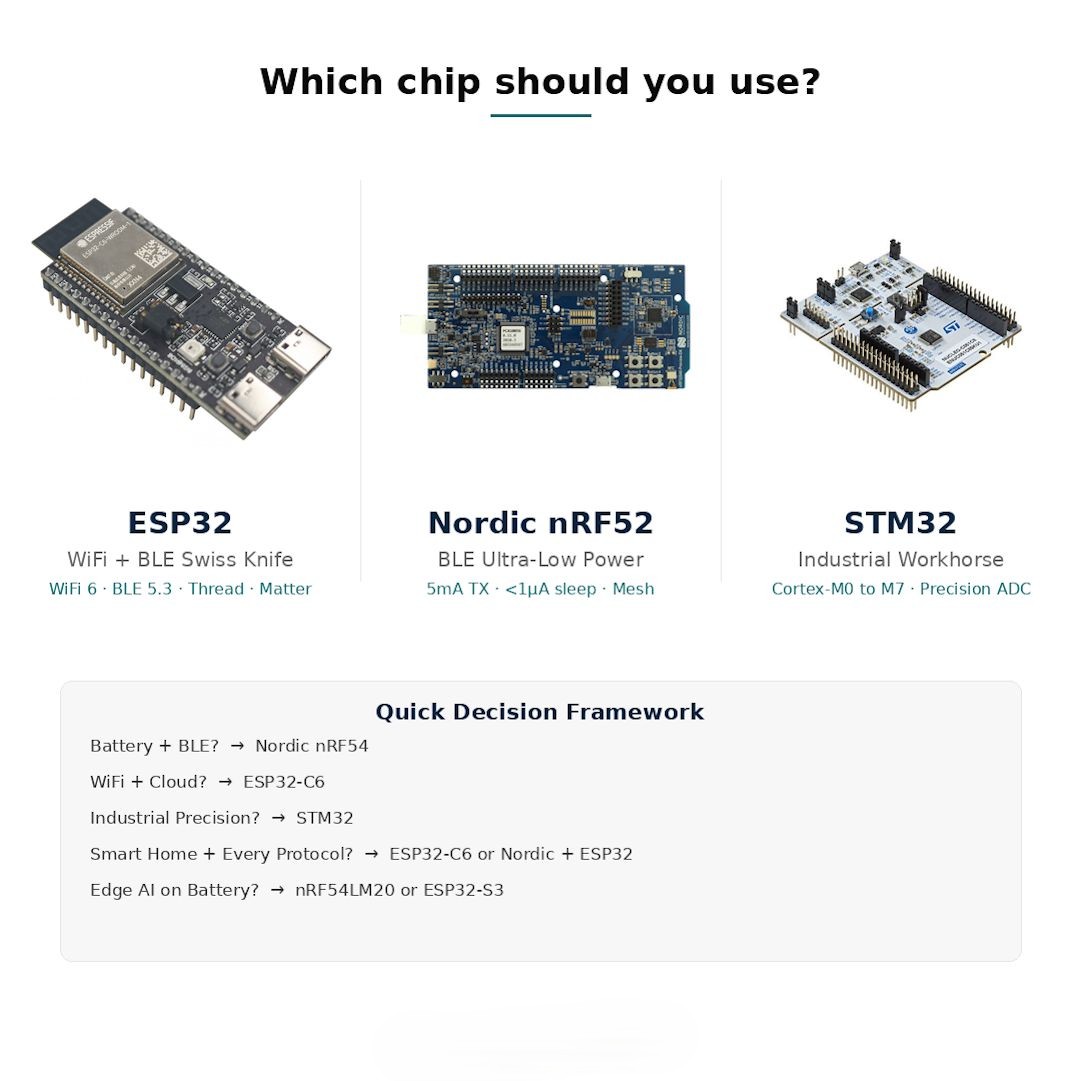
Choosing the right microcontroller for your Internet of Things (IoT) product is arguably one of the most critical decisions you’ll make in the development lifecycle. Get it wrong, and you’re not just looking at minor setbacks; you’re staring down the barrel of 6-12 months of costly redesigns, blown budgets, and missed market opportunities. I’ve witnessed this scenario play out more times than I care to count, having built products on all the major platforms.
This article cuts through the marketing hype and delivers an honest, experience-backed breakdown of three dominant chip families: Nordic nRF52/54, ESP32, and STM32. We’ll explore their strengths, weaknesses, and ideal use cases, helping you make an informed decision that aligns with your product’s unique constraints and goals, not just your firmware engineer’s comfort zone.
The High Stakes of Chip Selection
Before diving into the specifics of each chip, it’s crucial to understand why this decision carries so much weight. The microcontroller is the brain of your IoT device. It dictates everything from power consumption and connectivity options to processing capability, peripheral availability, security features, and even the certification pathway for your product.
The True Cost of a Mismatch
Imagine launching a product that requires stellar battery life, only to find your chosen chip gulps power like a thirsty camel. Or perhaps you need robust wireless communication, but your chosen solution struggles with interference or has limited range. These aren’t minor glitches; they’re fundamental architectural flaws that necessitate significant hardware and software changes.
A redesign means:
- Time Delays: Months spent re-evaluating, re-designing PCBs, ordering new prototypes, and rewriting firmware. This translates directly to delayed market entry.
- Increased Costs: Engineering hours, manufacturing costs for new prototypes, and potentially re-certification fees can quickly obliterate your development budget.
- Lost Opportunity: While you’re stuck in redesign hell, competitors could be launching similar products, seizing market share, and establishing their brand.
The foundational principle here is simple: choose chips because the architecture matches your product’s constraints: power, connectivity, security, and certification timeline. Do not choose a chip simply because your firmware engineer “knows Arduino” or it’s the latest shiny object.
Nordic nRF52/54: The BLE King
When ultra-low power and robust Bluetooth Low Energy (BLE) connectivity are paramount, the Nordic nRF52 and its successor, the nRF54 series, reign supreme. These chips are engineering marvels for battery-powered applications where every microampere counts.
Unparalleled Power Efficiency
The most striking feature of the Nordic series is its extraordinary power management. We’re talking about transmit currents of around 5mA and sleep currents plummeting to less than 1µA. This exceptional efficiency is a game-changer for devices that need to operate for months or even years on a coin cell battery.
This level of power optimization isn’t accidental. Nordic Semiconductor has meticulously designed its chips and accompanying software stack to minimize energy consumption at every possible opportunity. From sophisticated power modes to optimized radio operations, the nRF series is built from the ground up for battery longevity.
Rock-Solid BLE with SoftDevice
At the heart of Nordic’s BLE prowess is its proprietary SoftDevice. This pre-compiled, pre-certified BLE stack is renowned for its stability, reliability, and ease of use. It abstracts away much of the complexity of BLE development, allowing engineers to focus on application-specific logic rather than wrestling with the intricacies of the wireless protocol. The SoftDevice runs as a separate, independent entity, ensuring that your application code won’t inadvertently corrupt the BLE stack, which is a common headache on other platforms.
The Next Generation: nRF54 Series
The nRF54 series builds upon the already impressive foundation of the nRF52, introducing several significant advancements that push the boundaries of what’s possible in low-power wireless.
- Bluetooth 6.0 Channel Sounding: This feature enables highly accurate distance measurements, opening doors for advanced indoor positioning systems, asset tracking with centimeter-level precision, and enhanced security applications.
- Edge AI NPU: The inclusion of a Neural Processing Unit (NPU) for edge AI processing is a monumental leap. This allows for local, power-efficient processing of sensor data, enabling smart, responsive devices without constant reliance on cloud connectivity. Think sophisticated gesture recognition in wearables or predictive maintenance in industrial sensors, all processed on-device with minimal power draw.
- Thread/Zigbee Support: While the nRF52 primarily focuses on BLE, the nRF54 expands its wireless repertoire to include Thread and Zigbee. This makes the nRF54 a compelling option for mesh networking in smart home and industrial settings, especially when combined with its low-power capabilities.
Robust Ecosystem and Zephyr RTOS
Nordic Semiconductor provides a mature and well-supported ecosystem for its chips. This includes comprehensive development kits, extensive documentation, and a vibrant community. The increasing adoption of Zephyr RTOS (Real-Time Operating System) across the Nordic product line is another significant advantage. Zephyr is an open-source, scalable, and secure RTOS designed for resource-constrained devices, offering a standardized approach to embedded development.
Key Considerations and Limitations
The Nordic nRF series is undeniably powerful for its niche. However, its primary limitation is its focus on BLE (and Thread/Zigbee in the nRF54).
- No Built-in WiFi: If your product requires direct WiFi connectivity to a local network or the cloud, the Nordic nRF series in isolation is not the right choice. You would need to pair it with an external WiFi module, adding complexity, cost, and power consumption.
- Cost: While offering exceptional value for its features, Nordic chips can sometimes have a slightly higher unit cost compared to some alternatives, especially for very high-volume, cost-sensitive applications where BLE isn’t the primary driver.
Ideal Use Cases for Nordic nRF52/54
- Wearables: Smartwatches, fitness trackers, and hearables where battery life and compact size are paramount.
- Medical Devices: Glucose monitors, connected inhalers, and other health monitoring devices where precision, reliability, and long battery life are critical.
- Beacons and Asset Tags: Low-cost, long-lasting devices for proximity marketing, indoor navigation, and inventory tracking.
- Battery-Powered Sensors: Environmental sensors, agricultural monitors, and industrial sensors requiring infrequent data transmission and extended field deployment.
When to Skip Nordic nRF52/54
- You absolutely need WiFi for cloud-direct connectivity without an external module.
- Your application demands high-bandwidth data transfer typical of video streaming or large file uploads over a wireless connection.
ESP32: The Swiss Army Knife
The Espressif ESP32 family has revolutionized the IoT landscape, offering an incredible combination of features, connectivity, and affordability. Labelled “The Swiss Army Knife,” it lives up to its name by providing a versatile platform suitable for a vast array of projects.
Integrated WiFi + BLE on a Single Chip
The biggest draw of the ESP32 is its integrated WiFi and Bluetooth Low Energy (BLE) capabilities on a single, low-cost chip. This immediately addresses the “no WiFi” limitation of the Nordic nRF series and significantly simplifies hardware design by eliminating the need for separate wireless modules. For under $3 in many cases, you get a full-featured wireless SoC ready to connect to diverse networks.
This dual-mode capability makes the ESP32 exceptionally flexible. You can use WiFi for high-throughput cloud communication and BLE for local device configuration, mesh networking, or interaction with smartphones.
Expanding Horizons: ESP32-C6, ESP32-S3, and More
Espressif hasn’t rested on its laurels, constantly expanding the ESP32 family with specialized variants that cater to emerging IoT needs.
- ESP32-C6: This newer iteration is a powerhouse for modern IoT protocols. It adds WiFi 6 support for enhanced performance and efficiency, alongside Thread, Matter, and Zigbee. Matter, in particular, is a new standard designed to unify the smart home ecosystem, and the ESP32-C6 positions itself as a key enabler for interoperable smart home devices.
- ESP32-S3: For applications requiring on-device intelligence, the ESP32-S3 integrates AI/ML acceleration. This allows for efficient edge inference, performing machine learning tasks directly on the device. Think of image recognition for smart security cameras, voice processing for interactive appliances, or advanced sensor data analysis without offloading to the cloud. This brings formidable local processing capabilities to battery-powered edge devices.
- Other ESP32 Variants: The broader ESP32 family also includes cost-optimized versions (like the ESP32-C3) and those with specific security features, ensuring there’s an ESP32 for almost any requirement.
Massive Community and Development Ecosystem
One of the ESP32’s greatest assets is its enormous and active developer community. This translates into a wealth of readily available resources, tutorials, example code, and community support forums. This robust ecosystem significantly lowers the barrier to entry for new developers and accelerates the development process.
The ESP32 supports multiple development frameworks:
- Arduino IDE: For hobbyists and rapid prototyping, the Arduino environment offers simplicity and a vast library of pre-written functions.
- ESP-IDF (Espressif IoT Development Framework): This is Espressif’s official, more powerful, and flexible SDK based on the FreeRTOS operating system. It provides fine-grained control over the hardware and is ideal for professional-grade product development.
Power Consumption: The Achilles’ Heel
While incredibly versatile, the ESP32 does have a significant drawback: power consumption, especially when WiFi is active. When transmitting data over WiFi, the ESP32 can peak at around 300mA. This is a crucial consideration for battery-powered devices.
While the ESP32 does offer deep sleep modes to conserve power, these are generally not as efficient as the Nordic nRF series for applications requiring prolonged, very low-power operation. A coin cell battery, for example, would have a very short lifespan if powering an ESP32 with frequent WiFi activity.
Ideal Use Cases for ESP32
- Smart Home Devices: Smart plugs, light switches, thermostats, and other connected appliances that need WiFi connectivity and can often be mains-powered.
- Connected Appliances: Refrigerators, washing machines, and ovens that benefit from cloud connectivity for smart features and remote control.
- Gateways: Devices that bridge different wireless protocols (e.g., BLE sensors to a WiFi network) or act as local control hubs.
- Rapid Prototyping: Its ease of use, integrated connectivity, and low cost make it ideal for quickly bringing proof-of-concept devices to life.
- Edge AI (with ESP32-S3): Devices requiring local inference for speech recognition, object detection, or predictive analytics, especially when combined with mains power or a sufficiently large battery.
When to Skip ESP32
- Battery life is absolutely critical, and your device needs to run for extended periods on a small battery (like a coin cell) without frequent recharging or replacement.
- Your application is entirely BLE-focused, and the additional complexity and power draw of a combined WiFi/BLE chip are unnecessary.
STM32: The Industrial Workhorse
STMicroelectronics’ STM32 family of microcontrollers is the quintessential “Industrial Workhorse.” With an astonishing breadth of variants, from ultra-low-power Cortex-M0 to high-performance Cortex-M7 processors, STM32 chips are designed for applications demanding precision, reliability, and robust control over a wide range of peripherals.
A Massive Family: From Cortex-M0 to M7
The sheer scale of the STM32 portfolio is one of its most defining characteristics. With over 1000 different variants, developers can find an STM32 chip precisely tailored to their application’s needs, optimizing for performance, memory, peripheral count, and power consumption.
- Cortex-M0/M0+: Entry-level chips focusing on ultra-low power and cost-effectiveness for simpler control tasks.
- Cortex-M3/M4: Mid-range processors offering a balance of performance, features, and power efficiency, suitable for many general-purpose embedded applications. The M4 often includes a Floating-Point Unit (FPU) for faster mathematical operations.
- Cortex-M7: High-performance processors designed for complex applications requiring significant computational power, such as advanced motor control, digital signal processing, and sophisticated user interfaces.
This vast selection ensures that you’re not overpaying for unused features or compromising on essential capabilities.
Best-in-Class Analog Peripherals
STM32 microcontrollers are renowned for their superior analog peripherals. This is a critical advantage for applications that require high-precision sensing and control.
- Precision ADCs (Analog-to-Digital Converters): Many STM32 series boast high-resolution (e.g., 12-bit, 16-bit) and high-speed ADCs with advanced features like oversampling, hardware averaging, and multiple input channels. This is invaluable for accurately measuring real-world signals like temperature, pressure, and voltage.
- DACs (Digital-to-Analog Converters): Integrated DACs allow for precise generation of analog waveforms, essential for motor control, audio applications, and signal generation.
- Motor Control Timers: Several STM32 series are specifically designed with advanced timers and dedicated peripherals for efficient and precise control of various motor types (BLDC, stepper, brushed DC). This makes them a go-to choice for robotics, industrial automation, and power tools.
Ultra-Low-Power (L-series)
While the ESP32 is generally power-hungry for wireless, and the Nordic excels at BLE, the STM32 also has its own champions in the ultra-low-power domain. The STM32 L-series (e.g., STM32L0, STM32L4, STM32L5) is specifically engineered for extremely low power consumption, achieving sleep currents of less than 1µA.
These chips achieve this through sophisticated power management techniques, including multiple low-power modes, flexible clock gating, and optimized peripheral designs. This makes them competitive with Nordic for certain battery-powered applications where wireless is either not needed or handled by an external, dedicated module.
No Built-in Wireless (Typically)
The primary trade-off with theSTM32 family is its typical lack of integrated wireless connectivity. While some newer, specialized STM32 variants might include onboard BLE or other radio technologies, the vast majority of the portfolio requires an external RF module for wireless communication.
This means if your product needs WiFi, BLE, Zigbee, or Thread, you’ll likely be pairing your STM32 with a dedicated wireless module (e.g., an ESP32 module for WiFi/BLE, or a Nordic module for BLE only). This adds to the bill of materials (BOM), increases PCB complexity, and can impact overall power consumption and development time.
Ideal Use Cases for STM32
- Motor Control: Industrial robots, drones, electric vehicles, and precision machinery where complex motor algorithms and robust control are essential.
- Industrial Automation: PLCs (Programmable Logic Controllers), factory sensors, process control systems, and human-machine interfaces (HMIs) requiring high reliability and real-time performance.
- Medical Instruments: Diagnostic equipment, patient monitoring systems, and laboratory instruments that demand high precision, advanced sensing, and robust operation.
- Precision Sensing: High-accuracy data acquisition systems, sensor fusion applications, and scientific instruments where the quality of analog input is paramount.
- Wired Connectivity: Devices primarily relying on Ethernet, CAN bus, RS485, or other wired industrial protocols.
When to Skip STM32
- You want integrated wireless connectivity (WiFi, BLE, Thread, Zigbee) on a single chip to minimize BOM and PCB area, and simplify design.
- Your application is purely wireless-centric with minimal need for complex peripheral control or high-performance computation.
- Your firmware engineering team lacks experience with more complex embedded RTOS (like FreeRTOS or Zephyr) or bare-metal development, as the STM32 ecosystem can have a steeper learning curve than simple Arduino-based development.
The Real Decision Framework: A Strategic Approach
Now that we’ve delved into the specifics of each chip family, let’s synthesize this knowledge into a practical decision framework. This structured approach will help you navigate the complexities and choose the optimal microcontroller for your specific IoT product.
1. Battery Powered + BLE? Choose Nordic nRF54
If your product’s defining characteristic is its need for extended battery life and its primary wireless communication is Bluetooth Low Energy, the Nordic nRF54 series is your unequivocally best choice. This applies to:
- Wearables that need to last days or weeks on a charge.
- Medical sensors placed on a patient for continuous monitoring.
- Asset tags or beacons that operate for years without maintenance.
- Any sensor node where power efficiency is paramount and data transmission is infrequent or low-bandwidth.
The nRF54’s class-leading power consumption, robust SoftDevice, and advanced features like edge AI NPU and Channel Sounding make it unmatched in this domain.
2. Needs WiFi + Cloud? Choose ESP32 (C6 for Matter/Thread)
When direct cloud connectivity via WiFi is a non-negotiable requirement, and your device can tolerate higher power consumption (either mains-powered or with a substantial battery), the ESP32 family is your go-to.
- For general WiFi + BLE: The standard ESP32 offers excellent value and versatility.
- For smart home and future-proofing: The ESP32-C6 is particularly compelling. With WiFi 6, Thread, Matter, and Zigbee support, it’s designed for interoperable smart home devices that need to communicate reliably within diverse ecosystems. This positions your product for longevity in a rapidly evolving market.
- For rapid prototyping: The ESP32’s community support and ease of use accelerate initial development significantly.
3. Industrial Precision + Wired? Choose STM32
If your application demands high-precision analog measurements, robust motor control, real-time operating capabilities, and primarily relies on wired industrial protocols (e.g., Ethernet, CAN, RS485), the STM32 family is the clear winner.
- Industrial automation equipment where reliability and deterministic control are critical.
- Complex medical instruments requiring delicate sensor readings and precise actuator control.
- Robotics and machinery where real-time motor control algorithms are executed on the edge.
Remember, if wireless is needed here, you’ll pair the STM32 with an external module, leveraging the best of both worlds: STM32 for control and computation, a dedicated wireless module for connectivity.
4. Smart Home + Every Protocol? Choose ESP32-C6 or Nordic + ESP32 Combo
This scenario reflects the increasing complexity of smart home ecosystems, where devices often need to speak multiple wireless languages.
- ESP32-C6 for comprehensive integration: If a single chip solution is preferred, the ESP32-C6, with its support for WiFi 6, Thread, Matter, and Zigbee, offers a potent package for devices aiming for broad smart home interoperability. This is often suitable for mains-powered devices or those with larger battery capacities.
- Nordic nRF54 + ESP32 Combo for ultimate flexibility: For battery-powered smart home devices that also need WiFi, a combination approach might be optimal. Use a Nordic nRF54 for the ultra-low-power, BLE/Thread/Zigbee primary function (e.g., a battery-operated smart sensor), and pair it with an ESP32 acting as a WiFi gateway or co-processor for cloud communication when needed. This allows you to achieve the tight power budgets of Nordic while still enabling WiFi connectivity. This approach adds complexity but provides maximum optimization.
5. Edge AI on Battery? Choose nRF54LM20 (NPU) or ESP32-S3
The rise of edge Artificial Intelligence means more processing is happening on the device itself, reducing latency and reliance on the cloud. When this needs to be done on a battery-powered device, the choice becomes critical.
- Nordic nRF54LM20 (NPU): If your edge AI tasks are specifically tuned for low-power neural network inference (e.g., simple keyword spotting, gesture recognition, anomaly detection) and your primary communication is BLE, the nRF54 with its integrated NPU is an excellent, power-efficient choice. Its ultra-low power nature makes it ideal for long-lasting, intelligent sensors.
- ESP32-S3 (AI/ML acceleration): For more complex edge AI models, particularly those involving vision or more intensive audio processing, and when WiFi connectivity is also a factor, the ESP32-S3 with its dedicated AI/ML acceleration is a powerful contender. While potentially drawing more power than the Nordic for AI tasks, it offers greater computational horsepower and integrated WiFi, making it suitable for devices with larger batteries or mains power that still require on-device intelligence.
The key here is to carefully evaluate the power budget of your specific AI model and the overall connectivity requirements of your product.
Beyond the Chip: Architectural Design Principles
Selecting the right microcontroller is just one piece of the puzzle. A successful IoT product requires a holistic architectural approach that considers:
Software Architecture
The choice of RTOS (Real-Time Operating System) – be it Zephyr, FreeRTOS, or a custom bare-metal solution – significantly impacts development complexity, security, and real-time performance. A well-structured software architecture ensures scalability, maintainability, and efficient resource utilization.
Security from the Ground Up
In IoT, security is not an afterthought; it’s a foundational requirement. Consider:
- Secure Boot: Ensuring only trusted firmware runs on the device.
- Over-the-Air (OTA) Updates: Securely updating firmware in the field without compromising device integrity.
- Hardware Security Modules (HSMs) or Secure Elements: Protecting cryptographic keys and sensitive data.
- Trusted Execution Environments (TEEs): Isolating critical code and data from the main application.
Many modern chips, including the nRF54 and newer STM32 and ESP32 variants, incorporate hardware security features that should be leveraged.
Ecosystem and Toolchain Maturity
A robust development ecosystem is invaluable. This includes:
- Development Boards and Evaluation Kits: Accelerating prototyping.
- Compilers and Debuggers: Reliable tools for writing and testing code.
- Software Development Kits (SDKs) and Libraries: Providing pre-built functionalities.
- Community and Documentation: Access to support and learning resources.
A mature ecosystem can drastically reduce development headaches and time-to-market.
Certification and Regulatory Compliance
IoT products often require various certifications (e.g., FCC, CE, Bluetooth SIG, WiFi Alliance, Matter). The chosen chip and its associated wireless modules can significantly impact the complexity and cost of these certifications. Using pre-certified modules or chips with robust documentation can streamline this process.
Consider the compliance requirements relevant to your target markets early in the design process to avoid costly re-engineering later.
Supply Chain Resilience
In today’s volatile global market, supply chain considerations are more critical than ever.
- Availability: Ensure the chosen chip is readily available and has a predictable supply roadmap.
- Multi-sourcing: If possible, consider designs that allow for alternative chips or modules from different manufacturers to mitigate single-source risks.
- Longevity: For long-life industrial or medical products, choose chips with clear longevity commitments from the manufacturer.
Conclusion: Make Informed Decisions, Not Assumptions
The choice of microcontroller is a make-or-break decision for your IoT product. It’s not about which chip is “best” in isolation, but which chip is best for your specific product’s needs and constraints.
- For bleeding-edge ultra-low-power BLE with AI at the edge, choose Nordic nRF54.
- For versatile WiFi and BLE integration, especially for smart home, prototyping, or high-performance edge AI, choose ESP32.
- For industrial-grade precision, robust control, and unparalleled peripheral options, especially with wired connectivity, choose STM32.
Avoid the common trap of choosing based on familiarity or isolated specifications. Instead, engage in a comprehensive evaluation process that considers power, connectivity, security, performance, cost, ecosystem, and your target certification timeline. Investing time in this strategic decision upfront will save you months of frustration, millions in redesign costs, and ultimately, ensure the successful launch of your transformative IoT product.
Comparative Analysis of Nordic nRF52/54, ESP32, and STM32 Microcontrollers
To further aid in your decision-making, here’s a comparative table summarizing the key characteristics, strengths, and ideal use cases for the Nordic nRF52/54, ESP32, and STM32 families.
| Feature / Category | Nordic nRF52/54 | ESP32 | STM32 (General) |
|---|---|---|---|
| Primary Strength | Ultra-low power, BLE perfection | Integrated WiFi + BLE, highly versatile | Industrial workhorse, precision peripherals, vast family |
| Connectivity | BLE (nRF52), BLE + Thread/Zigbee (nRF54) | WiFi + BLE (ESP32), WiFi 6 + Thread + Matter + Zigbee (ESP32-C6) | No built-in wireless (typically, requires external module) |
| Power Consumption | Excellent: ~5mA TX, <1µA sleep | Moderate to High: Peaks 300mA on WiFi TX, good deep sleep options | Variable: <1µA sleep (L-series), higher for performance variants |
| Edge AI Capability | Yes (nRF54 adds NPU) | Yes (ESP32-S3 for acceleration) | Yes (via CPU, no dedicated accelerator typically) |
| Community/Ecosystem | Mature, growing (Zephyr RTOS focus) | Massive, very active (Arduino, ESP-IDF) | Extensive, professional (various IDEs, RTOS options) |
| Development Style | SDK-based, Zephyr RTOS, low-level control | Arduino IDE, ESP-IDF, FreeRTOS | Bare-metal, various RTOS (FreeRTOS, Zephyr, Mbed OS etc.) |
| Cost | Moderate | Low to Moderate | Low to High (depending on variant) |
| Analog Peripherals | Good | Moderate | Excellent: High-precision ADC, DAC, motor control timers |
| Digital Peripherals | Standard GPIO, SPI, I2C, UART, PWM | Rich set: GPIO, SPI, I2C, UART, PWM, Hall effect, touch sensors | Very extensive: GPIO, SPI, I2C, UART, PWM, CAN, USB, Ethernet, etc. |
| Security Features | Hardware crypto, secure boot, TrustZone (nRF54) | Secure boot, flash encryption, hardware crypto, WPA3 | Secure boot, secure memory, hardware crypto, HASH, RNG |
| Ideal for | Wearables, medical devices, beacons, battery-powered sensors, asset tracking, advanced mesh networks | Smart home, connected appliances, gateways, rapid prototyping, general IoT, voice assistants | Motor control, industrial automation, medical instruments, precision sensing, wired networking |
| Avoid if | Needs WiFi or cloud-direct connectivity | Battery life is absolutely critical (coin cell won’t survive with frequent WiFi) | Wants wireless without external modules; constrained by BOM/PCB space for wireless |
Don’t let the wrong chip stall your IoT innovation. For expert guidance in navigating complex chip architectures, optimizing your product design, and accelerating your time to market, reach out to us today. We’re here to help you make the right choices for your next big idea.
Email us at info@iotworlds.com to discuss your project!
