

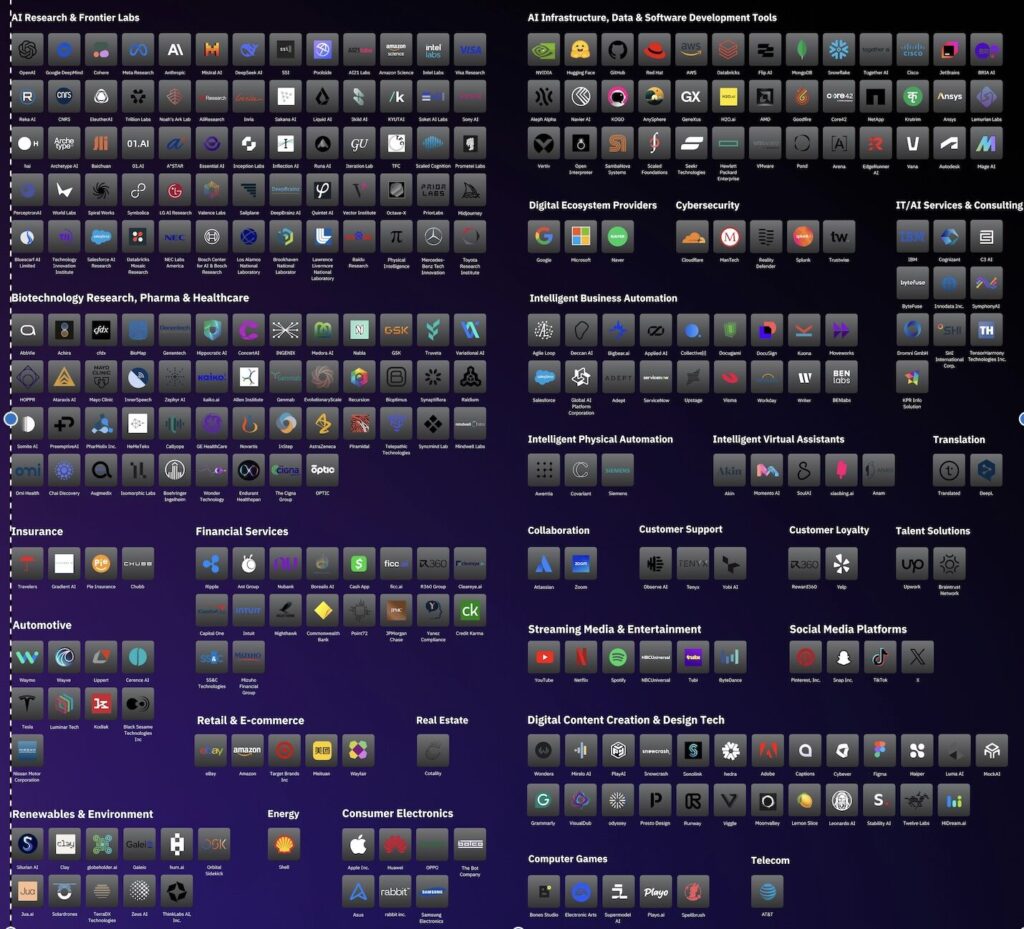
If you follow AI news, you have probably seen diagrams that look like the image attached to this article: hundreds of logos laid out on a dark background, grouped by categories such as:
- AI research and frontier labs
- AI infrastructure and developer tools
- Digital ecosystem providers
- Cybersecurity, business automation, and virtual assistants
- Vertical industries such as biotech, automotive, energy, telecom, finance, retail, and more
That image is effectively a map of foundation models and their ecosystem.
For IoT Worlds readers—people who design, deploy, and operate connected devices, industrial control systems, and edge‑AI applications—this landscape can be both exciting and overwhelming. Which foundation models matter for your use case? How do you navigate the explosion of options? When does it make sense to use a general‑purpose large language model (LLM) versus a domain‑specific model for manufacturing, energy, or telecom?
This long‑form guide breaks down the big picture and then zooms into practical implications for IoT and OT/ICS.
We will cover:
- What foundation models are and why they matter for IoT
- How to interpret the “map” of foundation‑model providers
- Key categories: research labs, infrastructure, horizontal solutions, vertical industries
- How to choose the right models and platforms for IoT and edge use cases
- Real examples by industry vertical
- A practical checklist for evaluating vendors and models
- What’s coming next for foundation models and IoT
1. Foundation Models 101: The New Substrate for IoT Intelligence
1.1 What is a foundation model?
A foundation model is a very large machine‑learning model—typically based on transformer architectures—trained on diverse data at massive scale. Once trained, it can be adapted to many downstream tasks with relatively little additional data or fine‑tuning.
Common types include:
- Large Language Models (LLMs) for text and code
- Vision and multimodal models for images, video, and sensor fusion
- Audio and speech models for transcription, translation, and voice interfaces
- Specialized models built on similar architectures but tuned for domains such as biology, chemistry, finance, or cybersecurity
They are called “foundation” models because they provide a base of capability you can:
- use directly via APIs,
- augment with retrieval‑augmented generation (RAG),
- or fine‑tune for your own data and tasks.
1.2 Why they matter for IoT and edge systems
Historically, IoT analytics were dominated by:
- simple thresholds and rule engines,
- classical machine‑learning models for anomaly detection or forecasting,
- domain‑specific algorithms implemented by control engineers.
Foundation models change the equation:
- Multimodal understanding: Modern models can jointly reason over time‑series sensor data, text logs, images, diagrams, and even audio.
- Natural‑language interfaces: Instead of custom dashboards, you can ask questions like “Why has line 3 been underperforming this week?” or “Show me all alarms similar to yesterday’s incident.”
- Autonomous agents: Agents built on top of LLMs can call tools and APIs, execute workflows, and interact with OT and IT systems.
- Transfer learning: You can leverage general world knowledge (physics, safety principles, standards) and then adapt to your specific plant, city, or fleet.
In other words, foundation models are becoming the brain of IoT platforms, with edge devices providing the senses and actuators.
2. Reading the Foundation‑Model Map
The attached image is a dense landscape of logos. While we won’t reproduce every name here, we can explain the structure.
The map essentially divides the ecosystem into several layers:
- AI research & frontier labs – companies and labs creating state‑of‑the‑art models
- AI infrastructure, data & software‑development tools – the plumbing for training, deploying, and managing models
- Horizontal solution categories – cybersecurity, automation, digital assistants, collaboration, customer support, and more
- Vertical industries – healthcare, biotech, finance, insurance, automotive, manufacturing, energy, retail, telecom, media, games, etc.
- Consumer and ecosystem platforms – cloud providers, social media, streaming, and operating systems that are integrating foundation models deeply
2.1 AI research & frontier labs
Along the top left of the image you typically find the frontier labs:
- major cloud providers and AI companies,
- open‑source‑oriented research groups,
- academic or nonprofit labs pushing fundamental research.
These are the teams that train the largest, most capable general‑purpose models—often with hundreds of billions of parameters—and release them as APIs or open‑weights.
They matter for IoT because:
- their models often become the default LLM behind IoT copilots, code assistants, and chat interfaces;
- they publish research that later trickles into smaller, specialized models;
- they define de‑facto standards for model APIs and safety practices.
2.2 AI infrastructure, data & developer tools
On the top right you see a dense cluster of logos labelled something like “AI infrastructure, data and software‑development tools.” This is the layer IoT teams interact with a lot:
- vector databases for RAG,
- orchestration and agent frameworks,
- MLOps and observability platforms,
- data‑labeling and data‑quality tools,
- GPU and accelerator providers, cloud‑native runtimes, and serverless platforms.
In IoT projects, this corresponds to:
- where you store device telemetry for retrieval (vector DBs with embeddings),
- how you run inference at the edge or in the cloud,
- how you monitor model performance and detect drift,
- how you manage CI/CD for agents and LLM prompts.
2.3 Digital ecosystem providers
Large ecosystems—major search engines, productivity suites, developer platforms, app stores—sit at another layer. These providers:
- integrate foundation models directly into productivity apps (docs, email, spreadsheets),
- offer SDKs to embed their models and tools in your own workflows,
- and act as AI “operating systems” for business processes.
For IoT organizations, this often becomes the starting point: enabling generative‑AI features inside tools you already use (service‑management platforms, documentation systems, collaboration tools) before building bespoke agents.
2.4 Horizontal AI solutions
The map then shows horizontal solution categories, typically including:
- Cybersecurity – for network, cloud, and OT/ICS defense
- Intelligent business automation – workflow automation, process mining, decision engines
- Intelligent physical automation – robotics, warehouse automation, industrial automation platforms
- Intelligent virtual assistants – chatbots, enterprise assistants, call‑center bots
- Collaboration, customer support, customer loyalty – AI integrated into CRM, support desks, marketing tools
- Human resources and talent solutions – AI for recruiting, skills mapping, workforce planning
- Translation and localization, etc.
These vendors often wrap foundation models in:
- domain‑specific data,
- guardrails and workflows,
- integrations to common enterprise systems.
For IoT teams, they are ready‑made building blocks: you might plug an OT monitoring system into an AI‑powered service‑desk platform, or use an “intelligent physical automation” provider as the control layer for robots and AGVs.
2.5 Vertical industries
Finally, large parts of the map are dedicated to industry verticals:
- biotechnology, pharma, and healthcare
- insurance
- financial services and fintech
- automotive and mobility
- retail and e‑commerce
- real estate
- renewables and environment
- energy and utilities
- consumer electronics and smart‑device manufacturers
- streaming, media, and entertainment
- games
- telecom operators
Here, companies use foundation models either as internal tools or as AI‑powered products.
In biotech, models may understand molecules and proteins; in finance, they analyze documents and markets; in automotive, they help with autonomous driving, maintenance, and driver interaction.
IoT Worlds readers should pay special attention to categories like:
- Automotive – because vehicles are becoming rolling IoT devices;
- Energy and renewables – grids, microgrids, smart meters;
- Manufacturing, logistics, consumer electronics – the classic Industrial IoT domains;
- Telecom – connectivity for devices and edge computing.
3. How Foundation Models Power IoT and Edge Use Cases
Understanding the map is useful, but the key question is: what can foundation models actually do for your IoT or OT/ICS environment?
Let’s look at common capability clusters and map them to typical use cases.
3.1 Understanding text, logs, and documentation
LLMs excel at:
- summarizing long maintenance or incident reports,
- extracting key entities from logs,
- answering natural‑language questions about standards, manuals, and SOPs,
- generating documentation from code or configuration.
For example:
- An operations engineer can paste a long SNMP or syslog dump and ask, “Summarize the main issues affecting Device X over the last 24 hours.”
- A technician can query, “Show me the lockout / tagout procedure for the pump model installed in Line 4.”
3.2 Reasoning over sensor data and time‑series
While foundational time‑series models are still emerging, LLMs combined with other models can:
- interpret anomalies detected in telemetry,
- generate narratives: “This vibration pattern suggests misalignment or bearing wear.”
- plan troubleshooting steps based on KPIs and sensor trends.
Some vertical models explicitly target predictive maintenance, energy optimization, or process control.
3.3 Multimodal understanding: images, diagrams, and video
Edge cameras and inspection systems produce huge volumes of imagery. Vision and multimodal foundation models can:
- detect defects or safety hazards,
- read dials and analog gauges,
- interpret camera streams from manufacturing lines or remote sites,
- understand diagrams, P&IDs, schematics, and layout drawings.
Combined with language capabilities, this enables interaction like:
“Look at this thermo‑graphic image and the attached P&ID. Is any insulation missing or any valve mislabeled?”
3.4 Code, configuration, and automation
For IoT developers, foundation models have become pair programmers:
- generating device firmware boilerplate,
- writing cloud‑function glue code,
- composing SQL or time‑series queries,
- writing infrastructure‑as‑code for IoT networks,
- generating test scripts for OTA updates.
On the OT side, models can help:
- explain PLC ladder logic,
- translate between vendor dialects,
- draft function‑block diagrams based on textual requirements (with human verification).
3.5 Conversational interfaces and virtual experts
Virtual assistants—one of the map’s key horizontal categories—become the front door for many IoT use cases:
- technicians ask the assistant for troubleshooting guidance on site, via tablet or AR headset;
- control‑room operators get natural‑language summaries of ongoing incidents;
- managers query KPIs across plants without needing to know query languages or dashboards.
Behind these assistants often sit:
- a general‑purpose LLM,
- a RAG layer indexing your internal documents and data,
- optional tools (querying historians, asset registries, CMMS, ticketing systems).
3.6 Autonomous agents and agentic systems
The most advanced scenarios use AI agents built on top of foundation models. These agents:
- observe data and events,
- reason about possible actions,
- call tools (APIs, control systems, simulators),
- and loop until a goal is achieved.
Examples:
- an energy‑optimization agent that adjusts HVAC setpoints and battery usage;
- a maintenance‑planning agent that schedules work orders, orders parts, and coordinates downtime windows;
- an OT‑security agent that triages alerts, enriches them with threat‑intelligence, and pre‑populates incident tickets.
Agentic AI takes this a step further by coordinating multiple specialized agents—for example, one for production planning, one for maintenance, one for energy, and one for safety—working together under human supervision.
4. Choosing the Right Foundation Models for IoT
Looking at the huge map of vendors, you might ask: Where do I even start? The answer depends on your use case, constraints, and strategy.
4.1 Start from the problem, not the model
Clarify:
- Is your primary task text‑based (documentation, Q&A, support), numerical (forecasting, optimization), visual, or mixed?
- Will the model be used by humans via chat/UI, or by software/agents as part of workflows?
- Is this usage safety‑critical (affecting physical processes), security‑sensitive (OT networks), or mostly informational?
4.2 General‑purpose vs domain‑specific models
General‑purpose LLMs and multimodal models are a great starting point for:
- prototypes and PoCs,
- general knowledge and reasoning,
- tasks that do not require deep domain jargon.
However, for high‑performance IoT applications you may want more specialized options:
- models trained or fine‑tuned on industrial telemetry and logs,
- models that understand engineering jargon and standards,
- models for weather, energy markets, or traffic flows.
Some industry vendors—especially in energy, manufacturing, healthcare, and finance—offer such domain‑tuned models, shown in the vertical sections of the map.
4.3 Cloud API vs on‑prem / edge deployment
You must also decide where the model runs:
- Cloud APIs from frontier labs or ecosystem providers are:
- easy to start with,
- automatically updated,
- but involve data‑transfer and often cannot be used for the most sensitive OT/ICS data.
- Self‑hosted models (open‑source or licensed) running on your own infrastructure or even at the edge:
- give you control over data locality and latency,
- can be pruned or quantized for embedded devices,
- but require skills in MLOps and hardware sizing.
Many IoT organizations adopt a hybrid strategy:
- cloud LLMs for general knowledge and non‑sensitive use,
- local smaller models for confidential or safety‑critical workloads.
4.4 Build vs buy vs integrate
You do not always need to interact with models directly. Often you can:
- Buy a vertical solution (e.g., an OT threat‑detection platform, an energy‑optimization SaaS) that already embeds foundation models.
- Integrate AI features from digital‑ecosystem providers into existing workflows (CRM, ticketing, ERP).
- Build custom agents only where you need competitive differentiation or deep integration with your unique systems.
Ask:
- Is this problem core to our business strategy, or is it a commodity capability we can outsource?
- Do we have—or can we hire—the skills to manage models ourselves?
- Can we start with an off‑the‑shelf tool and keep the option to add our own models later?
4.5 Data strategy: RAG, fine‑tuning, and safety
For most IoT and OT/ICS scenarios:
- RAG (retrieval‑augmented generation) is the right first step—index your documents, logs, and metrics in a vector database, then let the LLM query them.
- Fine‑tuning or adapter training becomes relevant when you have:
- large, high‑quality datasets of your own,
- repetitive tasks where style and structure must be extremely consistent.
You must also address safety:
- red‑team and test prompts that touch safety or control,
- enforce permission boundaries around tools and APIs,
- set default models to be conservative and transparent about uncertainty.
5. Industry Examples: How Verticals Use Foundation Models with IoT
Let’s connect the dots between vertical clusters on the map and concrete IoT examples.
5.1 Manufacturing and industrial automation
Manufacturing sits at the intersection of several map categories: intelligent physical automation, intelligent business automation, and verticals like consumer electronics, automotive, and industrial suppliers.
Use cases:
- Predictive maintenance copilots
- RAG over maintenance history, manuals, and failure‑mode libraries.
- Agents that automatically correlate sensor anomalies with known issues and propose next steps.
- Process‑optimization assistants
- Foundation models combined with process‑simulation tools.
- Operators ask, “How can we reduce scrap on Line 2 without exceeding energy limits?” and the agent explores parameter changes.
- Quality inspection and defect analysis
- Vision models on edge cameras detect defects.
- LLMs generate human‑readable explanations and reports.
- Worker guidance and training
- AR or tablet‑based assistants that walk technicians through complex procedures using natural language and images from manuals.
Vendors in this space may provide both models and complete platforms (MES, digital twins, robot control).
5.2 Automotive and mobility
Automotive logos appear in the vertical region, but link to many horizontal capabilities:
- in‑vehicle virtual assistants,
- ADAS and autonomous‑driving perception models,
- predictive maintenance for fleets,
- telematics and insurance partnerships.
Foundation‑model applications:
- Driver and passenger assistants that control vehicle functions, navigation, and infotainment.
- Fleet‑management copilots that analyze sensor data, driver behavior, and maintenance history.
- Manufacturing AI in automotive plants, as described above.
5.3 Energy, renewables, and utilities
Foundations models are rapidly transforming energy and environment:
- forecasting load and generation from distributed renewable resources,
- optimizing battery use and demand response,
- analyzing sensor data from smart grids, microgrids, and industrial energy systems.
Typical applications:
- Grid operations copilots
- Summarize alarms, outages, and contingency analyses.
- Translate between engineering language and executive summaries.
- Energy‑efficiency agents for buildings and campuses
- Agents adjust setpoints, control HVAC, schedule equipment, and advise occupants.
- Planning and asset‑management tools
- LLMs that digest regulations, permits, and engineering studies to help plan new lines or renewable plants.
Energy companies may adopt a mix of proprietary energy‑focused models and general‑purpose ones, with strong emphasis on compliance and safety.
5.4 Healthcare, biotech, and pharma
In life sciences, the map shows biotechnology research and pharma clusters. Many of these models focus on molecules, proteins, and medical language.
IoT intersects here through:
- connected medical devices and wearables,
- hospital automation and smart buildings,
- cold‑chain monitoring and pharmaceutical manufacturing.
Foundation‑model examples:
- Clinical documentation assistants that draft notes and reports from device data and clinician input.
- Bioprocess optimization agents that monitor fermenters and production lines.
- Drug‑discovery models that use generative chemistry combined with experimental robotics.
The regulatory burden is high, so healthcare players care deeply about model explainability, provenance, and validation.
5.5 Finance and insurance with IoT data
On the map you see specific clusters for financial services and insurance. IoT feeds them with:
- telematics (usage‑based insurance),
- smart‑home and industrial sensors for risk monitoring,
- transaction streams from connected devices.
Foundation models help with:
- underwriting assistants that incorporate sensor data, documents, and regulations,
- claims‑processing agents that analyze photos, sensor logs, and reports,
- fraud detection and anomaly explanation.
5.6 Telecom and connectivity
Telecom operators and network‑equipment vendors appear as another vertical cluster. They are central to IoT because they provide connectivity and edge computing.
AI use cases include:
- network planning and optimization across radio, backhaul, and core;
- anomaly detection in network telemetry;
- customer‑support bots for IoT device provisioning and troubleshooting;
- edge‑AI platforms hosted at base stations or local data centers for low‑latency applications (V2X, AR/VR, industrial control).
Foundation models here are often combined with domain‑specific network analytics and traffic models.
5.7 Cybersecurity for IoT/OT
Cybersecurity appears as its own horizontal category, with vendors building AI‑driven threat‑detection and response platforms.
For IoT and OT/ICS:
- models analyze logs, network flows, and process data to spot anomalies,
- LLMs help analysts triage huge volumes of alerts and write incident reports,
- specialized models understand OT protocols (Modbus, DNP3, OPC UA) and typical attack patterns.
Combining these with agent frameworks leads to semi‑autonomous SOC copilots and OT security assistants.
6. Checklist: Evaluating Foundation‑Model Options for IoT Projects
When you look at a dense foundation‑model map, every logo might claim to be “the best.” Use this checklist to cut through the noise.
6.1 Technical fit
- Modalities: Does the model support the types of data you care about (text, code, images, time‑series, audio)?
- Context length: Is the context window large enough to handle your prompts (long documents, multi‑sensor histories)?
- Latency and throughput: Can it respond fast enough for your edge or real‑time requirements?
- Tooling ecosystem: Are there SDKs, agents, vector DB integrations, and monitoring tools compatible with your tech stack?
6.2 Domain relevance
- Does the vendor offer pre‑trained or fine‑tuned models for your vertical (energy, manufacturing, healthcare, telecom)?
- Are there reference customers or case studies in similar environments?
- Can the model handle your specific jargon, abbreviations, and standards out of the box, or will you need extensive RAG and fine‑tuning?
6.3 Data, privacy, and security
- Where will data be processed and stored (region, cloud, on‑prem, edge)?
- Does API usage contribute to vendor training, or can you opt out?
- Are there certifications and compliance relevant to your sector (ISO, SOC, industry regulators)?
- Does the system support role‑based access control, encryption, and detailed logging?
6.4 Cost and licensing
- What are pricing units (tokens, calls, seats, devices), and how do they scale with your IoT fleet size?
- Are there volume discounts or private deployment options?
- For open‑source models: what is the license, and does it allow your intended commercial use?
- Consider total cost of ownership: hardware, operations, MLOps staff, safety reviews.
6.5 Reliability and governance
- Does the vendor provide uptime SLAs and support?
- Are there safety filters, content classifiers, and red‑team reports?
- Is there a roadmap and cadence of updates—and how might model changes affect your prompts and integrations?
- Can you run evaluation harnesses to benchmark model behavior before and after upgrades?
6.6 Ecosystem and interoperability
- Are there strong ties to your existing cloud, analytics, and IoT platforms?
- Is there an ecosystem of partners, integrators, and community tools?
- Does the vendor support open standards for formats (JSON, OpenAPI, ML model interchange)?
7. Looking Ahead: The Future of Foundation Models and IoT
The foundation‑model map will only get denser. Here are trends to watch that are especially relevant to IoT Worlds readers.
7.1 Smaller, more efficient edge models
While today’s largest LLMs run best in the cloud, we are already seeing:
- quantized mini‑models that fit on gateways and even microcontrollers,
- model‑compression techniques that preserve capabilities in smaller footprints,
- hardware optimized for on‑device inference.
This will enable:
- offline assistants for field technicians,
- real‑time anomaly detection at the edge,
- privacy‑preserving analytics directly on devices.
7.2 Multi‑agent and hybrid intelligence
As models improve, we will rely less on a single monolithic LLM and more on systems of cooperating agents, each with different skills and authorities.
For IoT:
- specialized agents for telemetry, control logic, safety checks, and business optimization will collaborate under human supervision;
- digital twins will become the playground where agentic systems can test scenarios safely before applying changes to the real world.
7.3 Stronger regulations and standards
Critical infrastructures—energy, water, transportation, healthcare—are already heavily regulated. Expect:
- AI‑specific guidance from safety and cybersecurity regulators,
- standardization of audit logs, incident reporting, and change‑control for AI systems,
- certification paths for models and agents used in OT/ICS environments.
Organizations that adopt rigorous AI governance early will be better prepared for these requirements.
7.4 Interoperability across ecosystems
Today, foundation‑model landscapes can feel siloed: each major provider has its own APIs and tools. Over time we will likely see:
- more adapters and orchestration layers that can talk to multiple models,
- shared formats for prompts, traces, and evaluations,
- best‑of‑both‑worlds architectures where you can pick the right model per task and route traffic intelligently.
This is particularly beneficial to IoT deployments that cross multiple clouds, vendors, and geographies.
8. Final Thoughts
The image of the foundation‑model map might look intimidating: hundreds of companies, overlapping categories, and new logos appearing every month. But you don’t need to master every name on the chart.
Instead, focus on understanding:
- The layers: frontier labs, infrastructure, horizontal solutions, vertical models.
- Your own needs: modalities, latency, safety, domain specificity, integration points.
- A clear adoption strategy: start with simple LLM/RAG copilots, then graduate to agents and multi‑agent systems where they bring real business and operational value.
For IoT Worlds readers building smart factories, grids, buildings, cities, vehicles, and devices, foundation models are no longer distant research curiosities. They are becoming the intelligent fabric woven through every layer of your stack—from design and simulation to operations, maintenance, and customer experience.
Use this guide as your compass for navigating the map. Start small, evaluate rigorously, and build AI systems that are not just powerful, but safe, transparent, and deeply aligned with the physical world they help you manage.
