

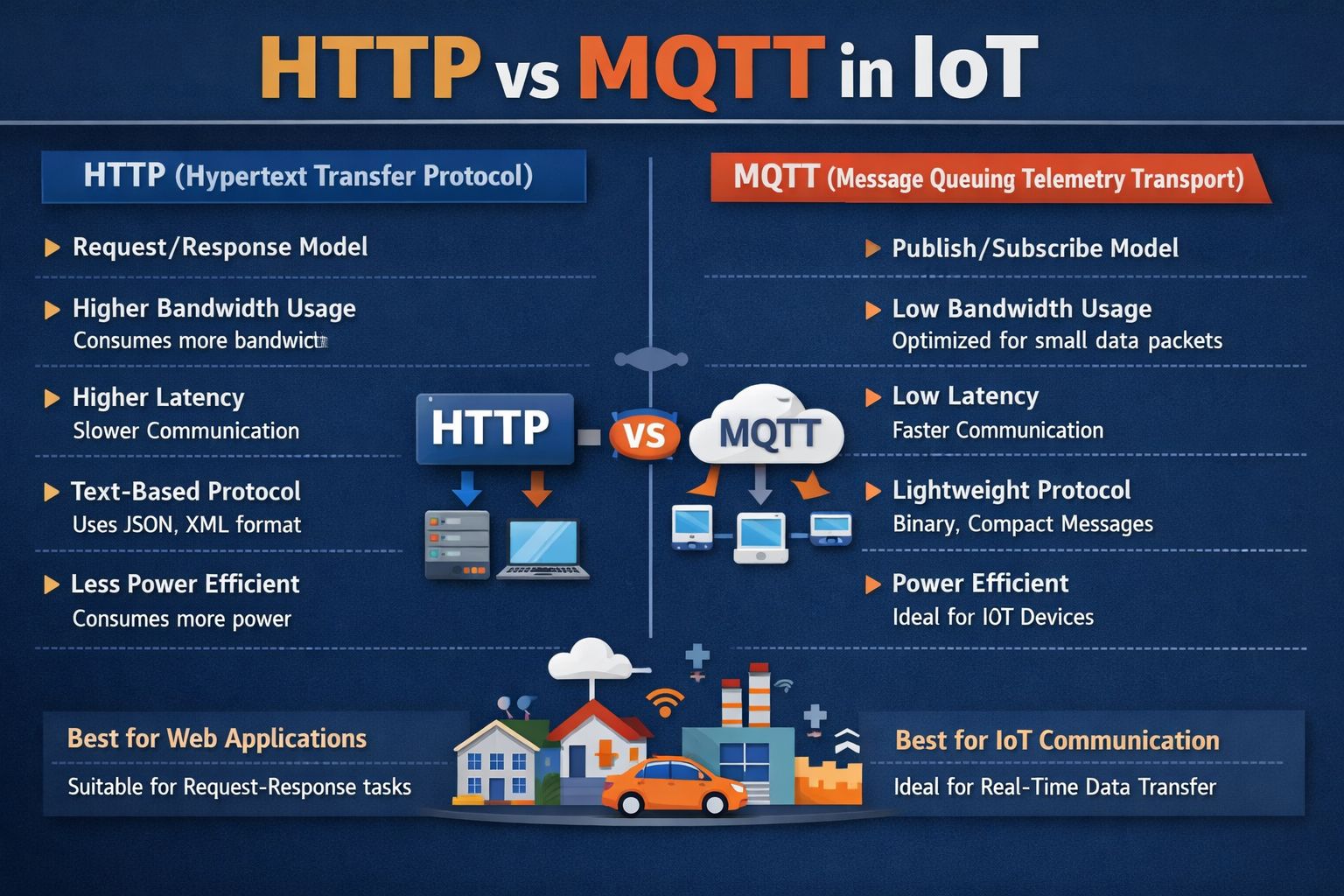
The Internet of Things (IoT) is rapidly transforming industries, homes, and cities, weaving a complex web of interconnected devices that generate, transmit, and analyze vast amounts of data. At the heart of this intricate ecosystem lies the critical challenge of communication. How do these diverse devices, often constrained by power, processing, and bandwidth, effectively exchange information? The answer lies in understanding the fundamental building blocks of IoT communication protocols. Among the most prominent, and often debated, are HTTP (Hypertext Transfer Protocol) and MQTT (Message Queuing Telemetry Transport). While both facilitate data exchange, they are designed with different philosophies and excel in distinct use cases. This comprehensive guide will delve into the intricacies of HTTP and MQTT, providing an in-depth analysis of their architectures, strengths, weaknesses, and optimal applications within the IoT landscape. By understanding these differences, engineers and business leaders can make informed decisions, designing robust, efficient, and scalable IoT systems that meet the evolving demands of our connected future.
The Foundation of Connectivity: Understanding Communication Protocols
Before we dive into the specific characteristics of HTTP and MQTT, it’s essential to grasp the fundamental role of communication protocols in the digital realm. A protocol is essentially a set of rules and guidelines that dictate how devices communicate with each other. It defines the format of data, the sequence of messages, error handling mechanisms, and overall interaction patterns. Without standardized protocols, interoperability would be an insurmountable hurdle, making the interconnected world we know today impossible.
In the context of IoT, these protocols face unique challenges. Unlike traditional internet communication where powerful devices with ample resources are the norm, IoT often involves resource-constrained devices – tiny sensors, actuators, and embedded systems – operating on limited battery power and narrow bandwidth. Therefore, the choice of communication protocol has profound implications for the efficiency, reliability, and cost-effectiveness of an IoT solution.
HTTP: The Ubiquitous Web Protocol in the IoT Context
HTTP, the backbone of the World Wide Web, is a familiar name to anyone who has ever used a web browser. Its prevalence and maturity often lead developers to consider it for IoT applications. However, its design, optimized for client-server interactions and web pages, presents both advantages and significant challenges in the IoT domain.
Unpacking the HTTP Request-Response Model
At its core, HTTP operates on a request-response model. This means that a client (e.g., a web browser or an IoT device) initiates a connection by sending a request to a server, and the server then processes that request and sends back a response. This synchronous, one-to-one communication pattern is fundamental to how HTTP functions.
Client-Server Architecture
In a typical HTTP interaction, an IoT device acts as a client, requesting data from or sending data to a central server. For instance, a smart thermostat might send a temperature reading to a cloud server using an HTTP POST request, and later receive a command to adjust the target temperature via an HTTP GET request. This clear separation of roles simplifies architectural design in many traditional web scenarios.
Stateless Communication
HTTP is inherently a stateless protocol. This means that each request from a client to the server is treated as an independent transaction, unrelated to any previous or subsequent requests. While statelessness can simplify server design by reducing the need to maintain session information, it can also lead to increased overhead in IoT applications where continuous context might be required. Each HTTP request carries all the necessary information for the server to fulfill it, including authentication details and data payloads.
The Bandwidth and Latency Equation in HTTP
One of the primary considerations when employing HTTP in IoT is its impact on bandwidth consumption and latency.
Higher Bandwidth Usage
HTTP messages, by design, tend to be verbose. They include extensive headers containing metadata such as content type, encoding, and authentication tokens. While these headers are crucial for robust web interactions, they introduce significant overhead for small data packets, which are common in IoT.
Consider a sensor sending a single temperature reading – perhaps just a few bytes of actual data. With HTTP, this small data payload would be encapsulated within a relatively large header, leading to a disproportionately high ratio of overhead to actual data. This can become a major concern in scenarios with limited bandwidth, such as cellular IoT deployments or remote locations with unreliable network access. The continuous exchange of redundant header information for every small data point can quickly exhaust available bandwidth, leading to slower data transfer and increased operational costs.
The use of human-readable text formats like JSON (JavaScript Object Notation) or XML (Extensible Markup Language) for data serialization further contributes to bandwidth consumption. While these formats are excellent for web readability and parsing, their text-based nature means they require more bytes to represent the same information compared to binary formats.
Higher Latency
The request-response nature of HTTP inherently introduces higher latency. Each interaction requires a full round trip: the client sends a request, the server processes it, and then the server sends a response. This sequential process means that for every piece of data exchanged, there’s a delay associated with establishing the connection, sending the request, processing on the server, and sending the response back.
In IoT applications where real-time responsiveness is critical – such as industrial automation, autonomous vehicles, or remote surgical equipment – even a few hundred milliseconds of latency can have severe consequences. The continuous polling by devices to check for new commands or data updates further exacerbates latency issues, as each poll is a new request-response cycle. This makes HTTP less suitable for applications demanding instantaneous feedback or continuous, low-delay data streams.
Power Consumption and Resource Overhead
Beyond bandwidth and latency, HTTP’s characteristics also impact the power consumption and processing overhead of IoT devices.
Less Power Efficient
For battery-powered IoT devices, power efficiency is paramount. The act of establishing and maintaining an HTTP connection, sending verbose requests, and processing complex responses consumes a significant amount of energy. Each time a device needs to communicate, it must power up its radio, establish a TCP connection (which HTTP typically runs over), perform TLS/SSL handshakes for secure communication, and then transmit and receive data. This entire process is energy-intensive.
In a scenario where devices frequently send small data packets, the cumulative power drain from these HTTP interactions can drastically reduce battery life. Many IoT devices are designed to operate for months or even years on a single battery, making power-hungry protocols like HTTP a major deterrent. The constant wake-up cycles required for HTTP communication contradict the low-power operating modes that many IoT devices are designed to leverage.
Text-Based Protocols: JSON and XML
HTTP commonly relies on text-based data formats like JSON and XML for data exchange. While these formats offer excellent human readability and easy parsing capabilities for web developers, they are inherently less efficient for constrained IoT environments.
- JSON (JavaScript Object Notation): A lightweight data-interchange format, JSON is widely used in web APIs. Its human-readable structure, however, means that it includes redundant characters like braces, brackets, commas, and quotes, adding to the message size.
- XML (Extensible Markup Language): Even more verbose than JSON, XML uses tags to define data elements, leading to significantly larger message sizes. While powerful for complex data structures, its overhead is generally prohibitive for resource-constrained IoT devices.
The overhead introduced by these formats necessitates more processing power for serialization and deserialization on the device, further impacting battery life and potentially requiring more powerful, and thus more expensive, microcontrollers.
When HTTP Excels in IoT: Web-Based Integrations
Despite its limitations, HTTP does have its place in the IoT ecosystem, particularly for scenarios that align with its strengths.
Client-Server Interactions
HTTP is well-suited for traditional client-server interactions where a central server orchestrates data exchange and device management. This is typical in cloud-based IoT platforms where devices interact with a web-accessible API.
Web Services and User Interfaces
For IoT solutions that require direct integration with web services, cloud platforms, or user-facing web applications, HTTP remains an excellent choice. When users interact with a dashboard to view device data or send commands, HTTP is the natural protocol for this front-end communication.
Firmware Updates and Batch Data Transfer
When large files, such as firmware updates or historical data logs, need to be transferred to or from IoT devices, HTTP’s ability to handle large data payloads gracefully can be an advantage. These are typically non-real-time operations where latency is less critical.
Less Frequent Communication
For devices that communicate infrequently, sending data only a few times a day, the overhead of HTTP might be acceptable. In such cases, the simplicity of developing with HTTP and its widespread tooling can outweigh its efficiency drawbacks.
MQTT: The IoT-Native Protocol
In stark contrast to HTTP, MQTT (Message Queuing Telemetry Transport) was explicitly designed to address the unique constraints and requirements of IoT environments. Developed by Andy Stanford-Clark of IBM and Arlen Nipper of Cirrus Link, MQTT prioritizes efficiency, low power consumption, and scalability, making it the de facto standard for many IoT applications.
The Publish-Subscribe Paradigm of MQTT
MQTT operates on a publish-subscribe model, a fundamentally different approach compared to HTTP’s request-response. Instead of direct client-server communication, MQTT introduces a central intermediary called a broker.
Brokers, Publishers, and Subscribers
In the publish-subscribe model:
- Publishers: IoT devices or applications that send data (messages) without knowing who the recipients are. They “publish” messages to specific topics on the MQTT broker.
- Subscribers: IoT devices or applications that receive data by “subscribing” to specific topics on the MQTT broker.
- Broker: The central hub that receives all messages from publishers and filters them, distributing copies to all subscribed clients. The broker acts as an intelligent router, decoupling publishers and subscribers.
This decoupling is a powerful feature. Publishers don’t need to know about subscribers, and subscribers don’t need to know about publishers. They only need to know about the broker and the topics they are interested in. This architecture greatly simplifies device management and scalability in large IoT deployments.
Topic-Based Messaging
Topics are hierarchical strings (e.g., home/livingroom/temperature, factory/machineA/status) that categorize messages. Publishers send messages to topics, and subscribers receive messages from topics. This flexible system allows for fine-grained control over data distribution and enables devices to subscribe to broad categories of data or very specific data streams. Wildcards can be used in subscriptions (e.g., home/+/temperature to get temperature from all rooms, or home/# to get all messages from the home).
Optimizing for Constrained Environments: Bandwidth and Latency
MQTT’s design choices are heavily geared towards minimizing resource consumption, making it ideal for the often-constrained nature of IoT devices.
Low Bandwidth Usage
MQTT is renowned for its low bandwidth usage. This is achieved through several mechanisms:
- Lightweight Headers: MQTT messages have incredibly small, fixed headers (typically 2-byte messages for control headers) compared to HTTP. This significantly reduces the overhead associated with each message transmission.
- Binary Message Payloads: While MQTT doesn’t dictate the payload format, it is commonly used with efficient binary serialization formats (e.g., Protocol Buffers, MessagePack) or even raw byte arrays. This allows developers to represent data using the fewest possible bytes, minimizing message size.
- Persistent Connections: MQTT clients typically maintain persistent TCP connections with the broker. This avoids the overhead of repeatedly establishing new connections for each message, as is common with HTTP. Once a connection is established, subsequent messages are sent with minimal overhead.
- Keep-Alive Mechanism: A small keep-alive message is exchanged periodically to ensure the connection remains active, signaling to the broker that the client is still present, further reducing the need for re-establishing connections.
These optimizations mean that a small sensor reading can be transmitted with very little additional data, making MQTT highly efficient for networks with limited bandwidth.
Low Latency and Faster Communication
The publish-subscribe model, combined with persistent connections, results in low latency and faster communication with MQTT. When a publisher sends a message, the broker immediately forwards it to all subscribed clients. There’s no polling required from the subscribers; messages are pushed as soon as they are available.
This push-based approach is crucial for real-time applications. For instance, in a smart home, a light switch command sent via MQTT can trigger the light almost instantaneously. In industrial control systems, immediate feedback from sensors and actuators is vital for safe and efficient operation, an area where MQTT excels. The ability to push data without explicit requests minimizes delay, making IoT applications feel more responsive and performant.
Energy Efficiency and Lightweight Operations
Power consumption is a critical factor for countless IoT devices, and MQTT shines in this regard.
Power Efficient: Ideal for IoT Devices
MQTT’s lean design directly translates to significantly better energy efficiency for IoT devices.
- Persistent Connections: By maintaining an always-on connection, devices avoid the energy-intensive process of repeatedly establishing and tearing down connections. Instead, they can send and receive data over an already established, low-power link.
- Message Buffering: The broker can buffer messages for clients that are temporarily offline, allowing devices to conserve power by only waking up periodically to connect and receive a batch of pending messages. This is particularly useful for devices that operate on very long battery cycles and only need to transmit or receive data at scheduled intervals.
- Minimal Processing: The compact message structure and efficient protocol stack require less processing power from the device’s microcontroller, directly contributing to lower energy usage. The device spends less time and energy on encoding, decoding, and managing network communication compared to HTTP.
These power-saving features make MQTT the preferred choice for battery-operated sensors, wearables, and other low-power IoT devices where extending battery life is a key design objective.
Lightweight Protocol: Binary and Compact Messages
MQTT is a truly lightweight protocol. Its design prioritizes conciseness and efficiency:
- Binary Control Headers: The protocol’s control messages and headers are in binary format, which is far more compact than text-based headers.
- Flexible Payload: While payloads can be text, the common practice in MQTT for IoT is to use binary formats to keep messages compact. This flexibility allows developers to choose the most efficient data representation for their specific needs, without being constrained by the protocol itself.
- Low Code Footprint: MQTT client libraries are typically very small, requiring minimal memory and processing resources on the device. This is crucial for devices with limited flash memory and RAM.
The overall lightweight nature of MQTT minimizes the resource requirements on the device, allowing for the use of less powerful, and therefore less expensive, microcontrollers and simpler network interfaces.
Quality of Service (QoS) in MQTT
A significant advantage of MQTT over basic HTTP in many IoT scenarios is its built-in Quality of Service (QoS) levels, which provide guarantees on message delivery. This is crucial for applications where data integrity and reliability are paramount.
QoS Levels
MQTT offers three QoS levels:
- QoS 0 (At Most Once): Messages are sent without any acknowledgment from the recipient. This is the fastest method but offers no guarantee of delivery. It’s suitable for non-critical data where some loss is acceptable, such as ambient temperature readings that are frequently updated.
- QoS 1 (At Least Once): Messages are guaranteed to arrive at least once. The publisher will resend the message if an acknowledgment is not received. Duplicates might occur, so either the publisher or the subscriber must handle potential duplicate messages if exact once delivery is required. This is suitable for important sensor data, where re-transmissions are acceptable.
- QoS 2 (Exactly Once): This is the highest level of service, guaranteeing that messages arrive exactly once. It involves a four-way handshake between the publisher, broker, and subscriber, which adds overhead but ensures no messages are lost or duplicated. This is critical for applications like financial transactions, command and control systems, or medical device data where every message is vital and must not be duplicated.
The ability to choose the appropriate QoS level allows developers to tailor message delivery guarantees to the specific needs of their application, balancing reliability with bandwidth and power consumption.
Security in MQTT
While MQTT itself is a data transport protocol, it integrates robust security mechanisms crucial for protecting sensitive IoT data.
TLS/SSL Encryption
MQTT typically runs over TCP/IP, and for secure communication, it leverages TLS (Transport Layer Security) or its predecessor SSL (Secure Sockets Layer). This encrypts the data exchanged between the MQTT client and the broker, preventing eavesdropping and tampering.
Authentication and Authorization
MQTT brokers support various authentication methods to verify the identity of connecting clients. This can include username/password authentication, client certificates, or integration with external identity providers. Authorization mechanisms then control which clients can publish to specific topics and subscribe to others, ensuring that devices only access the data they are permitted to see.
When MQTT is the Undisputed Champion in IoT
MQTT’s strengths make it the go-to protocol for a vast array of IoT applications.
Real-Time Data Streaming
For applications demanding immediate data updates and continuous streams of information, such as live sensor monitoring, telematics, and video surveillance feeds, MQTT’s low latency and push-based delivery are indispensable.
Low-Power and Battery-Operated Devices
Any IoT device with strict power constraints, including smart home sensors, smart meters, wearables, and remote agricultural monitors, will benefit immensely from MQTT’s energy efficiency. Its ability to maintain persistent connections with minimal power drain is a game-changer for extending device longevity.
Highly Scalable Systems
The publish-subscribe model naturally lends itself to highly scalable architectures. As the number of devices grows, adding new publishers or subscribers doesn’t require modifications to existing ones. The broker efficiently handles the distribution, allowing for millions of connected devices without overwhelming publishers or subscribers with direct connections.
Unreliable Network Environments
In environments with intermittent or poor network connectivity, such as rural areas or industrial settings, MQTT’s persistent connections, message buffering capabilities, and QoS guarantees offer superior reliability. Messages can be stored and forwarded when connectivity is restored, ensuring data eventually reaches its destination.
Bidirectional Communication
MQTT facilitates seamless bidirectional communication. Devices can both publish data (e.g., sensor readings) and subscribe to commands (e.g., turning a light on/off) from the same connection, enabling rich interactive IoT experiences.
HTTP vs MQTT: A Head-to-Head Comparison
To solidify the understanding of these two protocols, let’s directly compare their key characteristics across various dimensions.
Communication Model
- HTTP: Request-Response. Client initiates, server responds. Synchronous communication.
- MQTT: Publish-Subscribe. Broker acts as intermediary. Asynchronous communication.
Data Efficiency
- HTTP: Higher bandwidth usage due to verbose headers and typically text-based payloads (JSON/XML).
- MQTT: Low bandwidth usage due to minimal headers and support for compact, binary payloads.
Latency
- HTTP: Higher latency due to multiple request-response cycles and connection setup overhead for each transaction.
- MQTT: Low latency due to persistent connections and push-based messaging.
Power Consumption
- HTTP: Less power efficient. Frequent connection setup, verbose data, and continuous polling drain battery life quickly.
- MQTT: Highly power efficient. Persistent connections, reduced data overhead, and message buffering prolong battery life.
Scalability
- HTTP: Can be scaled, but requires careful management of individual client connections and server load. Each device needs to know the server’s address.
- MQTT: Inherently highly scalable due to the decoupled publish-subscribe model. The broker handles distribution, simplifying the addition of new devices.
Reliability
- HTTP: Relies on underlying TCP for reliability. Applications must build their own retry mechanisms for intermittent connectivity.
- MQTT: Offers built-in Quality of Service (QoS) levels (0, 1, 2) to guarantee message delivery, even in unreliable networks.
Security
- HTTP: Secured with HTTPS (HTTP over TLS/SSL) for encryption. Authentication typically handled via tokens or session cookies.
- MQTT: Secured with TLS/SSL for encryption. Authentication and authorization typically handled by the broker.
Complexity
- HTTP: Relatively simple for basic web interactions, but building a robust IoT system with HTTP can require significant custom code for reliability and efficiency.
- MQTT: Broker setup can be a initial learning curve, but once established, device-side implementation is straightforward, offering robust features out-of-the-box.
Use Cases
- HTTP: Web-based integrations, device management interfaces, firmware updates, infrequent data transfers, large file transfers.
- MQTT: Real-time sensor data, command and control, telemetry, low-power devices, high-volume message delivery, edge computing.
Hybrid Approaches and Coexistence
It’s important to recognize that HTTP and MQTT are not mutually exclusive. In many sophisticated IoT architectures, they coexist, each serving its purpose where it offers the most advantage. A hybrid approach often provides a more robust and flexible solution.
For example, a typical IoT deployment might use:
- MQTT for real-time sensor data and control commands: Devices communicate with an MQTT broker in real-time, leveraging its efficiency and low latency.
- HTTP for device management and configuration: A web-based dashboard or a mobile application might use HTTP to interact with a cloud-based API to manage device settings, update firmware, or pull historical data for reporting.
- HTTP for onboarding new devices: Initially, a device might use HTTP to register itself with the IoT platform and retrieve its MQTT broker credentials.
This layered approach allows developers to harness the best of both worlds, optimizing each segment of their IoT system for performance, efficiency, and functionality.
The Future of IoT Protocols
While HTTP and MQTT are dominant, the IoT landscape is constantly evolving, and other protocols are emerging or gaining traction for specific niches. CoAP (Constrained Application Protocol) and AMQP (Advanced Message Queuing Protocol) are notable examples. However, for the vast majority of IoT applications, the choice will primarily revolve around HTTP and MQTT, or a combination of both.
The decision ultimately depends on a careful analysis of various factors:
- Device Constraints: Are devices battery-powered? Do they have limited processing power and memory?
- Data Characteristics: Is data small and frequent, or large and intermittent? Is real-time delivery critical?
- Network Environment: Is bandwidth limited? Is connectivity reliable or intermittent?
- Scalability Requirements: How many devices are expected to connect?
- Security Needs: What level of data protection and authentication is required?
- Development Ecosystem: What tools, libraries, and expertise are available?
By meticulously considering these aspects, engineers can architect IoT solutions that are not only functional but also optimized for performance, cost, and longevity.
Conclusion: Making the Informed Choice for Your IoT Ecosystem
The choice between HTTP and MQTT for your IoT project is not merely a technical decision; it’s a strategic one that profoundly impacts the success, efficiency, and scalability of your connected solution. HTTP, with its pervasive presence and robust web integration capabilities, remains valuable for specific IoT use cases, particularly those involving web services, user interfaces, or large data transfers where latency and bandwidth are less critical.
However, for the vast majority of IoT applications characterized by resource-constrained devices, real-time data requirements, and the need for optimal power efficiency, MQTT stands out as the superior choice. Its lightweight publish-subscribe architecture, low bandwidth footprint, expedited communication, and inherent power-saving features make it an indispensable protocol for building scalable, reliable, and cost-effective IoT ecosystems.
Understanding the fundamental differences, strengths, and weaknesses of both protocols is paramount for designing efficient and reliable IoT systems. By aligning the protocol choice with the specific application requirements, device constraints, and network conditions, you can unlock the full potential of your IoT vision.
At IoT Worlds, we specialize in navigating these complex choices, transforming your innovative ideas into powerful, connected realities. Whether you’re looking to optimize your existing IoT infrastructure or embark on a new venture, our expertise in protocol selection, system architecture, and end-to-end development ensures your success.
Reach out to us today to discuss how we can help you build the next generation of intelligent, interconnected solutions. Your journey towards an optimized and robust IoT future begins now.
For expert guidance on your IoT project and to explore how to leverage the right communication protocols for your specific needs, send an email to info@iotworlds.com.
