

The Internet of Things (IoT) is rapidly transforming industries and daily life, connecting billions of devices to create a more intelligent and responsive world. From smart homes to vast industrial complexes, the demand for seamless, efficient, and reliable communication between these devices is paramount. A cornerstone of this interconnected future lies in the ability to transmit data over significant distances while consuming minimal power. This is precisely where Long Range (LoRa) and Long Range Wide Area Network (LoRaWAN) technologies emerge as essential enablers.
Understanding long-range communication in IoT is not merely an academic exercise; it’s fundamental for building scalable and energy-efficient systems that can truly revolutionize various sectors. Consider the challenges of deploying sensors across sprawling agricultural fields, monitoring environmental conditions in remote locations, or managing extensive smart city infrastructure. Traditional wireless technologies often fall short in these scenarios, either due to range limitations, excessive power consumption, or high deployment costs.
LoRa and LoRaWAN have risen to prominence as key technologies addressing these challenges, empowering low-power, long-range connectivity for IoT devices across a diverse range of applications, including smart cities, agriculture, industrial monitoring, and environmental sensing. These technologies are not just buzzwords; they represent a significant leap forward in how we envision and implement IoT solutions.
This comprehensive article delves into the intricacies of LoRa and LoRaWAN, offering a detailed explanation of their core components, operational mechanisms, and the profound impact they have on the IoT landscape. We will explore the fundamental principles that allow for kilometer-range communication with minimal power consumption, highlighting their crucial role in the development of LPWAN-based IoT ecosystems. Join us as we uncover the technical marvels and practical advantages of these long-range wireless technologies, providing a quick technical overview for anyone exploring IoT networking architectures.
The Genesis of Long-Range, Low-Power Communication
Before we dive into the specifics of LoRa and LoRaWAN, it’s crucial to understand the driving forces behind their development. The proliferation of IoT devices brought forth a unique set of communication requirements that traditional wireless protocols like Wi-Fi, Bluetooth, and cellular networks struggled to meet efficiently.
Limitations of Traditional Wireless Protocols in IoT
- Wi-Fi and Bluetooth: While ubiquitous for short-range communication, their power consumption increases with range, making them unsuitable for battery-powered devices needing to operate for years. Their limited range also necessitates a high density of access points for wide-area coverage, leading to increased infrastructure costs.
- Cellular Networks (2G, 3G, 4G, 5G): Offer broad coverage but are primarily designed for high-bandwidth data transmission, consuming significant power. The cost per module and subscription fees can also be prohibitive for low-data-rate IoT applications, especially for devices that transmit small packets infrequently. Furthermore, their infrastructure is often optimized for human-centric communication rather than machine-to-machine, leading to inefficiencies for many IoT use cases.
The Emergence of LPWAN
Recognizing these gaps, the concept of Low-Power Wide-Area Networks (LPWANs) emerged. LPWAN technologies are specifically engineered to provide long-range communication with minimal power consumption, making them ideal for battery-operated IoT devices that transmit small amounts of data over extended periods. LoRa and LoRaWAN are leading examples within the LPWAN ecosystem.
Deconstructing LoRa: The Physical Layer Foundation
At the heart of the LoRaWAN ecosystem lies LoRa, which stands for Long Range. LoRa is a proprietary spread spectrum modulation technique derived from Chirp Spread Spectrum (CSS) technology. It operates at the physical layer (Layer 1) of the OSI model, focusing on how data is transmitted wirelessly.
What is LoRa?
LoRa is essentially a modulation scheme that transforms digital data into radio signals for transmission. Its key characteristics are:
- Long Range: LoRa can achieve communication distances of up to 15-20 kilometers in rural areas and 2-5 kilometers in urban environments, depending on obstacles and environmental conditions. This remarkable range is a significant advantage over other low-power wireless technologies.
- Low Power: Designed for energy efficiency, LoRa enables devices to operate on small batteries for years, dramatically reducing maintenance costs and increasing deployment flexibility.
- Robustness to Interference: LoRa’s spread spectrum technology makes it highly resilient to noise and interference, crucial for reliable communication in complex RF environments.
- High Link Budget: This refers to the maximum permissible signal loss between the transmitter and receiver. LoRa’s high link budget, typically around 150-160 dB, allows signals to penetrate obstacles and cover vast distances effectively.
How LoRa Works: Chirp Spread Spectrum Demystified
The magic behind LoRa’s long-range and low-power capabilities lies in its unique modulation technique. CSS technology encodes data using ‘chirps’ – signals that continuously change frequency over time.
- Chirp Modulation: Instead of transmitting data at a single frequency, LoRa spreads the signal across a wide band of frequencies using chirps. This makes the signal resistant to interference and natural phenomena like multipath fading.
- Spreading Factor (SF): LoRa uses a configurable spreading factor (SF), typically ranging from SF7 to SF12. A higher spreading factor increases the transmission time (airtime) of the signal, making it more robust against noise and enabling longer ranges. However, a higher SF also reduces the data rate. This adaptability allows network operators to optimize for range, battery life, or data rate based on specific application requirements.
- Adaptive Data Rate (ADR): LoRaWAN networks intelligently manage the spreading factor of each device through Adaptive Data Rate (ADR). Devices closer to a gateway can use a lower SF, transmitting data faster and conserving battery life, while devices further away or in noisy environments can switch to a higher SF for increased reliability.
- Frequency Hopping: While not strictly part of the LoRa modulation itself, LoRa devices often employ frequency hopping spread spectrum (FHSS) techniques to further enhance robustness and avoid sustained interference on a single channel.
LoRa Frequencies and Regulations
LoRa operates on unlicensed sub-gigahertz ISM (Industrial, Scientific, and Medical) radio bands. The specific frequencies vary by geographical region:
- Europe: 868 MHz band
- North America: 915 MHz band
- Asia: 433 MHz and 923 MHz bands
Adhering to these regional regulations is crucial for lawful operation and to avoid interference with other services. This ensures that LoRa devices can be deployed globally while complying with local spectrum regulations.
LoRaWAN: The Network Layer for IoT Connectivity
While LoRa defines the physical layer, LoRaWAN (Long Range Wide Area Network) is the network layer protocol that sits atop LoRa. It defines the communication protocol and system architecture for the entire network, enabling secure and bidirectional communication between LoRa devices and applications. Think of LoRa as the road, and LoRaWAN as the traffic rules and infrastructure that allow vehicles (data) to travel efficiently and safely.
The LoRaWAN Network Architecture
A typical LoRaWAN network consists of several key components that work in concert to provide end-to-end connectivity:
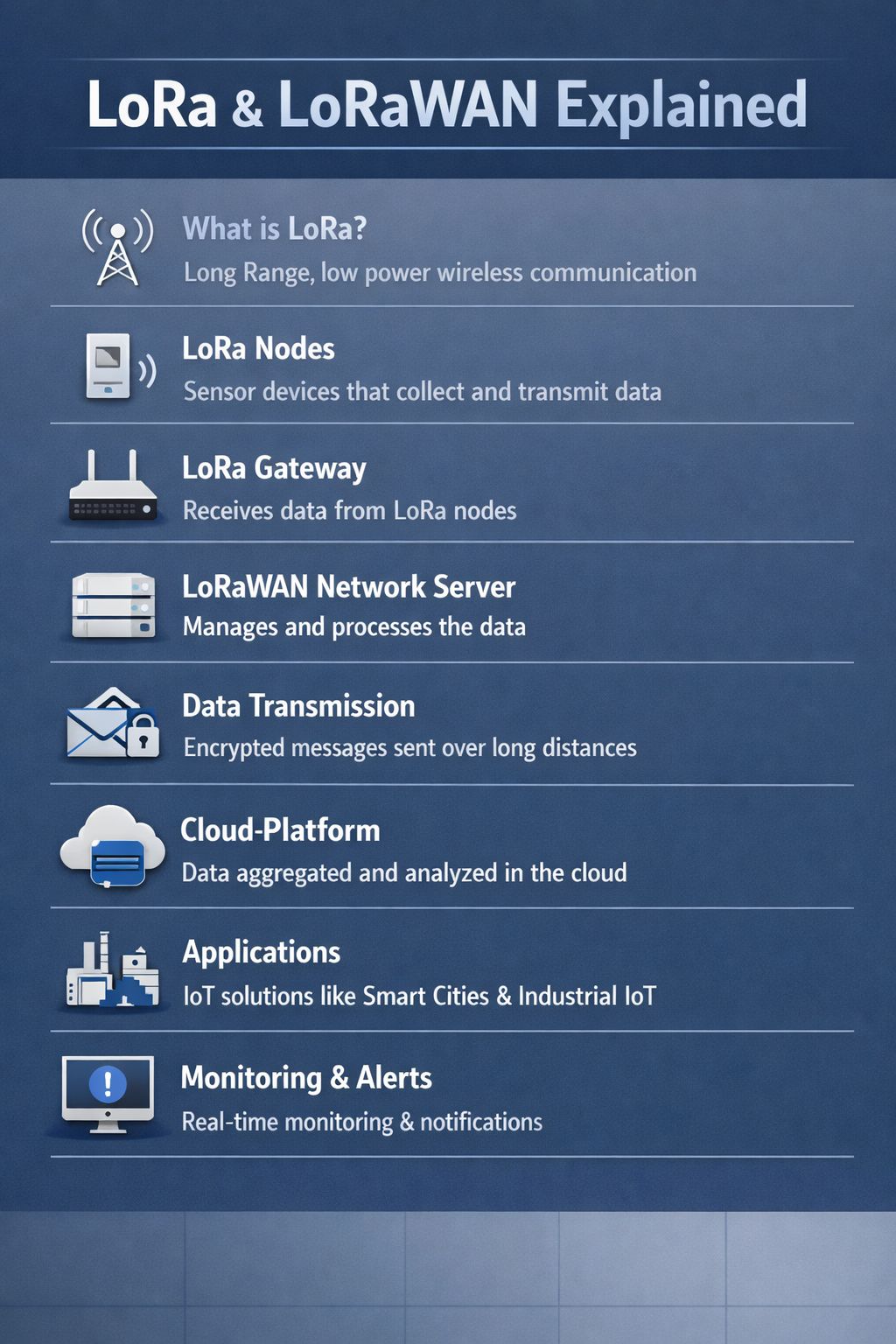
- LoRa Nodes (End Devices): These are the physical IoT devices embedded with LoRa modules. They serve as the sensors or actuators that collect data (e.g., temperature, humidity, GPS coordinates) or receive commands. LoRa nodes are designed for low power consumption, allowing them to operate for years on a single battery. They typically communicate with gateways unsynchronously, transmitting data only when necessary to preserve power. Examples include smart meters, environmental sensors, asset trackers, and industrial monitoring equipment.
- LoRa Gateways (Concentrators): Gateways are the bridges between the LoRa end devices and the LoRaWAN network server. They receive LoRa packets from multiple end devices and forward them to a central network server via standard IP connections (e.g., Ethernet, Wi-Fi, cellular). Gateways act as transparent relays, simply converting RF packets to IP packets and vice versa. A single gateway can cover a vast area, receiving data from thousands of end devices.
- LoRaWAN Network Server (LNS): The LNS is the brain of the LoRaWAN network. It manages and processes the data received from gateways. Its primary responsibilities include:
- Data Deduplication: Eliminating redundant packets received by multiple gateways (a feature called “geo-location” can also be derived from this).
- Security: Decrypting and authenticating data from end devices.
- Adaptive Data Rate (ADR) Management: Optimizing the data rate and spreading factor for each end device to maximize battery life and network capacity.
- Routing: Forwarding data packets from end devices to the appropriate application servers and routing downlink messages from application servers back to end devices.
- Device Management: Managing the registration and activation of end devices.
- Join Server: A specialized server responsible for managing the Over-the-Air Activation (OTAA) process, ensuring secure onboarding of new devices to the network.
- Application Servers: These are the final destinations for the IoT data. Application servers receive processed data from the network server, allowing users to visualize, analyze, and act upon the information. They also generate downlink commands that are sent back to end devices through the network server and gateways. This is where the real-world value of IoT data is realized, powering dashboards, alerts, and automated actions.
- Cloud-Platform: Often, application servers are hosted on cloud platforms, providing scalability, data storage, analytics capabilities, and integration with other enterprise systems. Cloud platforms aggregate and analyze the vast amounts of data collected, transforming raw sensor readings into actionable insights.
LoRaWAN Device Classes
LoRaWAN defines three device classes (A, B, and C) to optimize for different application requirements regarding battery life, latency, and communication modality.
- Class A (All): This is the default and lowest power consumption class. Class A devices are bi-directional, meaning they can both transmit and receive data. After an uplink transmission, a Class A device opens two short receive windows to listen for downlink messages. If no downlink message is received during these windows, the device goes back to sleep, conserving power. This asymmetric communication is ideal for applications that primarily send data and only occasionally need to receive commands.
- Class B (Beacon): Class B devices offer scheduled receive windows. In addition to the two receive windows after an uplink, Class B devices periodically open extra receive windows based on a synchronized beacon from the gateway. This allows for more predictable downlink communication without consuming as much power as Class C, making it suitable for applications that require regular but not constant downlink messages, such as actuator control or firmware updates.
- Class C (Continuously Listening): Class C devices offer the lowest latency and highest power consumption. They keep their receive windows open continuously, except when transmitting. This allows for near real-time bidirectional communication, making them suitable for applications that require constant monitoring and immediate control, such as streetlights or industrial automation. However, Class C devices are typically mains-powered due to their high energy demands.
The choice of device class is a critical design decision, directly impacting the trade-off between power consumption and communication responsiveness.
Data Transmission and Security in LoRaWAN
Data transmission in LoRaWAN is designed with security and efficiency in mind.
- Encrypted Messages: All messages transmitted over a LoRaWAN network are secured using two layers of encryption:
- Network Session Key (NwkSKey): This encryption key is shared between the end device and the network server, ensuring that only authorized devices can join and communicate within the network and that the integrity of the messages is maintained.
- Application Session Key (AppSKey): This encryption key is shared between the end device and the application server, providing end-to-end encryption for the payload data. This means that even if a network operator were to intercept the data, they would not be able to read the application-level information.
- Activation Methods: LoRaWAN devices can be activated in two ways:
- Over-the-Air Activation (OTAA): This is the preferred and most secure method. The device performs a join procedure with the network server, during which the unique device identities and session keys are securely exchanged.
- Activation By Personalization (ABP): In ABP, the device’s addresses and session keys are pre-programmed before deployment. While simpler for small deployments, it offers less security as the keys are static and can be compromised if the device is tampered with.
- Data Aggregation and Analysis: Once encrypted messages are transmitted over long distances and received by gateways, they are forwarded to the network server. The network server decrypts the network layer and then passes the encrypted application payload to the application server. The application server then decrypts the application payload using the
AppSKey, aggregates the data, and performs analysis. This process transforms raw sensor data into meaningful insights, enabling real-time monitoring and advanced analytics.
The Advantages of LoRa and LoRaWAN for IoT
The combination of LoRa and LoRaWAN offers a compelling set of advantages that are driving their widespread adoption across various IoT verticals.
Extended Range and Coverage
Unlike short-range technologies, LoRaWAN networks can span kilometers, providing broad coverage with fewer gateways. This significantly reduces infrastructure costs and simplifies deployment, especially in rural or sparsely populated areas. The ability to penetrate obstacles also enhances coverage in urban environments, allowing for reliable communication indoors and in basements.
Ultra-Low Power Consumption
This is arguably the most significant advantage for many IoT applications. LoRaWAN devices are designed to consume minimal power, enabling them to operate for 5-10 years on standard AA batteries. This longevity dramatically reduces the total cost of ownership by minimizing maintenance, battery replacement, and associated labor.
High Network Capacity
A single LoRaWAN gateway can support tens of thousands of end devices. This high capacity is achieved through LoRa’s spread spectrum technology and the network server’s ability to manage adaptive data rates, ensuring efficient use of the available spectrum.
Cost-Effectiveness
- Lower Infrastructure Costs: Fewer gateways are needed to cover a large area, leading to reduced capital expenditure for network deployment.
- Reduced Device Costs: LoRa modules are relatively inexpensive, and the long battery life further contributes to lower operational costs.
- Unlicensed Spectrum: Operating on unlicensed ISM bands eliminates the need for expensive spectrum licenses, further lowering the barrier to entry for deploying LoRaWAN solutions.
Robust and Secure Communication
- Interference Resilience: LoRa’s CSS modulation provides excellent immunity to interference, ensuring reliable data transmission even in noisy RF environments.
- End-to-End Security: The two layers of encryption (NwkSKey and AppSKey) ensure that data is secure from the device to the application, protecting against eavesdropping and tampering.
Scalability and Interoperability
LoRaWAN is an open standard maintained by the LoRa Alliance, fostering an ecosystem of interoperable devices, gateways, and network servers from various manufacturers. This open standard promotes competition, drives innovation, and ensures that solutions can be scaled easily without vendor lock-in.
Real-World Applications of LoRa and LoRaWAN
The unique capabilities of LoRa and LoRaWAN make them ideal for a wide array of IoT applications that require long-range, low-power connectivity.
Smart Cities
LoRaWAN is a cornerstone technology for developing intelligent urban environments.
- Smart Street Lighting: Remotely monitor and control streetlights, optimizing energy consumption and facilitating proactive maintenance.
- Smart Waste Management: Sensors in waste bins detect fill levels, enabling optimized collection routes and reducing operational costs.
- Environmental Monitoring: Deploy sensors to track air quality, noise pollution, and water levels, providing real-time data for urban planning and public health initiatives.
- Smart Parking: Guide drivers to available parking spaces, reducing congestion and improving urban mobility.
- Public Safety: Connected devices for disaster preparedness, asset tracking for emergency services, and smart infrastructure monitoring.
Agriculture (Smart Farming)
The vast and often remote nature of agricultural operations makes LoRaWAN an ideal fit.
- Soil Moisture Monitoring: Sensors provide real-time data on soil conditions, optimizing irrigation schedules and water usage.
- Crop Monitoring: Tracking environmental parameters like temperature, humidity, and light intensity to enhance crop yield and prevent diseases.
- Livestock Tracking: GPS-enabled LoRa devices monitor animal locations and health, improving herd management and preventing loss.
- Asset Tracking: Locating and managing farm equipment, preventing theft, and optimizing utilization.
- Smart Irrigation Systems: Automated control of irrigation based on sensor data and weather forecasts, leading to significant water savings.
Industrial IoT (IIoT)
LoRaWAN addresses critical needs for monitoring and automation in industrial settings.
- Asset Tracking: Real-time location and status monitoring of industrial assets, tools, and vehicles within large facilities or across widespread operational sites.
- Predictive Maintenance: Sensors monitor the health and performance of machinery, allowing for proactive maintenance and preventing costly breakdowns.
- Facility Management: Monitoring temperature, humidity, gas leaks, and occupancy in factories and warehouses for safety, efficiency, and compliance.
- Supply Chain and Logistics: Tracking goods and containers throughout the supply chain, enhancing visibility and security.
- Utility Monitoring: Smart metering for gas, water, and electricity, enabling remote readings, consumption analysis, and leak detection.
Environmental Sensing and Conservation
For applications requiring data collection in remote and challenging environments, LoRaWAN excels.
- Wildlife Monitoring: Tracking animal movements and environmental conditions in conservation areas.
- Water Quality Monitoring: Sensors deployed in rivers, lakes, and oceans to monitor pollution levels and ecological health.
- Forest Fire Detection: Early warning systems using temperature and smoke sensors in remote forest areas.
- Glacier and Climate Monitoring: Deploying sensors in extreme environments to collect data on climate change indicators.
Other Emerging Applications
The versatility of LoRaWAN continues to inspire new and innovative applications:
- Building Automation: Smart lighting, HVAC control, occupancy sensing, and security systems within commercial and residential buildings.
- Healthcare: Patient tracking within hospitals, monitoring of medical equipment, and cold chain monitoring for sensitive pharmaceuticals.
- Retail: Inventory management, smart shelving, customer tracking for analytics, and security.
- Logistics and Asset Security: Securing valuable assets in transit or storage, with real-time alerts for unauthorized movement or access.
The breadth of these applications underscores the transformative potential of LoRa and LoRaWAN in creating a truly interconnected and intelligent world. The ability to deploy low-cost, long-lasting sensors across vast areas without robust power infrastructure opens up new possibilities for data collection and automation that were previously unfeasible.
Challenges and Considerations for LoRaWAN Deployment
While LoRaWAN offers numerous advantages, it’s essential to consider certain challenges and design considerations for successful deployment.
Data Rate Limitations
LoRaWAN is designed for low-data-rate applications, typically transmitting small packets of data (payloads are often tens to hundreds of bytes). It is not suitable for high-bandwidth applications like video streaming or large file transfers. Understanding this limitation is crucial when selecting the right technology for a given IoT use case.
Latency
Due to its asynchronous nature and duty cycle limitations (especially in certain regions to comply with regulations), LoRaWAN can introduce latency in communication. While Class C devices offer lower latency, they consume more power. For applications requiring immediate, real-time control, alternative technologies might be more appropriate.
Duty Cycle Regulations
In several regions (e.g., Europe’s 868 MHz band), there are strict regulations on the maximum transmission time (duty cycle) for devices operating on unlicensed ISM bands. This limits how frequently a device can transmit, which needs to be factored into application design and data transmission intervals.
Network Planning and Coverage Optimization
While LoRaWAN offers excellent range, careful network planning is still essential. Factors such as gateway placement, antenna type, environmental obstacles (buildings, terrain), and interference sources can impact coverage and signal strength. RF planning tools and site surveys are often necessary for optimal network deployment.
Security Implementation
While LoRaWAN inherently provides two layers of encryption, proper key management and implementation of security best practices are paramount. Device authentication, secure storage of keys, and secure communication with application servers must be meticulously handled to protect against cyber threats.
Scalability Management
As the number of devices on a LoRaWAN network grows, effectively managing device activation, data flow, and network performance becomes critical. Robust network server software and scalable cloud infrastructure are essential to handle increasing data volumes and device counts.
Battery Life Optimization
While LoRaWAN is inherently low-power, optimizing battery life requires careful consideration of several factors:
- Spreading Factor Selection: Using the lowest possible SF while maintaining reliable communication.
- Transmission Interval: Transmitting data only when necessary and minimizing uplink frequency.
- Device Class: Choosing the appropriate device class (A, B, or C) based on application requirements.
- Sensor Power Consumption: The power consumption of the sensor itself can dominate the overall device power budget.
Addressing these challenges through thoughtful design, robust implementation, and careful network management is key to unlocking the full potential of LoRaWAN in diverse IoT environments.
The Future of LoRa and LoRaWAN
The journey of LoRa and LoRaWAN is far from over. The technology continues to evolve, driven by ongoing innovation and the growing demands of the IoT market.
Continued Evolution of the LoRaWAN Standard
The LoRa Alliance, the open association promoting the LoRaWAN standard, continually releases updates and enhancements to the protocol. These updates aim to improve efficiency, security, and introduce new features such as:
- Geolocation Enhancements: Improving the accuracy and efficiency of device localization.
- Firmware Updates Over-the-Air (FUOTA): Enabling remote updates of firmware on deployed devices, crucial for maintenance and security patches.
- Multicast Features: Allowing a single downlink message to be sent to multiple devices simultaneously, enhancing efficiency for group commands.
- Increased Data Rates: Exploring ways to achieve higher data rates while maintaining long-range and low-power characteristics without compromising existing advantages.
Integration with Other Technologies
LoRaWAN is increasingly being integrated with other communication technologies and platforms to create hybrid IoT solutions.
- Satellite LoRaWAN: Projects are underway to extend LoRaWAN coverage to truly remote areas by leveraging satellite constellations. This opens up possibilities for monitoring in oceanic regions, deserts, and other areas without terrestrial network infrastructure.
- Integration with Edge Computing: Combining LoRaWAN with edge computing allows for local data processing and analytics, reducing reliance on cloud infrastructure and enabling faster decision-making for latency-sensitive applications.
- Convergence with 5G: While different in their core purpose, there’s potential for LoRaWAN to complement 5G deployments by handling the massive number of low-power, low-data-rate connections where 5G’s high bandwidth capabilities might be overkill or too power-intensive.
Growing Ecosystem and Market Penetration
The LoRaWAN ecosystem is expanding rapidly, with a growing number of chip manufacturers, module vendors, gateway providers, network operators, and solution integrators. This vibrant ecosystem fuels innovation, drives down costs, and makes LoRaWAN more accessible to a wider range of businesses and developers.
As industries continue their digital transformation, LoRa and LoRaWAN are poised to play an even more critical role. Their ability to provide pervasive, long-range, and energy-efficient connectivity forms the backbone of countless IoT applications, enabling sustainable growth and intelligent operations across the globe. The economic and environmental benefits derived from optimizing resource usage, improving efficiency, and gaining actionable insights from vast amounts of data will continue to propel LoRaWAN’s widespread adoption.
Conclusion: Empowering the Future of IoT with LoRa and LoRaWAN
The journey through the intricacies of LoRa and LoRaWAN reveals a powerful and indispensable technological duo for the Internet of Things. We have explored how LoRa, with its unique Chirp Spread Spectrum modulation, provides the foundational long-range, low-power wireless communication. Building upon this, LoRaWAN establishes the robust network architecture, enabling secure and scalable connectivity for a myriad of IoT devices.
From the fundamental LoRa Nodes collecting vital data to the LoRa Gateways acting as crucial bridges, the intelligent orchestration of the LoRaWAN Network Server, and the ultimate processing on Cloud-Platforms and Application Servers, each component plays a pivotal role in transforming raw data into actionable insights. The inherent security of Encrypted messages sent over long distances ensures data integrity and privacy, while the ability to deliver Real-time monitoring & notifications empowers proactive decision-making.
The impact of LoRa and LoRaWAN is evident across diverse sectors. In Smart Cities, they enable efficient resource management and enhanced public services. In Industrial IoT, they drive operational efficiency and predictive maintenance. In Agriculture, they foster sustainable farming practices and optimize crop yields. These technologies are not just connecting devices; they are enabling a new era of intelligence and efficiency in our world.
By enabling kilometer-range communication with minimal power consumption, LoRa and LoRaWAN have undeniably carved out a major role in the development of LPWAN-based IoT ecosystems. As the demand for pervasive and energy-efficient connectivity continues to grow, these technologies will remain at the forefront, powering the next wave of IoT innovation.
For businesses and organizations looking to harness the full potential of IoT, understanding and strategically implementing LoRa and LoRaWAN is no longer optional but a strategic imperative. The ability to deploy long-lasting, low-maintenance sensors and devices across vast geographical areas opens up unprecedented opportunities for data collection, automation, and transformative change.
Ready to Transform Your IoT Vision into Reality?
At IoT Worlds, we specialize in designing, deploying, and managing cutting-edge IoT solutions powered by technologies like LoRa and LoRaWAN. Whether you’re envisioning a smart city initiative, optimizing industrial operations, enhancing agricultural productivity, or exploring new environmental sensing applications, our team of experts is here to guide you every step of the way. Unlock the power of long-range, low-power connectivity and build scalable, energy-efficient systems that drive real-world value.
Contact us today to discuss your project and discover how LoRa and LoRaWAN can revolutionize your business. Send an email to info@iotworlds.com to get started.
