

The Internet of Things (IoT) is no longer a futuristic concept; it’s a rapidly expanding reality transforming industries, homes, and cities worldwide. At the heart of every successful IoT deployment lies efficient communication – the ability for countless devices, from simple sensors to complex industrial machinery, to seamlessly exchange data. This seemingly straightforward requirement presents a significant challenge when dealing with the unique constraints of IoT, where devices often operate on limited power, memory, and network bandwidth.
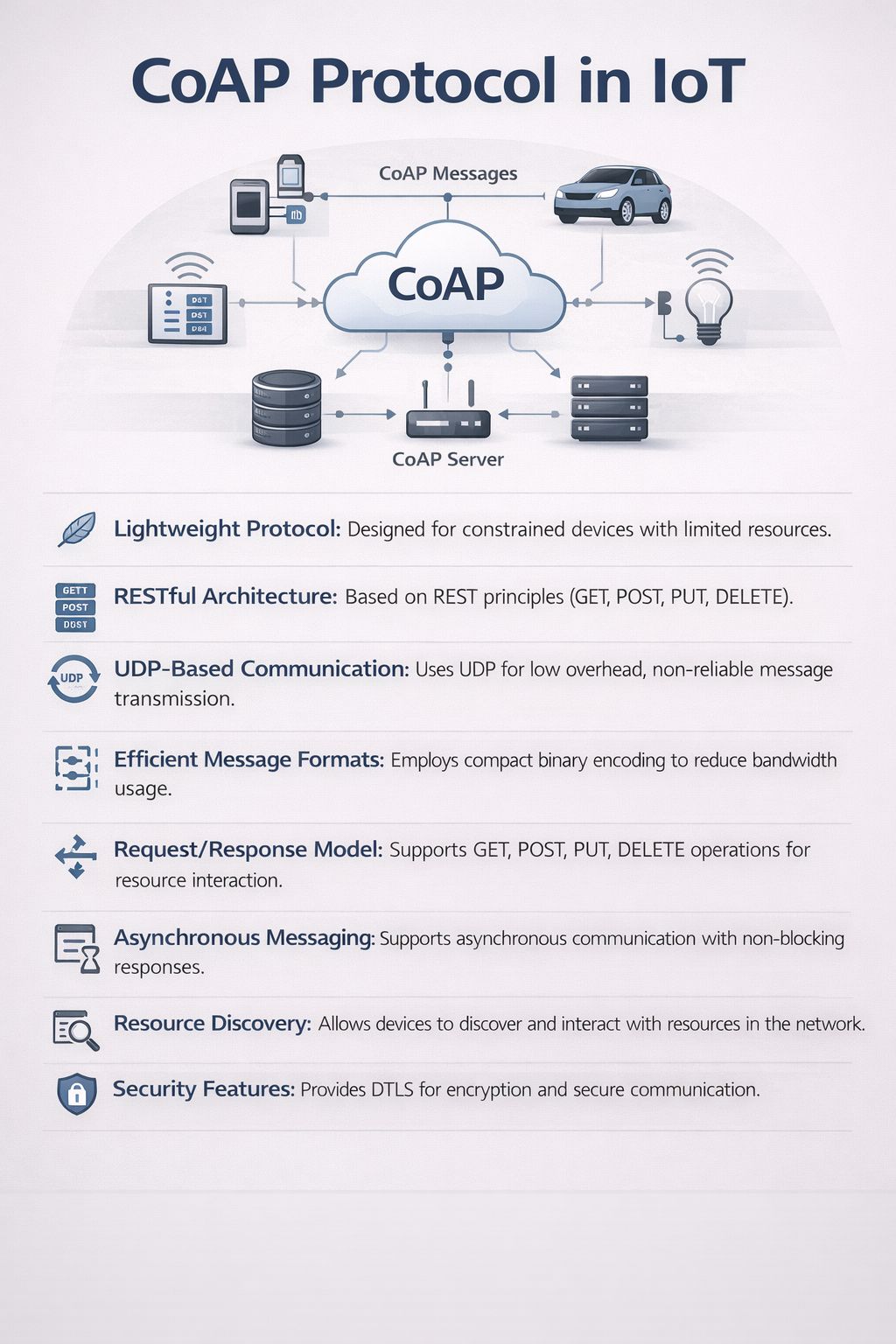
Enter the Constrained Application Protocol (CoAP). CoAP is a specialized web transfer protocol meticulously engineered for resource-constrained IoT devices. It provides a lightweight, low-overhead communication mechanism that enables these devices to interact effectively even across networks with limited bandwidth and intermittent connectivity. Built upon a RESTful architecture and leveraging UDP-based messaging, CoAP empowers a diverse range of IoT devices, including sensors, actuators, and embedded systems, to exchange data efficiently while maintaining low latency and minimal resource consumption. This article delves into the core principles, functionalities, and critical role CoAP plays in establishing reliable communication within smart environments, industrial IoT (IIoT), and edge-based systems.
The Genesis of CoAP: Addressing IoT’s Unique Challenges
The evolution of communication protocols is a direct response to the demands of the environments they serve. In the early days of the internet, protocols like HTTP were designed for human-to-human interaction, prioritizing rich content and reliable delivery over resource efficiency. However, the IoT paradigm introduced a completely different set of requirements.
The Constrained Environment of IoT
IoT devices are inherently different from the powerful, always-on machines that typically interact over the internet. Their distinguishing characteristics include:
- Limited Power: Many IoT devices are battery-powered and expected to operate for months or even years without human intervention. This necessitates protocols that consume minimal energy for communication.
- Limited Memory and Processing Power: Microcontrollers and embedded systems commonly found in IoT devices have significantly less RAM and processing capabilities compared to traditional computers. Protocols must be lean and require minimal overhead.
- Low Bandwidth Networks: IoT deployments often occur in varied environments, from sprawling industrial complexes to remote agricultural fields, where network connectivity can be patchy, unreliable, and characterized by low bandwidth.
- High Device Counts: A single IoT application can involve thousands, even millions, of devices communicating simultaneously. The protocol must be scalable to handle such density without network congestion.
- Intermittent Connectivity: Devices might only connect to the network periodically to send data bursts, requiring a protocol that can gracefully handle disconnections and retransmissions.
Traditional protocols like HTTP, while robust, proved ill-suited for these demanding conditions. Their verbose headers, TCP’s connection overhead, and reliance on persistent connections would quickly drain device batteries, overwhelm limited memory, and saturate low-bandwidth networks. This void necessitated the creation of a protocol specifically tailored for the constrained IoT world – and thus, CoAP was born.
CoAP’s Core Philosophy: Efficiency Above All Else
CoAP’s design philosophy revolves around maximizing efficiency in every aspect of communication. It achieves this by:
- Minimizing Message Size: CoAP messages are exceptionally compact, reducing the amount of data transmitted over the network.
- Reducing Protocol Overhead: The protocol stack is streamlined, demanding fewer computational resources from the device.
- Supporting Asynchronous Operations: This allows devices to perform other tasks while waiting for a response, improving resource utilization and power management.
- Leveraging Existing Web Concepts: By adopting a RESTful architecture, CoAP makes it easier for developers familiar with web services to integrate IoT devices.
These foundational principles have made CoAP a cornerstone for efficient machine-to-machine (M2M) communication in modern IoT infrastructures.
Unpacking CoAP’s Architectural Pillars
CoAP’s design borrows heavily from established web technologies while meticulously adapting them for the constrained environments of IoT. Its architecture is built upon several critical pillars that collectively enable its renowned efficiency and reliability.
RESTful Architecture: A Web-Inspired Approach for IoT
One of CoAP’s most significant strengths is its adoption of a RESTful architecture. REST (Representational State Transfer) is an architectural style widely used in web services, emphasizing stateless, client-server communication. By applying REST principles, CoAP provides a familiar and intuitive model for interacting with IoT resources.
Key REST Principles in CoAP:
- Resources: In CoAP, every piece of data or controllable function on an IoT device is treated as a “resource,” much like a URL identifies a resource on the web. For example, a temperature sensor might expose a resource
/temperature, and an actuator might have a resource/light. - Resource Identifiers (URIs): Each resource is uniquely identified by a URI (Uniform Resource Identifier). This allows clients to address specific resources on a device.
- Standard Methods: CoAP utilizes a small set of standard methods, mirroring HTTP verbs, to manipulate resources:
GET: Retrieves the current state or representation of a resource. For instance, aGET /temperaturerequest would return the current temperature reading.POST: Creates a new resource or submits data to an existing resource. APOST /readingscould send a batch of sensor data to a server.PUT: Updates or replaces the entire state of a resource. APUT /lightwith a new value could turn a light on or off.DELETE: Removes a resource. For example,DELETE /old_logcould remove an old log file from a device.
- Representations: Resources are represented in a compact format, often plain text, JSON, or CBOR (Concise Binary Object Representation), to minimize payload size.
- Stateless Communication: Each CoAP request from a client to a server contains all the information needed to understand the request. The server doesn’t store any client context between requests, simplifying server design and improving scalability.
This RESTful approach makes CoAP services highly intuitive for developers already familiar with web-based communication. It promotes a clear and organized way of interacting with IoT devices, abstracting away the low-level complexities of device hardware.
UDP-Based Communication: The Foundation of Low Overhead
Unlike HTTP, which relies on the Transmission Control Protocol (TCP) for reliable, connection-oriented communication, CoAP opts for the User Datagram Protocol (UDP). This choice is fundamental to CoAP’s lightweight nature and efficiency in constrained environments.
Why UDP for CoAP?
- Connectionless: UDP is a connectionless protocol. This means there’s no handshake process to establish a connection before data transmission, significantly reducing latency and overhead compared to TCP’s three-way handshake. For IoT devices that send small bursts of data infrequently, avoiding connection establishment costs is crucial for power saving.
- Low Overhead: UDP headers are much smaller than TCP headers, leading to smaller overall message sizes. This is vital for networks with limited bandwidth, as it means more application data can be packed into each packet.
- Non-Reliable by Default (but CoAP adds reliability): While UDP itself is considered “unreliable” because it doesn’t guarantee delivery, order, or duplication prevention, CoAP builds its own lightweight reliability mechanisms on top of UDP. This allows CoAP to selectively apply reliability when needed, avoiding the overhead of byte-stream reliability that TCP provides by default.
- Multicast Support: UDP natively supports multicast, allowing a single message to be sent to multiple recipients simultaneously. This is highly beneficial in IoT for scenarios like group device commands or resource discovery, where a device might query all nearby devices for a specific service.
By leveraging UDP, CoAP gains significant advantages in terms of speed, efficiency, and resource consumption, making it ideal for the often-unpredictable and resource-limited networks prevalent in IoT.
Efficient Message Formats: Maximizing Bandwidth Utilization
To further minimize bandwidth usage, CoAP employs highly efficient message formats. Every bit counts in constrained networks, and CoAP’s design reflects this meticulous attention to detail.
Compact Binary Encoding:
CoAP messages are encoded in a compact binary format, significantly reducing their size compared to character-based protocols like HTTP (which often uses verbose text-based headers and payloads like JSON or XML).
- Fixed-Size Header: CoAP messages begin with a fixed-size header (4 bytes), followed by optional token and options fields, and then the payload. This predictable structure simplifies parsing and reduces overhead.
- Option Field Optimization: Instead of carrying full headers for every piece of metadata, CoAP uses a system of options that are efficiently encoded using “deltas” for option numbers and variable-length encoding for values, only present when necessary.
- Payload Agnostic: While CoAP is payload-agnostic and can carry any type of data, it often uses highly compact formats like CBOR (Concise Binary Object Representation) for structured data or simple plain text for minimal data. CBOR is a binary serialization format designed to be much smaller than JSON for the same data, making it perfectly suited for CoAP.
This compact encoding extends from the headers to the data payload, ensuring that every message transmitted over the network is as small as possible, thereby conserving bandwidth and reducing transmission time and power consumption.
By combining a RESTful paradigm with UDP’s efficiency and highly optimized message formats, CoAP lays a robust foundation for scalable and reliable communication in the most challenging IoT environments.
Core Functionalities of CoAP: Enabling Intelligent Interactions
Beyond its architectural pillars, CoAP offers a rich set of functionalities that enable intelligent and efficient interactions between IoT devices. These features are meticulously designed to overcome the limitations of constrained environments, paving the way for sophisticated IoT applications.
Request/Response Model with Reliability Features
At its heart, CoAP operates on a request/response model, similar to HTTP. A client sends a request (e.g., GET to read sensor data, PUT to change a device setting), and a server responds with the requested information or an acknowledgment. However, given UDP’s inherent lack of reliability, CoAP introduces its own mechanisms to ensure messages reach their destination when required.
Confirmable and Non-Confirmable Messages:
CoAP defines four message types:
- Confirmable (CON): These messages require an acknowledgment (ACK) from the recipient. If an ACK is not received within a timeout period, the sender retransmits the CON message. This mechanism provides a lightweight form of reliability for critical operations.
- Non-Confirmable (NON): These messages do not require an acknowledgment. They are used for data that is not critical or is sent frequently, where occasional loss is acceptable (e.g., periodic sensor readings). This reduces network traffic and overhead.
- Acknowledgment (ACK): Sent by the recipient to confirm receipt of a CON message.
- Reset (RST): Sent by the recipient to indicate that it cannot process a received CON message (e.g., due to an unknown Message ID).
This selective reliability, based on message type, is a key differentiator from TCP, which applies reliability uniformly to all data. CoAP’s approach allows developers to choose the appropriate reliability level for each message, balancing between overhead and data criticality.
Asynchronous Messaging and Observe Mechanism
A significant advantage of CoAP, particularly in IoT, is its robust support for asynchronous messaging. Instead of continuously polling a device for updates, CoAP allows devices to “subscribe” to resources and receive notifications when their state changes. This is achieved through the CoAP Observe option.
How the Observe Mechanism Works:
- A client sends a
GETrequest to a resource on a server with theObserveoption set. - The server responds with the current state of the resource, similar to a regular
GETrequest, but also registers the client as an observer. - Whenever the resource’s state changes, the server proactively sends an updated representation of the resource to all registered observers.
- Clients can cancel their observation by sending another
GETrequest with theObserveoption unset or by simply not sending an acknowledgment to a notification (if it was a confirmable notification).
Benefits of Asynchronous Messaging:
- Reduced Network Traffic: Instead of constant polling, data is only sent when there’s a change, significantly reducing bandwidth consumption.
- Lower Power Consumption: Devices don’t need to stay awake constantly to send or receive polling requests, leading to extended battery life.
- Real-time Updates: Clients receive immediate notifications of changes, enabling responsive applications.
- Decoupling: Clients and servers are more decoupled, as the server initiates communication only when necessary.
The Observe mechanism is crucial for many IoT applications, such as smart home systems where sensors need to push alerts (e.g., “door opened”) or industrial monitoring systems requiring instant updates on equipment status.
Resource Discovery: Finding Services in Dynamic Environments
In a dynamic IoT environment, devices need a way to discover available resources and services without prior knowledge. CoAP provides an efficient mechanism for resource discovery, allowing clients to find resources hosted on a CoAP server.
Well-Known Interface: /.well-known/core
CoAP mandates a standardized resource path: /.well-known/core. A GET request to this URI will return a list of all resources exposed by the CoAP server.
- Link Format: The response is typically in a special “CoRE Link Format” that efficiently describes resources, including their URI path, media types, and other attributes (e.g., whether a resource is observable).
- Filtering: Clients can specify filters in their
GETrequest to/.well-known/coreto discover only specific types of resources (e.g.,GET /.well-known/core?rt=temperature-sensorto find all temperature sensors). - Multicast Discovery: CoAP allows
GETrequests to/.well-known/coreto be sent to a CoAP multicast address. This enables a client to discover all CoAP servers and their resources within a local network segment with a single message.
Resource discovery is essential for plug-and-play functionality in IoT, enabling new devices to join a network and immediately announce their capabilities, or for clients to find existing services without hardcoding their addresses.
Security Features: DTLS for Protection in Constrained Settings
Security is paramount in IoT, where devices often control critical infrastructure or handle sensitive data. CoAP addresses security concerns by integrating Datagram Transport Layer Security (DTLS).
Why DTLS for CoAP?
- UDP Compatibility: DTLS is the datagram-based equivalent of TLS (Transport Layer Security), which is used to secure TCP connections (e.g., HTTPS). Since CoAP runs over UDP, DTLS is the natural choice for providing secure communication.
- End-to-End Security: DTLS provides end-to-end security features, including:
- Authentication: Verifying the identity of communicating parties (client and server).
- Confidentiality (Encryption): Protecting data from eavesdropping by encrypting the CoAP messages.
- Integrity: Ensuring that messages have not been tampered with during transit.
- Lightweight Nature: DTLS is designed to be as lightweight as possible while providing strong security, making it suitable for resource-constrained devices. It minimizes the number of handshakes and retransmissions compared to TCP/TLS over an unreliable network.
Implementing DTLS within CoAP ensures that the sensitive data exchanged between IoT devices is protected against unauthorized access, modification, and spoofing, which is critical for maintaining trust and reliability in any IoT ecosystem.
Through its request/response model with reliability, asynchronous messaging, flexible resource discovery, and robust security features, CoAP provides a comprehensive and highly optimized solution for the diverse communication needs of modern IoT.
CoAP in Action: Real-World Applications and Use Cases
The unique characteristics and functionalities of CoAP make it an indispensable protocol for a wide array of IoT applications, especially where resource constraints, low power consumption, and efficient data exchange are paramount. From smart environments to complex industrial systems, CoAP enables the seamless machine-to-machine communication that defines the modern IoT landscape.
Smart Environments: Homes, Buildings, and Cities
CoAP is a natural fit for smart environments due to its ability to manage a multitude of low-power devices and its event-driven communication model (Observe).
Smart Homes:
- Lighting Control: Smart bulbs and light switches can use CoAP to receive commands (e.g.,
PUT /light/statusto turn on/off) and report their state. TheObservemechanism allows home automation hubs to be notified instantly when a light is switched manually. - HVAC Systems: Thermostats and environmental sensors can report temperature and humidity readings via CoAP
POSTrequests and receive temperature setpoints viaPUT. Regular updates, if observable, keep the system responsive without constant polling. - Security Sensors: Door/window sensors, motion detectors, and smoke alarms can use non-confirmable CoAP messages for periodic health checks and confirmable messages for critical alerts (e.g.,
POST /alertwhen a door opens unexpectedly). - Energy Monitoring: Smart meters and individual appliance monitors can transmit energy consumption data over CoAP, allowing for efficient energy management and billing.
Smart Buildings:
- Occupancy Sensing: Sensors distributed throughout a building can report occupancy data to optimize lighting, heating, and cooling, leading to significant energy savings.
- Asset Tracking: Bluetooth Low Energy (BLE) beacons combined with CoAP gateways can track the location of assets within a large building or campus.
- Environmental Monitoring: Air quality sensors, temperature, and humidity sensors can contribute to a healthier and more comfortable indoor environment.
Smart Cities:
- Street Lighting: CoAP can control individual streetlights, allowing for adaptive lighting schemes based on traffic, time of day, and weather, dramatically reducing energy consumption.
- Waste Management: Smart bins equipped with ultrasonic sensors can use CoAP to report their fill levels, enabling optimized waste collection routes.
- Air Quality Monitoring: Networks of small, battery-powered air quality sensors can send data to a central platform for city-wide environmental awareness.
- Traffic Monitoring: Roadside sensors can use CoAP to provide real-time traffic flow data, supporting intelligent traffic management systems.
In these environments, CoAP’s lightweight nature and efficiency are critical for enabling ubiquitous sensing and control applications without overwhelming network infrastructure or rapidly depleting device batteries.
Industrial IoT (IIoT) and Factory Automation
The Industrial IoT (IIoT) demands extreme reliability, low latency, and robust security – all areas where CoAP shines. Its ability to operate over diverse network topologies, including LPWANs (Low-Power Wide-Area Networks) and mesh networks, makes it ideal for industrial settings.
- Predictive Maintenance: Sensors on machinery (vibration, temperature, current) send data via CoAP. The
Observemechanism can trigger alerts when parameters exceed predefined thresholds, allowing for proactive maintenance and preventing costly downtime. - Process Monitoring and Control: In manufacturing plants, CoAP-enabled sensors monitor various process parameters (pressure, flow, level), and actuators can receive commands for process adjustments.
- Asset Management and Tracking: Tracking the location and status of tools, parts, and vehicles within a factory or logistics hub.
- Environmental Monitoring in Hazardous Areas: Robust, low-power CoAP devices can monitor conditions in dangerous or remote industrial zones, ensuring worker safety and compliance.
- Energy Management in Factories: Monitoring energy consumption of individual machines or production lines to identify inefficiencies and optimize usage.
CoAP’s compact messages and UDP basis help reduce network congestion in often-crowded industrial frequency bands, while its reliability features ensure critical data reaches its destination. The DTLS security layer is essential for protecting sensitive operational data and preventing malicious attacks on industrial control systems.
Edge-Based Systems: Computation Closer to the Source
Edge computing in IoT involves processing data closer to its source, rather than sending everything to a centralized cloud. CoAP plays a vital role here by facilitating communication between edge devices and edge gateways or local servers.
- Local Data Aggregation: Edge devices can send raw sensor data to a local CoAP server (often running on a gateway) for initial processing, filtering, and aggregation.
- Real-time Local Decision Making: For applications requiring immediate response (e.g., industrial safety systems), edge devices using CoAP can communicate directly with each other or with a local controller without round-tripping to the cloud.
- Offline Operation: In scenarios where cloud connectivity is intermittent, edge systems using CoAP can continue to operate and communicate locally, caching data until cloud access is restored.
- Reduced Backhaul Traffic: By processing data at the edge, only critical or aggregated data needs to be sent to the cloud, significantly reducing the load on internet backhaul networks.
The lightweight nature of CoAP is perfect for the constrained compute and network resources often found at the edge. It enables efficient communication within these localized IoT ecosystems, contributing to faster response times, reduced costs, and improved resilience.
Agriculture and Environmental Monitoring
CoAP is also highly beneficial for IoT applications in agriculture and environmental monitoring, often characterized by remote locations, battery-powered devices, and LPWAN connectivity.
- Crop Monitoring: Soil moisture sensors, temperature probes, and humidity sensors can send data to a central farm management system via CoAP, optimizing irrigation and fertilization.
- Livestock Tracking: GPS-enabled collars can report animal locations and health metrics, often over LPWAN technologies that integrate well with CoAP.
- Weather Stations: Remote weather stations can transmit critical meteorological data for forecasting and agricultural planning.
- Environmental Quality: Water quality sensors, pollution monitors, and forest fire detection systems can leverage CoAP for efficient data transmission from remote and challenging environments.
In these diverse application areas, CoAP consistently proves its value by providing a robust, efficient, and secure communication layer that respects the inherent limitations of IoT devices and networks. Its versatility underscores its importance as a fundamental building block for the future of connected intelligence.
Advanced CoAP Concepts and Enhancements
While the core principles of CoAP provide a solid foundation for IoT communication, the protocol has evolved with several advanced concepts and enhancements to address even more complex requirements and integrate seamlessly into broader IoT architectures.
Proxies and Gateways: Bridging the Divide
In many IoT deployments, devices using CoAP may need to communicate with applications or services that rely on other protocols, most notably HTTP, or access resources outside the immediate CoAP network. This is where proxies and gateways become crucial.
CoAP-HTTP Proxies:
- Protocol Translation: A CoAP-HTTP proxy acts as an intermediary, translating requests and responses between CoAP and HTTP. This allows an HTTP client (e.g., a web browser or a cloud application) to interact with a CoAP server (an IoT device) and vice versa.
- Examples: A smart home application running on a cloud server might send an HTTP request to turn on a light. A CoAP-HTTP proxy in the home network would translate this into a CoAP
PUTrequest to the smart bulb. - Address Translation: These proxies can also handle addressing differences, allowing CoAP devices with local IP addresses to be accessible from the wider internet.
CoAP Gateways:
- Network Bridging: Gateways often go beyond simple protocol translation. They can bridge different network technologies (e.g., a gateway connecting a local Zigbee/Bluetooth mesh network to an IP-based CoAP network).
- Security Enforcement: Gateways can enforce security policies, filter traffic, and manage authentication for devices under their purview.
- Data Aggregation and Buffering: A gateway might aggregate data from multiple CoAP devices before sending it (possibly via HTTP) to a cloud platform, or buffer data if the cloud connection is intermittent.
- Resource Discovery Proxy: Gateways can also act as proxies for resource discovery, maintaining a directory of resources available on their connected CoAP devices, making them easily discoverable by remote clients.
Proxies and gateways are essential for creating flexible and interoperable IoT ecosystems, allowing CoAP-enabled devices to participate in broader, more complex solutions.
Block-wise Transfers: Handling Larger Payloads
Despite CoAP’s focus on small messages, there are scenarios where IoT devices need to exchange larger amounts of data (e.g., firmware updates, application configurations, or substantial sensor logs). The standard CoAP message size (limited by UDP packet sizes, typically around 1280 bytes for IPv6 minimum MTU or even less for IPv4) can be restrictive. Block-wise Transfers address this limitation.
How Block-wise Transfers Work:
- Dividing Data into Blocks: A large payload is divided into smaller, manageable blocks.
- Requesting Blocks: The client requests blocks sequentially using the CoAP
Block2option for responses or theBlock1option for requests. The options indicate the block number and size. - CoAP Reliability per Block: Each block is transferred as a separate CoAP message. This means the built-in CoAP reliability (Confirmable messages) can be applied to individual blocks, ensuring that even if one block is lost, only that specific block needs retransmission, not the entire payload.
- Efficient Resumption: If a connection is interrupted, the transfer can often resume from the last successfully transferred block, rather than starting over.
This mechanism allows CoAP to efficiently handle larger data transfers without compromising its lightweight nature, by adapting to the underlying network characteristics and only re-transmitting lost segments.
Group Communication (Multicast)
CoAP natively supports group communication through UDP multicast. This is incredibly useful for several IoT scenarios where one device needs to address multiple devices simultaneously.
Benefits of CoAP Multicast:
- Efficient Control: A single multicast
PUTrequest can turn off all lights in a smart home zone or command multiple industrial actuators. - Simultaneous Discovery: As mentioned, multicast
GETrequests to/.well-known/corecan discover all CoAP servers and their resources on a local network. - Reduced Network Load: Instead of sending individual messages to each device in a group, only one message is broadcast, saving bandwidth and device processing power.
CoAP multicast offers a powerful way to manage and interact with groups of IoT devices, simplifying application logic and enhancing network efficiency.
Resource Directories (RD): Centralized Resource Management
For very large and dynamic IoT deployments, relying solely on local multicast discovery can become inefficient. Resource Directories (RDs) provide a centralized mechanism for managing and discovering CoAP resources.
How RDs Work:
- Registration: CoAP servers (IoT devices) register their resources with an RD, providing their URI and metadata (e.g., resource type, observable status).
- Querying: CoAP clients can then query the RD to discover resources, similar to how they would query
/.well-known/coreon a single device, but at a larger scale. - Updates: Devices periodically update their registration with the RD, and registrations typically have a lifetime after which they expire if not renewed, ensuring the directory remains current.
RDs streamline resource discovery in large-scale IoT networks, making it easier for new clients to find services and for managing the lifecycle of resources.
These advanced concepts and enhancements demonstrate CoAP’s adaptability and capability to scale from simple sensor networks to complex, enterprise-grade IoT architectures. By combining basic lightness with sophisticated features, CoAP remains at the forefront of efficient IoT communication.
The Future of CoAP: Integration and Evolution
The IoT landscape is constantly evolving, with new technologies, standards, and challenges emerging regularly. CoAP, as a foundational protocol, continues to adapt and integrate with these developments, ensuring its relevance and efficacy in the years to come.
Interoperability with Other IoT Protocols
While CoAP excels in constrained environments, it’s not the only protocol in the IoT ecosystem. MQTT, HTTP, and specialized industrial protocols all have their niches. The future of CoAP involves greater interoperability with these other protocols.
- Protocol Gateways (MQTT-CoAP, HTTP-CoAP): As discussed, gateways are crucial for translating between CoAP and other protocols, allowing seamless data flow between different segments of an IoT solution. Standardization efforts continue to refine these gateway functionalities.
- Common Data Models: The adoption of common data models and semantic interoperability layers (like those being developed by organizations such as oneM2M and W3C WoT) will allow devices to understand each other’s data regardless of the underlying communication protocol, making CoAP-enabled devices part of a larger, unified IoT.
- Integration with Cloud Platforms: Major cloud IoT platforms are increasingly offering native support for CoAP, allowing constrained devices to connect directly to the cloud without needing intermediate protocol translation at the edge.
LPWAN Integration: Expanding Reach
CoAP is a natural partner for Low-Power Wide-Area Network (LPWAN) technologies such as LoRaWAN, NB-IoT, and Sigfox. These networks are designed for long-range, low-data-rate communication, making them ideal for many constrained IoT devices.
- Optimized for LPWAN: CoAP’s compact message format and short transaction times are perfectly suited for the limited bandwidth and duty cycle restrictions of LPWANs.
- End-to-End Solutions: The combination of CoAP over LPWANs provides a complete, efficient, and low-power solution for connecting devices in remote locations, spanning agriculture, logistics, and smart city applications where traditional cellular or Wi-Fi is impractical.
- Header Compression (SCHC): Specialized header compression techniques (e.g., Static Context Header Compression – SCHC) are being integrated with CoAP to further reduce message overhead when running over very low-data-rate LPWANs, ensuring even greater efficiency.
CoAP in Fog and Edge Architectures
The rise of fog and edge computing continues to elevate CoAP’s role. As more processing and intelligence move closer to the data source, CoAP becomes the primary communication medium for interactions within these localized compute environments.
- Microservices at the Edge: CoAP can facilitate lightweight communication between different microservices deployed on edge gateways, enabling modular and scalable edge applications.
- Sensor-to-Actuator Loops: For critical, real-time control applications, CoAP enables direct, low-latency communication between sensors and actuators at the edge, reducing reliance on cloud round-trips.
- Data Pre-processing and Filtering: CoAP is used for efficient data transfer from raw sensors to edge processing units, where data can be filtered, aggregated, and analyzed before being sent to the cloud.
Enhanced Security Features
Security remains a top priority, and CoAP’s security mechanisms are continuously being enhanced.
- Certificate Management and PKI for IoT: Work continues on streamlining public key infrastructure (PKI) and certificate management for resource-constrained devices, allowing for more robust and scalable DTLS security deployments.
- Lightweight Cryptography: Research into and adoption of lightweight cryptographic algorithms specifically designed for IoT devices will further enhance CoAP’s security posture without significant resource penalty.
- Secure Firmware Updates: CoAP can play a role in secure firmware updates for devices, ensuring that only authenticated and authorized updates are installed.
Continued Standardization Efforts
Organizations like the IETF (Internet Engineering Task Force), which developed CoAP, continue to refine and extend the protocol.
- New Options and Extensions: The community actively works on defining new CoAP options and extensions to support emerging IoT use cases and requirements.
- Best Practices and Profiles: Development of best practices and specific CoAP profiles for various industries (e.g., smart home, industrial) to ensure greater interoperability and ease of deployment.
The future of CoAP is one of continuous evolution, focused on deepening its integration into the broader IoT ecosystem, maximizing its performance over next-generation networks, and bolstering its security in an increasingly connected world. Its fundamental design principles ensure it will remain a cornerstone of efficient and reliable machine-to-machine communication for years to come.
Conclusion: CoAP as an Enabler of the Connected World
Efficient communication is not merely a desirable feature in the Internet of Things; it is a fundamental, non-negotiable requirement for the realization of truly scalable, reliable, and intelligent IoT ecosystems. The Constrained Application Protocol (CoAP) stands as a testament to this truth, meticulously engineered to meet the stringent demands of resource-constrained devices, networks with limited bandwidth, and environments where power efficiency is paramount.
From its genesis as a response to the shortcomings of traditional web protocols in the IoT domain, CoAP has evolved into a robust and versatile solution. Its adoption of a RESTful architecture provides an intuitive and familiar interaction model, treating every device function and piece of data as a discoverable and addressable resource. By leveraging UDP-based communication, CoAP achieves a lean, low-overhead transport layer, shedding the bulk associated with connection-oriented protocols while building in selective reliability where it matters most.
The protocol’s brilliance extends to its efficient message formats, employing compact binary encoding to minimize every byte transmitted over the air, thereby conserving precious bandwidth and power. CoAP’s core functionalities, such as a flexible request/response model complemented by reliable and non-reliable message types, empower developers to strike the perfect balance between data criticality and resource consumption.
The innovation doesn’t stop there. The CoAP Observe mechanism revolutionary for enabling asynchronous, event-driven communication, eliminating the need for wasteful polling and delivering real-time updates directly to subscribed clients. Resource discovery through the /.well-known/core interface and the concept of Resource Directories ensures that devices and services can find each other dynamically in sprawling networks. Furthermore, the robust integration of DTLS-based security provides essential authentication, confidentiality, and integrity, safeguarding sensitive IoT data in a world increasingly vulnerable to cyber threats.
In practice, CoAP has proven its worth across a vast spectrum of applications. It forms the backbone of responsive smart homes and buildings, optimizing energy usage and enhancing comfort. In the demanding realm of Industrial IoT (IIoT), CoAP facilitates critical process monitoring, predictive maintenance, and control, driving operational efficiency and safety. Its lightweight nature makes it an ideal candidate for edge-based systems, enabling localized intelligence and reduced reliance on cloud connectivity. Even in remote and challenging settings like agriculture and environmental monitoring, CoAP ensures that vital data from low-power, long-range devices is reliably collected and delivered.
Looking ahead, CoAP’s journey is one of continuous integration and evolution. Its increasing interoperability with other IoT protocols, seamless collaboration with LPWAN technologies, central role in burgeoning fog and edge architectures, and ongoing security enhancements underscore its enduring relevance. As the physical and digital worlds continue to converge, protocols like CoAP will be the silent enablers, powering the trillions of smart, connected devices that define our future.
For organizations navigating the complexities of IoT development and deployment, understanding and leveraging the power of CoAP is not just an advantage – it’s a strategic imperative. Efficient machine-to-machine communication is the bedrock upon which successful IoT solutions are built, and CoAP provides that foundation with unparalleled grace and efficacy.
Ready to unlock the full potential of efficient IoT communication for your enterprise?
At IoT Worlds, we specialize in designing, developing, and deploying cutting-edge IoT solutions that leverage protocols like CoAP to deliver unparalleled performance and reliability. Whether you’re looking to optimize industrial processes, build smart city infrastructure, or create innovative consumer products, our team of experts can help you architect a robust and secure IoT ecosystem.
Contact us today to discuss your project and discover how CoAP and our expertise can transform your IoT vision into reality. Send an email to info@iotworlds.com and let’s start building your connected future.
