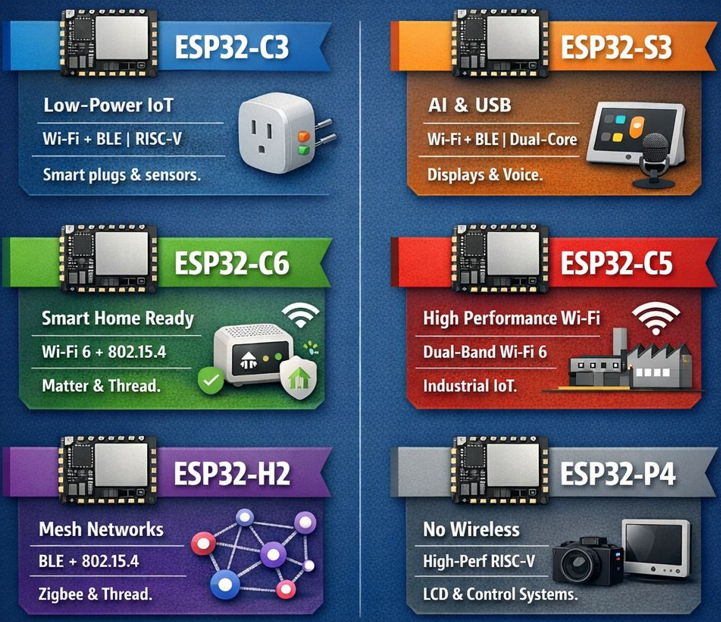
The world of embedded systems and the Internet of Things (IoT) has been revolutionized by Espressif Systems’ ESP32 family of microcontrollers. What started as a singular, powerful chip has blossomed into a diverse ecosystem, each variant meticulously crafted to excel in specific applications. This evolution, while providing incredible flexibility, also introduces a critical challenge: choosing the right ESP32 variant. A misstep in this selection can lead to unnecessary costs, power inefficiencies, or even fundamental performance bottlenecks that undermine an entire product’s success.
This in-depth guide will dissect the most common ESP32 variants, offering a practical breakdown of their strengths, ideal use cases, and where they fit within the broader IoT landscape. We’ll explore the nuances of each chip, arming you with the knowledge to make informed decisions that align perfectly with your product’s requirements. Remember, there’s no single “best” ESP32; there’s only the right ESP32 for your product and its unique constraints.
The ESP32 Ecosystem: A Family of Specialized Performers
The original ESP32, with its dual-core Xtensa LX6 processor, integrated Wi-Fi and Bluetooth, and a rich set of peripherals, quickly became a darling of makers and professional developers alike. Its versatility allowed it to power everything from smart home devices to industrial sensors. However, as the demands of the IoT market diversified, Espressif recognized the need for specialized chips. This led to the introduction of variants optimized for specific characteristics such as ultra-low power consumption, enhanced security, advanced wireless protocols, high-performance computing without wireless overhead, and robust graphics capabilities.
These specialized variants are not merely incremental upgrades; they represent strategic shifts in architecture and feature sets, often leveraging different CPU cores, such as the energy-efficient RISC-V. Understanding these core differences is paramount to making an optimal choice.
Why Variant Selection is Crucial
The choice of an ESP32 variant directly impacts several critical aspects of your product:
- Cost-Effectiveness: Over-specifying an MCU can lead to unnecessary material costs. Conversely, an underpowered chip can result in compromised performance or a need for costly redesigns down the line.
- Power Consumption: For battery-powered IoT devices, power efficiency is often the most critical design parameter. Selecting a variant optimized for low power can extend battery life from days to months or even years.
- Performance: The CPU speed, core count, and available memory dictate the complexity of tasks the device can handle. High-performance variants are essential for applications requiring rapid data processing, complex algorithms, or rich user interfaces.
- Connectivity: The wireless capabilities (Wi-Fi standards, Bluetooth versions, mesh networking protocols) determine how your device communicates within its environment. Future-proofing often means adopting newer, more efficient wireless technologies.
- Peripheral Set: The available GPIOs, ADC/DAC units, communication interfaces (SPI, I2C, UART), and specialized peripherals (USB, camera interfaces, LCD drivers) must match your product’s hardware requirements.
- Development Complexity: While all ESP32 variants share the ESP-IDF development framework, some specialized features might require more in-depth knowledge or specific external components.
By carefully considering these factors against your project’s technical and commercial goals, you can pinpoint the ESP32 variant that offers the best balance.
Diving Deep into the ESP32 Variants
Let’s explore the key characteristics and ideal applications for the most prominent ESP32 variants.
ESP32-C3: The Lean, Mean, Low-Power Machine
The ESP32-C3 marked a significant shift for Espressif, being one of its first chips to embrace the open-source RISC-V instruction set architecture. This variant is designed with a strong focus on cost-efficiency and low-power operations, making it an excellent candidate for a vast array of IoT endpoints.
- Core Architecture: Single-core RISC-V processor clocked at up to 160 MHz. This decision to move to RISC-V contributes to its cost-effectiveness and provides a modern, energy-efficient computational engine.
- Wireless Connectivity: Integrated 2.4 GHz Wi-Fi (802.11 b/g/n, Wi-Fi 4) and Bluetooth 5.0 Low Energy (BLE). The inclusion of BLE 5.0 is a notable upgrade over the original ESP32’s Bluetooth 4.2 capabilities, offering improved range, speed, and data throughput for low-power applications.
- SRAM: 400 KB of SRAM, which is ample for many sensor aggregation and cloud communication tasks.
- Flash Encryption / Secure Boot: Equipped with robust security features, including flash encryption and secure boot, which are essential for commercial IoT products that require protection against intellectual property theft and unauthorized firmware modifications.
- GPIO Pins: Around 22 GPIOs, sufficient for interfacing with a variety of sensors and simple actuators.
- Power Efficiency: Specifically designed for very low power consumption, making it ideal for battery-operated devices.
Ideal Use Cases for ESP32-C3:
- Smart Plugs and Switches: Its low cost, integrated Wi-Fi, and BLE make it perfect for simple, cloud-connected home automation devices where power efficiency is a plus.
- Simple Cloud-Connected Sensors: Whether it’s a temperature sensor sending data to the cloud, a motion detector, or a smart irrigation system, the C3 handles these tasks efficiently.
- Wearable Gadgets (Basic): For wearables that require occasional data synchronization over BLE or Wi-Fi and prioritize long battery life.
- Commercial IoT Devices: The strong security features make it suitable for commercial deployments where data integrity and device authentication are critical.
Why Choose ESP32-C3?
Choose the ESP32-C3 when your primary concerns are cost, power efficiency, and integrated Wi-Fi/BLE connectivity for relatively straightforward IoT applications. It’s a pragmatic choice for bringing a wide range of devices online without breaking the bank or requiring frequent battery changes.
ESP32-S3: The Powerhouse for Advanced Human-Machine Interfaces
Stepping up in performance and feature set, the ESP32-S3 is a dual-core chip built on the Xtensa LX7 architecture with a strong emphasis on applications requiring richer user interfaces, local AI processing, and versatile connectivity options.
- Core Architecture: Dual-core Xtensa LX7 processor clocked at up to 240 MHz. This provides significantly more computational horsepower than single-core variants, crucial for concurrent tasks and complex algorithms.
- AI Acceleration: A standout feature, the ESP32-S3 includes vector instructions that accelerate AI computations, making it suitable for TinyML (Tiny Machine Learning) applications directly on the edge device.
- Wireless Connectivity: Integrated 2.4 GHz Wi-Fi (802.11 b/g/n, Wi-Fi 4) and Bluetooth 5.0 Low Energy (BLE). Similar to the C3 in its wireless protocols, but with the added processing power to handle more demanding networking tasks.
- Native USB Support: Features USB OTG (On-The-Go) and USB Host capabilities, allowing it to act as a USB device (e.g., for HID or mass storage) or connect to external USB peripherals. This eliminates the need for external USB-to-UART bridge chips for programming and communication.
- PSRAM Support: Excellent support for external PSRAM (Pseudo-SRAM), significantly expanding the available memory for graphics buffers, larger datasets, or more complex applications.
- GPIO Pins: Up to 44 GPIO pins, offering extensive interfacing possibilities for complex systems.
- Power Efficiency: Designed for low power consumption, making it a good fit for battery-powered HMI devices.
Ideal Use Cases for ESP32-S3:
- HMI (Human-Machine Interface) Devices: Perfect for devices with displays, touch interfaces, and graphical user interfaces due to its dual-core processing, AI capabilities, and PSRAM support for rich visuals.
- Smart Displays: Powering smart home control panels, small smart screens, or interactive learning devices with local intelligence.
- Voice Processing Applications: Its AI acceleration and dual-core nature make it suitable for local speech recognition, voice command processing, and audio applications.
- USB-Enabled Devices: Any product that benefits from direct USB connectivity for data transfer, debugging, or acting as a USB peripheral (e.g., custom USB input devices, data loggers).
- TinyML (Edge AI): Running small machine learning models on the device for anomaly detection, predictive maintenance, or advanced sensor fusion.
Why Choose ESP32-S3?
Opt for the ESP32-S3 when your project demands more than just basic connectivity. If you need a graphical user interface, local AI processing, voice interaction, or direct USB communication, the S3 provides the necessary horsepower and specialized features to bring these advanced concepts to life.
ESP32-C6: Preparing for the Next Generation of Smart Homes
The ESP32-C6 is a forward-looking variant, positioned to be a cornerstone of future smart home ecosystems. It embraces the latest Wi-Fi standards and crucial mesh networking protocols, making it “Smart Home Ready.”
- Core Architecture: RISC-V processor. While specific details on core count and frequency are less emphasized for this variant’s primary use case, the RISC-V core ensures efficiency.
- Wireless Connectivity: Features cutting-edge Wi-Fi 6 (802.11ax) for the 2.4 GHz band and 802.15.4 (for Thread and Zigbee). The combination of Wi-Fi 6 and 802.15.4 is unique and highly strategic. Access to BLE is also provided, ensuring broad compatibility.
- Matter and Thread Support: Crucially designed with native support and optimizations for Matter and Thread protocols, which are poised to become the unifying standards for smart home devices.
- Future-Proofing: Its support for these emerging standards makes it an excellent choice for products intended for the future smart home market, ensuring interoperability and longevity.
Ideal Use Cases for ESP32-C6:
- Matter-Enabled Devices: Any new smart home product aiming to support the Matter standard for seamless interoperability across different brands and platforms.
- Thread Network Endpoints: Devices that will be part of a robust, self-healing Thread mesh network, offering greater reliability and range than traditional star topologies.
- Modern Smart Home Devices: From advanced smart lighting and thermostats to security sensors and appliance controls, the C6 is built for the interconnected smart home.
- Gateways and Bridges: While perhaps more suited for end devices, its comprehensive wireless capabilities make it a strong candidate for low-cost gateways transitioning between Wi-Fi 6 and Thread networks.
Why Choose ESP32-C6?
The ESP32-C6 is your go-to choice if you are developing products for the smart home market and want to ensure compatibility with the latest and upcoming standards like Matter and Thread. Its Wi-Fi 6 and 802.15.4 combination provides a powerful and highly relevant communication stack for future-proof smart home innovation.
ESP32-C5: Unleashing High-Performance Dual-Band Wi-Fi 6
The ESP32-C5 pushes the boundaries of wireless performance within the ESP32 family, specifically targeting applications that demand high throughput and low latency over Wi-Fi. It’s the first ESP32 variant to include dual-band Wi-Fi 6.
- Core Architecture: Dual-core RISC-V processor clocked at up to 240 MHz. This dual-core setup provides the necessary processing power to handle the increased data rates and complexities of Wi-Fi 6.
- Wireless Connectivity: The star feature is its dual-band (2.4 GHz and 5 GHz) Wi-Fi 6 (802.11ax) capabilities. This allows for higher data rates, reduced latency, and improved network efficiency, especially in congested environments. BLE is also included.
- Target Applications: Specifically designed for use cases where robust, high-speed wireless communication is paramount, such as demanding Industrial IoT scenarios.
Ideal Use Cases for ESP32-C5:
- High-Throughput Industrial IoT: Sensors and actuators in industrial environments that need to transmit large amounts of data quickly and reliably over Wi-Fi, such as production line monitoring or real-time control systems.
- Low-Latency Applications: Any application where minimal delay in wireless communication is critical, including certain gaming peripherals, remote control systems, or specialized medical devices.
- Wireless Cameras: Streaming high-definition video over Wi-Fi 6, benefiting from the increased bandwidth and efficiency.
- Data-Intensive Edge Devices: Devices that process and transmit significant volumes of data to the cloud or local servers, where faster upload/download speeds are an advantage.
Why Choose ESP32-C5?
When your project demands the absolute best in Wi-Fi performance, especially in terms of speed, capacity, and the benefits of the 5 GHz band, the ESP32-C5 is the clear choice. It’s engineered to meet the rigorous demands of industrial and high-bandwidth consumer applications where standard Wi-Fi might fall short.
ESP32-H2: The Maestro of Mesh Networks Without Wi-Fi
The ESP32-H2 takes a different approach by entirely omitting Wi-Fi, focusing instead on ultra-low-power mesh networking protocols. This specialized silicon is crucial for creating vast, energy-efficient networks of interconnected devices.
- Core Architecture: RISC-V processor, optimized for efficiency in low-power applications.
- Wireless Connectivity: Integrated Bluetooth 5.2 Low Energy (BLE) and 802.15.4. The deliberate absence of Wi-Fi sets it apart, emphasizing its role in dedicated mesh networks.
- Mesh Networking Focus: Expertly designed for protocols like Zigbee and Thread, which build robust and scalable mesh topologies ideal for large-scale deployments where individual device power consumption is critical.
- Ultra-Low Power: Without the power hungry Wi-Fi radio, the H2 can achieve significantly lower power consumption, making it perfect for battery-operated devices that need to last for years.
Ideal Use Cases for ESP32-H2:
- Zigbee and Thread Sensors: All types of environmental sensors (temperature, humidity, light, presence) that need to communicate wirelessly within a mesh network and run on coin cell batteries for extended periods.
- Smart Lighting Systems: Individual smart bulbs, light switches, and dimmers that form part of a larger Zigbee or Thread-based lighting ecosystem.
- Low-Power Home Automation: Simple actuators and sensors in a smart home that prioritize battery life and mesh network reliability over direct Wi-Fi connectivity.
- Industrial Mesh Networks: Monitoring conditions across large factory floors or agricultural fields where a mesh network provides superior range and resilience compared to traditional star networks.
- Wearables (Ultra-Low Power): Niche wearable applications that require very long battery life and primarily communicate over BLE or a Thread mesh.
Why Choose ESP32-H2?
If your application demands ultra-low power consumption, long battery life, and participation in an 802.15.4-based mesh network (like Zigbee or Thread), then the ESP32-H2 is the unequivocally correct choice. It streamlines the hardware and software stack by removing unnecessary Wi-Fi components, delivering peak efficiency for its intended purpose.
ESP32-P4: The Offline Powerhouse for Rich Peripherals
The ESP32-P4 represents yet another strategic diversification, focusing entirely on high-performance computing and rich peripheral integration without any wireless capabilities. This chip caters to applications where local processing, complex I/O, and advanced user interactions are paramount, and network connectivity is either handled by another module or not required at all.
- Core Architecture: High-performance RISC-V with multiple cores, designed for demanding local computational tasks and intricate peripheral control.
- No Wireless: The complete absence of Wi-Fi and Bluetooth is its defining characteristic, which means lower cost, reduced power consumption (for non-networked tasks), and a streamlined design for specific offline applications.
- Rich Peripherals: Specifically built for applications needing a wealth of I/O, including dedicated interfaces for LCDs, camera sensors, and real-time control systems. It typically features advanced DMA controllers, multiple UARTs, SPIs, I2Cs, and potentially specialized accelerators for graphics or video.
Ideal Use Cases for ESP32-P4:
- LCD and Control Systems: Embedded systems driving complex graphical user interfaces on displays without needing network connectivity, such as industrial control panels, medical devices, or elaborate consumer appliances.
- Camera and Image Processing: Applications requiring direct camera input and local image processing, such as security cameras with on-device analytics, smart doorbells, or machine vision systems where the data is processed locally before being potentially offloaded.
- Real-Time Control Systems: Industrial automation, robotics, or complex motor control systems that require precise timing, high-speed data acquisition, and robust local computation.
- Sophisticated Offline Devices: Any product that does not require direct network access but benefits from powerful embedded processing and extensive peripheral support, such as advanced test and measurement equipment or custom scientific instruments.
- Headless Devices with Complex Logic: Devices that perform intricate calculations or control sequences based on local inputs and sensors, where output might be to local actuators or a simple display.
Why Choose ESP32-P4?
Select the ESP32-P4 when your design demands significant local processing power, the ability to drive complex displays or camera modules, and a rich array of peripherals, but does not require integrated wireless connectivity. By shedding the RF components, it offers a cost-effective and power-optimized solution for high-performance offline embedded applications.
A Comparative Overview of All Variants
To solidify your understanding, let’s look at a comparative summary that highlights the core distinctions across these diverse ESP32 variants.
| Feature / Variant | ESP32 (Original) | ESP32-C3 | ESP32-S3 | ESP32-C6 | ESP32-C5 | ESP32-H2 | ESP32-P4 |
|---|---|---|---|---|---|---|---|
| CPU Core | Dual-core Xtensa LX6 | Single-core RISC-V | Dual-core Xtensa LX7 | RISC-V | Dual-core RISC-V | RISC-V | High-Perf RISC-V |
| Max Freq. | 240 MHz | 160 MHz | 240 MHz | N/A (Efficient) | 240 MHz | N/A (Efficient) | N/A (High) |
| Wi-Fi | Wi-Fi 4 (2.4 GHz) | Wi-Fi 4 (2.4 GHz) | Wi-Fi 4 (2.4 GHz) | Wi-Fi 6 (2.4 GHz) | Dual-band Wi-Fi 6 | ❌ None | ❌ None |
| Bluetooth | BLE 4.2 + Classic | BLE 5.0 | BLE 5.0 | BLE | BLE | BLE 5.2 | ❌ None |
| 802.15.4 | ❌ | ❌ | ❌ | ✅ (Thread/Zigbee) | ❌ | ✅ (Thread/Zigbee) | ❌ |
| Native USB | ❌ (External) | ❌ (External) | ✅ (OTG + Host) | ❌ (External) | ❌ (External) | ❌ (External) | ✅ (Advanced) |
| AI Acceleration | ❌ | ❌ | ✅ (Vector Instr.) | ❌ | ❌ | ❌ | Potentially |
| PSRAM Support | Limited | Limited | ✅ Good | Limited | Limited | Limited | ✅ Excellent |
| Power Focus | Moderate | ✅ Very Low | ✅ Low | ✅ Low | Moderate | ✅ Ultra-Low | Application-specific |
| Key Strength | Versatile, mature | Cost-eff. Low-power, Secure | HMI, AI, USB | Smart Home Ready, Wi-Fi 6, Mesh | High-Perf Wi-Fi 6, Dual-band | Ultra-Low Power Mesh | High-Perf Local Processing, Rich Peripherals |
| Example Use | General IoT, Home | Smart Plugs, Sensors | Smart Displays, Voice | Matter Devices | Industrial IoT, Video Streaming | Zigbee/Thread Sensors | LCDs, Cameras, Control Systems |
Strategic Considerations for Your ESP32 Selection Process
Choosing the right ESP32 variant is not a trivial task; it requires a systematic approach that balances technical requirements with market demands and cost constraints.
Defining Your Product’s Core Requirements
Before even looking at datasheets, clearly outline what your product needs to do:
- Functionality: What are the primary tasks the device will perform? (e.g., sense temperature, display graphics, stream video, control motors, listen for voice commands).
- Connectivity: How will it communicate? (e.g., Wi-Fi, Bluetooth, Zigbee, Thread, Ethernet, cellular, or purely local). What are the speed and range requirements?
- Power Source: Will it be battery-powered, line-powered, or energy-harvested? What is the target battery life? This is a major differentiator for variants.
- User Interface: Does it need a display (LCD, e-paper), touch input, buttons, voice interaction, or just indicator LEDs?
- Processing Needs: How much computational power is required? Is complex data processing, real-time control, or local AI inference necessary?
- Memory Requirements: Will you be dealing with large datasets, complex firmware, or graphical assets that demand significant RAM or external flash?
- Peripherals: What specific hardware interfaces are needed? (e.g., ADC, DAC, SPI, I2C, UART, USB, camera interface, LCD driver, PWM).
- Security: What level of security is required? (e.g., secure boot, flash encryption, hardware cryptography). Is it for a hobby project or a commercial deployment?
- Cost Target: What is the bill of materials (BOM) target for the MCU? This often dictates where you can compromise on features.
- Time-to-Market: The availability of development tools, community support, and pre-certified modules can influence your choice if speed is critical.
The Trade-Offs: Performance vs. Power vs. Cost
It’s rare to find a single chip that excels in all aspects. Most engineering decisions involve trade-offs:
- High Performance often means Higher Power Consumption: Powerful CPUs and advanced radios typically consume more energy. If battery life is paramount, you might sacrifice some processing speed or opt for less bandwidth-intensive communication.
- Feature-Rich often means Higher Cost: Variants with more cores, advanced accelerators, native USB, or cutting-edge Wi-Fi 6 usually come at a higher unit cost. Only pay for what you truly need.
- Specialization vs. Versatility: A highly specialized chip like the ESP32-H2 is fantastic for its niche (low-power mesh) but useless for applications requiring Wi-Fi. The original ESP32-S3 offers more versatility but might be overkill for a simple sensor.
Future-Proofing Your Design
Consider the longevity of your product and evolving standards:
- Wireless Protocols: For smart home devices, adopting Matter and Thread (via ESP32-C6) will likely be crucial for long-term interoperability. For industrial Wi-Fi, Wi-Fi 6 (ESP32-C5) offers significant advantages.
- Security: Robust security features are no longer optional for connected devices. All modern ESP32 variants incorporate secure boot and flash encryption, but ensuring your implementation utilizes them correctly is key.
- Software Updates: Ensure the chosen variant has adequate flash memory to support over-the-air (OTA) updates for future bug fixes, feature enhancements, and security patches.
Development Ecosystem and Community Support
Espressif provides a unified development framework called ESP-IDF, which supports all their chips. This consistency is a huge advantage. However, specific peripherals or specialized features might have varying levels of driver maturity or example code availability.
- Documentation: Espressif’s documentation is generally excellent, but always check the specific datasheet and programming guide for your chosen variant.
- Community: The original ESP32 has the largest community, meaning more tutorials, forum posts, and third-party libraries. Newer variants are catching up rapidly.
- Tools: Ensure your chosen integrated development environment (IDE) and debugging tools fully support the specific core architecture (Xtensa vs. RISC-V) and features of your variant.
Real-World Examples: Matching Variants to Products
Let’s illustrate the selection process with a few hypothetical product concepts:
Product Idea 1: Smart Home Energy Monitor
- Requirements: Measures power consumption of appliances, reports data to a cloud dashboard, low cost, needs to sit in a wall socket.
- Connectivity: Wi-Fi to connect to the home network.
- Power: Line-powered, so extreme low power is less critical than for battery devices, but efficiency is still good for overall cost.
- Processing: Simple data aggregation and communication.
- Security: Commercial product, so secure boot and flash encryption are important.
- No display or complex UI.
- Recommended Variant: ESP32-C3.
- Reasoning: Its single-core RISC-V is perfectly adequate for this task, offering Wi-Fi connectivity and strong security features at an excellent price point. The low-power design, while not strictly necessary for line-powered, contributes to overall system efficiency. It’s an ideal choice for this type of “set-and-forget” smart home device.
Product Idea 2: Portable Medical Diagnostic Device
- Requirements: Large color LCD with touch input, real-time sensor data acquisition, some local data analysis (e.g., anomaly detection using TinyML), USB for data transfer to a PC, battery-powered.
- Connectivity: BLE for short-range data sync to a phone; minimal Wi-Fi for configuration updates.
- Power: Battery-powered, so low power is important, but must balance with performance for display and processing.
- Processing: Dual-core for display updates and background sensor processing/AI.
- Memory: Needs ample RAM for graphics buffers and potentially large data sets from sensors.
- Peripherals: ADC for sensor input, LCD driver, USB OTG.
- Recommended Variant: ESP32-S3.
- Reasoning: The dual-core Xtensa LX7 is essential for driving a responsive GUI and running parallel sensor and AI tasks. Its native USB OTG simplifies data offloading. Good PSRAM support provides the memory required for a rich graphical experience. While not ultra-low power, its “low power” designation makes it suitable for many battery-operated display devices. The AI acceleration is a bonus for on-device diagnostics.
Product Idea 3: Industrial Sensor Network for a Large Warehouse
- Requirements: Hundreds of sensors reporting temperature, humidity, and vibration across a vast area; long battery life for individual nodes; robust, self-healing network; no Wi-Fi interference concerns.
- Connectivity: Mesh network (e.g., Thread or Zigbee) for range and reliability.
- Power: Very long battery life (multiple years) is absolutely critical for each sensor node.
- Processing: Very simple sensor reading and data transmission.
- No displays, no complex UI, minimal security requirements beyond basic authentication.
- Recommended Variant: ESP32-H2.
- Reasoning: This is the quintessential application for the H2. Its focus on ultra-low-power 802.15.4 mesh networking (Thread or Zigbee compatible) without Wi-Fi ensures maximum battery life and network resilience. The simple RISC-V core is more than enough for basic sensor tasks.
The Journey Forward with ESP32
The ESP32 family has grown into a sophisticated suite of microcontrollers, each designed to tackle specific challenges in the vast and ever-expanding world of the Internet of Things. As we’ve explored, the days of a “one-size-fits-all” ESP32 are long gone. Instead, designers now have the precise tools to optimize their products for cost, power, performance, and future compatibility.
Making the right choice from this diverse family means thoroughly understanding your project’s intrinsic needs – its functionality, power budget, connectivity paradigm, and user interaction model. It involves carefully weighing the trade-offs and considering the long-term implications of standard adoption and ecosystem support.
By diligently aligning your product’s requirements with the specialized strengths of each ESP32 variant, you can ensure your project is not only technically sound but also optimally positioned for success in the competitive IoT landscape. The adage holds true: there is no “best” ESP32; there is only the right ESP32 for the job you need it to do.
Unlock Your IoT Potential with IoT Worlds
Navigating the complexities of embedded systems, wireless protocols, and the myriad of ESP32 variants can be daunting. Whether you’re conceptualizing a new product, optimizing an existing design, or facing a particularly challenging integration, expert guidance can make all the difference.
At IoT Worlds, we specialize in transforming your innovative ideas into tangible, high-performing IoT solutions. Our team of seasoned engineers possesses deep expertise across the entire ESP32 ecosystem, from low-power sensor networks to high-performance HMI devices and cutting-edge Matter-compatible smart home products. We understand the nuances of hardware selection, firmware development, cloud integration, and security implementation that are critical for success.
Don’t let the choice of an MCU make or break your next big idea. Leverage our experience to select the optimal ESP32 variant, accelerate your development cycle, and bring a cost-effective, power-efficient, and secure product to market.
Ready to build the future of IoT? For a complimentary consultation and to explore how IoT Worlds can empower your next project, send an email to info@iotworlds.com today. Let’s build something extraordinary together.