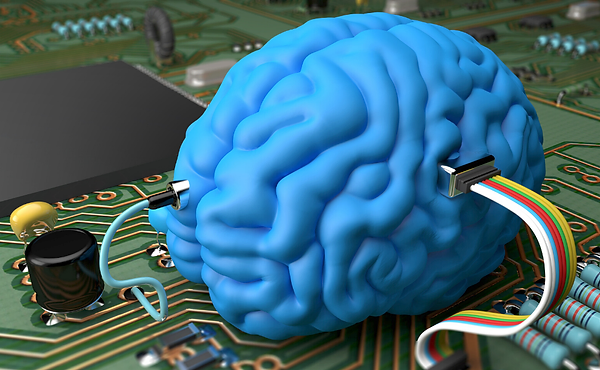
Elon Musk’s brain-chip startup Neuralink is gearing up to begin human trials, with the hope of providing relief to people with spinal cord injury by helping them regaining movement.
The company’s main chip communicates with a separate neural chip beneath the damaged section of spinal cord. This chip then sends signals to each person’s limbs, enabling them to walk again.
Brain-Computer Interface (BCI)
The Brain-Computer Interface (BCI) is a technology that enables users to manipulate devices by translating their brain activity into commands that can be transmitted to an external device like a virtual mouse or game controller.
The Brain-Computer Interface (BCI) utilizes electrodes that read signals produced by neurons. These electrodes then send these signals to receivers located on either a prosthetic limb or device.
One way to enhance the performance of BCIs is by enabling the system to utilize signals from multiple areas of the brain. This would increase the amount of information sent and, consequently, enhance reliability for the BCI.
Another way to enhance a BCI’s performance is by using electrodes made of glassy carbon, an improved material than standard thin-film platinum used for BCI electrodes. This material offers 10 times smoother surface area than its platinum counterpart and may thus yield improved results with BCIs.
Glassy carbon is a more durable material, but its safety and efficacy must still be tested. Some scientists have even suggested that the substance could experience corrosion issues which could eventually lead to leaks or other issues.
Other considerations when developing a BCI include its ethics of use, privacy and security, as well as whether it should be restricted to people with physical disabilities or accessible to all. A group of neurotechnologists, clinicians, ethicists and others involved in BCIs has formed a coalition to address these matters.
Additionally, creating a BCI suitable for people with spinal cord injuries necessitates rigorous clinical validation to demonstrate its benefits and demonstrate its usefulness in improving quality of life. To accomplish this challenging task, it requires dedicated multidisciplinary research teams with expertise across many relevant disciplines.
A sustainable and ethical business model will be necessary that provides commercial companies with financial incentive to develop BCIs while also compensating clinical and technical personnel who will implement them. As such, assistance to people living with physical disabilities will likely remain at the forefront of BCI development until such time that they become widely accessible for non-medical uses as well.
Intracranial Electrophysiology (IEE)
Electrophysiology, a branch of neuroscience, studies the electrical activity of living neurons to decipher their molecular and cellular signals.
Neurons communicate through both intercellular (transmitter-mediated) and intracellular (receptor-mediated) routes. Electrical signals are necessary to transmit these messages across a cell membrane and into a neuron’s dendrites.
Scientists use a variety of techniques to measure these signals. These include patch clamps, micropipettes and electrophysiology rigs.
Each technique necessitates specific preparations, depending on the experiment being conducted. A standard electrophysiology rig consists of an oscilloscope, amplifiers and a microelectrode placed inside nerve or muscle. The microelectrode is inserted into the cell or tissue under study and then connected to a reference electrode that lies outside it.
Researchers can compare the difference between a recording electrode and a reference electrode over time, giving them an intuitive visual representation of membrane potential and enabling scientists to measure its magnitude. Modern computer software makes running these experiments simple; researchers can adjust parameters like recording thresholds and stimulus delivery timing with ease.
Vibration isolation systems, such as air tables, are utilized to absorb minute changes in vibration that could disrupt the placement of microelectrodes. Doing this helps protect them from becoming damaged and ensures they remain in their intended spot for recording electrical signals.
Electrophysiology rigs often come equipped with an automated stimulus delivery system and oscilloscope that displays the results of experiments in real time. This can be especially helpful when the researcher is uncertain how well a stimulation worked.
Although these methods can be costly, they provide an invaluable means of measuring the electrical activity in neural circuits. Furthermore, they give scientists insight into how the brain functions and may enable them to develop new treatments for neurological conditions.
One promising application of these technologies is the creation of neuroprostheses for those suffering from neuralink spinal cord injury (SCI). SCI can cause severe paralysis and impaired voluntary motor function, impairing people’s daily living activities such as communication or shopping, in addition to increasing their need for nursing home care.
Co-robots in Neurosurgery
Neurosurgery has seen the widespread adoption of surgical robots to provide access to deep pathologies. Despite their many benefits, there remain a host of challenges that must be overcome in order for this technology to truly excel.
One of the most crucial needs is precision and accuracy during surgical procedures. The brain, being particularly sensitive to movement, requires high levels of accuracy during these operations. To meet these demands, various robotic systems have been created.
One type, the telesurgical robot, is often utilized in minimally invasive brain surgery and can assist with biopsy needles and depth electrodes as well as spinal instrumentation like screws and rods. On the other hand, a supervisory surgeon controlled robot is often utilized for spinal fusion and operated by either a radiologist or neurosurgeon.
In addition to these systems, handheld shared/controlled robots are also available for surgical applications and often referred to as “handheld telerobots”. Mazor X (Mazor Surgical Technologies, Caesarea, Israel) is one such example; it performs various tasks such as planning and executing neurosurgical procedures on the spine.
Neurosurgeons will find this to be a huge benefit, as it reduces fatigue and the time necessary for procedures. Furthermore, the Mazor X has the additional advantage of being able to detect and avoid collisions within the operating room during surgery.
Neurosurgeons now possess the necessary technologies to achieve precision in brain surgery. Additionally, some of these solutions have been created with the goal of minimizing bleeding during procedures.
For instance, MIT has developed a neurosurgical robotic system to guide soft magnetic wires through complex brain arteries. It includes an arm with magnet attached to its wrist and joystick for adjusting magnet orientation – enabling surgeons to manipulate the arm using live imaging while altering wire position accordingly.
The University of Illinois at Chicago and Neuralink are developing a third type of neurosurgical robotic system. This device will enable patients with neurosurgical issues to receive treatment without the need for general anesthetic.
The Future of Neurosurgery
Neurosurgery is a medical specialty that diagnoses and treats disorders of the brain, spinal cord, and peripheral nerves. Depending on the extent of an injury or disease, neurosurgeons can provide both surgical and nonsurgical care to patients.
Neurosurgery has undergone a profound evolution since its beginnings in the late 19th century. Nowadays, this subspecialty of surgery requires incredible precision and accuracy; many neurosurgeons now employ minimally invasive procedures to access problem areas with the least amount of damage possible to both nervous system tissue and surrounding tissues.
One of the more remarkable advances in neurosurgery is Neuralink’s brain-computer interface device, developed by Elon Musk’s startup Neuralink. This implantable device links our brains to computers and helps paralyzed individuals move again after suffering a spinal cord injury.
To implant the device, a hole is drilled into the skull and an electrode placed inside. The extension extends out four millimetres above brain surface and is connected to a computer via cable.
Early testing with large and small animals indicates this technology can successfully communicate with the brain. However, more work needs to be done before this technology can be put to clinical use.
Dr Gregoire Courtine from the EPFL spoke to BBC News and explained: “We’ve demonstrated that implanting an electrical signal into the spine can target and activate certain areas of the spinal cord. Our experiments show that these messages can travel from the brain to the spine, providing patients with some movement again.”
However, this technique may not be suitable for everyone. Some individuals are allergic to electrodes and so cannot have their implants placed.
The device may not be completely safe for patients as it can irritate the skin or harm blood vessels in the brain, potentially leading to bleeding or other complications. The procedure is intricate and requires extensive training; however, this could potentially provide great relief to people suffering from severe spinal cord injuries.
Discover the IoT Worlds Healthcare sections, click here.