

The world of embedded processors has long been characterized by a relentless pursuit of efficiency and the unwavering reliability demanded by deterministic workloads. These characteristics have been the bedrock upon which countless industrial, automotive, and consumer devices have been built. However, a profound transformation is now underway, driven by the explosive growth of generative AI, sophisticated vision AI, and the burgeoning era of autonomous machines. This seismic shift is forcing a fundamental re-evaluation of edge silicon architecture, demanding a new breed of processors capable of delivering unprecedented computational power and intelligent capabilities directly at the point of data creation.
This pivotal moment in technological evolution is perfectly encapsulated by the recent unveiling of the MediaTek Genio Pro 5100 at Embedded World 2026. This new platform, a flagship offering in MediaTek’s Genio Pro series, is not merely an incremental upgrade; it represents a paradigm shift. It signifies the injection of smartphone-class compute and AI capabilities into the heart of high-performance IoT and embedded applications, such as advanced robotics, commercial drones, and complex industrial IoT systems. MediaTek, traditionally renowned for its mobile and computing silicon, is now strategically re-articulating its core strengths to redefine the landscape of edge AI. This article will delve into the critical aspects of this evolution, exploring how the Genio Pro 5100 exemplifies the smartphone-ification of edge AI, and what this means for the future of intelligent machines.
The Convergence of Mobile and Embedded: Smartphone-Class Silicon at the Edge
For decades, the design philosophies behind mobile System-on-Chips (SoCs) and embedded processors diverged significantly. Mobile SoCs prioritized raw processing power, advanced multimedia capabilities, and energy efficiency for interactive user experiences, while embedded processors emphasized reliability, real-time performance, and a lean compute footprint for specific, often repetitive, tasks. The Genio Pro 5100 shatters these traditional boundaries, serving as a powerful testament to the convergence of these two formerly disparate domains.
Unprecedented Compute Power for Complex Workloads
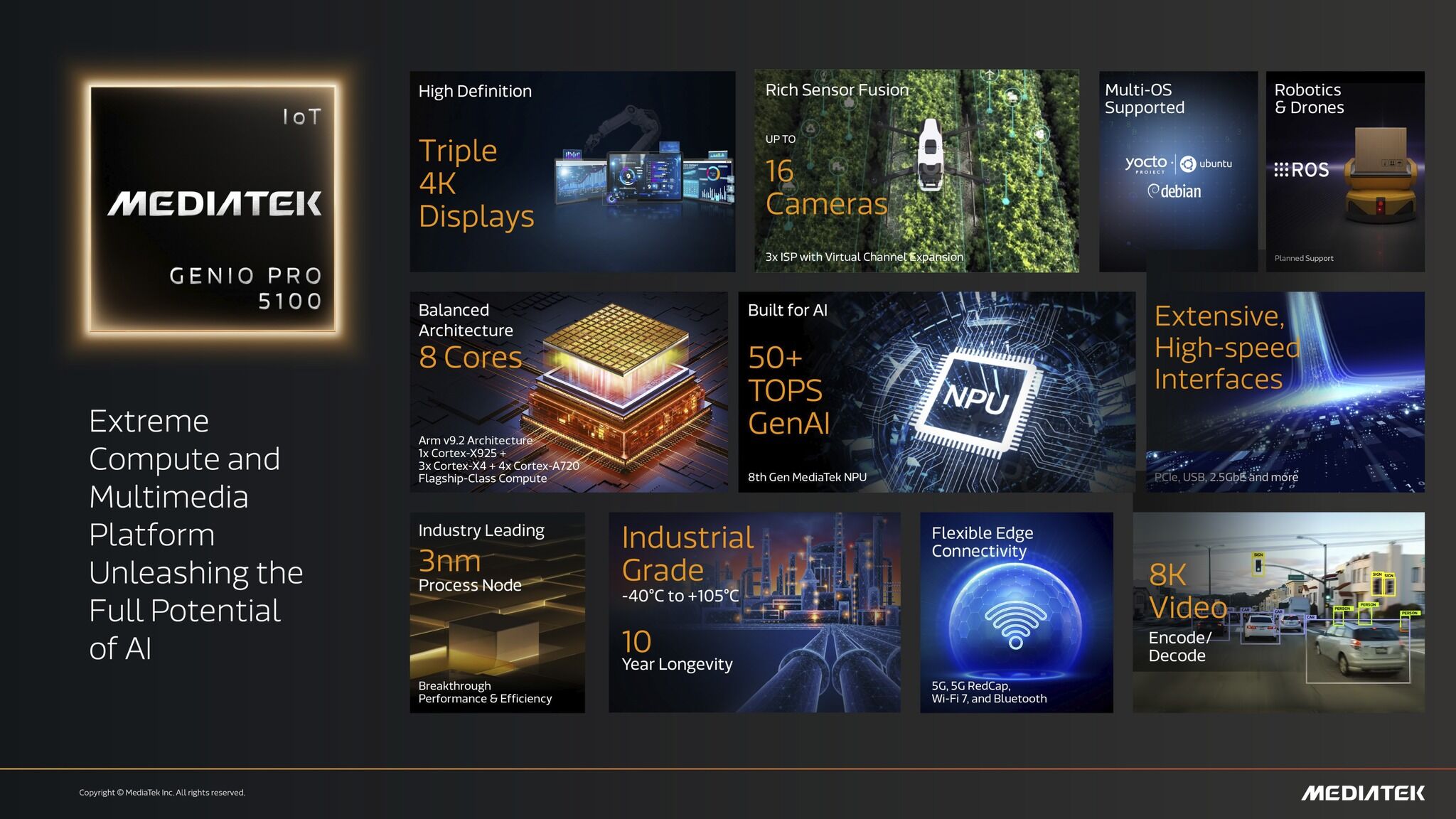
The most striking feature of the Genio Pro 5100 is its processor architecture, which directly borrows from the pinnacle of mobile computing. Built on TSMC’s cutting-edge 3nm process technology, the platform boasts an “all big-core” Arm v9.2 CPU configuration. This formidable arrangement includes one Arm Cortex-X925, three Cortex-X4, and four Cortex-A720 cores.
To truly appreciate the significance of this, one must understand the implications of an “all big-core” design. Unlike traditional embedded processors that often utilize a mix of powerful “big” cores for demanding tasks and energy-efficient “little” cores for background processes, the Genio Pro 5100 dedicates its entire CPU complex to high-performance computing. This enables it to deliver an astounding 260K DMIPS (Dhrystone Million Instructions Per Second) of compute performance. This level of raw processing power is critical for handling the increasingly intricate and computationally intensive workloads emerging in modern edge applications. Consider the demands of real-time perception for autonomous robots, the complex pathfinding algorithms required by advanced drones, or the intricate data analysis needed for preventative maintenance in industrial settings. These tasks go far beyond the scope of traditional embedded systems, requiring the kind of high-density compute capabilities previously reserved for flagship smartphones and high-end computing devices.
This shift means that embedded systems are no longer confined to simple control loops or basic data acquisition. They can now execute sophisticated algorithms, process vast amounts of sensor data in real-time, and even run complex software stacks that were once the exclusive domain of cloud-based servers. The smartphone-class compute moving into embedded systems represents a fundamental leap in their organizational intelligence, allowing them to make more autonomous and informed decisions directly at the edge.
The Power of the 3nm Process Node
The choice of TSMC’s 3nm process node is not merely a specification; it is a critical enabler of the Genio Pro 5100’s exceptional performance and efficiency. Smaller process nodes allow for a higher density of transistors on a given chip area, leading to several key advantages:
- Increased Performance: More transistors mean more processing units, enabling higher clock speeds and greater parallel processing capabilities. This directly translates to the 260K DMIPS compute performance cited earlier.
- Enhanced Power Efficiency: Despite the increased performance, smaller transistors consume less power. This is a crucial factor for edge devices, many of which operate on limited power budgets or require long operational lifespans between charges or maintenance cycles.
- Reduced Die Size: A smaller die size makes the chip more cost-effective to manufacture and allows for more compact system designs, which is vital for space-constrained applications like drones and robotics.
The 3nm process node, a technology typically associated with the most advanced consumer electronics, signifies MediaTek’s commitment to bringing leading-edge semiconductor manufacturing to the embedded space, truly marking this as the “smartphone moment” for edge AI.
AI Acceleration: The Heartbeat of Intelligent Edge Platforms
The rise of AI, particularly generative AI and advanced vision AI, has irrevocably altered the requirements for edge silicon. It’s no longer sufficient for an embedded processor to simply execute instructions; it must be inherently designed to accelerate complex AI workloads with unparalleled efficiency. The Genio Pro 5100 places AI acceleration at its core, demonstrating a profound understanding of this evolving demand.
Over 50 TOPS of Generative AI Acceleration
The centerpiece of the Genio Pro 5100’s AI capabilities is its integrated 8th-generation MediaTek NPU (Neural Processing Unit). This dedicated hardware accelerator delivers a staggering 50+ TOPS (Tera Operations Per Second) of system-level AI performance. TOPS is a critical metric for gauging AI performance, representing the sheer number of operations an NPU can perform per second. A higher TOPS value indicates a greater capacity for accelerating AI inferences and computations.
What truly differentiates the Genio Pro 5100 in this regard is its explicit focus on generative AI (GenAI). The platform is specifically engineered to support on-device generative AI models with up to 7 billion parameters, achieving a remarkable token generation rate of up to 23 tokens per second.
To put this into perspective:
- Generative AI Models: These models, such as large language models (LLMs) or generative adversarial networks (GANs), are capable of creating new content (text, images, audio) rather than merely classifying or analyzing existing data. Running these complex models on-device, at the edge, rather than relying on cloud infrastructure, offers significant advantages in terms of latency, privacy, and connectivity.
- Model Parameters: The number of parameters in an AI model directly correlates with its complexity and capabilities. Supporting models with up to 7 billion parameters on the edge is a significant achievement, enabling sophisticated GenAI applications without constant cloud interaction.
- Token Generation Rate: For LLMs, the token generation rate indicates how quickly the model can produce new units of text (tokens, which can be words or sub-word units). A rate of 23 tokens per second means that the Genio Pro 5100 can generate human-like text at a speed comparable to a fast human typer, opening up possibilities for real-time natural language interaction, dynamic content creation, and intelligent decision-making in edge applications.
This level of on-device generative AI acceleration unlocks a new realm of possibilities for smart machines. Imagine robots that can engage in natural language conversations to receive instructions, drones that can dynamically generate optimal flight paths based on real-time environmental changes, or industrial systems that can predict complex failures and proactively suggest maintenance schedules using contextually relevant generated reports. The shift from traditional AI inference to powerful on-device generative AI is a game-changer for organizational intelligence at the edge.
Robust AI Framework Support
To further empower developers and ensure broad applicability, the Genio Pro 5100’s NPU is backed by the MediaTek NeuroPilot framework. This robust platform provides comprehensive support for leading AI frameworks, including:
- PyTorch: A popular open-source machine learning framework known for its flexibility and ease of use, particularly in research and development.
- ONNX Runtime: An open-source inference engine that can run ONNX (Open Neural Network Exchange) models across different hardware and software platforms, ensuring interoperability.
- TFLite (LiteRT): A lightweight version of TensorFlow designed for on-device inference, optimized for small memory footprints and low-power consumption.
This extensive framework support dramatically simplifies the deployment of AI models onto the Genio Pro 5100, allowing developers to leverage their existing expertise and easily port a wide range of AI applications. This ensures that the powerful NPU is not just a theoretical capability but a highly accessible and practical tool for developing cutting-edge AI-driven edge solutions.
The Visual Edge: Powerful Graphics and Vision Compute for Intelligent Machines
Intelligent machines, by their very nature, interact with and interpret the physical world. This necessitates powerful graphics processing and advanced vision compute capabilities. Whether it’s a robotic arm performing intricate assembly, a drone navigating a complex urban environment, or a machine vision system inspecting product quality, the ability to see, understand, and render visual information in high fidelity is paramount. The Genio Pro 5100 addresses this critical need with flagship-class multimedia and display support.
Arm Immortalis-G925 GPU: Graphics Powerhouse
Central to the Genio Pro 5100’s visual prowess is the integrated Arm Immortalis-G925 GPU. This cutting-edge graphics processing unit delivers an impressive 3.1 TFLOPS (Tera Floating Point Operations Per Second) of compute and graphics performance. TFLOPS is a measure of a processor’s performance in floating-point calculations, which are fundamental to graphics rendering, scientific simulations, and many AI operations. A high TFLOPS count indicates superior capability in handling graphically intensive tasks.
This powerful GPU enables:
- Advanced Vision Processing: Beyond simple object detection, the Immortalis-G925 can accelerate complex computer vision algorithms, including real-time semantic segmentation, 3D reconstruction, and pose estimation. These capabilities are essential for enabling machines to understand their environment with a level of detail and nuance previously unattainable at the edge.
- Rich User Experiences: For applications requiring human interaction, such as Human-Machine Interfaces (HMIs) in industrial settings or interactive displays on commercial robotics, the GPU delivers smooth, high-resolution graphics, enabling intuitive and engaging user experiences.
- Multi-Display Capabilities: The platform supports up to three 4K displays simultaneously. This is a crucial feature for applications like control rooms, advanced surveillance systems, or multi-screen robotics dashboards, where operators need to monitor vast amounts of visual data or interact with complex interfaces across multiple screens.
The integration of such a high-performance GPU underscores MediaTek’s commitment to equipping edge devices with multimedia capabilities on par with those found in premium consumer devices, further solidifying the “smartphone moment” narrative.
Rich Sensor Fusion: Up to 16 Cameras
Modern autonomous systems rely heavily on a multitude of sensors to build a comprehensive understanding of their surroundings. Among these, cameras are often the most crucial, providing rich visual data for perception, navigation, and interaction. The Genio Pro 5100 is designed for “rich sensor fusion,” supporting an astounding up to 16 cameras through three Image Signal Processors (ISPs) with virtual channel expansion.
This extensive camera support is vital for:
- 360-degree Perception: Robots and drones operating in dynamic environments require a complete, unobstructed view of their surroundings to avoid obstacles, identify targets, and navigate safely. Supporting 16 cameras allows for comprehensive 360-degree vision.
- Stereo and Multi-View Depth Sensing: Multiple cameras can be used to create stereo vision systems, which are fundamental for accurate depth perception and 3D mapping, critical for autonomous navigation and object manipulation.
- Specialized Vision Tasks: Different cameras can be dedicated to specific tasks, such as wide-angle surveillance, telephoto target tracking, thermal imaging, or infrared sensing, all processed concurrently by the powerful Genio Pro 5100.
- Enhanced Redundancy and Reliability: In safety-critical applications, multiple cameras can provide redundant data pathways, ensuring continued operation even if one sensor fails.
The ability to process high-resolution video streams from up to 16 cameras concurrently, combined with the powerful NPU and GPU, enables an unprecedented level of real-time environmental understanding for edge devices. This capability is absolutely essential for the next generation of autonomous mobile robotics, commercial drones, and advanced machine vision systems.
8K Video Encode/Decode
Further enhancing its multimedia capabilities, the Genio Pro 5100 supports 8K video encoding and decoding. This feature is particularly significant for applications where high-resolution video capture, processing, and display are paramount.
- High-Fidelity Data Logging: For applications like drone inspections of critical infrastructure or high-precision industrial monitoring, 8K video capture allows for extremely detailed data logging, facilitating post-analysis and forensic examination.
- Advanced Vision AI Training: High-resolution video data captured at the edge can be invaluable for training and refining AI models, especially for tasks requiring minute detail recognition.
- Immersive Remote Operation: For remotely operated vehicles or telepresence robots, 8K video streams can provide operators with an incredibly immersive and detailed view of the remote environment, enhancing control and decision-making.
The comprehensive multimedia and visual compute capabilities of the Genio Pro 5100 make it a truly “multimedia platform unleashing the full potential of AI” at the edge.
Edge AI’s Tipping Point: Timing the Next Wave of Intelligent Devices
The convergence of smartphone-class compute, dedicated AI acceleration, and powerful multimedia capabilities within a single edge silicon platform is not just a technological feat; it’s a strategically timed move that aligns perfectly with the impending explosion of AI-driven edge devices.
Strategic Product Rollout
The Genio Pro 5100 will begin sampling in Q1 2026, with full production targeted for Q3 2026. This aggressive timeline places MediaTek at the forefront of the market, allowing OEMs and developers to rapidly integrate this advanced technology into their next-generation products. This timing is crucial as industries across the board are increasingly recognizing the transformative potential of edge AI. Early adopters who leverage platforms like the Genio Pro 5100 will gain a significant competitive advantage in a rapidly evolving market.
Enabling the Next Generation of AI-Driven Edge Devices
The capabilities of the Genio Pro 5100 are purpose-built for the emerging demands of:
- Autonomous Mobile Robotics: From automated guided vehicles (AGVs) in warehouses to sophisticated delivery robots and field robots, these machines require real-time perception, complex path planning, and on-device decision-making, all heavily reliant on AI.
- Commercial Drones: Inspection drones, agricultural drones, and surveillance drones are evolving to incorporate more autonomy, advanced sensor fusion, and on-board AI for real-time analysis and action.
- Edge AI Devices: A broad category encompassing smart city infrastructure, intelligent retail solutions, and next-generation security systems, all of which benefit from localized AI processing for enhanced responsiveness and privacy.
- Machine Vision Systems: In manufacturing and quality control, these systems are moving beyond simple pattern matching to complex defect detection, predictive analytics, and even generative design validation, all powered by advanced AI.
- Transportation and Logistics Platforms: Autonomous vehicles, intelligent traffic management systems, and smart logistics hubs will increasingly rely on sophisticated edge AI for optimized operations and enhanced safety.
The capabilities embedded within the Genio Pro 5100 directly address the core requirements of these applications, providing the necessary computing horsepower, AI acceleration, and multimedia features to unlock their full potential.
Robust and Reliable for Industrial Applications
Beyond raw performance, industrial and embedded applications demand unwavering reliability and longevity. The Genio Pro 5100 is designed for true “Industrial Grade” operation, capable of functioning flawlessly across an extreme temperature range of −40∘C to +105∘C. This broad operational range ensures its suitability for deployment in harsh industrial environments, outdoor applications, and other challenging conditions where standard consumer-grade silicon would fail.
Furthermore, MediaTek guarantees a “10 Year Longevity” for the Genio Pro 5100. This commitment to long-term availability and support is absolutely critical for industrial customers who often design products with extended lifecycles, ensuring they can rely on a consistent supply chain and stable platform for many years.
Multi-OS Support for Diverse Applications
Flexibility in software development is another cornerstone of successful embedded platforms. The Genio Pro 5100 offers extensive multi-OS support, catering to a wide range of development preferences and application needs. This includes:
- Yocto Project: A collaborative open-source project defining processes, tools, and methods for creating custom Linux distributions for embedded systems. Ideal for highly optimized and controlled environments.
- Ubuntu: A popular Linux distribution known for its ease of use and extensive community support, appealing to a broad developer base.
- Debian: Another widely respected and stable Linux distribution, often chosen for its robustness and security.
- ROS (Robot Operating System): Planned support for ROS 2 underscores the platform’s commitment to robotics development. ROS is a flexible framework for writing robot software, and native support will significantly accelerate the creation of advanced robotic solutions.
This rich OS ecosystem ensures that developers can select the most appropriate environment for their specific application, maximizing efficiency and leveraging existing expertise.
Extensive, High-Speed Interfaces
Connectivity and data transfer are paramount in any intelligent edge system. The Genio Pro 5100 integrates “Extensive, High-speed Interfaces” to ensure seamless communication and expansion. These include:
- PCIe Gen4: A high-speed serial expansion bus for connecting peripherals like dedicated AI accelerators, high-speed storage, or complex communication modules.
- USB 3.2 Gen2 and USB 2.0: Versatile serial buses for connecting a wide array of peripherals, from cameras and sensors to storage devices and human interface devices.
- Dual 2.5GbE MAC (with TSN): Dual 2.5 Gigabit Ethernet with Time-Sensitive Networking (TSN) capabilities provides high-bandwidth, low-latency, and deterministic connectivity, crucial for industrial automation and real-time control systems.
- Flexible Edge Connectivity: Support for emerging wireless standards like Wi-Fi 7, 5G, 5G RedCap, and Bluetooth ensures that devices built on the Genio Pro 5100 can seamlessly integrate into modern networked environments, offering robust and flexible communication options.
These comprehensive interface options provide the necessary bandwidth and flexibility to build complex, interconnected edge AI systems that can effectively gather, process, and transmit data.
The Future is AI-Native at the Edge
The introduction of the MediaTek Genio Pro 5100 is not just about a new product; it’s a harbinger of a new era for embedded systems. The edge silicon landscape is undergoing a rapid metamorphosis, driven by the insatiable demand for AI inference, advanced vision processing, and generative AI capabilities to be performed locally, on-device.
Vendors who can effectively leverage their expertise in mobile-class silicon and scale that capability to meet the rigorous demands of industrial and embedded environments will undoubtedly hold a strong advantage. MediaTek, with its deep reservoir of experience in high-performance, power-efficient mobile SoCs, is exceptionally well-positioned to lead this charge. The Genio Pro series, and specifically the Genio Pro 5100, is a clear demonstration of their strategic intent and technical prowess in this evolving market.
This “smartphone moment” for edge AI silicon signals a future where robots are more autonomous, drones are smarter, industrial systems are more predictive, and every intelligent edge device is imbued with a level of computational and AI capability that was unimaginable just a few years ago. It’s a future where organizational intelligence is distributed, real-time, and inherently more powerful.
Elevate Your Organizational Intelligence with IoT Worlds
The complexities of navigating this rapidly evolving landscape of edge AI and IoT are immense. Staying ahead requires not just access to cutting-edge technology, but also deep insights into market trends, strategic partnerships, and robust implementation strategies. At IoT Worlds, we are at the forefront of this revolution, providing unparalleled expertise and solutions to help businesses harness the full potential of intelligent edge computing.
Whether you’re looking to integrate advanced AI into your robotics platform, deploy cutting-edge vision systems for industrial automation, or develop the next generation of autonomous machines, IoT Worlds is your trusted partner. Our team of experts understands the nuances of edge AI silicon, the intricacies of generative AI deployment, and the demands of industrial-grade solutions. We can help you identify the right technologies, optimize your deployments, and build competitive advantages in this dynamic market.
Don’t let the complexity of the future hold your organization back. Unlock new levels of efficiency, intelligence, and autonomy. Take the first step towards transforming your operations and realizing the full potential of AI at the edge.
Send an email to info@iotworlds.com today to explore how we can help you integrate these revolutionary technologies and elevate your organizational intelligence.
