

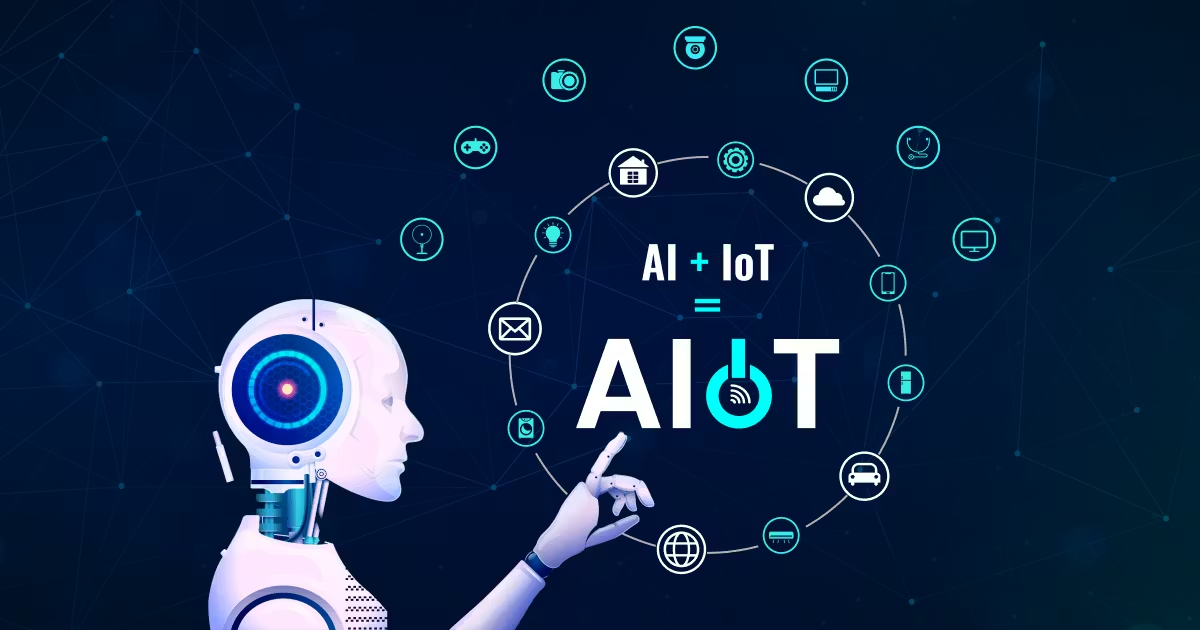
Artificial Intelligence of Things—AIoT—is where the physical world of connected devices meets the intelligence of machine learning and analytics.
Smart factories predicting equipment failures, logistics fleets optimizing routes in real time, buildings adjusting energy use automatically, hospitals tracking patient vitals 24/7: all of these are powered by AIoT.
The opportunity is huge, but so is the risk of failure. Many organizations:
- start too big and burn budget before delivering value,
- neglect integration with existing systems,
- underestimate security,
- or launch without a clear plan for data, maintenance, and people.
Whether you’re a CTO, OT engineer, product manager, or founder, this article will help you answer:
- Where should we start with AIoT?
- How do we avoid hype and choose use cases that pay back?
- What infrastructure, skills, and processes must we have in place first?
Let’s dive in.
What Is AIoT, Really?
Before we explore the 10 essentials, it is worth defining AIoT clearly.
- IoT (Internet of Things) connects physical devices—sensors, machines, vehicles, wearables—to networks so they can send and receive data.
- AI (Artificial Intelligence) encompasses algorithms and models that can recognize patterns, make predictions, and automate decisions.
AIoT is the combination: connected devices continuously generate data, and AI models turn that data into actionable insight and autonomous behavior.
Examples:
- Predictive maintenance on industrial equipment using vibration, temperature, and historical fault data.
- Computer vision at the edge to detect product defects in a production line.
- Smart‑building platforms that use occupancy and climate data to optimize HVAC and lighting.
- Retail analytics that track in‑store traffic and stock levels to adjust staffing or dynamic pricing.
These solutions often involve:
- hardware (sensors, gateways, embedded devices),
- networks (Wi‑Fi, LTE/5G/6G, LoRaWAN, NB‑IoT, BLE, wired industrial protocols),
- cloud and edge compute,
- data lakes and streaming platforms,
- AI/ML models and dashboards,
- and integration with enterprise systems such as ERP, CRM, MES, or EHR.
Because AIoT touches so many layers, planning is everything. That’s where our 10 things come in.
1. Start With a Small Pilot
“Begin with one focused use case. Prove value before attempting full‑scale AIoT rollout.”
Many AIoT initiatives fail because they try to “boil the ocean”:
- connect every asset in a plant,
- build a universal data platform,
- promise dozens of use cases before delivering even one.
A small, well‑chosen pilot use case is your best defense against this trap.
1.1 Characteristics of a great AIoT pilot
Look for projects that:
- have clear, measurable business value (cost savings, revenue uplift, safety improvement),
- involve limited scope—a single line, building, fleet segment, or process,
- use data you can access relatively easily,
- have stakeholders who are eager to collaborate and champion success.
Examples:
- Predictive maintenance for one class of motors that frequently fail.
- Energy optimization for a single office building or production hall.
- Real‑time location tracking for high‑value tools in one workshop.
- Computer‑vision quality inspection for a single product station.
1.2 Define concrete success metrics
Before you install a single sensor, decide:
- What metric will tell us the pilot succeeded?
- How will we compare “before vs. after”?
Typical key performance indicators (KPIs):
- reduced unplanned downtime by X%,
- energy cost per square meter decreased by Y%,
- scrap rate decreased by Z%,
- mean time to repair (MTTR) improved,
- safety incidents reduced.
1.3 Time‑box and budget the pilot
A good pilot should:
- run for 3–6 months, not multiple years,
- have a capped budget that is visible to leadership,
- include time for integration, user training, and change management—not just tech.
If the pilot demonstrates value, you’ll have the credibility and learning to justify scale‑up. If it fails, you will have limited the blast radius and gained insight for the next attempt.
2. Integrate With Existing Systems
“AIoT only works when it connects seamlessly. Plan integrations with ERPs, CRMs, MES, and cloud tools early.”
IoT proof‑of‑concepts often run in isolation: a neat demo dashboard that never talks to the systems people use day‑to‑day. Real value, however, emerges only when AIoT integrates into the existing digital backbone of your business.
2.1 Map your system landscape
Before implementing AIoT, create a simple map:
- Operational Technology (OT): PLCs, SCADA, DCS, MES, BMS, historian databases.
- IT systems: ERP, CRM, HR, EAM/CMMS, BI tools.
- Cloud platforms: analytics, data lakes, existing IoT platforms.
- Edge devices and gateways already deployed.
Identify:
- which systems contain source data your AI models will need,
- which systems are targets for actions (e.g., open a work order in CMMS, adjust a setpoint in BMS).
2.2 Use open standards and APIs
Avoid vendor lock‑in by favoring:
- MQTT, OPC UA, REST/GraphQL APIs, and other open protocols,
- platforms that support flexible data ingestion and export,
- microservices architectures that can evolve as needs change.
If you must integrate with legacy systems that lack APIs, consider:
- industrial protocol gateways,
- data historians that can bridge OT and IT,
- robotic process automation (RPA) as a last resort.
2.3 Design for people, not just data
Integration is not only about machines talking to machines; it’s about humans receiving insight where they already work:
- Maintenance technicians live in CMMS and messaging tools.
- Operators work from SCADA/HMI screens.
- Managers use BI dashboards and email.
- Executives want mobile summaries or slide decks.
Think about how AIoT outputs (alerts, predictions, recommendations) will surface in these channels. Embedding them where users already live massively increases adoption.
3. Prioritize ROI, Not Hype
“Choose projects that actually save money or increase efficiency. Avoid shiny‑but‑useless tech.”
With AI, IoT, digital twins, and metaverse talk everywhere, it’s easy to chase hype. But budgets—and stakeholder patience—are finite.
3.1 Build a value‑driven use‑case portfolio
List potential AIoT use cases and score them on:
- Business impact (cost savings, risk reduction, revenue),
- Feasibility (data availability, technical complexity, dependencies),
- Time to value (how quickly benefits can be realized),
- Strategic alignment (support for long‑term digital‑transformation goals).
Prioritize those that sit at the intersection of high impact, reasonable feasibility, and short time to value.
3.2 Quantify economics early
A simple financial model makes conversations concrete:
- estimated initial investment (hardware, licenses, integration, internal staff),
- ongoing operating cost (connectivity, cloud, maintenance, support),
- projected annual benefits (reduced downtime, energy savings, reduced scrap, labor savings, new revenue).
Calculate:
- payback period,
- net present value (NPV),
- internal rate of return (IRR) over 3–5 years.
You don’t need perfect accuracy, but ballpark figures prevent falling in love with technically cool but economically weak ideas.
3.3 Beware of vanity metrics
High message counts, impressive dashboards, or complex neural networks don’t equal success. Focus on operational KPIs and business outcomes, not purely technical ones.
4. Build Strong Data Foundations
“AIoT needs clean, consistent, real‑time data. Invest in sensors, pipelines, and quality checks.”
AI is only as good as the data it learns from. In AIoT that means thinking carefully about:
- which signals you capture,
- how frequently,
- with what accuracy and calibration,
- in what structure and format.
4.1 Instrumentation: the right sensors and telemetry
Start from your use case and ask:
- What physical phenomena matter? (temperature, vibration, current, pressure, occupancy, location…)
- Are existing sensors sufficient or do we need new ones?
- What sampling frequency is required? (A motor vibration model may need kHz sampling; energy monitoring might manage with one sample every minute.)
- What is the acceptable latency from measurement to decision?
Over‑instrumentation wastes money and bandwidth; under‑instrumentation starves AI models.
4.2 Data modeling and semantics
Develop a common data model for assets, events, and measurements:
- consistent naming conventions for devices, lines, sites, and signals,
- units of measurement standardized and documented,
- metadata about sensor locations, calibration, and maintenance history.
Standards like Asset Administration Shell (AAS) in Industry 4.0, Project Haystack for buildings, or GS1 for supply chains can provide inspiration.
4.3 Data pipelines and quality checks
Implement pipelines that:
- ingest data from diverse sources (devices, logs, enterprise systems),
- validate and clean it (remove outliers, fill gaps, handle duplicates),
- enrich it with context (asset hierarchies, production schedules, weather),
- store it in scalable, queryable formats (time‑series databases, data lakes).
Automated data‑quality monitoring should flag:
- missing or delayed data from devices,
- sensors stuck at constant values,
- unrealistic jumps.
Without these checks, AI models may learn from corrupted data and produce misleading outputs.
4.4 Labeling and ground truth
Supervised learning requires labeled examples:
- actual failure events with timestamps,
- manual quality inspections,
- historical maintenance tickets,
- external outcomes like customer complaints.
Plan early how to collect, clean, and align labels with sensor data. Sometimes this is the hardest part of the AIoT journey.
5. Plan for Long‑Term Maintenance
“Devices fail, networks break, and models degrade. Budget for updates, monitoring, and hardware refresh cycles.”
Too many organizations focus on initial rollout and forget that AIoT solutions are living systems.
5.1 Device lifecycle management
Every physical component has a lifespan:
- sensors may wear out or drift,
- batteries need replacement,
- gateways hit end‑of‑support,
- new regulations require hardware changes.
Create a device management strategy that covers:
- asset inventory and configuration tracking,
- remote firmware updates and patches,
- health monitoring (battery level, connectivity, error logs),
- procedures for decommissioning and secure disposal.
5.2 Model lifecycle management (MLOps)
AI models also age:
- data distributions shift (concept drift),
- equipment is upgraded,
- new operating modes introduced,
- anomalies that were rare become common.
MLOps practices help:
- track which model version runs where,
- monitor prediction performance over time,
- automate retraining with new labeled data,
- roll out updates safely with canary deployments and A/B tests.
5.3 Operational support and SLAs
Decide:
- who responds when sensors stop sending data or models crash,
- what uptime and response times are acceptable,
- how issues are escalated between OT, IT, and vendor teams.
Treat AIoT platforms like any business‑critical IT system, with clear ownership, support processes, and budgets for maintenance.
6. Focus on Security From Day One
“Every connected device is a potential attack point. Implement encryption, device identity, and secure firmware.”
Security is not an afterthought in AIoT; it is a foundational requirement. Each additional sensor or gateway is a new door an attacker might try.
6.1 Secure device identity and provisioning
Ensure each device:
- has a unique cryptographic identity anchored in hardware where possible (TPMs, secure elements),
- uses secure boot and firmware integrity checking,
- is provisioned using authenticated and auditable processes.
Avoid shared credentials or hard‑coded passwords. Technologies such as X.509 certificates, TPM‑based keys, or decentralized identifiers (DIDs) can support strong identity.
6.2 Encryption in transit and at rest
All communication between devices, gateways, and cloud should use:
- TLS or DTLS with modern cipher suites,
- certificate validation and rotation,
- optional VPN or network segmentation in OT environments.
Data stored on devices, edge servers, and in the cloud should be encrypted and access‑controlled.
6.3 Principle of least privilege
- Devices should have access only to the minimal resources and APIs they need.
- Internal microservices should authenticate to each other; don’t assume trust because they’re “inside the network.”
- Human roles (operators, engineers, data scientists) require granular, role‑based access control (RBAC).
6.4 Vulnerability management and patching
Put in place:
- processes to track security advisories for all hardware and software components,
- regular security‑patch windows and roll‑out mechanisms,
- penetration testing and red‑teaming for critical deployments.
Ignoring security until “after the pilot” is a recipe for technical debt and increased risk.
7. Choose the Right Connectivity
“Wi‑Fi, LoRaWAN, NB‑IoT, BLE—choose based on range, power, and data needs. One wrong choice can break the whole project.”
Connectivity is the circulatory system of AIoT. The wrong network technology can:
- drain batteries too fast,
- produce unacceptable latency,
- blow up operating costs,
- or be impossible to deploy in your physical environment.
7.1 Consider these dimensions
When evaluating connectivity options, analyze:
- Range and coverage: How far is each device from the nearest gateway or base station? Indoors or outdoors?
- Bandwidth: How much data does each device send/receive, and how frequently?
- Latency: Do you need sub‑second response or is batch transmission fine?
- Power consumption: Are devices mains‑powered or battery/energy‑harvesting? What lifetime is required?
- Reliability and redundancy: How critical is uptime? Is interference common?
- Regulatory constraints: Licensed vs. unlicensed spectrum, regional band rules.
- Cost: Module cost, subscription fees, infrastructure investments.
7.2 Common options and where they fit
- Wi‑Fi: high bandwidth, short‑to‑medium range, great for indoor spaces with existing infrastructure; power‑hungry, not ideal for long‑life battery devices.
- Ethernet / Industrial fieldbuses: extremely reliable and low latency; best for fixed industrial equipment; cabling cost can be high.
- BLE (Bluetooth Low Energy): short range, low power; good for wearables, beacons, proximity sensors; often used with smartphones as gateways.
- LoRaWAN: long range, very low power, low bandwidth; perfect for sparse sensors (utility meters, environmental monitoring, agriculture).
- NB‑IoT / LTE‑M: cellular LPWAN; good coverage via mobile operators, low bandwidth but better QoS than LoRaWAN; subscription costs apply.
- 4G/5G:/6G high bandwidth and low latency; suited for video, mobile robots, or remote sites needing backhaul; higher power and cost.
- Private 5G: enterprises deploy dedicated networks for factories, ports, or campuses requiring deterministic performance.
Often the best architecture is hybrid: for example, BLE sensors → local gateway over Ethernet → cloud via 5G.
7.3 Design for future flexibility
Choose connectivity solutions and platforms that allow:
- adding new network types without redesigning applications,
- roaming between networks where needed,
- remote reconfiguration of network parameters.
This flexibility is crucial as business needs and technologies evolve.
8. Use Edge AI Where It Matters
“For low latency, poor connectivity, or high‑volume data, edge AI cuts cost and boosts performance.”
Not all AI processing belongs in the cloud. Edge AI means running models on or near devices: in gateways, on embedded processors, or in local servers.
8.1 When edge AI is essential
Consider pushing intelligence to the edge when:
- Latency is critical. Safety monitoring, closed‑loop control, and interactive experiences can’t wait for cloud round trips.
- Connectivity is intermittent. Remote sites, moving assets, or regulatory constraints may prevent always‑on cloud connections.
- Data volume is massive. Video analytics or high‑frequency sensor streams are expensive to backhaul; pre‑processing and filtering at the edge reduce cost.
- Privacy mandates local processing. Regulations or company policy may forbid raw data leaving premises (for example, facial images in hospitals).
8.2 Edge AI patterns
Common architectural patterns include:
- Feature extraction at the edge, modeling in the cloud. Devices compute statistical summaries or embeddings, which are smaller to transmit.
- Full model inference at the edge, training in the cloud. Models are retrained centrally, then deployed to devices for real‑time scoring.
- Federated learning. Edge nodes train local models and send only model updates, not raw data, back to the cloud for aggregation.
8.3 Hardware and software considerations
Edge AI requires:
- suitable hardware (MCUs with DSP extensions, NPUs, TPUs, GPUs, FPGAs depending on workload),
- efficient model architectures (TinyML, quantization, pruning),
- deployment pipelines that manage versions and rollback safely.
Selecting an edge AI framework (TensorFlow Lite, ONNX Runtime, OpenVINO, etc.) that matches your target hardware can save significant effort.
9. Prepare Your Team for a Mindset Shift
“AIoT requires collaboration across IT, OT, data teams, product, and leadership. Skill gaps need to be addressed early.”
Technology is only half the AIoT story. The other half is people and culture.
9.1 Break down silos between IT and OT
In many organizations:
- OT teams manage physical assets and industrial networks.
- IT teams run corporate infrastructure and applications.
- Data and AI teams live somewhere in between or in separate innovation labs.
AIoT cuts across these boundaries. Success requires:
- shared governance structures,
- joint architecture decisions,
- combined security frameworks,
- and regular communication.
Consider cross‑functional AIoT squads with members from each discipline working toward common goals.
9.2 Upskill and reskill
Key competencies include:
- embedded and edge computing,
- data engineering and MLOps,
- cybersecurity for OT and IoT,
- domain knowledge in your specific industry (manufacturing, healthcare, energy, etc.),
- product management and UX for data‑driven services.
Invest in training, hiring, and partnerships. Encourage knowledge sharing through internal meetups, documentation, and mentoring.
9.3 Manage change and expectations
AIoT can change:
- daily routines for operators and technicians,
- decision‑making processes for managers,
- business models for leaders.
Involve stakeholders early:
- explain the “why” behind projects,
- address concerns about automation and job impact,
- co‑design dashboards and alerts with the people who will use them.
Change management is not optional; it determines adoption.
10. Measure, Monitor & Scale Gradually
“Use dashboards and analytics to track value and failures. Scale only when the model, hardware, and process all work reliably.”
After a successful pilot, the temptation is to roll out everywhere at once. Resist it. Instead, adopt a measure‑and‑scale approach.
10.1 Instrument your AIoT solution
Monitor not only business KPIs but also:
- device health (online/offline status, battery level, error logs),
- data pipeline health (latency, drop rates),
- model metrics (accuracy, drift indicators, confidence scores),
- user engagement (how often alerts are acknowledged, dashboards viewed).
Dashboards should cover multiple levels:
- operational views for engineers and support,
- business views for managers and executives.
10.2 Learn from failures
Don’t hide or ignore issues like:
- sensors frequently failing,
- high false‑positive rates from models,
- user complaints about irrelevant alerts.
Instead, treat them as feedback loops:
- adjust thresholds, retrain models, or improve features,
- reinforce training and documentation,
- refine SLAs with vendors and partners.
10.3 Scale in waves
Rather than jumping from one pilot site to global rollout, scale in controlled waves:
- Pilot at one site or line.
- Expand to a few more with similar characteristics.
- Generalize to different geographies or asset types.
- Industrialize processes (procurement, deployment scripts, training).
At each stage, ensure:
- the technology is stable,
- support processes are in place,
- ROI remains positive,
- local regulations are met.
Common Pitfalls to Avoid in AIoT Projects
To conclude the playbook, here are pitfalls we repeatedly see—and how the 10 principles help avoid them.
Pitfall 1: Technology chasing
- Symptom: starting with “we must use AI/5G/Blockchain” rather than a business problem.
- Prevention: Principle 1 and 3—start with a focused pilot and prioritize ROI.
Pitfall 2: Ignoring integration
- Symptom: shiny dashboards that no one uses because they are separate from core systems.
- Prevention: Principle 2—design integrations with ERP, CRM, MES, BMS, CMMS from the start.
Pitfall 3: Underestimating data quality
- Symptom: models that seem to work in lab tests but fail in production due to bad or missing data.
- Prevention: Principle 4—invest heavily in sensors, pipelines, and data governance.
Pitfall 4: No plan for operations
- Symptom: pilot works; two years later devices are dead, firmware outdated, models irrelevant.
- Prevention: Principle 5 and 10—plan for maintenance and continuous monitoring.
Pitfall 5: Security bolt‑on
- Symptom: insecure devices deployed, then patched in a hurry when vulnerabilities emerge.
- Prevention: Principle 6—embed security into design, provisioning, and updates.
Pitfall 6: Wrong connectivity
- Symptom: battery life too short, coverage patchy, costs higher than expected.
- Prevention: Principle 7—systematic evaluation of network technologies.
Pitfall 7: Over‑centralized AI
- Symptom: high latency, cloud costs exploding, privacy issues.
- Prevention: Principle 8—use edge AI wherever it makes economic and technical sense.
Pitfall 8: Resistance from people
- Symptom: operators bypass the system, managers ignore alerts.
- Prevention: Principle 9—prepare teams, communicate benefits, involve users in design.
Final Thoughts: Turning AIoT Vision Into Reality
AIoT promises a world where:
- machines tell us when they need attention,
- buildings and cities optimize themselves,
- products evolve based on real‑world usage data,
- and businesses make decisions with unprecedented situational awareness.
But realizing that vision requires more than buying sensors and signing an AI contract. It requires:
- Starting with small, value‑driven pilots.
- Integrating seamlessly with your digital core.
- Prioritizing ROI over hype.
- Building strong data and labeling foundations.
- Planning for device and model lifecycles.
- Embedding security and privacy from day one.
- Choosing connectivity strategically.
- Putting AI at the edge when it matters.
- Preparing your team for new ways of working.
- Measuring relentlessly and scaling in controlled stages.
Follow these principles, and your AIoT projects will move beyond proof‑of‑concept theater into genuine digital transformation—creating safer, more efficient, and more sustainable operations.
The next generation of industry leaders will be those who master the interplay of AI, IoT, edge computing, security, and human factors. Start now, start small, and build the AIoT future one successful pilot at a time.
