

The Internet of Things (IoT) continues its relentless expansion, permeating every aspect of our lives, from smart homes and connected cities to industrial automation and personal wearables. At the heart of this revolution lies the need for robust, reliable, and, crucially, energy-efficient wireless connectivity. As we demand more from our IoT devices – always-on functionality, years of battery life, and seamless integration into complex ecosystems – the underlying hardware must evolve to meet these exacting requirements.
Espressif, a long-standing innovator in the world of Wi-Fi and Bluetooth SoCs, has once again raised the bar with the announcement of the ESP32-H21. This new System-on-Chip (SoC) is not just an incremental update; it represents a significant leap forward in low-power wireless technology, poised to redefine what’s possible for battery-powered IoT products.
The Power Challenge in IoT: A Fundamental Hurdle
The promise of IoT is often tethered to the reality of power consumption. Many compelling IoT applications, such as environmental sensors, asset trackers, and smart-home devices, are envisioned as truly “install and forget” solutions. This vision is shattered if device batteries require frequent recharging or replacement. Designing for ultra-low power is therefore not merely a feature; it’s a foundational requirement for the widespread adoption and viability of many IoT segments.
Traditional wireless communication often demands substantial power, especially during active transmission and reception phases. For devices expected to operate for months or even years on a coin cell battery, every milliampere of current matters. This challenge has driven innovation in various areas, from advanced power management techniques to the development of highly efficient wireless protocols.
Active Current vs. Sleep Current: Understanding the Trade-offs
When evaluating the power consumption of an IoT device, two primary metrics are crucial: active current and sleep current.
- Active Current: This refers to the current drawn when the device is fully operational, performing tasks such as transmitting data, receiving signals, or executing computations. High active current directly impacts the operational time of a battery-powered device, especially in applications that require frequent communication.
- Sleep Current: This is the current drawn when the device is in a low-power state, waiting for an event or a scheduled wake-up. Minimizing sleep current is paramount for applications that spend most of their time idle, as it determines the baseline battery drain and, consequently, the overall battery life.
Achieving a balance between these two states is key. A device might have extremely low sleep current, but if its active current is too high, frequent activity will quickly drain the battery. Conversely, a device with low active current but poor sleep modes will still struggle to achieve long battery life if it’s mostly idle. The ideal IoT SoC excels in both areas, delivering efficient operation when active and nearly imperceptible power draw when dormant.
Introducing the ESP32-H21: A New Era of Efficiency
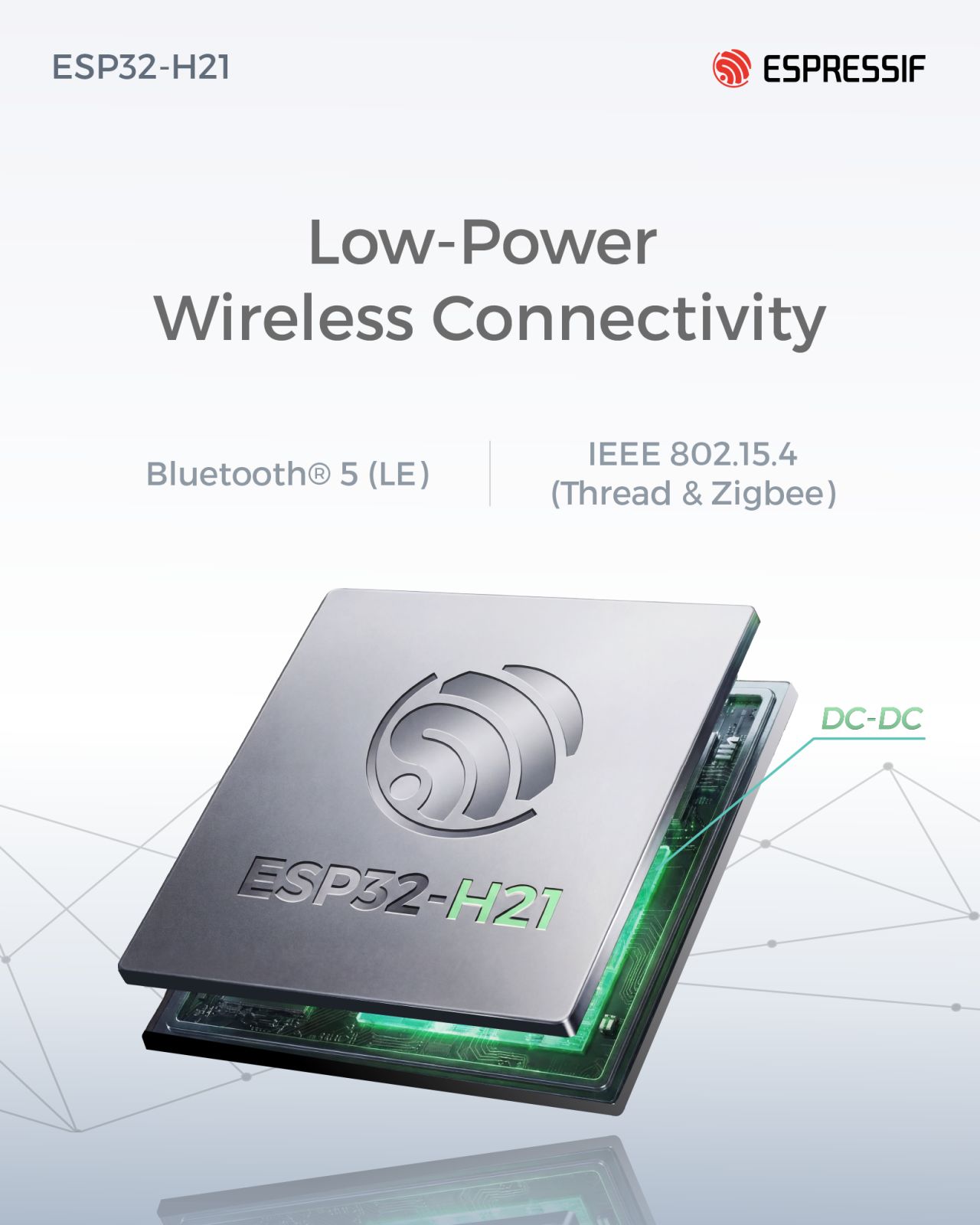
Espressif’s ESP32-H21 is engineered from the ground up to tackle these power challenges head-on. As an evolution of the successful ESP32-H2 platform, the H21 integrates a critical component that dramatically boosts its energy efficiency: an on-chip DC-DC converter.
This integration is a game-changer for battery-powered IoT devices. By efficiently regulating voltage directly on the chip, the DC-DC converter minimizes energy loss and allows the SoC to operate at optimal efficiency across various power states.
Unprecedented Low-Power Performance
The impact of the integrated DC-DC converter on the ESP32-H21’s power consumption is remarkable.
- RX Active Current: Under typical operating conditions, the ESP32-H21 boasts an impressive RX active current of approximately 8.2 mA. This low figure is crucial for applications that involve frequent listening for incoming data, such as mesh network nodes or sensing applications.
- Light Sleep Mode: For periods of brief inactivity, the ESP32-H21 can enter a light sleep mode, drawing as little as 9 µA. This mode allows for quick wake-up times while significantly reducing power consumption compared to active operation.
- Deep Sleep Mode: For extended periods of dormancy, the SoC can enter deep sleep, where its current consumption plummets to an extraordinary 5 µA. This ultra-low deep sleep current is fundamental for achieving multi-year battery life in devices that only need to report data periodically.
These figures place the ESP32-H21 at the forefront of low-power wireless SoCs, making it a direct competitor to established players in the ultra-low-power segment. Its ability to achieve such low current draws in both active and various sleep modes ensures that it can meet the stringent power requirements of the most demanding battery-powered IoT applications.
Connectivity Tailored for the Modern IoT Landscape
Beyond its exceptional power efficiency, the ESP32-H21 offers a robust and versatile wireless connectivity suite, making it ideal for the evolving standards of the IoT. It integrates two crucial wireless technologies: IEEE 802.15.4 and Bluetooth Low Energy (LE).
IEEE 802.15.4: The Foundation for Mesh Networks
IEEE 802.15.4 is the foundational standard for low-power, low-data-rate wireless personal area networks (WPANs). It’s the physical and Media Access Control (MAC) layer for several prominent IoT mesh protocols, including:
- Thread: A royalty-free, IP-based wireless mesh networking protocol designed for low-power IoT devices. Thread excels in reliability, security, scalability, and enabling direct IP-addressability for every device, simplifying cloud integration.
- Zigbee: A widely adopted, self-organizing, and self-healing mesh network standard, particularly popular in smart home, building automation, and industrial control applications.
The ESP32-H21’s native support for IEEE 802.15.4 positions it perfectly for these mesh networking applications. Mesh networks are inherently robust, as they allow data to hop between multiple devices to reach its destination, thereby extending range and improving reliability, especially in environments with obstacles or interference. This makes the ESP32-H21 well-suited for:
- Smart-home and Building Automation Sensors: Think motion sensors, contact sensors, temperature/humidity sensors, and smart light switches that can form a reliable, interconnected network.
- Bluetooth Mesh Nodes: Devices that participate in a Bluetooth Mesh network, further enhancing coverage and control in various settings.
- Lighting and Control Devices: Efficiently managing large-scale lighting installations in commercial buildings or smart homes, where hundreds of devices need to communicate reliably.
Bluetooth Low Energy (BLE): Versatility and Direct Connectivity
Bluetooth Low Energy (BLE) is a wireless personal area network technology designed for transmitting data over short distances. Its primary advantages for IoT include:
- Extremely Low Power Consumption: As its name suggests, BLE is optimized for minimal power usage, making it ideal for battery-powered devices.
- Ubiquitous Support: Found in nearly all smartphones, tablets, and computers, BLE enables direct connectivity to user devices without requiring a proprietary hub.
- Mesh Capabilities (Bluetooth Mesh): While historically point-to-point or star network focused, the introduction of Bluetooth Mesh has expanded BLE’s capabilities to support large-scale mesh networks, similar to Thread and Zigbee.
The integration of BLE in the ESP32-H21 provides significant advantages:
- Local Control and Commissioning: Users can directly interact with ESP32-H21-based devices via their smartphones for setup, configuration, and local control.
- Edge Connectivity: Enables direct communication with edge computing devices or gateways that support BLE.
- Diverse Applications: From wearables and medical devices to asset tracking and proximity sensing.
The combination of IEEE 802.15.4 and BLE on a single SoC provides developers with immense flexibility. They can leverage the strengths of each protocol, building hybrid solutions or choosing the best fit for specific application requirements.
Optimized for Matter: Leading the Smart Home Revolution
One of the most exciting aspects of the ESP32-H21 is its strong support for Matter. Matter is an open-source connectivity standard championed by the Connectivity Standards Alliance (CSA) and backed by major industry players like Apple, Google, Amazon, and Samsung. Its goal is to create a unified, interoperable experience across different smart home ecosystems, eliminating fragmentation and simplifying device setup and control.
The ESP32-H21’s capabilities make it an ideal choice for developing Matter-enabled devices:
- Thread Connectivity: Matter primarily relies on Thread for its robust mesh networking capabilities. Since the ESP32-H21 fully supports IEEE 802.15.4, it forms a natural and highly efficient hardware foundation for Thread-based Matter devices.
- Low Power for Battery Devices: A key promise of Matter is the ability to easily integrate a wide range of devices, including those that are battery-powered and operate for extended durations. The ESP32-H21’s ultra-low power consumption directly addresses this need, enabling long-lasting Matter endpoints such as sensors and controllers.
ESP-MatterSDK Integration: Espressif deeply invests in making development with its chips seamless. The ESP32-H21 is compatible with Espressif’sESP-MatterSDK, providing developers with the necessary tools, libraries, and examples to rapidly bring Matter-compliant products to market.
By leveraging the ESP32-H21, manufacturers can develop battery-powered Matter devices that are not only interoperable with a vast ecosystem but also exceptionally energy-efficient, delivering a superior user experience and reducing the total cost of ownership for consumers. This positions the ESP32-H21 as a cornerstone for the next generation of smart home and building automation solutions.
Robust Wireless Performance: Range and Reliability
Power efficiency is vital, but so too is reliable wireless communication, especially in challenging environments. The ESP32-H21 addresses this with impressive RF capabilities.
- Up to 20 dBm Transmit Power: The SoC supports a transmit power of up to 20 dBm. This high output power is crucial for several reasons:
- Extended Wireless Range: Greater transmit power allows signals to travel further, an essential factor in larger homes, commercial buildings, or industrial settings where devices might be widely dispersed.
- Improved Link Robustness: A stronger signal can better penetrate walls, mitigate interference from other wireless devices, and overcome signal attenuation, leading to more reliable connections.
- Performance in Dense Environments: In dense IoT deployments or interference-prone environments (e.g., bustling urban areas with many Wi-Fi networks and other wireless signals), higher transmit power helps maintain stable communication for Thread and Bluetooth LE networks.
This powerful RF section, combined with the low-power design, ensures that ESP32-H21-based devices can maintain continuous, reliable connectivity even in demanding conditions, without excessively compromising battery life.
A Powerful Core: RISC-V Architecture
At the heart of the ESP32-H21 lies a high-performance, yet efficient, 32-bit RISC-V microcontroller.
- Clock Speed up to 96 MHz: Running at up to 96 MHz, the RISC-V core provides ample processing power for a wide range of IoT tasks, including:
- Efficient Protocol Handling: Capably managing the complexities of Thread, Zigbee, and Bluetooth LE stacks.
- Sensor Data Processing: Performing local computations, filtering, and aggregation of sensor data before transmission, reducing the amount of data sent over the air and further saving power.
- Application Logic: Executing custom application code for device control and functionality.
- RISC-V Advantages: The RISC-V instruction set architecture (ISA) is gaining significant traction in the embedded world due to its open, extensible, and modular nature. This fosters innovation and offers a strong foundation for future-proof designs.
Memory Configuration
The ESP32-H21 features an integrated memory architecture designed for efficient operation:
- 320 KB SRAM: This generous amount of Static Random-Access Memory (SRAM) provides fast, on-chip storage for critical application data, protocol stacks, and real-time processing.
- 128 KB ROM: The Read-Only Memory (ROM) is used to store essential boot code and functions, ensuring reliable startup.
- External Flash Support: For more complex applications requiring significant code storage or data logging, the ESP32-H21 supports external flash memory. This flexibility allows developers to scale their solutions without being constrained by on-chip limitations.
This memory configuration ensures that the ESP32-H21 can handle sophisticated IoT applications, from complex mesh networking protocols to custom sensor algorithms, while maintaining its low-power profile.
Rich Peripheral Set for Flexible Integration
The utility of any SoC is not just in its core and wireless capabilities but also in its ability to interact with the outside world. The ESP32-H21 offers a comprehensive array of peripherals and up to 19 GPIOs (General-Purpose Input/Output pins), enabling compact and cost-effective system integration.
This rich peripheral set includes commonly used interfaces such as:
- UART (Universal Asynchronous Receiver/Transmitter): For serial communication with other microcontrollers, sensors, or debugging.
- SPI (Serial Peripheral Interface): A high-speed synchronous serial data interface often used for communicating with external flash memory, displays, or advanced sensors.
- I²C (Inter-Integrated Circuit): A two-wire serial bus commonly used for communicating with a wide variety of lower-speed peripheral devices like sensors, EEPROMs, and real-time clocks.
- I²S (Integrated Interchip Sound): For digital audio communication, essential for audio-related IoT devices.
- PWM (Pulse Width Modulation): For controlling motors, dimming LEDs, or generating analog-like signals.
- ADC (Analog-to-Digital Converter): For reading analog sensor data, such as temperature, light, or pressure.
- Timers: Essential for precise timing, scheduling events, and managing low-power modes.
- DMA (Direct Memory Access): Allows peripherals to transfer data directly to and from memory without involving the CPU, improving efficiency and reducing CPU overhead.
The availability of these peripherals means that developers can connect the ESP32-H21 to a vast ecosystem of sensors, actuators, and user-interface components, creating highly functional and versatile IoT devices. This flexibility, combined with its low-power characteristics, makes it an excellent choice for diverse applications ranging from simple environmental monitors to more complex industrial control interfaces.
Accelerated Development with ESP-IDF
Hardware is only one part of the equation; robust software support is equally critical for rapid development and market deployment. Espressif excels in this area with its well-established ESP-IDF (Espressif IoT Development Framework).
The ESP32-H21 is fully supported by the ESP-IDF, providing developers with:
- Comprehensive Tools: A complete toolchain for compilation, flashing, and debugging.
- Extensive Software Components: A rich library of drivers, FreeRTOS operating system, networking stacks, and utility functions.
- Established Workflows: Developers familiar with other Espressif chips will find a seamless transition, allowing them to leverage existing knowledge and codebases.
- Active Community and Documentation: A vibrant developer community and extensive documentation further accelerate the learning curve and troubleshooting process.
This robust software ecosystem significantly reduces development time and effort, enabling manufacturers to bring their innovative ESP32-H21-based products to market faster and more efficiently. The ESP-IDF‘s continuous development and strong community support ensure that developers always have access to the latest features and security updates.
Use Cases and Applications: Where the ESP32-H21 Shines
The unique combination of ultra-low power consumption, robust wireless connectivity (Thread, Zigbee, Bluetooth LE, Matter), powerful RISC-V core, and rich peripherals makes the ESP32-H21 incredibly versatile. It is perfectly suited for a wide array of always-connected, battery-powered products across various sectors:
- Smart Home and Building Automation:
- Occupancy and Environmental Sensors: Battery-powered sensors for motion, temperature, humidity, air quality, light levels, enabling intelligent climate control and security systems.
- Smart Switches and Dimmers: Wireless control of lighting and other appliances, fitting seamlessly into Matter ecosystems.
- Door/Window Contact Sensors: Enhancing security systems with long-lasting battery life.
- Smart Thermostats and TRVs (Thermostatic Radiator Valves): Efficiently managing heating and cooling in individual rooms.
- Industrial IoT (IIoT) and Smart Agriculture:
- Asset Monitoring Devices: Tracking equipment, tools, or inventory within industrial facilities or across vast agricultural fields, providing insights into location and status.
- Environmental Monitoring: Sensors for soil moisture, air quality, or machinery health in remote locations.
- Condition Monitoring Sensors: Continuously monitoring vibrations, temperature, or other parameters of industrial equipment for predictive maintenance.
- Retail and Logistics:
- Electronic Shelf Labels (ESL): Dynamic pricing and product information updates without the need for constant wire connections.
- Proximity Beacons: For indoor navigation, targeted marketing, and asset location services.
- Personal Health and Wearables (select applications):
- Certain low-data-rate wearables or health monitors that require extended battery life and can leverage BLE for data transfer.
- General Sensing Applications:
- Any application where a sensor needs to periodically report data wirelessly over an extended period without a wired power source.
The ESP32-H21 enables new possibilities for designers and engineers, allowing them to create innovative products that were previously constrained by power limitations or connectivity complexities. Its focus on efficiency and interoperability aligns perfectly with the future direction of the IoT.
The Broader Espressif Ecosystem
The ESP32-H21 is not an isolated product; it’s a strategic addition to Espressif’s ever-growing family of IoT SoCs. Understanding its place within this ecosystem highlights Espressif’s commitment to providing targeted solutions for various market needs.
Espressif offers a diverse portfolio, including:
- ESP32 Series: High-performance Wi-Fi and Bluetooth LE SoCs, often featuring dual-core processors and robust peripheral sets, suitable for demanding applications like AI, display interfaces, and complex networking.
- ESP32-C Series: Cost-optimized, single-core RISC-V based Wi-Fi and Bluetooth LE SoCs, balancing performance and efficiency for a broad range of IoT devices.
- ESP32-S Series: Powerful, single-core or dual-core Wi-Fi and Bluetooth LE SoCs with advanced features like USB OTG, larger memory, and enhanced security, catering to more sophisticated applications.
- ESP32-H2: The predecessor to the ESP32-H21, primarily focused on IEEE 802.15.4 and Bluetooth LE, well-suited for Thread and Zigbee. The H21 builds upon this by adding the crucial on-chip DC-DC converter for even greater power efficiency.
This expansive product line ensures that developers can find an Espressif chip perfectly tailored to their specific project requirements, whether it’s a high-bandwidth video streaming device or an ultra-low-power environmental sensor like those powered by the ESP32-H21. Furthermore, the ESP-IDF platform provides a unified development experience across many of these chips, streamlining the transition between different hardware variations.
Looking Ahead: The Future of Low-Power IoT
The announcement of the ESP32-H21 underscores Espressif’s proactive approach to addressing the evolving needs of the IoT market. As the number of connected devices continues to skyrocket, the demand for sustained, battery-powered operation will only intensify. This chip is a testament to the ongoing innovation within the semiconductor industry to push the boundaries of energy efficiency.
The widespread adoption of standards like Matter, coupled with the enhanced capabilities of SoCs like the ESP32-H21, promises a future where IoT devices are not only smarter and more powerful but also more sustainable. Longer battery life reduces waste, lowers maintenance costs, and makes IoT solutions more accessible and practical for a broader user base.
The future of IoT is inherently wireless and often battery-powered. Products like the ESP32-H21 are critical enablers of this future, providing the robust yet highly efficient foundation upon which a truly ubiquitous and seamless connected world can be built. Developers, product managers, and innovators seeking to create the next generation of smart, connected devices will find the ESP32-H21 to be an invaluable component in achieving their vision. Its ability to marry exceptional low-power performance with cutting-edge connectivity standards positions it as a key driver in the continued growth and success of the Internet of Things.
If you are navigating the complex landscape of IoT development and are looking to leverage the power of advanced, low-energy solutions like the ESP32-H21 for your next project, IoT Worlds is here to help. Our expertise spans hardware selection, software development, cloud integration, and deployment strategies. For a tailored consultation to turn your IoT vision into reality, reach out to us at info@iotworlds.com. We’re ready to connect you to the future of connected devices.
