

In the rapidly expanding universe of the Internet of Things (IoT), where billions of devices communicate and collaborate, a foundational understanding often gets overlooked amidst the excitement of advanced applications and intricate networks. Before data embarks on its journey through the cloud, before sophisticated algorithms process insights, and before actuators respond to commands, everything begins with signals. These ubiquitous and often invisible carriers of information form the bedrock of how physical phenomena are translated into actionable intelligence.
At the heart of this initial translation lies the critical distinction between analog and digital signals. For anyone venturing into the world of IoT, grasping this fundamental difference is not merely academic; it’s essential for designing, troubleshooting, and optimizing connected systems. The real world, with its continuous variations in temperature, sound, light, and pressure, “speaks” primarily in analog. Machines, particularly the microcontrollers that form the brains of IoT devices, “understand” and operate in the language of digital. Bridging this communication gap is paramount to transforming raw environmental data into meaningful information that drives the intelligence of IoT.
This comprehensive guide will delve deep into the characteristics, applications, and conversions of analog and digital signals within the IoT landscape. We will explore why this distinction matters so profoundly, examine the critical role of Analog-to-Digital Converters (ADCs) and Digital-to-Analog Converters (DACs), and illustrate these concepts with real-world IoT examples. By the end of this exploration, you will have a robust understanding of the signal’s journey, from its origin in the physical realm to its digital processing and eventual re-translation back into actions that influence our physical world.
The Foundation of Information: Understanding Electrical Signals
Before we dissect the nuances of analog and digital, it’s crucial to understand what an electrical signal fundamentally represents in the context of IoT. In essence, an electrical signal is a time-varying electrical quantity, such as voltage or current, used to convey information. This information might represent a physical measurement, a command, or data being transmitted between components or devices. The way this information is encoded within the electrical signal determines whether it’s analog or digital.
In IoT, sensors are the primary interface with the physical world, converting various forms of energy (like heat, light, sound, presence) into electrical signals. These signals then travel through circuits, are processed by microcontrollers, and ultimately drive actuators to perform specific tasks. The accuracy, reliability, and efficiency of this entire chain are heavily influenced by the nature of the signals involved.
The Significance of Signal Integrity in IoT
Signal integrity refers to the quality of an electrical signal, indicating how well it retains its original shape and information content as it travels through a system. In IoT, where devices are often deployed in challenging environments and data transmission occurs over various mediums, maintaining signal integrity is paramount.
Poor signal integrity can lead to:
- Inaccurate readings: Sensors might report erroneous data, leading to flawed decisions.
- Communication errors: Devices might fail to communicate effectively, resulting in data loss or system malfunctions.
- Increased power consumption: Devices might expend more energy trying to retransmit corrupted data.
- System instability: Unreliable signals can cause unpredictable behavior and system crashes.
Understanding the inherent susceptibility of analog versus digital signals to noise and distortion is a key aspect of designing robust IoT solutions, which we will explore in detail.
Analog Signals: The World’s Natural Language
An analog signal is, by its very nature, a continuous representation of a physical phenomenon. Think of it as a smooth, uninterrupted wave that precisely mimics the variations of the real world it’s measuring. Just as temperature gradually rises and falls, or sound waves undulate through the air, an analog signal can take on an infinite number of values within a given range. There are no abrupt jumps or discrete steps; every tiny fluctuation in the physical quantity is reflected in a corresponding variation in the signal’s amplitude, frequency, or phase.
This continuous nature makes analog signals incredibly rich in information, capable of capturing the most subtle variations of the environment. However, this richness also comes with certain challenges, particularly in the noisy and complex environments where IoT devices often operate.
Key Characteristics of Analog Signals
To truly appreciate the role of analog signals in IoT, it’s essential to understand their defining characteristics:
- Smooth Waveform: When visualized on an oscilloscope, an analog signal typically appears as a smooth, flowing curve. This visual representation directly reflects its continuous nature, showing gradual transitions between different values.
- Continuous Variation: Unlike digital signals, which have distinct states, an analog signal can assume any value within a specified range. For instance, a temperature sensor might output a voltage that continuously varies from 0V to 5V as the temperature changes from 0∘C to 100∘C. Every single temperature in that range corresponds to a unique voltage.
- Direct Representation of Real-World Phenomena: Analog signals are excellent for directly representing physical quantities. A microphone converts sound pressure waves into an analogous electrical voltage, retaining all the nuances of pitch, volume, and timbre. Similarly, a strain gauge converts physical deformation into a proportional electrical resistance change, which can then be read as an analog voltage.
- Infinite Values within a Range: This is perhaps the most defining characteristic. In theory, between any two points on an analog waveform, there are an infinite number of possible values. This high resolution allows for very precise measurements, but it also creates challenges for storage, processing, and transmission.
- Susceptibility to Noise: One of the primary drawbacks of analog signals is their vulnerability to noise. Any unwanted electrical interference, temperature fluctuations, or electromagnetic radiation can subtly alter the signal’s waveform. Because the information is encoded in the continuous variations, even small amounts of noise can lead to significant inaccuracies in the measurement or interpretation of the signal. This is a critical consideration in IoT, where devices often operate in electrically noisy industrial settings or are connected via long cables that can act as antennas for interference.
Real-World Examples of Analog Signals in IoT
The physical world is inherently analog, and consequently, many of the initial inputs to an IoT system are also analog. Here are some common examples:
- Temperature Sensor Output (e.g., LM35): The LM35 is a classic analog temperature sensor that outputs a voltage directly proportional to the ambient temperature. As the temperature rises, the output voltage increases smoothly. If the temperature is 25.3∘C, the sensor might output 253mV. If it changes to 25.4∘C, the output will be 254mV, and so on, with continuous intermediate values.
- Sound Waves: When a microphone in an IoT device (like a voice-controlled smart home hub) captures sound, it converts the analog pressure variations of sound waves into an analog electrical signal. This signal preserves the continuous variations in amplitude and frequency that define the sound.
- Light Intensity Variation: A photoresistor (LDR – Light Dependent Resistor) or a photodiode converts varying light intensity into a continuously changing electrical resistance or current. As the light gets brighter or dimmer, the electrical property changes smoothly, providing an analog representation of light levels. This is used in applications like automatic lighting control or ambient light sensing.
- Humidity Sensors: Many basic humidity sensors provide an analog voltage output that corresponds to the percentage of relative humidity.
- Pressure Sensors: Sensors measuring atmospheric pressure, water pressure, or force often produce an analog voltage or current output that varies continuously with the applied pressure.
- Analog Joysticks/Potentiometers: In control applications, potentiometers or joysticks provide an analog voltage output that varies continuously with their position, allowing for fine-grained control.
These examples highlight that “real-world signals are naturally analog.” This fundamental truth drives the necessity for conversion when these signals interact with digital processing units.
Digital Signals: The Language of Machines
In stark contrast to analog signals, digital signals are discrete. They are not continuous but rather exist in distinct, separable states. In the vast majority of digital systems, including nearly all microcontrollers and IoT processors, these distinct states are represented by just two values: 0 and 1. These are often referred to as “LOW” and “HIGH,” or “OFF” and “ON,” corresponding to specific voltage levels (e.g., 0V for LOW and typically 3.3V or 5V for HIGH).
This binary nature is the cornerstone of all modern computing and allows for highly reliable and efficient processing, storage, and transmission of information. While the physical world operates in a continuum, the digital world simplifies this complexity into a series of unambiguous choices.
Key Characteristics of Digital Signals
Understanding the core characteristics of digital signals reveals why they are so indispensable for modern IoT systems:
- Square Waveform: When visualized on an oscilloscope, a digital signal typically appears as a series of square waves. These sharp transitions between HIGH and LOW represent the discrete, abrupt changes in state, rather than the smooth curves of analog signals.
- Binary Representation: The fundamental characteristic of digital signals is their binary nature. Information is encoded as a sequence of bits (0s and 1s). A single 0 or 1 is a bit, and groups of bits form bytes, words, and more complex data structures. This binary code is the universal language of microprocessors and digital electronics.
- Discrete Values: Unlike analog signals, which have infinite values within a range, digital signals have a finite and typically small set of predefined values (usually two). This quantization simplifies processing and storage significantly.
- Noise-Resistant: This is one of the most significant advantages of digital signals. Because the signal only needs to differentiate between two distinct states (HIGH or LOW), a certain amount of noise or interference can be tolerated without corrupting the information. As long as the noise isn’t so severe that it causes a LOW to be misinterpreted as a HIGH, or vice versa, the original data can be recovered perfectly. This inherent robustness makes digital communication highly reliable, especially over long distances or in noisy environments.
- Easy to Process & Store: Digital signals are perfectly suited for processing by digital logic circuits, microcontrollers, and computers. Boolean algebra and digital gates allow for complex operations to be performed with high speed and accuracy. Similarly, storing digital data is straightforward using memory chips, hard drives, or cloud storage, as the 0s and 1s can be represented by various physical states (e.g., charge in a capacitor, magnetic orientation).
- Error Detection and Correction: The discrete nature of digital signals also facilitates the implementation of sophisticated error detection and correction codes. These mechanisms can identify and even repair errors introduced during transmission or storage, further enhancing reliability.
- Flexibility and Programmability: Digital data can be easily manipulated through software. This programmability allows for highly flexible and adaptable IoT systems, where functionality can be changed or updated remotely without physical intervention.
Real-World Examples of Digital Signals in IoT
While sensors primarily produce analog signals, many IoT components and inputs are inherently digital:
- Button Pressed (1) / Not Pressed (0): A simple push button is a classic example of a digital input. When the button is pressed, it might complete a circuit and send a HIGH signal (1) to a microcontroller; when released, it sends a LOW signal (0). This is a purely binary state.
- Motion Detected / Not Detected: PIR (Passive Infrared) motion sensors often provide a digital output. When motion is detected, the sensor’s output pin goes HIGH; when no motion is present, it goes LOW. There are no intermediate “partially detected” states.
- Microcontroller GPIO Output: General Purpose Input/Output (GPIO) pins on microcontrollers like the Arduino Uno are primarily designed for digital signals. They can be set to HIGH or LOW to control LEDs (on/off), relays (open/closed), or other digital components.
- Door/Window Contact Sensors: These sensors typically use a magnetic switch. When the door/window is closed, the switch is activated, sending a digital HIGH (or LOW) signal. When opened, the switch deactivates, sending the opposite digital signal.
- On/Off Switches: Any simple two-state switch, whether it’s for toggling a light or activating a device, generates a digital signal.
- Encoders: Rotary or linear encoders often output digital pulses that represent movement or position, making them suitable for precise digital measurement of rotation or displacement.
These examples illustrate that while the world speaks analog, machines prefer and excel at understanding digital. The interaction between these two signal types is where the true engineering challenge and innovation in IoT lie.
Why This Matters in IoT: Bridging the Analog-Digital Divide
The crux of understanding digital vs. analog signals in IoT boils down to a fundamental incompatibility and the ingenious solutions developed to overcome it. As previously established:
- Most sensors produce analog signals. They are the direct translators of physical reality, capturing the continuous nuances of temperature, pressure, light, sound, and more.
- Microcontrollers (like Arduino Uno, ESP32, Raspberry Pi) process digital signals. These are the brains of IoT devices, designed to execute instructions, perform calculations, and manage data using binary logic.
This creates a critical disconnect. The information gathered from the physical world, rich in its analog detail, cannot be directly understood or processed by the digital heart of an IoT device. It’s like two people trying to communicate, each speaking a different native language. To facilitate understanding, a translator is needed.
The Indispensable Role of ADCs: Analog-to-Digital Conversion
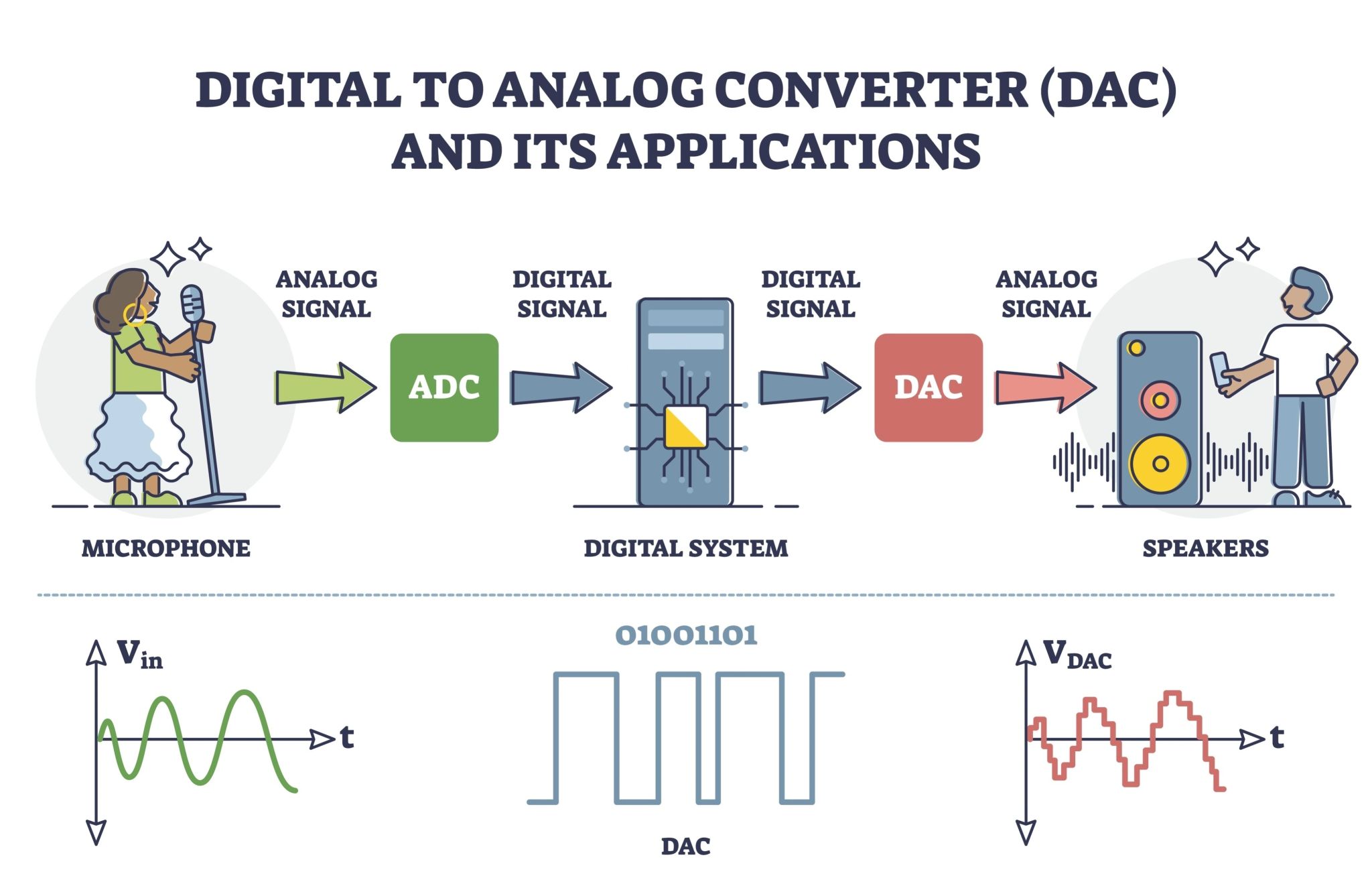
This “translator” is the Analog-to-Digital Converter (ADC). The ADC is a vital component in nearly every IoT system that interacts with the physical world. Its sole purpose is to convert a continuous analog signal into a discrete digital representation that a microcontroller can understand and process.
How an ADC Works (Simplified)
The process of analog-to-digital conversion involves two main steps:
- Sampling: The analog signal’s amplitude is measured at regular intervals. Imagine taking snapshots of the continuous waveform at fixed points in time. The frequency at which these snapshots are taken is called the sampling rate. A higher sampling rate captures more detail of the original analog signal.
- Quantization: Each sampled value is then converted into a discrete digital code (a binary number). Since the digital system has a finite number of possible values (determined by the ADC’s resolution, typically measured in bits), the analog value is rounded to the closest available digital step. For example, an 8-bit ADC can represent 28=256 distinct values. A 10-bit ADC offers 210=1024 values, providing finer resolution and less quantization error.
The output of the ADC is a stream of binary numbers, each representing the analog signal’s amplitude at a specific point in time. This digital stream can then be fed into the microcontroller for processing, analysis, storage, or transmission.
Importance of ADCs in IoT
- Data Acquisition: ADCs enable IoT devices to gather meaningful data from a wide array of analog sensors. Without them, most environmental monitoring, industrial automation, and smart agriculture applications would be impossible.
- Interoperability: They bridge the gap between the analog physical world and the digital computational world, making it possible for microcontrollers to interact with real-world phenomena.
- Noise Immunity: Once converted to digital, the signal benefits from the inherent noise resistance of digital data.
- Storage and Transmission: Digital data is far easier to store (in memory, databases, cloud) and transmit (over Wi-Fi, Bluetooth, cellular networks) without degradation compared to analog signals.
The Counterpart: DACs for Digital-to-Analog Conversion
While ADCs allow microcontrollers to understand the world, sometimes an IoT system needs to influence the physical world through an analog output. This is where the Digital-to-Analog Converter (DAC) comes into play. A DAC takes a digital signal (a stream of 0s and 1s) from a microcontroller and converts it back into a continuous analog voltage or current.
How a DAC Works (Simplified)
A DAC essentially reverses the ADC process. It takes a binary input and outputs a corresponding analog voltage or current level. For example, if a microcontroller sends the binary code 11111111 (for an 8-bit DAC), the DAC might output its maximum voltage (e.g., 5V). If it sends 00000000, it might output 0V. Intermediate binary codes would produce proportionally intermediate analog voltages.
The output waveform from a DAC is often a “stair-step” approximation of a smoother analog signal. The “steps” arise because the digital input is discrete. To achieve a smoother output, a low-pass filter is often used after the DAC to smooth out these steps and create a more continuous analog waveform.
Importance of DACs in IoT
While less common as direct sensor interfaces, DACs are crucial for many IoT applications that require analog control or output:
- Motor Speed Control: Controlling the speed of a DC motor with variable voltage, often driven by a Pulse Width Modulation (PWM) signal from a microcontroller which, when filtered, acts like a form of DAC.
- LED Brightness Control: While PWM is often used for this, true analog brightness control for specific lighting applications might use a DAC.
- Audio Output: In IoT devices that produce audio (e.g., smart speakers, alarm systems), DACs convert digital audio data into analog electrical signals that can drive speakers.
- Variable Voltage/Current Sources: In industrial control systems, DACs can be used to generate variable control voltages or currents for analog actuators or instrumentation.
- Precision Control: For applications requiring very fine and continuous control over a physical parameter (like hydraulic valve positioning), DACs provide the necessary analog drive signal.
In essence, ADCs allow the machine to listen to the world, and DACs allow the machine to speak back to the world in its own analog language.
The Interplay: A Complete IoT Signal Journey
To fully appreciate the significance of digital vs. analog, let’s trace the journey of a signal through a typical IoT system, from sensing a physical event to triggering an action.
Imagine an IoT smart agriculture system designed to monitor soil moisture and automatically water plants when levels drop too low.
- Analog Input (Sensing): A soil moisture sensor is placed in the ground. This sensor typically measures the electrical resistance of the soil, which changes continuously with moisture content. The sensor outputs a variable analog voltage (e.g., 0V to 3V), where a higher voltage might indicate drier soil and a lower voltage wetter soil. This is the “world speaking analog.”
- Analog-to-Digital Conversion (Translation): The analog voltage from the soil moisture sensor is fed into an ADC on an IoT microcontroller board (e.g., an ESP32). The ADC samples this continuous voltage at regular intervals and converts each sample into a binary number. For example, a voltage of 2.5V might be converted to
11111000(assuming an 8-bit ADC and specific scaling). - Digital Processing (Understanding and Decision-Making): The microcontroller receives this stream of digital data. It processes these binary numbers, comparing the current moisture level to predefined thresholds. If the digital value indicates that the soil moisture is below a critical threshold (i.e., too dry), the microcontroller makes a decision: “Initiate watering.” This is the “machine receiving and understanding digital.”
- Digital Output (Command): To initiate watering, the microcontroller sends a digital command to a relay module. This command is a simple HIGH or LOW signal on a GPIO pin. For example, a HIGH signal might turn the relay ON. This is the “machine speaking digital.”
- Digital-to-Analog Conversion (Optional/Implied for Actuation): If the watering system uses a variable-speed pump, the microcontroller might use a DAC (or PWM approximating a DAC) to control the pump’s speed. A digital value from the microcontroller tells the DAC to output a specific analog voltage, which in turn controls the pump’s motor speed. In a simpler system, the digital HIGH signal directly activates a solenoid valve (an ON/OFF digital action). This is the “machine translating digital back to analog to influence the world.”
- Analog Output (Actuation): The activated relay or variable-speed pump then directly influences the physical world by turning on the water pump. This is the “world reacting to the machine’s analog influence.”
This simplified example illustrates the constant dance between analog and digital signals in an IoT ecosystem. The efficiency and accuracy of each conversion and processing step are critical for the overall system’s effectiveness and reliability.
Advanced Considerations and Best Practices in IoT Signal Management
While the fundamental distinction between analog and digital signals is clear, real-world IoT deployments present a myriad of complexities that require a deeper understanding of signal management.
Sampling Rate and Resolution in ADCs
The quality of the digital representation from an ADC is determined by two key factors:
- Sampling Rate: How frequently the analog signal is measured. According to the Nyquist-Shannon sampling theorem, the sampling rate must be at least twice the highest frequency component of the analog signal to accurately reconstruct it without losing information. If the sampling rate is too low, aliasing can occur, leading to a distorted digital representation. In IoT, determining the appropriate sampling rate is crucial for capturing dynamic events without oversampling, which wastes processing power and storage.
- Resolution: The number of bits the ADC uses to represent each sampled value. A higher bit resolution (e.g., 12-bit, 16-bit, 24-bit) means more discrete steps are available to represent the analog range, resulting in finer distinctions and less quantization error. For example, a 10-bit ADC dividing a 5V range provides 5V/1024≈4.88mV per step, while a 12-bit ADC provides 5V/4096≈1.22mV per step, offering four times the precision. The choice of resolution depends on the required accuracy of the IoT application.
Noise Reduction Techniques
Given the susceptibility of analog signals to noise, implementing effective noise reduction techniques is critical for robust IoT systems:
- Shielding: Using shielded cables for analog signal lines helps prevent electromagnetic interference from coupling into the signal.
- Grounding: Proper grounding techniques are essential to minimize ground loops and common-mode noise.
- Filtering: Low-pass filters are frequently used to remove high-frequency noise components from analog signals before they reach the ADC. On the digital side, digital filters can be applied in software to smooth out noisy data.
- Averaging: Taking multiple samples of an analog signal and averaging them can help reduce random noise. This is a common technique in sensor readings.
- Differential Signaling: For critical analog measurements, using differential inputs where the signal is transmitted as a difference between two lines, rather than as a single signal referenced to ground, can significantly improve noise immunity.
- Close Proximity: Locating the ADC as close as possible to the analog sensor minimizes the length of the analog signal path, reducing the chances of noise pick-up.
Power Management and Signal Integrity
Power supply quality plays a significant role in signal integrity, especially for analog components. Noisy power supplies can introduce ripples and fluctuations that translate directly into noise on analog signals.
- Clean Power Supplies: Using stable, low-noise power regulators and proper decoupling capacitors near sensitive analog components (like ADCs and sensors) is crucial.
- Separate Power Planes: In complex IoT PCBs, sometimes separate power planes are used for analog and digital circuitry to prevent digital switching noise from contaminating analog power supplies.
Security Implications
While perhaps not immediately obvious, the nature of signals can have security implications. Analog signals, by being continuous, can sometimes be more vulnerable to “eavesdropping” if not properly protected, as subtle changes can be detected. Digital signals, especially when encrypted, offer robust security mechanisms during transmission. Secure communication protocols built on digital data are paramount for IoT device security, protecting sensitive sensor data and ensuring the integrity of control commands.
Future Trends: Analog Computing and Edge AI
While the world primarily moves towards digital processing, there’s a growing interest in analog computing for specific edge AI applications. Analog computers can process certain types of data (like neural network calculations) directly in the analog domain, potentially offering significant power efficiency and speed advantages for tasks like inference at the edge. This doesn’t negate the digital revolution but rather explores specialized niches where the continuous nature of analog can be leveraged effectively without extensive analog-digital conversions.
Another significant trend is Edge AI, where processing is brought closer to the data source. This often involves microcontrollers with more powerful built-in ADCs and specialized low-power AI accelerators that can process digital sensor data locally, reducing the need to send all raw data to the cloud. This trend further emphasizes the importance of efficient and accurate analog-to-digital conversion at the device level.
Conclusion: The Unseen Foundation of the IoT Revolution
The seemingly simple distinction between analog and digital signals forms the unseen, yet utterly critical, foundation upon which the entire Internet of Things paradigm is built. From a tiny temperature sensor quietly reporting the ambient conditions in a smart building to a complex industrial robot executing precise movements based on machine vision, the journey of information invariably begins with the conversion of the analog physical world into the digital language of machines.
Understanding this dynamic interplay is not just a technicality; it’s a fundamental prerequisite for anyone involved in designing, developing, deploying, or managing IoT solutions. It dictates how accurately we perceive our environment, how reliably our devices communicate, and how effectively we can automate and control physical processes. The judicious selection of sensors, the careful implementation of ADCs and DACs, the rigorous application of noise reduction techniques, and a keen awareness of sampling rates and resolutions are all critical engineering considerations that stem directly from this foundational knowledge.
As IoT continues its inexorable expansion, permeating every facet of our lives and industries, the mastery of signal fundamentals will remain paramount. It empowers engineers to build more robust, efficient, and intelligent systems capable of truly transforming raw data into actionable insights, making the promise of a smarter, more connected world a tangible reality. The world speaks analog, and machines understand digital – mastering this translation is the key to unlocking the full potential of limitless connectivity.
Unlock Your IoT Potential with IoT Worlds
Are you ready to transform your ideas into innovative IoT solutions? At IoT Worlds, we specialize in providing the expertise, tools, and strategies to navigate the complexities of the Internet of Things, from fundamental signal processing to advanced deployment. Whether you’re grappling with sensor integration, optimizing data flow, or developing robust cloud platforms, our team of seasoned professionals is here to guide you every step of the way.
Don’t let the intricacies of digital and analog signals or any other IoT challenge hinder your progress.
Contact us today to explore how we can help you build, optimize, and scale your next-generation IoT projects.
Send an email to info@iotworlds.com and let’s start a conversation about your IoT aspirations!
