

The Internet of Things (IoT) has rapidly transformed from a futuristic concept into an integral part of our daily lives and industrial operations. From smart homes and wearable fitness trackers to intelligent factories and interconnected cities, IoT devices are constantly gathering data, communicating with each other, and automating processes. While the visible aspects of IoT—the sleek devices, the intuitive apps, and the vast cloud platforms—often capture our attention, the true “superpower” behind this revolution lies within the intricate world of embedded systems.
Embedded systems are the unassuming heroes of the IoT, working tirelessly behind the scenes to make every “smart” thing truly intelligent. These specialized computing units, seamlessly integrating hardware and software, are the bedrock upon which the entire IoT ecosystem is built. Without them, the raw signals from sensors would remain mere electrical pulses, and the promise of real-time insights and automated actions would be an unfulfilled dream.
This comprehensive article delves deep into the pivotal role of embedded systems in the IoT, exploring their core functionalities, the critical factors influencing their design, and the transformative impact of emerging technologies like Low-Power Wide-Area Networks (LPWAN). We will uncover why, when it comes to IoT, the optimal results are born from designing an end-to-end system where every component, from power budget to firmware, security to connectivity, and maintainability, is meticulously considered from the outset.
The Unseen Engine: What Exactly Are Embedded Systems?
At its heart, an embedded system is a computer system with a dedicated function within a larger mechanical or electrical system, often with real-time computing constraints. Unlike general-purpose computers, which are designed to perform a wide variety of tasks, embedded systems are engineered for specific functions, optimizing for factors like cost, power consumption, size, and reliability.
In the context of IoT, embedded systems are the intelligent core of connected devices. They are responsible for:
- Sensing and Actuation: Interfacing with the physical world through sensors to gather data (temperature, pressure, motion, light, etc.) and through actuators to initiate actions (turning lights on/off, adjusting thermostats, controlling machinery).
- Local Processing and Decision-Making: Performing computations, filtering data, and making real-time decisions at the edge, reducing reliance on constant cloud connectivity and minimizing latency.
- Communication: Enabling devices to connect and communicate with other devices, gateways, and cloud platforms using various wired and wireless protocols.
- Security: Implementing mechanisms to protect data and devices from unauthorized access and cyber threats.
- Power Management: Optimizing energy consumption, especially for battery-powered devices, to maximize operational lifespan.
The magic of an embedded system in IoT truly unfolds where hardware meets firmware. This synergistic combination is where raw sensory input transcends its basic form, transforming into actionable intelligence that drives reliable outcomes in the field.
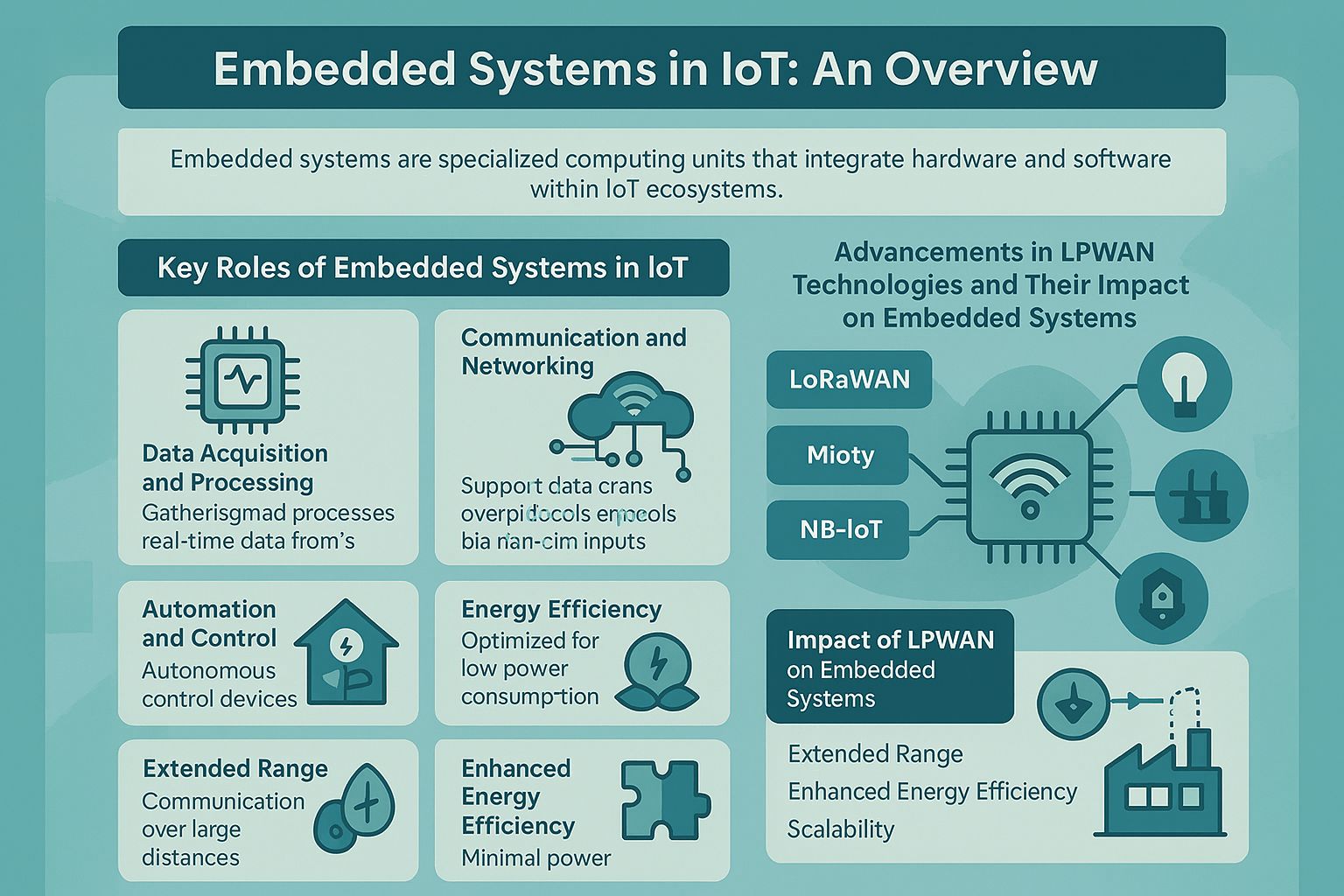
Key Roles of Embedded Systems in IoT
The influence of embedded systems permeates every layer of an IoT solution, underpinning its functionality and determining its overall effectiveness. Let’s explore the critical roles they play:
Data Acquisition and Processing: Making Sense of the World
The fundamental purpose of many IoT devices is to gather data from the physical environment. Embedded systems are the primary orchestrators of this process. They interface directly with a multitude of sensors, converting analog signals into digital data that can be understood and processed.
Real-Time Decisions at the Edge
One of the most significant advantages offered by embedded systems is their ability to perform data acquisition and processing at the “edge” – directly on the device itself, or at a nearby gateway, rather than sending all raw data to the cloud for analysis. This paradigm shift offers several compelling benefits:
- Reduced Latency: Critical decisions can be made almost instantaneously, without the delays associated with transmitting data to the cloud and waiting for a response. This is crucial for applications requiring immediate action, such as industrial control systems, autonomous vehicles, and medical devices.
- Optimized Bandwidth Usage: Instead of flooding the network with raw, often redundant, data, embedded systems can preprocess, filter, and aggregate information, sending only relevant insights to the cloud. This significantly reduces bandwidth requirements and associated costs.
- Enhanced Privacy and Security: Sensitive data can be processed and analyzed locally, minimizing the exposure of raw information during transmission to the cloud. This is particularly important for applications handling personal or proprietary data.
- Improved Reliability: Edge processing allows devices to continue functioning and making critical decisions even when cloud connectivity is intermittent or unavailable, ensuring operational continuity.
The sophistication of embedded processors and the efficiency of embedded software are key determinants of how effectively an IoT device can gather, analyze, and act upon data in real-time.
Communication and Networking: Connecting the Dots
An IoT device, by definition, must be able to communicate. Embedded systems are equipped with the communication modules and protocols necessary to facilitate this connectivity, forming the intricate web that defines the Internet of Things.
Choosing the Right Pipe and Protocol
The choice of communication technology and protocol is a critical design decision for any IoT solution, directly impacting power consumption, range, data throughput, and cost. Embedded systems must be designed to support a variety of communication standards to suit different application requirements. These include:
- Short-Range Wireless:
- Bluetooth/Bluetooth Low Energy (BLE): Ideal for personal area networks (PANs) and applications requiring moderate data rates over short distances, such as wearables, smart home devices, and asset tracking within a limited area. BLE is particularly optimized for low power consumption.
- Wi-Fi: Suitable for applications requiring higher data throughput and existing infrastructure, like smart home hubs, security cameras, and industrial gateways within local area networks (LANs).
- Zigbee/Z-Wave: Popular for smart home automation, offering mesh networking capabilities for increased range and reliability, and designed for low power consumption.
- Long-Range Wireless:
- Cellular (2G/3G/4G/5G): Provides wide area coverage, suitable for geographically dispersed devices that require reliable data transmission. 5G, with its low latency and high bandwidth, is opening up new possibilities for critical IoT applications.
- Low-Power Wide-Area Networks (LPWAN): Designed for applications that require long-range communication, low power consumption, and often small data packets. This category includes technologies like LoRaWAN, mioty, and NB-IoT, which we will explore in detail later.
- Wired Connections:
- Ethernet: Provides high bandwidth and reliable communication for static devices or industrial applications where robustness and speed are paramount, and power consumption is less of a concern.
- Serial Protocols (e.g., I2C, SPI, UART): Used for intra-device communication between different components within the embedded system itself.
The embedded system’s firmware manages the entire communication stack, from the physical layer (radio frequency modulation, antenna control) to the application layer (data packets, protocols). The efficiency and robustness of this communication layer are vital for maintaining continuous connectivity and ensuring data integrity across the IoT ecosystem.
Automation and Control: From Insights to Actions
The ultimate goal of many IoT deployments is to automate processes and enable intelligent control. Embedded systems are the crucial link that translates data insights into tangible actions in the physical world.
Closed-Loop Operations
When an embedded system acquires data, processes it, and then uses that information to control an actuator, it forms a “closed-loop” operation. This means the system can autonomously monitor a situation, make decisions, and implement changes without human intervention. Examples include:
- Smart Thermostats: Sensors detect room temperature, the embedded system processes this data, and then controls the HVAC system to maintain a desired temperature.
- Industrial Automation: Embedded systems in machinery monitor operational parameters, identify anomalies, and trigger corrective actions or alerts to prevent failures.
- Smart Lighting Systems: Light sensors detect ambient light levels, and the embedded system adjusts the brightness of lights accordingly, or motion sensors trigger lights to turn on/off based on occupancy.
- Automated Irrigation: Soil moisture sensors inform the embedded system, which then controls irrigation valves to optimize water usage.
The reliability and responsiveness of embedded systems in these control applications are paramount. Any delays or inaccuracies can have significant consequences, especially in critical infrastructure or industrial settings. Therefore, embedded software development for automation and control demands rigorous testing and adherence to real-time operating system (RTOS) principles to ensure deterministic behavior.
Energy Efficiency: Battery Life as a Product Feature
For a vast percentage of IoT devices, particularly those deployed in remote locations, wearables, or smart home environments, power consumption is not just a technical specification; it’s a fundamental product feature. No matter how advanced a device is, if its battery dies quickly, its utility is severely compromised. Embedded systems are at the forefront of the battle for energy efficiency.
Optimizing for Low Power Consumption
Embedded system designers employ a multifaceted approach to maximize battery life:
- Low-Power Microcontrollers (MCUs): Selecting MCUs specifically designed for low power consumption, often featuring multiple power modes (sleep, deep sleep, hibernate) that allow the processor to conserve energy when not actively processing.
- Efficient Firmware Design: Writing highly optimized code that minimizes CPU cycles, avoids unnecessary operations, and leverages power-saving features of the hardware. This includes intelligent scheduling of tasks, efficient data processing algorithms, and minimizing wake-up times.
- Duty Cycling: A common technique where devices spend most of their time in a low-power sleep state and “wake up” periodically to collect data, transmit, or perform tasks. The frequency and duration of these active periods are carefully managed to balance data freshness with battery life.
- Component Selection: Choosing other components (sensors, communication modules, memory) that also exhibit low power characteristics.
- Power Management Integrated Circuits (PMICs): Specialized chips that efficiently regulate and distribute power to different components of the embedded system, further reducing energy waste.
- Energy Harvesting: While not always feasible, some advanced embedded systems integrate energy harvesting techniques (e.g., solar, kinetic, thermal) to extend battery life or even operate battery-free.
The relentless pursuit of energy efficiency in embedded systems is what allows for the widespread deployment of IoT devices in environments where frequent battery replacement is impractical or impossible, unlocking new applications and business models.
Range and Scalability: Expanding the IoT Frontier
The ambition of IoT is to connect billions of devices across vast geographical areas. This necessitates embedded systems capable of supporting communication over extended ranges and designed for inherent scalability.
The challenge lies in balancing range with other factors like power consumption, data rate, and cost. Traditional short-range wireless technologies (like Wi-Fi or Bluetooth) are excellent for local area networks but fall short when devices are spread across a city, a farm, or a factory campus without extensive gateway infrastructure. This is where Low-Power Wide-Area Networks (LPWAN) technologies emerge as critical enablers.
LPWAN Shines
LPWAN technologies are specifically engineered to provide long-range communication for devices that transmit small amounts of data infrequently, all while consuming very little power. This makes them ideal for a wide array of IoT applications, from smart agriculture and utility metering to asset tracking and environmental monitoring.
Several prominent LPWAN technologies are vying for market dominance, each with its unique strengths and optimal use cases:
- LoRaWAN (Long Range Wide Area Network):
- Technology: An open standard based on LoRa (Long Range) modulation, which uses a spread spectrum technique to achieve long range with low power.
- Characteristics: Non-cellular, operates in unlicensed spectrum, offers excellent penetration through obstacles, and supports both star and mesh-like topologies through gateways.
- Use Cases: Smart cities (parking, waste management), smart agriculture (soil monitoring, livestock tracking), industrial IoT (asset tracking, equipment monitoring), utility metering.
- Advantages: Low cost, long battery life (up to 10+ years), deep indoor penetration, extensive ecosystem.
- Considerations: Lower data rates, potential for interference in unlicensed bands.
- mioty alliance:
- Technology: Based on the Telegram Splitting Multiple Access (TSMA) protocol, mioty focuses on robustness and massive scalability. It transmits data packets in redundant sub-packets across different frequencies and times, making it highly resilient to interference.
- Characteristics: Non-cellular, operates in unlicensed sub-GHz bands, offers extreme robustness and very high scalability.
- Use Cases: Industrial IoT (critical asset monitoring in harsh environments), logistics, smart utilities.
- Advantages: Superior interference immunity, high scalability (millions of devices per gateway), low power consumption, long range.
- Considerations: Newer technology, ecosystem still developing compared to LoRaWAN.
- NB-IoT (Narrowband Internet of Things):
- Technology: A cellular-based LPWAN technology standardized by 3GPP, operating within existing LTE networks (in-band, guard-band, or standalone).
- Characteristics: Cellular, operates in licensed spectrum, leverages existing mobile network infrastructure, offering carrier-grade security and reliability.
- Use Cases: Smart metering, smart agriculture, asset tracking, smart cities (street lighting, environmental sensors), requiring reliable, wide-area coverage.
- Advantages: High reliability, robust security (cellular grade), global standard, leverages established cellular networks.
- Considerations: Higher module costs than non-cellular LPWAN, potential for higher power consumption than LoRaWAN/mioty for certain applications, depends on operator rollout.
The integration of these LPWAN technologies into embedded systems expands the reach of IoT exponentially. Embedded developers must carefully evaluate the unique requirements of each IoT solution—considering factors like coverage needs, total cost of ownership, regulatory environments, and data throughput—to determine the most appropriate LPWAN technology to incorporate. The choice directly impacts the embedded system’s design, from the communication module to the power management strategy.
Designing for Success: The End-to-End Approach
Building truly effective and scalable IoT solutions demands more than just stitching together off-the-shelf components. The best results consistently emerge from an end-to-end design philosophy, where the entire system is conceptualized and engineered holistically. This means deeply considering every facet of the embedded system from the initial ideation phase, rather than treating them as isolated concerns.
Power Budget: The Foundation of Longevity
Before a single line of code is written or a circuit board is designed, a meticulous power budget analysis is indispensable. This critically informs component selection, firmware architecture, and overall system design.
- Understanding Consumption: Accurately estimate the power consumption of every component (MCU, sensors, communication module) in different operational states (active, sleep, transmit, receive).
- Battery Sizing: Based on the power budget and desired operational lifespan, determine the appropriate battery capacity and chemistry.
- Energy Harvesting Strategy: If applicable, design in energy harvesting mechanisms (e.g., solar panels, thermoelectric generators) and corresponding power management circuits.
- Firmware Optimization: Develop firmware with a strong emphasis on power states, duty cycling, and efficient task scheduling to minimize energy draw.
A well-defined power budget ensures that the device can operate reliably for its intended duration without requiring frequent, costly, or difficult battery replacements.
Firmware: The Brains of the Operation
The firmware is the embedded system’s operating intelligence, bridging the gap between hardware and high-level applications. Its design is paramount to the device’s functionality, efficiency, and robustness.
- Real-Time Operating Systems (RTOS): For complex applications requiring deterministic timing and multitasking, an RTOS can provide the necessary framework for managing resources, scheduling tasks, and ensuring responsiveness.
- Robustness and Reliability: Firmware must be designed to handle unexpected events, sensor failures, communication dropouts, and power fluctuations gracefully. Error handling, watchdog timers, and robust boot-up sequences are essential.
- OTA Updates: Over-The-Air (OTA) firmware updates are critical for long-term device maintenance, allowing bug fixes, security patches, and feature enhancements to be deployed remotely. This requires secure bootloaders and efficient update mechanisms.
- Memory Management: Given the often-constrained memory resources of embedded systems, efficient memory allocation and management are crucial to prevent crashes and ensure stable operation.
- Protocol Implementation: Implementing the chosen communication protocols and security layers efficiently within the firmware is key to seamless connectivity and data protection.
High-quality firmware is the difference between a functional device and a truly reliable and intelligent IoT solution.
Security: Protecting the Edge
In a world of increasing cyber threats, security in IoT is non-negotiable. Embedded systems, as the edge nodes of the network, are often the first line of defense and present significant vulnerabilities if not properly secured.
- Hardware-Level Security: Incorporating hardware security modules (HSMs) or Trusted Platform Modules (TPMs) to provide secure key storage, cryptographic operations, and hardware-rooted trust.
- Secure Boot: Ensuring that only authenticated and authorized firmware can run on the device, preventing malicious code injection.
- Encryption and Authentication: Implementing strong encryption protocols (e.g., TLS/SSL) for all data in transit and at rest, along with robust authentication mechanisms to verify the identity of devices and users.
- Access Control: Restricting access to device functions and data based on roles and permissions.
- Vulnerability Management: Designing embedded systems with mechanisms for regular security patching and updates to address newly discovered vulnerabilities.
- Physical Security: Considering physical tamper detection and resistance, especially for devices deployed in public or accessible locations.
A breach at the embedded system level can compromise the entire IoT ecosystem, making a “security-by-design” approach absolutely critical.
Connectivity: Reliable Pathways for Data
While already discussed under communication, the holistic view of connectivity extends beyond merely supporting a protocol. It encompasses the entire journey of data from sensor to cloud and back.
- Network Resilience: Designing for situations where primary connectivity might fail, incorporating fallback mechanisms (e.g., switching from Wi-Fi to cellular LPWAN).
- Gateway Design: If gateways are part of the architecture, optimizing their placement, processing capabilities, and connectivity options to embedded devices and the cloud.
- Scalable Integration: Ensuring that the chosen connectivity solutions can scale efficiently as the number of devices grows, without leading to network congestion or management overhead.
- Remote Management: Implementing capabilities for remote monitoring, diagnosis, and configuration of connectivity modules within embedded devices.
Reliable, scalable, and secure connectivity is the lifeblood of any IoT solution, enabling the continuous flow of data and commands that drive intelligence.
Maintainability: Ensuring Long-Term Viability
IoT solutions are designed for long lifespans, often measured in years or even decades. Therefore, the maintainability of embedded systems is a crucial design consideration that impacts the total cost of ownership and the longevity of the deployment.
- Remote Diagnostics: Building in capabilities for remote monitoring of device health, performance metrics, and error logs, allowing for proactive maintenance and troubleshooting.
- Remote Configuration: The ability to remotely configure device parameters, sensor thresholds, or operational modes streamlines management and reduces the need for costly field visits.
- Modular Hardware Design: Using modular components can simplify repairs and upgrades, allowing for easier replacement of faulty parts or integration of new functionalities.
- Well-Documented Code and Hardware: Comprehensive documentation is essential for future development, troubleshooting, and handover to new teams.
- Standardization: Adhering to industry standards and best practices for both hardware and software can improve interoperability and simplify maintenance.
- Testability: Designing embedded systems with built-in test points and diagnostic modes facilitates efficient debugging and quality assurance throughout the product lifecycle.
A maintainable embedded system reduces operational costs, extends the useful life of IoT deployments, and ensures that the solution remains relevant and effective over time.
The Future of Embedded Systems in IoT
As the IoT continues its exponential growth, so too will the demands and capabilities of embedded systems. Several trends are shaping their evolution:
- Edge AI and Machine Learning: More embedded systems will incorporate AI and ML capabilities, enabling more sophisticated local data analysis, anomaly detection, predictive maintenance, and autonomous decision-making without always relying on the cloud.
- Enhanced Security Frameworks: With increasing cyber threats, next-generation embedded systems will feature even more robust hardware-rooted security, advanced encryption, and proactive threat detection capabilities.
- Greater Integration of Sensors and Actuators: Miniaturization and advanced integration techniques will lead to highly sophisticated System-on-Chips (SoCs) that combine processing, communication, and multiple sensor/actuator interfaces onto a single chip.
- Self-Healing and Autonomous Systems: Embedded systems will become more capable of self-diagnosis, self-correction, and autonomous recovery from various failures, reducing the need for manual intervention.
- Energy Neutrality: The push for extreme energy efficiency will lead to more devices operating solely on harvested energy, further reducing environmental impact and operational costs.
- Quantum-Resistant Cryptography: As quantum computing advances, embedded systems will need to adopt new cryptographic methods resistant to quantum attacks to ensure long-term data security.
These advancements will further solidify the role of embedded systems as the critical enabler for increasingly intelligent, autonomous, and secure IoT solutions across all sectors.
Conclusion: The Quiet Superpower Unveiled
Embedded systems are, without a doubt, the quiet superpower behind every “smart” thing we deploy in IoT. They are the intricate blend of hardware and firmware that transforms raw sensory data into actionable intelligence, enabling real-time decisions at the edge, fostering seamless communication, driving automation, optimizing energy consumption, and expanding reach through scalable networking.
The journey from a simple sensor reading to a valuable business outcome is meticulously orchestrated by these specialized computing units. They are the unsung heroes that gather and process data, choose the right communication “pipe” and protocol, convert insights into closed-loop operations, ensure battery life is a feature, not an afterthought, and provide the range and scalability required for truly widespread IoT adoption.
For any organization embarking on an IoT initiative, the message is clear: success hinges on an end-to-end design approach. Meticulously considering the power budget, crafting robust firmware, implementing ironclad security, ensuring reliable connectivity, and prioritizing maintainability from the very beginning will yield not just functional devices, but truly resilient, scalable, and economically viable IoT solutions.
Whether you’re exploring the potential of LoRaWAN for smart city applications, leveraging mioty for mission-critical industrial monitoring, or relying on NB-IoT for broad-area utility management, the underlying strength of your solution will come from the intelligence and efficiency of its embedded systems.
Ready to unlock the full potential of embedded systems for your next IoT innovation?
At IoT Worlds, we specialize in designing, developing, and deploying robust, secure, and scalable IoT solutions, with a keen focus on the embedded systems that power them. Our expertise spans hardware design, firmware development, LPWAN integration, security architecture, and end-to-end system optimization.
Don’t leave the intelligence of your IoT devices to chance. Contact our experts today to discuss your project and discover how our tailored solutions can help you achieve your goals.
Email us at info@iotworlds.com to start the conversation.
