

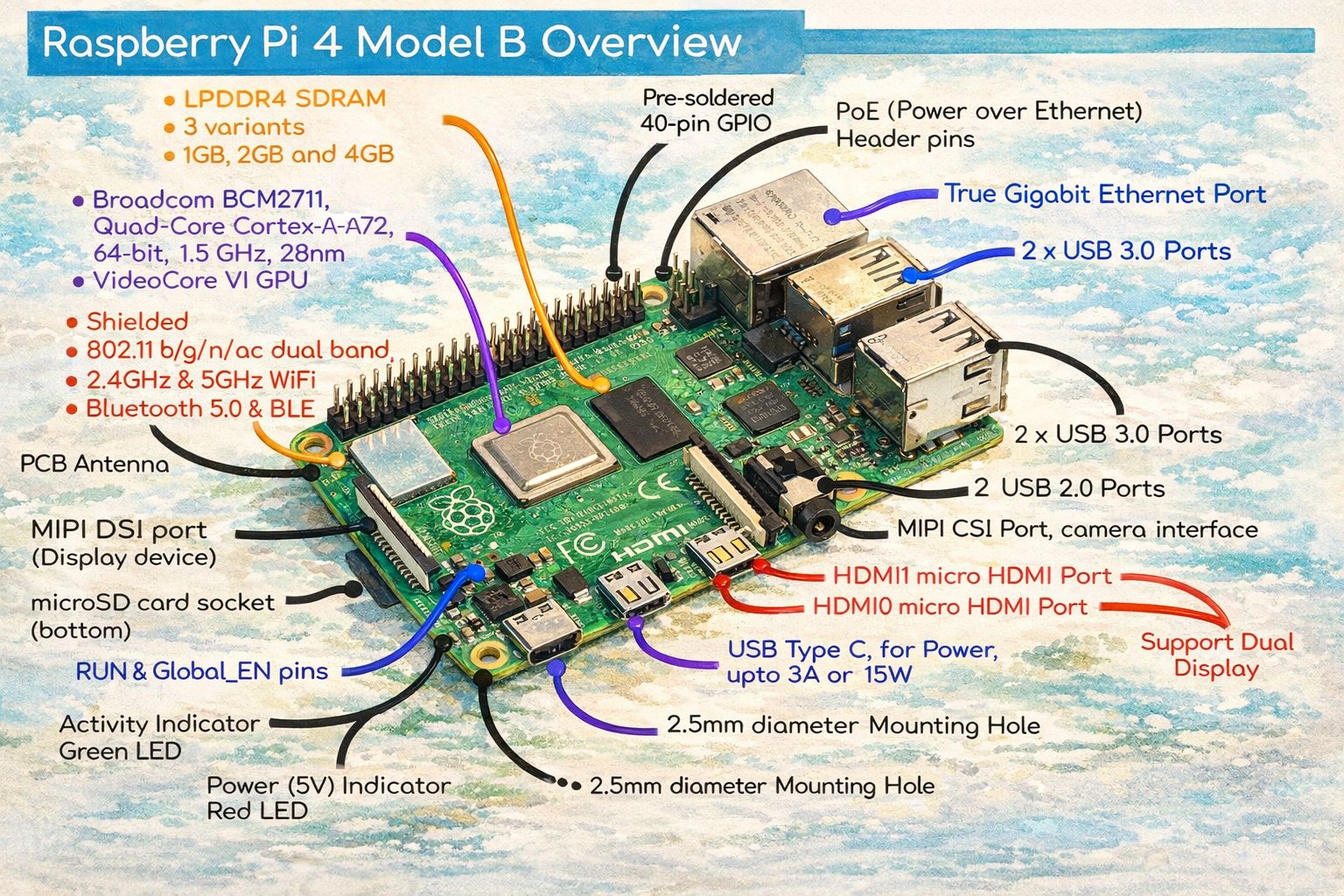
In an era defined by rapid technological advancement, the Raspberry Pi 4 Model B stands out as a beacon of innovation, democratizing access to powerful computing for hobbyists, educators, and professional developers alike. This tiny single-board computer (SBC) transcends its humble dimensions, offering desktop-level capabilities that unlock a universe of project potential. From orchestrating complex IoT ecosystems to pioneering advancements in AI and robotics, the Raspberry Pi 4 Model B is not just a piece of hardware; it’s a launchpad for dreams.
The Heart of the Innovation: Understanding the Core Architecture
At the core of the Raspberry Pi 4 Model B’s remarkable performance lies a meticulously engineered architecture, each component playing a vital role in its ability to power innovation across diverse applications. Much like the intricate gears of a finely crafted clockwork mechanism, these elements work in concert to deliver a seamless and powerful computing experience.
The Powerhouse Processor: Broadcom BCM2711
The beating heart of the Raspberry Pi 4 Model B is the Broadcom BCM2711, a Quad-Core Cortex-A72 (64-bit) processor clocked at an impressive 1.5 GHz. This isn’t just a minor upgrade; it’s a significant leap forward in processing power compared to its predecessors.
The Cortex-A72 architecture brings several key advantages to the table. Firstly, its 64-bit capability allows for more efficient handling of larger datasets and complex computations, which is crucial for modern operating systems and demanding applications. This translates to snappier multitasking, faster application loading, and a generally more responsive user experience.
Secondly, the quad-core design means that the processor can handle multiple tasks simultaneously, significantly improving performance in scenarios where parallel processing is beneficial. Imagine running a web server, a machine learning model, and a custom sensor reading script all at once – the BCM2711 handles such workloads with remarkable efficiency. This makes the Raspberry Pi 4 Model B an ideal candidate for edge computing, where real-time data processing and decision-making are paramount.
The 1.5 GHz clock speed, while seemingly modest compared to high-end desktop CPUs, is perfectly optimized for the Raspberry Pi’s ecosystem and power consumption profile. It strikes a superb balance between raw processing power and energy efficiency, allowing the board to run cool and reliably even under sustained load. The 28nm manufacturing process further contributes to this efficiency, ensuring that the powerful processor doesn’t become a power hog.
Visual Brilliance: The VideoCore VI GPU
Complementing the powerful CPU is the VideoCore VI GPU. Graphics processing is often overlooked in SBCs, but its importance cannot be overstated, especially in applications involving user interfaces, multimedia, and even certain types of parallel computation.
The VideoCore VI GPU provides a significant boost in graphics performance, enabling support for dual micro-HDMI outputs with resolutions up to 4Kp60. This means you can drive two 4K displays simultaneously, transforming the tiny Raspberry Pi into a capable desktop replacement or a powerful multimedia center. Imagine using it for digital signage, multi-monitor productivity setups, or immersive gaming experiences.
Beyond display output, the GPU also accelerates video encoding and decoding, making the Raspberry Pi 4 Model B perfect for streaming high-definition content, processing video feeds from cameras (e.g., for security systems or robotics), and even light video editing tasks. For developers working on embedded systems with graphical user interfaces, the VideoCore VI GPU ensures a smooth and responsive experience, making the development and deployment process much more efficient.
The synergy between the Broadcom BCM2711 CPU and the VideoCore VI GPU is what truly elevates the Raspberry Pi 4 Model B from a simple development board to a versatile computing platform capable of handling a wide array of tasks. Together, they form a formidable pair, ready to tackle challenges from basic programming to advanced AI inference.
Memory and Connectivity: The Unseen Forces
While the processor and GPU are the visible engines of performance, the memory and connectivity options are the unseen forces that enable the Raspberry Pi 4 Model B to truly shine. These elements dictate how efficiently data is accessed, how the board communicates with the outside world, and ultimately, the scope and ambition of projects it can undertake.
Lightning-Fast Memory: LPDDR4 SDRAM
The Raspberry Pi 4 Model B features LPDDR4 SDRAM, a significant upgrade from the DDR2 and DDR3 variants found in previous models. LPDDR4 stands for Low Power Double Data Rate 4 Synchronous Dynamic Random-Access Memory. The “Low Power” aspect is crucial for an SBC, ensuring that the memory consumes minimal energy while still delivering high performance.
The memory comes in three variants: 1GB, 2GB, and 4GB. The choice of RAM directly impacts the board’s multitasking capabilities and the complexity of applications it can run.
- 1GB Variant: Ideal for lighter applications, embedded systems, and basic IoT projects where resource consumption is minimal. This variant is perfect for dedicated tasks that don’t require extensive memory.
- 2GB Variant: A good all-rounder, suitable for a wide range of projects, including educational use, modest server applications, and more complex IoT deployments.
- 4GB Variant: The most powerful option, enabling the Raspberry Pi 4 Model B to truly function as a desktop replacement. It’s perfect for web browsing with many tabs open, running virtual machines, developing large-scale software, and handling demanding AI workloads.
The speed of LPDDR4 RAM is also a critical factor. Faster memory allows the CPU and GPU to access data more quickly, reducing bottlenecks and improving overall system responsiveness. This is particularly noticeable in data-intensive applications such as image processing, video analysis, and machine learning inference, where rapid data transfer is essential.
Wireless Freedom: Dual-Band WiFi and Bluetooth 5.0
In today’s interconnected world, robust wireless connectivity is no longer a luxury but a necessity. The Raspberry Pi 4 Model B rises to the occasion with an integrated 802.11 b/g/n/ac dual-band Wi-Fi (2.4GHz and 5GHz) and Bluetooth 5.0 with BLE (Bluetooth Low Energy).
The dual-band Wi-Fi offers significant advantages:
- 2.4GHz Band: Provides wider coverage and better penetration through obstacles, ideal for applications where range is more important than raw speed.
- 5GHz Band: Offers faster data transfer rates and less interference from other devices, perfect for high-bandwidth applications like video streaming, large file transfers, and real-time data acquisition.
The inclusion of 802.11ac, also known as Wi-Fi 5, ensures modern wireless performance, allowing the Raspberry Pi to seamlessly integrate into contemporary network environments. The Wi-Fi module is also shielded, which helps to reduce electromagnetic interference and improve signal integrity, leading to a more reliable wireless connection.
Bluetooth 5.0 is another significant upgrade. It offers increased speed, greater range, and higher bandwidth compared to older Bluetooth versions. BLE (Bluetooth Low Energy) is particularly important for IoT devices, as it allows for extremely low-power communication with sensors, smart wearables, and other compatible devices. This significantly extends battery life in portable projects and enables new possibilities for data collection in energy-constrained environments.
From controlling smart home devices to building custom wireless sensor networks, the Raspberry Pi 4 Model B’s advanced wireless capabilities provide the flexibility and performance needed for a vast array of interconnected projects.
Wired Reliability: True Gigabit Ethernet
For applications requiring stable, high-speed wired network connectivity, the Raspberry Pi 4 Model B features a True Gigabit Ethernet port. While wireless is convenient, wired connections offer unparalleled reliability, lower latency, and consistent bandwidth, which are crucial for certain industrial, server, and networking applications.
“True Gigabit Ethernet” means the port is directly connected to the SoC (System on Chip) via a dedicated PCIe lane, rather than through a shared USB bridge, as was the case in some previous models. This direct connection ensures maximum throughput, preventing bottlenecks and allowing the Raspberry Pi to achieve actual gigabit speeds.
This makes the Raspberry Pi 4 Model B an excellent choice for:
- Network Attached Storage (NAS): Creating a powerful, energy-efficient home or small office NAS.
- Routers/Firewalls: Building custom network appliances for enhanced security and control.
- Industrial Automation: Ensuring reliable data transfer in mission-critical systems.
- Server Applications: Hosting websites, databases, or game servers where consistent performance is key.
The combination of advanced wireless and true wired networking options gives the Raspberry Pi 4 Model B unparalleled flexibility in how it connects to and interacts with the digital world, making it a truly versatile platform for any project requiring robust communication.
Expanding Horizons: Ports, Peripherals, and Power
Beyond its core processing and memory capabilities, the Raspberry Pi 4 Model B is designed with an extensive array of ports and peripheral interfaces that dramatically expand its functionality and applicability. These connectors are the gateways through which the tiny board communicates with displays, external storage, cameras, custom hardware, and the myriad of components that bring projects to life.
Versatile Data Transfer: USB 3.0 and USB 2.0
The Raspberry Pi 4 Model B significantly enhances its peripheral connectivity by offering both USB 3.0 and USB 2.0 ports. Specifically, it features two USB 3.0 ports and two USB 2.0 ports.
USB 3.0 Ports
The inclusion of USB 3.0 is a major upgrade. USB 3.0, also known as SuperSpeed USB, offers theoretical data transfer rates of up to 5 gigabits per second (Gbps), which is approximately ten times faster than USB 2.0. This speed is crucial for:
- External Storage: Connecting SSDs (Solid State Drives) or high-speed external hard drives for faster data storage and retrieval. This dramatically improves the performance of applications that rely heavily on disk I/O, such as databases, media servers, or operating systems booting from USB.
- High-Bandwidth Peripherals: Interfacing with devices like high-resolution webcams, capture cards, or specialized industrial sensors that require rapid data streaming.
- Network Adapters: Using USB 3.0 to Gigabit Ethernet adapters to add additional network interfaces with high throughput if needed.
The two USB 3.0 ports provide ample connectivity for demanding peripherals, enabling the Raspberry Pi 4 Model B to handle tasks that were previously bottlenecked by slower USB 2.0 speeds.
USB 2.0 Ports
The two USB 2.0 ports (High-Speed USB) still serve a vital role. With a theoretical maximum transfer rate of 480 megabits per second (Mbps), they are perfectly adequate for:
- Input Devices: Connecting keyboards, mice, and other human interface devices.
- Low-Bandwidth Peripherals: Interfacing with standard USB drives, printers, microcontrollers, and various sensors that don’t require the extreme speeds of USB 3.0.
- Powering Devices: Providing 5V power to compatible USB accessories.
The combination of both USB 3.0 and USB 2.0 ports ensures that the Raspberry Pi 4 Model B can cater to a wide range of peripheral needs, balancing high-speed requirements with compatibility for older or less demanding devices.
Dual Display Delight: Micro-HDMI Ports
One of the most exciting features for desktop users and multimedia enthusiasts is the dual micro-HDMI output. The Raspberry Pi 4 Model B comes equipped with two micro-HDMI ports (HDMI0 and HDMI1), capable of driving two independent displays – even at 4K resolution at 60 frames per second (4Kp60) on one port, or two 4Kp30 displays simultaneously.
This capability transforms the Raspberry Pi into a genuine desktop alternative for many users. Imagine:
- Productivity Workstations: Setting up a dual-monitor workspace for coding, writing, or web browsing.
- Digital Signage: Powering interactive displays or dynamic advertisements across multiple screens.
- Kiosks: Creating engaging, multi-screen information points.
- Media Centers: Connecting to a primary TV and a secondary smaller display for information or controls.
The micro-HDMI form factor necessitates the use of micro-HDMI to standard HDMI cables or adapters, which are readily available. This design choice contributes to the board’s compact size while still delivering high-definition video output. The ability to support dual displays significantly enhances the user experience and opens up new avenues for applications that require extensive visual feedback or multiple simultaneous views.
Powering the Possibilities: USB Type-C
The Raspberry Pi 4 Model B adopts the modern USB Type-C connector for power input, capable of accepting up to 3A or 15W. This is a significant upgrade from the micro-USB power input of previous models.
USB Type-C offers several advantages:
- Higher Power Delivery: The increased power capacity ensures stable operation, especially when driving power-hungry peripherals or under heavy CPU/GPU load. This helps prevent voltage drops that could lead to system instability.
- Reversible Connector: The symmetrical design of USB Type-C means there’s no “wrong way” to plug in the cable, improving user convenience and reducing the risk of damaging the port.
- Wider Compatibility: USB Type-C is becoming the universal standard for power and data, making it easier to find compatible power adapters.
Using a high-quality 5.1V 3A USB-C power supply is recommended to ensure optimal performance and stability of the Raspberry Pi 4 Model B, especially when connecting multiple USB peripherals.
Interfacing with the Physical World: 40-pin GPIO
No discussion of the Raspberry Pi would be complete without highlighting its 40-pin GPIO (General Purpose Input/Output) header. This row of pins is the gateway to the physical world, allowing the Raspberry Pi to interact with an almost limitless array of electronic components, sensors, actuators, and custom hardware. The 40-pin GPIO on the Raspberry Pi 4 Model B is pre-soldered, making it ready for immediate use.
The GPIO pins support various protocols and functionalities:
- Digital I/O: Reading signals from buttons, switches, and digital sensors, or controlling LEDs, relays, and other digital devices.
- I2C (Inter-Integrated Circuit): A two-wire serial bus commonly used to communicate with a wide range of peripherals, including accelerometers, gyroscopes, temperature sensors, and small OLED displays.
- SPI (Serial Peripheral Interface): Another serial communication protocol, often used for faster data transfer with devices like LCD displays, SD card readers, and certain types of sensors.
- UART (Universal Asynchronous Receiver-Transmitter): A common serial communication method for connecting to devices like GPS modules, Bluetooth modules, and other microcontrollers.
- PWM (Pulse Width Modulation): Generating analog-like signals from digital pins, useful for controlling the brightness of LEDs, the speed of DC motors, and generating audio.
- 5V and 3.3V Power: Providing regulated power to external circuits, simplifying connections and reducing the need for external power supplies in many cases.
The GPIO header is what makes the Raspberry Pi an unparalleled platform for robotics, home automation, scientific instrumentation, and embedded systems prototyping. It empowers users to move beyond software and directly manipulate their environment, bringing digital ideas into physical reality.
Camera and Display Interfaces: MIPI CSI and DSI
For specialized multimedia applications, the Raspberry Pi 4 Model B includes dedicated interfaces for cameras and displays:
- MIPI CSI (Camera Serial Interface) Port: This dedicated port allows you to connect a compatible camera module directly to the Raspberry Pi. The Camera Module V2 (8-megapixel Sony IMX219 sensor) and the High-Quality Camera (12.3-megapixel Sony IMX477 sensor) are popular choices, offering excellent image and video capture capabilities. This is vital for projects involving computer vision, security cameras, time-lapse photography, and robotics with integrated vision.
- MIPI DSI (Display Serial Interface) Port: This port is designed for connecting a compatible display device, such as the official Raspberry Pi Touch Display. It provides a direct, high-speed interface for screens, making it ideal for creating embedded UIs, portable devices, and custom control panels without relying on the HDMI outputs.
These dedicated interfaces ensure optimal performance for camera and display applications, minimizing CPU overhead and providing a streamlined connection to essential multimedia peripherals.
Mounting and Indicators: Practical Considerations
Beyond the active components and ports, the Raspberry Pi 4 Model B also incorporates several practical features for ease of use, physical integration, and status monitoring. These often overlooked details contribute significantly to the board’s versatility and reliability in various project environments.
Secure Integration: 2.5mm Diameter Mounting Holes
The Raspberry Pi 4 Model B is equipped with two 2.5mm diameter mounting holes. These holes are strategically placed to allow the board to be securely affixed to project enclosures, robotic chassis, or custom PCBs. The standardized diameter makes it easy to find compatible screws and standoffs.
Secure mounting is crucial for:
- Durability in Embedded Systems: Preventing the board from rattling or becoming dislodged in mobile or industrial applications.
- Neat Enclosures: Allowing for clean and organized integration into custom cases or products.
- Vibration Resistance: Protecting the board from physical stresses in environments prone to movement or vibration.
These simple yet essential mounting points highlight the Raspberry Pi’s suitability for deployment in real-world, often demanding, scenarios beyond a desktop environment.
Visual Feedback: Activity and Power Indicators
The Raspberry Pi 4 Model B includes two LED indicators that provide vital visual feedback on the board’s operational status:
- Activity Indicator (Green LED): This LED typically flashes to indicate microSD card activity. A rapidly flashing green light signifies data being read from or written to the SD card, which can be useful for diagnosing boot issues or monitoring disk I/O during operation.
- Power (5V) Indicator (Red LED): This LED illuminates continuously when the Raspberry Pi is receiving a stable 5V power supply. If this LED is off or flickers, it can indicate a power supply issue, such as insufficient current or a faulty power adapter. It’s a quick and easy way to confirm that the board is receiving power.
These indicator LEDs are invaluable for troubleshooting, especially in headless (monitor-less) setups, providing immediate visual cues about the board’s basic health and activity.
The Foundation of Firmware: MicroSD Card Socket
The microSD card socket located on the bottom of the board is where the operating system and user data are stored. The Raspberry Pi typically boots from an operating system image (like Raspberry Pi OS) written to a microSD card.
Key aspects of the microSD card:
- Boot Device: Essential for starting up the Raspberry Pi.
- Storage: Stores all programs, files, and configurations.
- Selection: Choosing a high-speed (Class 10 or U3 recommended) microSD card is crucial for optimal performance, as slow cards can be a significant bottleneck, especially during boot-up and application loading.
- Replaceability: The ability to easily swap microSD cards means you can have multiple operating systems or project configurations on different cards, offering great flexibility.
The microSD card socket is fundamental to the Raspberry Pi’s operation, acting as its primary persistent storage.
Emergency Controls: RUN & Global_EN Pins
The RUN and Global_EN pins provide hardware-level control over the Raspberry Pi 4 Model B:
- RUN Pins: These pins can be shorted to initiate a hardware reset of the Raspberry Pi. This is useful in situations where the software becomes unresponsive and a clean reboot is required, or for integrating a physical reset button into a project.
- Global_EN Pins: These pins (often labelled as
GLOBAL_ENor similar) are typically used in advanced scenarios for controlling the overall power state or enabling/disabling certain functionalities at a hardware level. Their specific use can vary based on the Raspberry Pi model and external circuitry.
These pins offer advanced users and system integrators critical physical control options, further enhancing the Raspberry Pi’s utility in specialized embedded applications.
Power over Ethernet (PoE) Header Pins
For industrial and enterprise deployments, the Raspberry Pi 4 Model B includes a set of PoE (Power over Ethernet) header pins. These pins allow the Raspberry Pi to draw power directly through the Ethernet cable, eliminating the need for a separate power supply.
To utilize PoE, an official Raspberry Pi PoE HAT (Hardware Attached on Top) or a compatible third-party PoE module must be connected to these pins and the 40-pin GPIO header.
Benefits of PoE:
- Simplified Cabling: Only one Ethernet cable is needed for both power and data, reducing cable clutter and installation complexity.
- Flexible Placement: Allows the Raspberry Pi to be installed in locations where power outlets are inconvenient or unavailable.
- Centralized Power Management: Power can be managed from a central PoE-enabled switch, simplifying shutdowns and restarts.
- Reliability: Often used in industrial settings where stable and robust connectivity is paramount.
PoE capabilities make the Raspberry Pi 4 Model B an even more attractive option for permanent installations, remote sensor networks, and deployments where power sourcing can be challenging.
Unleashing Potential: Applications and Use Cases
The robust architecture and versatile connectivity of the Raspberry Pi 4 Model B translate into an almost limitless spectrum of applications, making it an indispensable tool across various domains. Its power and flexibility enable it to transition seamlessly from a learning aid to a professional development platform, truly embodying the concept of “massive possibilities.”
Perfect for IoT
The Internet of Things (IoT) is perhaps one of the most natural fits for the Raspberry Pi 4 Model B. Its combination of powerful processing, diverse communication options (Wi-Fi, Bluetooth, Ethernet), and extensive GPIO makes it an ideal central hub or edge device for connected ecosystems.
Imagine:
- Smart Home Automation: Controlling lights, thermostats, security systems, and door locks through a central Raspberry Pi server running Home Assistant or Node-RED.
- Environmental Monitoring: Collecting data from temperature, humidity, air quality, and motion sensors, then transmitting it to a cloud platform for analysis and alerts.
- Industrial IoT (IIoT): Monitoring machinery, tracking production lines, and predicting maintenance needs in factories through connected sensors and data analytics performed at the edge.
- Smart Agriculture: Automating irrigation systems, monitoring soil conditions, and tracking livestock using a network of Raspberry Pi-powered sensors.
The Raspberry Pi 4 Model B’s ability to run various operating systems and support multiple programming languages (Python, Node.js, C#, etc.) provides developers with the flexibility to create bespoke IoT solutions tailored to specific needs.
Edge Computing Pioneer
Edge computing, where data processing occurs closer to the source of data generation rather than in a centralized cloud, is gaining widespread prominence. The Raspberry Pi 4 Model B, with its powerful CPU and GPU, is an excellent candidate for edge deployments.
Use cases include:
- Real-time Video Analytics: Processing video feeds from security cameras at the edge to detect anomalies, identify objects, or count people, reducing bandwidth requirements and improving response times.
- Local AI Inference: Running machine learning models directly on the device for tasks like predictive maintenance, quality control in manufacturing, or facial recognition, without constant reliance on cloud connectivity.
- Data Pre-processing: Filtering, aggregating, and compressing raw sensor data before sending it to the cloud, minimizing data transfer costs and improving efficiency.
- Autonomous Systems: Providing the computational backbone for drones, robots, or autonomous vehicles that need to make immediate decisions based on local sensor data.
The Raspberry Pi’s combination of power efficiency and robust processing capability allows it to perform complex computations in environments where network latency or bandwidth are critical constraints.
Embedded Systems Excellence
Embedded systems are specialized computer systems designed to perform dedicated functions within a larger mechanical or electrical system. The Raspberry Pi 4 Model B, with its small form factor, low power consumption, and rich GPIO, is a superb platform for prototyping and even deploying embedded solutions.
Consider:
- Custom Control Systems: Building specialized controllers for industrial machinery, HVAC systems, or laboratory equipment.
- Smart Displays: Creating interactive digital signage, kiosks, or information panels with custom software and hardware.
- Medical Devices: Prototyping basic diagnostic tools or patient monitoring systems.
- Home Appliances: Integrating advanced features and connectivity into everyday household devices.
Its ability to run a full Linux operating system provides a familiar and powerful development environment, significantly accelerating the embedded system development cycle compared to traditional microcontrollers.
Robotics Revolutionizer
Robotics is a field where the Raspberry Pi 4 Model B truly shines. Its blend of processing power, real-time operating system support (via custom kernels), and extensive I/O capabilities makes it ideal for controlling robots of varying complexity.
Applications in robotics:
- Mobile Robots: Serving as the central brain for differential drive robots, robotic arms, or humanoid robots, performing tasks like navigation, path planning, and motor control.
- Computer Vision for Robotics: Processing camera feeds to enable object detection, tracking, and recognition for robotic manipulation or autonomous driving.
- Sensor Integration: Interfacing with a multitude of sensors (ultrasonic, LiDAR, IMU, encoders) to gather data about the robot’s environment and internal state.
- ROS (Robot Operating System) Platform: Running ROS, a flexible framework for writing robot software, allowing for modular development and integration of advanced robotic functionalities.
The GPIO pins are instrumental for connecting motor drivers, servo controllers, and feedback sensors, while the USB ports can interface with specialized robotic peripherals.
AI Prototyping Powerhouse
Artificial Intelligence (AI) and Machine Learning (ML) are rapidly transforming industries, and the Raspberry Pi 4 Model B provides an accessible entry point for prototyping AI-powered solutions. While not a substitute for dedicated AI accelerators for large-scale training, it excels in inference (running pre-trained models) at the edge.
Potential projects:
- Object Recognition: Building systems that can identify objects in images or video streams for security, inventory management, or educational purposes.
- Speech Recognition: Creating voice-controlled interfaces for smart devices or accessibility tools.
- Gesture Control: Developing systems that respond to specific hand movements for touchless interaction.
- Anomaly Detection: Monitoring sensor data for unusual patterns that could indicate equipment malfunction or security breaches.
- TinyML and Edge AI: Deploying small, optimized machine learning models for low-power, real-time inference on the device.
The availability of popular AI frameworks and libraries (e.g., TensorFlow Lite, OpenCV) optimized for ARM processors further enhances the Raspberry Pi’s capabilities in the AI domain, allowing developers to bring intelligent functionalities to compact and cost-effective devices.
Making Hardware Engaging
The idea of “reimagining the Raspberry Pi 4 Model B architecture speaks to a profound truth: technology, at its heart, is about creation and wonder. A well-designed learning experience can turn complex technical concepts into accessible and inspiring journeys.
This approach emphasizes visual storytelling and clarity, breaking down intricate components into understandable, interconnected elements within a larger, beautiful landscape. It’s about seeing the “soul” in the circuitry, the hidden gears that give life to innovation. This philosophy is not just for novices; even experienced engineers can benefit from a fresh, intuitive perspective that rekindles curiosity and fosters deeper understanding.
By presenting the architecture in such a way, the Raspberry Pi 4 Model B is not just a circuit board; it becomes a whimsical city of silicon and copper, where data flows like rivers and processes hum like busy workshops. Each component, from the powerful Broadcom BCM2711 acting as the bustling central marketplace to the myriad of ports as gateways to other realms, plays a harmonious role in this miniature world of computation. This imaginative approach transforms the typically dry subject of hardware architecture into an engaging narrative, encouraging exploration and sparking creativity in learners of all ages and backgrounds.
Conclusion: Bridging Imagination and Reality
The Raspberry Pi 4 Model B is more than just a single-board computer; it’s a testament to how far miniaturized computing has come and how accessible powerful technology can be. From its formidable Broadcom BCM2711 Quad-Core Cortex-A72 processor and efficient VideoCore VI GPU to its diverse memory options, blazing-fast connectivity, and extensive GPIO, every element is meticulously crafted to empower users. It offers a powerful platform that bridges the gap between imagination and tangible technological innovation.
Whether you’re embarking on your first coding project, designing an intricate IoT network, pushing the boundaries of edge AI, or building complex robotics, the Raspberry Pi 4 Model B provides the tools and the potential. It’s a desktop-level capability packed into a tiny, affordable board, ready to transform your ideas regardless of their scale or complexity. The massive possibilities are genuinely limitless.
Unlock Your Project’s Full Potential
Are you ready to take your IoT, Edge Computing, Embedded Systems, Robotics, or AI prototyping to the next level? The Raspberry Pi 4 Model B offers the perfect foundation, but harnessing its full power often requires specialized insights and expert guidance.
At IoT Worlds, we specialize in transforming ambitious concepts into functional, robust, and scalable solutions. Our team of seasoned professionals can help you navigate the complexities of hardware integration, software development, data analytics, and deployment strategies. From initial brainstorming to final implementation, we provide the expertise to ensure your projects succeed.
Don’t let technical hurdles stand in the way of your innovation. Let us help you fully realize the potential of the Raspberry Pi 4 Model B and beyond.
To explore how IoT Worlds can accelerate your success and bring your most visionary projects to life, send an email to info@iotworlds.com. We look forward to powering your next breakthrough.
