

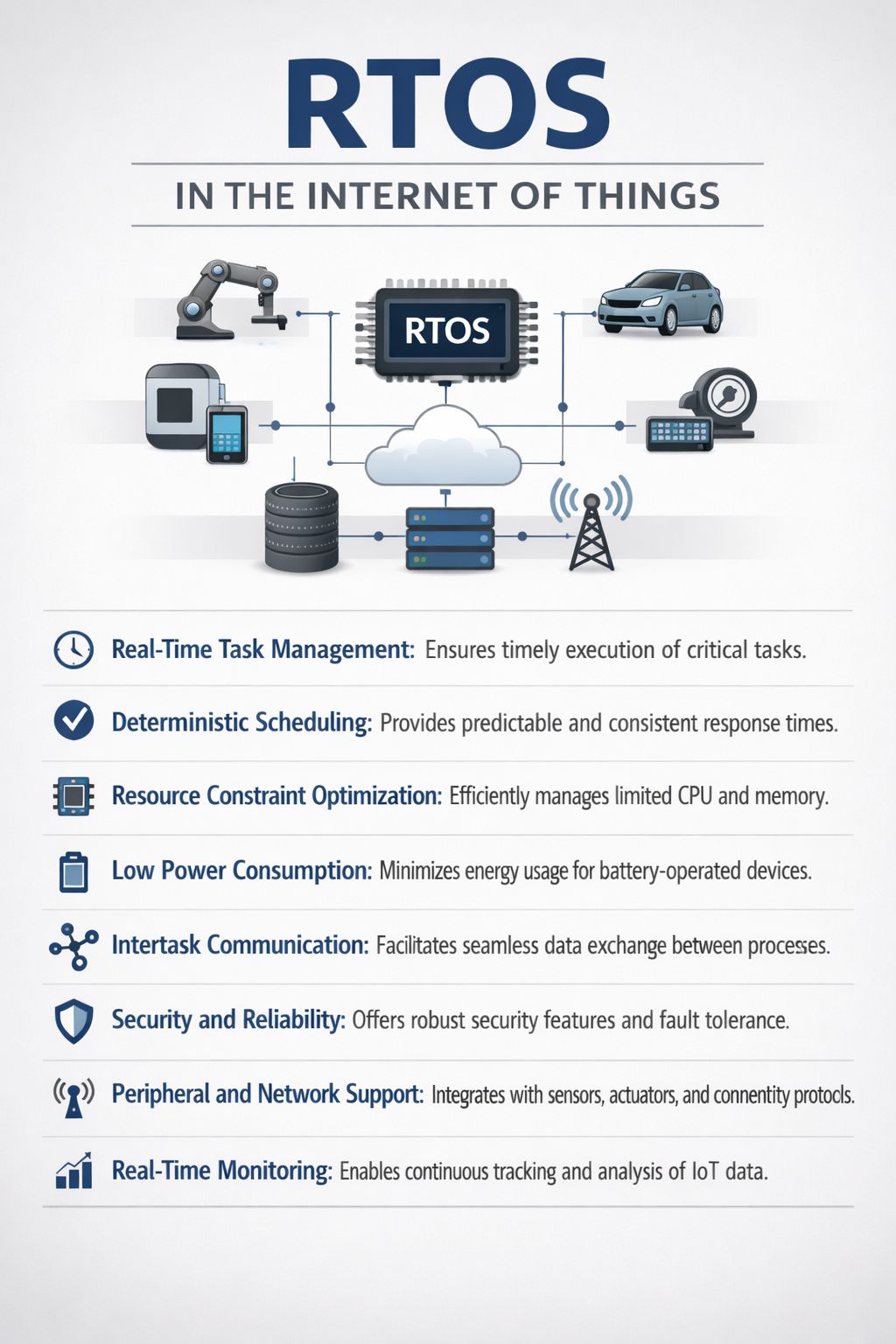
The Internet of Things (IoT) is no longer a futuristic concept; it’s an omnipresent force reshaping industries, homes, and cities. From smart thermostats optimizing energy consumption to autonomous vehicles navigating complex environments, IoT devices are becoming increasingly sophisticated and integral to our daily lives. At the heart of these intelligent connected systems lies a fundamental, yet often overlooked, component: the Real-Time Operating System (RTOS).
An RTOS plays a foundational role in enabling the deterministic, low-latency, and reliable execution demanded by modern IoT architectures. Its significance spans task scheduling, memory optimization, power efficiency, and secure inter-process communication, ensuring that resource-constrained embedded systems meet strict timing requirements without compromising performance or stability. As IoT ecosystems expand into industrial automation, smart mobility, healthcare devices, and edge computing, understanding the architectural significance of RTOS becomes essential for every embedded systems and electronics engineer. This comprehensive guide will outline the core functional layers and engineering considerations that make RTOS a critical backbone of intelligent connected systems.
The Essence of Real-Time: Why Timing is Everything in IoT
Understanding an RTOS begins with grasping the concept of “real-time.” In the context of computing, real-time does not necessarily mean “fast,” but rather “predictable” and “deterministic.” It refers to the system’s ability to guarantee a response within a specified, strict time constraint, regardless of other system activities. This characteristic is paramount in applications where delays, even minuscule ones, can have significant, sometimes catastrophic, consequences.
Determinism vs. Throughput: A Critical Distinction
Traditional general-purpose operating systems (GPOS), like those found in your personal computer or smartphone, are designed for maximum throughput. They aim to process as much data as possible over a given period, often prioritizing overall system responsiveness and user experience. While a GPOS might offer good average performance, its response times can vary widely due to factors like task switching overhead, virtual memory management, and disk I/O. These variable delays, known as jitter, are unacceptable in real-time applications.
An RTOS, conversely, prioritizes determinism. Its primary goal is to ensure that critical tasks are executed within their deadlines, even if it means sacrificing some overall system throughput. This predictability is achieved through specialized scheduling algorithms, efficient interrupt handling, and a leaner kernel footprint. In essence, an RTOS guarantees when something will happen, not just that it will happen eventually.
Hard Real-Time, Soft Real-Time, and Firm Real-Time Systems
The criticality of timing introduces different classifications of real-time systems:
- Hard Real-Time Systems: These systems have absolute deadlines that must be met. Failure to meet a hard deadline can lead to catastrophic consequences, such as loss of life, significant financial damage, or critical equipment failure. Examples include aerospace control systems, medical life-support equipment, and industrial process control.
- Soft Real-Time Systems: In these systems, missing a deadline is undesirable but not catastrophic. The system can still function correctly, but performance might degrade, or the quality of service might suffer. Missing a deadline for a soft real-time task might result in a slightly delayed video frame or an audio glitch. Examples include multimedia streaming, online gaming, and some human-machine interface (HMI) applications.
- Firm Real-Time Systems: These are a hybrid between hard and soft real-time. Missing a deadline makes the result useless, but the system itself doesn’t fail catastrophically. For instance, in a real-time stock trading application, if a price update arrives too late, the old price is no longer relevant, but the trading system continues to operate.
In the IoT landscape, devices often integrate elements of all three. A connected medical device might have hard real-time requirements for vital sign monitoring, firm real-time for data logging, and soft real-time for user interface updates. The RTOS is the foundational layer that orchestrates these diverse timing demands.
The Architectural Layers of an RTOS
An RTOS is a sophisticated piece of software, meticulously designed to manage the hardware resources of an embedded system efficiently and predictably. Its architecture typically comprises several core functional layers, each contributing to its real-time capabilities.
Kernel: The Heart of the RTOS
The kernel is the lowest-level component of an RTOS and is responsible for managing the system’s most fundamental operations. It provides the core services that enable real-time behavior.
Task Management and Scheduling
The most crucial function of the RTOS kernel is task management and scheduling. In an embedded system, different functionalities are often implemented as independent tasks or threads. The kernel is responsible for:
- Task Creation and Deletion: Allowing applications to create and destroy tasks dynamically.
- Task States: Managing the various states a task can be in (running, ready, blocked, suspended).
- Context Switching: Efficiently saving the state of one task and restoring the state of another when switching between them. This operation must be extremely fast to minimize overhead and maintain determinism.
- Scheduling Algorithm: Implementing the rules that determine which task gets to execute on the CPU at any given time. This is where the real-time nature of the RTOS shines.
Common RTOS scheduling algorithms include:
- Preemptive Priority-Based Scheduling: This is the most common scheduling strategy in RTOS. Each task is assigned a priority. The scheduler always executes the highest-priority task that is ready to run. If a higher-priority task becomes ready while a lower-priority task is executing, the RTOS immediately preempts the lower-priority task and switches to the higher-priority one. This ensures that critical tasks are always given precedence.
- Round-Robin Scheduling: Tasks of the same priority share CPU time in a cyclic manner, each getting a short time slice. This provides fair CPU allocation among tasks of equal importance.
- Rate Monotonic Scheduling (RMS): A static-priority scheduling algorithm often used in hard real-time systems. Priorities are assigned based on the task’s period (how frequently it needs to run); tasks with shorter periods receive higher priorities.
- Earliest Deadline First (EDF): A dynamic-priority scheduling algorithm where the task with the earliest deadline is always executed first. EDF can achieve higher CPU utilization than RMS but is more complex to implement and analyze.
The choice of scheduling algorithm significantly impacts the system’s determinism and responsiveness, and careful consideration is required based on the application’s real-time requirements.
Interrupt Management
Interrupts are hardware signals that typically indicate an event requiring immediate attention, such as a timer expiring, data arriving from a sensor, or a network packet being received. The RTOS kernel effectively manages these interrupts to ensure timely responses without disrupting critical ongoing tasks.
- Interrupt Service Routines (ISRs): When an interrupt occurs, the CPU jumps to an ISR to handle the event. ISRs are typically kept as short and efficient as possible to minimize latency.
- Interrupt Prioritization: The RTOS allows for different priority levels for interrupts, ensuring that more critical hardware events are handled before less critical ones.
- Deferred Interrupt Handling: Often, an ISR will perform minimal work and then signal a higher-level task to complete the remaining processing. This approach keeps ISRs short and ensures that the system quickly returns to executing other critical tasks.
Inter-Task Communication and Synchronization
In a multi-tasking environment, tasks often need to share data or coordinate their activities. The RTOS provides mechanisms to facilitate secure and efficient inter-task communication (ITC) and synchronization, preventing race conditions and ensuring data integrity.
- Semaphores: Used for controlling access to shared resources, ensuring that only one task can access a critical section of code or a shared peripheral at a time.
- Mutexes (Mutual Exclusion Objects): Similar to semaphores but specifically designed to protect shared resources from simultaneous access by multiple tasks. Mutexes often include priority inheritance mechanisms to mitigate priority inversion problems.
- Message Queues: Allow tasks to send and receive messages (data packets) to each other, enabling asynchronous communication and decoupling tasks.
- Mailboxes: A simplified form of message queue, typically holding only one message at a time.
- Event Flags/Groups: Used to signal the occurrence of events to one or more tasks, allowing tasks to wait for specific combinations of events before proceeding.
- Pipes: A communication channel that allows data to flow from one task to another, typically used for stream-oriented data.
- Shared Memory: Allows multiple tasks to access the same region of memory, providing a very fast communication mechanism, but requiring careful synchronization to avoid data corruption.
The careful selection and implementation of these ITC mechanisms are crucial for building robust and reliable real-time IoT applications.
Memory Management
Embedded systems, especially those in IoT, often operate with limited memory resources. The RTOS provides efficient memory management capabilities tailored for these constraints.
- Static Memory Allocation: Many RTOS environments favor static allocation, where memory is reserved at compile time. This avoids the overhead and potential non-determinism of dynamic memory allocation.
- Dynamic Memory Allocation: While less common for critical real-time paths, some RTOSes offer dynamic allocation (e.g.,
malloc/freeor custom heap managers). When used, these are often optimized for speed and fragmentation control within the real-time context. - Memory Pools: Pre-allocated blocks of memory that can be quickly assigned and deallocated, reducing fragmentation and increasing determinism compared to general-purpose heap allocators.
- Memory Protection: In more sophisticated RTOS environments, memory protection units (MPUs) or memory management units (MMUs) can be utilized to prevent tasks from accidentally or maliciously accessing memory regions not allocated to them, enhancing system stability and security.
Timer Management
Accurate timekeeping is critical for many real-time applications. The RTOS provides services for managing hardware timers and offering various time-related functionalities.
- System Tick: The RTOS uses a periodic hardware timer interrupt, known as the system tick, to maintain its internal time base. This tick drives the RTOS scheduler and provides timing for delays and timeouts.
- Software Timers: These are timers managed by the RTOS kernel, allowing tasks to set alarms or schedule functions to be executed after a specified delay or at regular intervals.
- High-Resolution Timers: For applications requiring extremely precise timing, the RTOS might offer access to high-resolution hardware timers, bypassing the system tick for finer granularity.
Engineering Considerations for RTOS in IoT
Building successful IoT solutions with an RTOS requires more than just understanding its components; it demands careful engineering considerations at every stage of development.
Resource Constraints and Optimization
IoT devices are often characterized by their limited resources – small microcontrollers, meager RAM, and finite power sources. An RTOS for IoT must be designed with these constraints in mind.
Footprint Minimization
The RTOS kernel itself needs to be compact to fit into the limited flash memory of embedded devices. Modern RTOSes are highly configurable, allowing developers to exclude unused features and reduce the memory footprint.
Low Power Consumption
Many IoT devices are battery-powered and expected to operate for extended periods without recharging. The RTOS plays a crucial role in enabling low-power operation through:
- Tickless Idling: The RTOS can stop the periodic system tick interrupt when no tasks are ready to run, allowing the CPU to enter deep sleep modes and significantly reduce power consumption. The system awakens only when an interrupt occurs or a scheduled event is due.
- Dynamic Voltage and Frequency Scaling (DVFS): Some RTOSes and underlying hardware support adjusting the CPU’s voltage and clock frequency based on the workload, further optimizing power usage.
- Peripheral Power Management: The RTOS can manage the power states of various peripherals (e.g., turning off unused radios or sensors) to conserve energy.
Efficient CPU Utilization
Optimizing CPU cycles is crucial for battery life and overall performance. The RTOS ensures efficient utilization through its scheduling algorithms and minimal context switching overhead.
Reliability and Robustness
IoT devices often operate in harsh environments or safety-critical applications, demanding extreme reliability and robustness.
Error Handling and Fault Tolerance
A robust RTOS provides mechanisms for handling unexpected errors and, where possible, recovering from faults. This includes:
- Watchdog Timers: Hardware or software watchdogs that reset the system if it becomes unresponsive, preventing hangs and ensuring continuous operation.
- Memory Protection: As mentioned earlier, MPUs/MMUs prevent tasks from corrupting each other’s memory, isolating faults.
- Exception Handling: The RTOS provides frameworks for catching and handling exceptions (e.g., divide-by-zero, illegal memory access) gracefully, preventing system crashes.
Deterministic Behavior
The inherent determinism of an RTOS is a cornerstone of reliability. By guaranteeing timely responses, it simplifies the analysis of system behavior and makes it easier to predict outcomes, even under extreme load.
Security in a Connected World
With the proliferation of IoT devices, security has become a paramount concern. An RTOS contributes to the overall security posture of an IoT system.
Secure Boot and Firmware Updates
Many RTOSes integrate with secure boot mechanisms to ensure that only trusted firmware can execute. They also facilitate secure over-the-air (OTA) and over-the-wire (OTW) firmware updates, protecting against malicious code injection.
Memory Isolation and Access Control
Memory protection features prevent unauthorized access to sensitive data or critical code sections, isolating tasks and preventing them from interfering with each other’s memory spaces.
Secure Communication
While not directly an RTOS function, the RTOS provides the underlying platform for implementing secure communication protocols (e.g., TLS/SSL, DTLS) by managing network stacks and cryptographic libraries efficiently in a real-time context.
Separation of Privilege
Some RTOSes support separation of privilege, where critical components (e.g., kernel) run at higher privilege levels, and application tasks run at lower levels, limiting the potential impact of vulnerabilities in application code.
Peripheral and Network Support
IoT devices are fundamentally about sensing, actuation, and connectivity. The RTOS must provide robust support for these functionalities.
Device Drivers
The RTOS provides a framework for integrating and managing device drivers for various peripherals such as sensors, actuators, displays, and storage devices. Efficient drivers are crucial for maximizing performance and minimizing latency.
Network Stacks
For connected IoT devices, a comprehensive network stack (e.g., TCP/IP, UDP, CoAP, MQTT) is essential. RTOSes often come with integrated or readily integrable network stacks optimized for embedded environments, supporting various connectivity options like Wi-Fi, Bluetooth, Zigbee, LoRaWAN, and cellular.
Middleware Integration
Beyond basic connectivity, IoT solutions often require middleware for data aggregation, cloud connectivity, and device management. The RTOS provides the stable foundation upon which this middleware can operate predictably.
Real-Time Monitoring and Debugging
Developing and deploying real-time systems requires specialized tools for monitoring and debugging.
Tracing and Logging
RTOSes often include facilities for logging system events, task state changes, and communication patterns. Tracing tools visualize these events over time, helping developers understand system behavior and identify bottlenecks or timing issues.
Debugging Tools
Integrated development environments (IDEs) often provide RTOS-aware debugging capabilities, allowing developers to inspect task states, view call stacks, and analyze memory usage within the real-time context.
Performance Analysis
Tools for performance analysis can help identify CPU hogging tasks, analyze interrupt latencies, and profile memory usage, ensuring that the system meets its real-time performance requirements.
The RTOS Ecosystem: Popular Choices and Emerging Trends
The RTOS landscape is diverse, with numerous options catering to different embedded system requirements.
Popular RTOSes for IoT
- FreeRTOS: One of the most popular open-source RTOSes, known for its small footprint, scalability, and broad community support. It’s highly configurable and supports a wide range of microcontrollers.
- Zephyr RTOS: An open-source, vendor-agnostic RTOS designed for resource-constrained, connected devices. It offers robust security features, modularity, and strong support for various communication protocols.
- Azure RTOS (formerly ThreadX): A Microsoft-owned RTOS known for its certification for safety-critical applications and integration with Azure IoT services.
- VxWorks: A commercial, highly robust RTOS widely used in mission-critical applications like aerospace, defense, and industrial control.
- QNX: Another commercial RTOS renowned for its reliability, security, and microkernel architecture, often found in automotive and industrial systems.
- Mbed OS: An open-source RTOS specifically designed for ARM Cortex-M microcontrollers, focusing on ease of development for IoT applications.
- RIoT: A well-established operating system for IoT devices, offering a modular kernel, energy efficiency, and support for a wide range of hardware platforms and networking protocols.
Emerging Trends and Future Directions
The RTOS landscape is continuously evolving to meet the demands of the rapidly expanding IoT market.
Edge Computing and AI Integration
As more intelligence moves to the edge, RTOSes are adapting to support machine learning inference at the device level. This includes optimizing for heterogeneous computing architectures (e.g., microcontrollers with AI accelerators) and providing frameworks for deploying pre-trained models.
Enhanced Security Features
With increasing cyber threats, future RTOSes will continue to enhance security features, focusing on hardware-rooted trust, secure enclaves, and cryptographic acceleration.
Simplified Development and Abstraction Layers
To democratize IoT development, RTOS vendors are focusing on providing higher-level abstraction layers, rich software development kits (SDKs), and seamless integration with cloud platforms, making it easier for developers to build complex IoT applications without deep RTOS expertise.
Standardized APIs and Interoperability
Efforts are underway to standardize RTOS APIs and features, promoting greater interoperability between different RTOSes and enabling easier code migration and reuse.
Functional Safety and Certification
For safety-critical IoT applications (e.g., autonomous vehicles, medical devices), RTOSes are increasingly offering functional safety certifications (e.g., ISO 26262, IEC 61508) to meet stringent regulatory requirements.
Real-World Applications: Where RTOS Shines in IoT
The impact of RTOS in IoT is best illustrated through its diverse applications.
Industrial Automation and Control
In industrial settings, precise timing and reliability are paramount. RTOS-powered controllers manage robotic arms, factory assembly lines, and critical process control systems. Any delay or unpredictability could lead to costly production errors, equipment damage, or safety hazards. The deterministic nature of RTOS ensures that actions are executed precisely when required, enabling high-precision manufacturing and responsive control.
Smart Mobility and Automotive Systems
Modern vehicles are essentially complex IoT devices on wheels. RTOSes power critical automotive subsystems, including:
- Engine Control Units (ECUs): Managing fuel injection, ignition timing, and emission controls with strict real-time deadlines.
- Advanced Driver-Assistance Systems (ADAS): Processing sensor data from cameras, radar, and lidar in real-time to enable features like adaptive cruise control, lane-keeping assist, and automatic emergency braking.
- Infotainment Systems: While less critical, these also benefit from the organized multitasking capabilities of an RTOS, ensuring a responsive user experience.
- Autonomous Driving Platforms: The intricate coordination of sensors, perception algorithms, path planning, and vehicle control all rely heavily on hard real-time execution provided by an RTOS.
Healthcare Devices
From wearable health trackers to sophisticated medical implants and diagnostic equipment, healthcare IoT relies on RTOS for accuracy, reliability, and patient safety.
- Patient Monitoring Systems: Real-time collection and analysis of vital signs, ensuring immediate alerts in case of anomalies.
- Implantable Devices: Pacemakers, insulin pumps, and neurostimulators require ultra-reliable, low-power RTOS operation to manage critical functions and communicate with external devices.
- Surgical Robotics: Precision and deterministic movements are crucial in robotic-assisted surgery, making RTOS an indispensable component.
Smart Home and Consumer Electronics
Even in seemingly less critical consumer-grade IoT devices, RTOS plays a vital role in providing a seamless and responsive user experience.
- Smart Thermostats: Real-time monitoring of temperature and humidity, coordinating with HVAC systems to optimize comfort and energy efficiency.
- Smart Appliances: Managing complex internal processes, communicating with users, and connecting to cloud services.
- Wearables: Fitness trackers and smartwatches use RTOS for efficient sensor data processing, battery management, and responsive user interfaces.
Edge Computing
As the volume of IoT data grows, processing moves closer to the data source – the “edge.” RTOS-powered edge devices perform local data aggregation, filtering, and even machine learning inference, reducing latency and bandwidth requirements for cloud communication. This local processing requires deterministic performance to make timely decisions based on real-time data.
The Role of RTOS in a Broader IoT Architecture
While the RTOS is confined to the embedded device, its influence extends throughout the entire IoT architecture.
Bridging Hardware and Software
The RTOS acts as the crucial interface between the raw hardware components of an IoT device and the application software. It abstracts away the complexities of low-level hardware interactions, providing a consistent and manageable environment for application developers.
Enabling Scalability
By providing a robust and predictable foundation, an RTOS allows developers to build complex, multi-functional IoT applications without getting bogged down by intricate timing issues. This modularity and determinism contribute to the scalability of IoT solutions, allowing for easier expansion and integration of new features.
Facilitating Cloud Integration
While the RTOS operates locally on the device, it provides the stable platform necessary for running software components that facilitate communication with cloud platforms. This includes network stacks, security protocols, and data formatting layers that ensure seamless and reliable data exchange with IoT platforms such as AWS IoT, Google Cloud IoT, and Azure IoT Hub.
Driving Innovation
The reliability and predictability offered by an RTOS empower engineers to push the boundaries of what’s possible with embedded systems. It enables the development of highly sensitive, complex, and intelligent IoT devices that can truly transform various sectors. Without the deterministic execution guaranteed by an RTOS, many of the advanced functionalities we take for granted in modern IoT would simply not be feasible.
Conclusion: The Indispensable Role of RTOS in the Future of IoT
Real-Time Operating Systems are far more than just a piece of software; they are the unseen architects and silent guardians of modern IoT. Their ability to deliver deterministic, low-latency, and reliable execution is not merely a feature but a fundamental requirement for the ever-expanding universe of connected devices. From task scheduling and memory optimization to power efficiency, secure inter-process communication, and robust error handling, an RTOS ensures that even the most resource-constrained embedded systems meet stringent timing requirements without compromising performance, stability, or security.
As IoT ecosystems continue their relentless march into industrial automation, smart mobility, healthcare, and edge computing, the architectural significance of RTOS will only grow. For every embedded systems and electronics engineer, a deep understanding of RTOS functional layers and engineering considerations is not just beneficial, but absolutely essential. By providing the critical backbone for intelligent connected systems, RTOS will continue to drive innovation and enable the creation of the next generation of transformative IoT solutions, shaping a future where connectivity is not just widespread, but also reliably intelligent, secure, and precisely timed.
Ready to build the next generation of intelligent, real-time IoT solutions? Unleash the full potential of your embedded systems with expert guidance and cutting-edge strategies. Send us an email at info@iotworlds.com to explore how IoT Worlds can empower your projects.
